Spitalskirche
Maria-Theresien-Strasse 2
Worth knowing
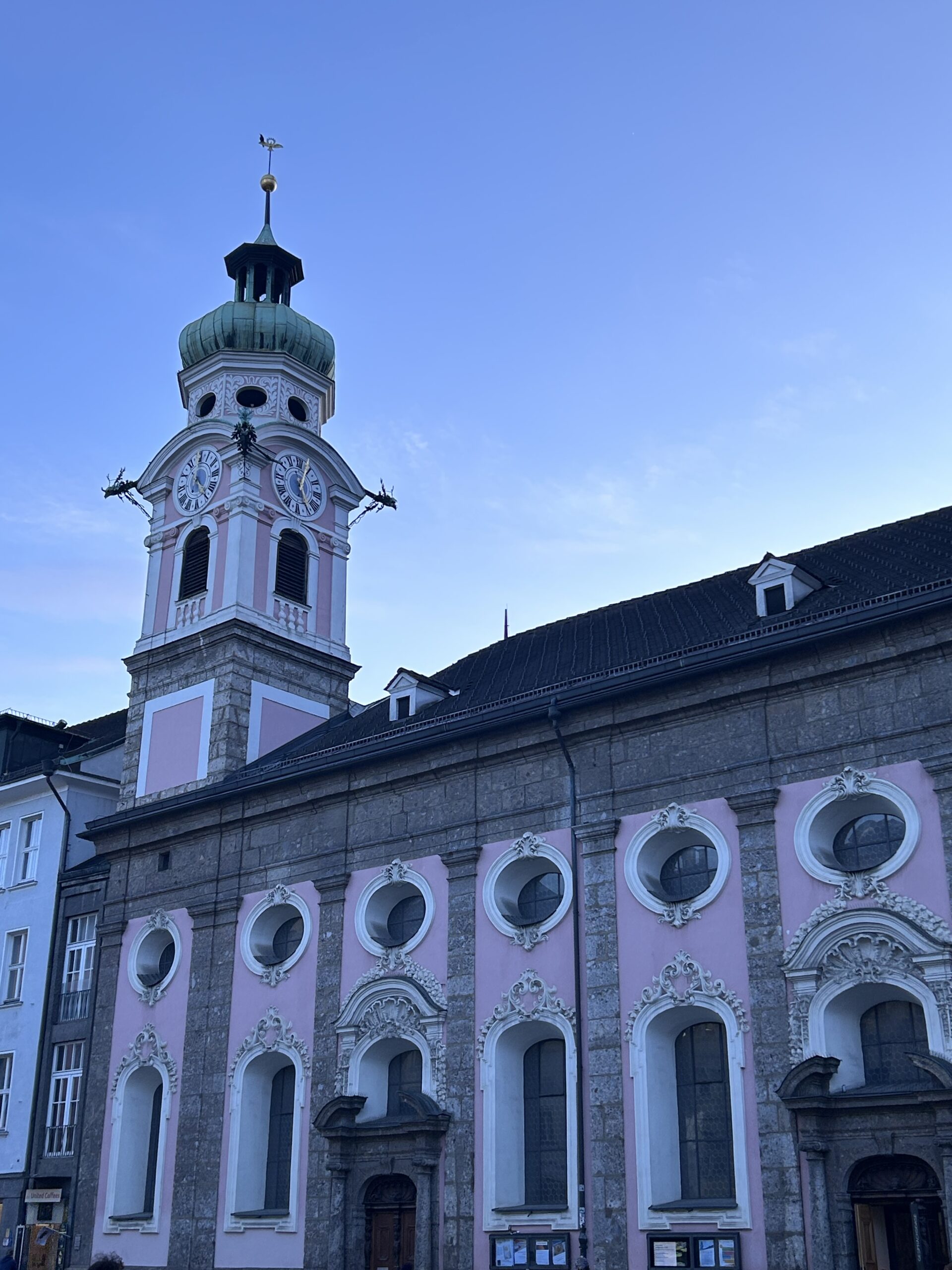
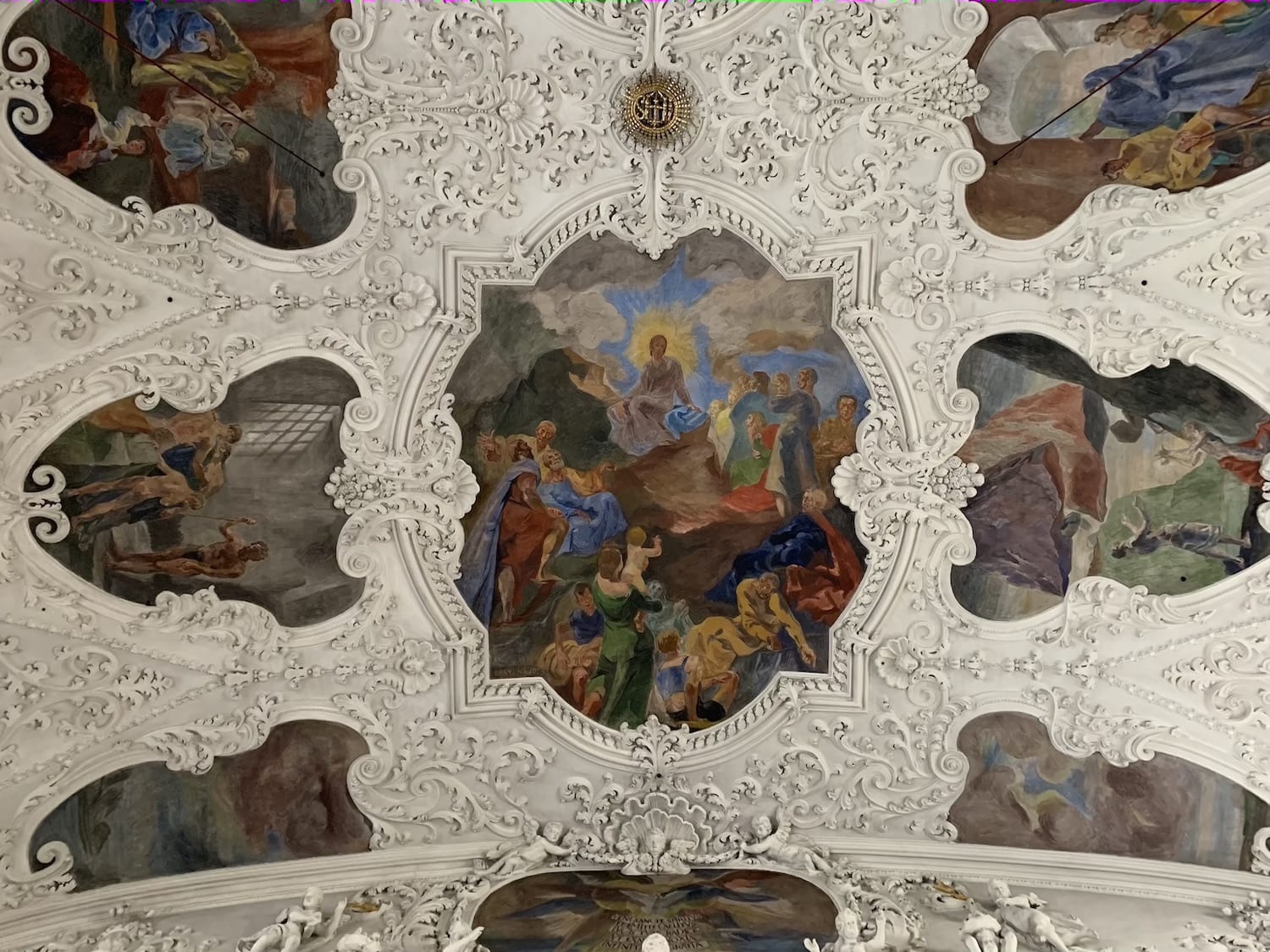
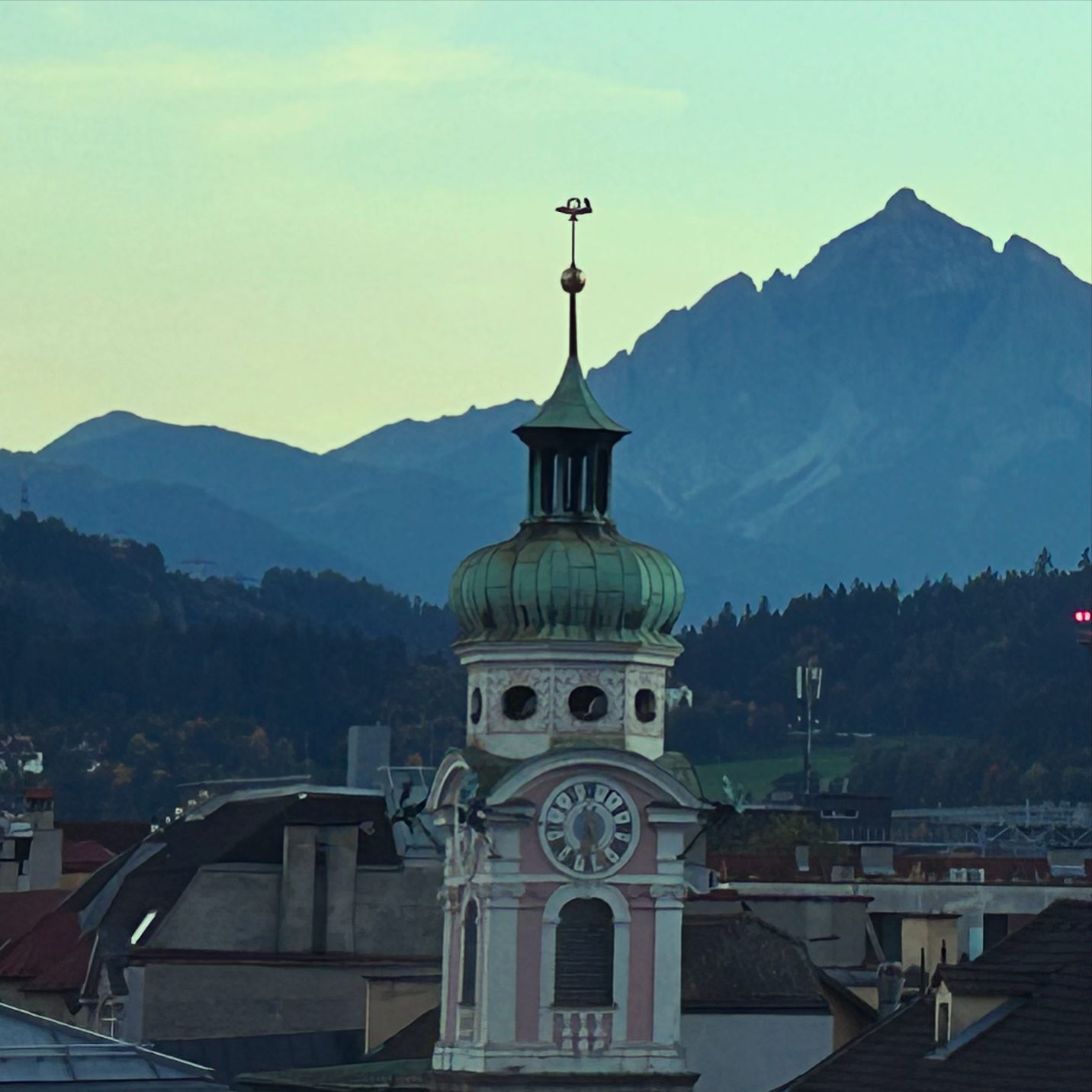
In soft pink, the Spitalskirche marks the beginning of Maria-Theresien-Straße, even though it is somewhat overshadowed by the taller adjoining buildings. The striking color, known as American Pink, was added to the façade in 1992. This was the latest in a series of developments that transformed a small Gothic chapel at the city hospital into the present-day church. After the earthquakes of 1689 and 1700, the Spitalskirche received its Baroque structure based on plans by court architect Johann Martin Gumpp. The fresco of the Virgin Mary above the organ, the stucco figures of the apostles on the columns with putti and Baroque ornamentation, the marble main altar, and the side altars made of wood imitating marble—along with the Gothic crucifix—survived the next wave of destruction when a bomb hit the building during World War II air raids. Renovation took place between 1959 and 1962. Innsbruck artist Hans Andre succeeded in bringing the Baroque paintings, such as the ceiling fresco of the Holy Spirit, into the modern era. He depicted the seven Christian virtues—wisdom, justice, courage, temperance, faith, love, and hope—after the horrors of the war years. Above the entrance gate stands the programmatic inscription: “In medio civitatis ecclesia illibata”—a church without blemish in the heart of the city. The church is dedicated to the Holy Spirit, patron of healing, comfort, and courage in the face of life’s burdens.
The history of the Spitalskirche and the former city hospital is closely linked to the development of healthcare, elderly care, and poor relief in Innsbruck. This chapter of the city’s history illustrates how care for subjects and citizens shifted from the Church toward the modern welfare state. As people of the 21st century, we expect to leave a hospital healthy. Until the 18th century, hospitals—including Innsbruck’s—were more often the final stop before the afterlife, under Christian care and supervision. The Innsbruck hospital chapel was first mentioned in a 1307 charter by Duke Henry of Carinthia and Tyrol. The hospital was founded by a charitable brotherhood of Innsbruck citizens and funded by church donations and endowments from wealthy locals. The 14th century was marked by increasing urbanization. Cities enjoyed privileges due to their economic importance. The civic hospital was intended to care for key workers. The hospice was located outside the city walls near the cemetery to minimize the spread of disease in the narrow streets. Its role was not only to care for the sick but also to support the destitute. Families remained the primary safety net in emergencies. Craftsmen organized some social care for incapacitated members or their widows and orphans themselves. People without families—servants, laborers, and the childless—were not abandoned, contrary to common belief. Poor women could give birth in hospitals. Elderly and needy citizens received clothing, food, and care. Orphans and illegitimate children were also taken in.
Institutions like Innsbruck’s hospital distinguished the city from villages, where healthcare and elderly care were far worse and laborers often worked until death. Wealthier members of the brotherhood, as paying members, could expect better care than non-members. The hospital also distributed alms to the poorest. This can be seen as an early form of social welfare at the municipal level. This system persisted for a long time. Until the 19th century—and in many areas until after World War I—it was not the central state but the municipality or benefactors who cared for the poor, sick, orphans, elderly, and disabled. Emperor Maximilian I, for example, planned a hospital at today’s Domplatz for old and sick members of his court, later named the “Kaiserspital.” The Church often co-organized this social work.
With industrialization and urban growth, the old hospital in the midst of residential buildings became too small. Innsbruck society changed not only in size. Workers and employees could no longer rely on the safety net of extended rural families in case of illness or accidents. Beda Weber described the old care facility in his Handbook for Travelers in Tyrol as part of his Innsbruck guide:
"Next to the church is the hospital, whose distinguished benefactor is King Henry of Bohemia, who in 1307 assigned considerable revenues to it. The number of patients, the mentally ill, and pensioners exceeds at least 100… Next to the hospital is a so-called brother house for 36 poor women and maids, who enjoy free lodging, laundry, firewood, and six kreuzers daily. From the hospital one steps onto the cemetery, surrounded by gardens and fields and enclosed by arcades."
Until the discoveries in microbiology and medicine in the second half of the 19th century by Robert Koch (1843 - 1910) and Louis Pasteur (1922 - 1895), hygiene was an underestimated factor in nursing.
"The entire hospital complex had only one well in the courtyard, from which water had to be carried to all rooms. There was no sewer system; only cesspits. The kitchen was on the ground floor, and directly behind it was the mortuary, where bodies were laid out. The cellar served as a drying and disinfection room. The sisters had to heat a baking oven until all lice were dead. The garden was divided for male and female patients. In a small building, the mentally ill were housed; two rooms were for calm patients, then three cells for the violent and a tea kitchen… Typhus patients were not isolated at all. If delirious patients tried to leave their beds, a fixed grille was simply placed around the bed."
Even before the relocation, the city hospital was a teaching hospital closely linked to the university. Teaching was one of the main reasons for the move and expansion; rapid population growth was another. After the university reopened in 1826, there were only about 20 students—today’s scale of study and clinical operations would have been unimaginable. In 1888, the hospital moved to its current location at the western end of Anichstraße, where it grew to impressive size. Innsbruck’s clinic is now renowned and respected far beyond Tyrol’s borders. The complex is almost a city district of its own, and Tirol Kliniken is the largest employer in the region.
Of Maultasch, Habsburgs and the Black Death
Between the last Count of Andechs and the first Tyrolean territorial prince from the House of Habsburg lay 115 eventful years in the history of the city of Innsbruck. After the extinction of the Andechs line, the Counts of Tyrol guided the fortunes of the region for about a hundred years and thus also largely shaped the development of the city of Innsbruck. Meinhard II of Tyrol (1239–1295) succeeded, through skillful politics and a measure of good fortune, in expanding his territory. From his ancestral seat in Merano, he managed to unite what had previously been a patchwork of lands into a coherent county. Alongside the Prince-Bishops of Brixen and Trent—who were not politically disempowered until the 19th century—the Counts of Tyrol were the most powerful territorial lords in the region that today encompasses Trentino as well as North and South Tyrol. Meinhard’s more modern and tightly administered territories were politically and economically closer to the pulse of the times. His advisers included Florentine merchants and bankers, who at the time represented the most advanced financial and commercial expertise in Europe. Under his rule, a codified territorial law was created, granting estates, entrepreneurs, and subjects a certain degree of legal security. For the first time, all possessions in Tyrol were uniformly recorded in a land register (Urbar). Financial matters were also brought under centralized control. Meinhard broke the bishops’ monopoly on coinage and had coins minted bearing the Tyrolean eagle, following Italian models. This significantly curtailed the de facto power of the Church. Although the bishops of Brixen and Trent remained landowners and feudal lords, their imperial immediacy had become largely formal, as their ties and dependencies on the County of Tyrol had grown too close. In 1254, the territory was no longer referred to merely as the “land in the mountains,” but officially as the Dominium Tirolis—the Lordship of Tyrol. Innsbruck also grew under Meinhard’s rule, with approximately 1,500 inhabitants settling there. Beyond the city walls, the Neustadt began to develop in the area where Maria-Theresien-Straße today invites leisurely strolling. Meinhard found his final resting place at Stams Abbey, which today is known as a training center for Tyrol’s winter sports elite.
His son and successor as Tyrolean territorial prince, Duke Henry of Carinthia (1265–1335), ranked among the most important nobles in the Holy Roman Empire as King of Bohemia. Owing to his extensive possessions in southeastern Europe, Henry was one of the most powerful princes of his time. He was a strong supporter of cities, recognizing their growing importance. In Innsbruck, he promoted the construction of the civic hospital in the Neustadt. However, Henry had no male heir. Before his death, he ensured that his daughter Margaret of Tyrol-Gorizia (1318–1369) could succeed him. She assumed power as territorial princess at the age of seventeen. This placed the young ruler at the center of power struggles among the leading dynasties of the age: the Habsburgs, the Wittelsbachs, and the Luxembourgs. She entered marital alliances with two of these houses; the third would ultimately inherit the County of Tyrol and thus the city of Innsbruck. After her father’s death, Margaret was married to John Henry of Luxembourg, the son of the new King of Bohemia. John Henry was even younger than his wife and primarily served as a political foothold for his father in Tyrol. He was opposed by the Habsburgs and Wittelsbachs as well as by the local nobility. His rule proved disastrous. In the Hall saltworks—leased to Florentine financiers and, alongside customs duties, the backbone of Tyrol’s economy—labor unrest broke out. Despite severe financial difficulties, the court of John Henry was reportedly conducted in an extravagant manner. In 1341, with the support of Emperor Louis of Bavaria, a Wittelsbach, the Tyrolean estates expelled John Henry from the country in a coup planned together with Margaret. Contemporary sources hostile to Margaret portrayed her in highly polemical and defamatory terms. [Here, contemporary scandalous descriptions and explicit allegations are omitted or neutralized.] An imperial chronicler sympathetic to the emperor described John Henry as incapable of fulfilling marital duties, allegedly due to immaturity. These rumors were deliberately circulated throughout the empire to enable the emperor to install his son, Louis of Brandenburg, as Margaret’s new husband and thus as ruler of the strategically important transit territory of Tyrol. This coup, which entered history as the “Tyrolean marital scandal,” triggered a far-reaching crisis. Even the philosopher and critic of papal authority William of Ockham commented on the affair. The issue was not merely the separation itself, but the fact that Margaret had not been formally divorced from her first husband at the time of her second marriage. The emperor and his supporters regarded the marriage between John Henry and Margaret as unconsummated and therefore invalid. The fourth major political power of Central Europe at the time, the papacy, took a different view. Pope Benedict XII excommunicated the emperor and his son because of what he considered an unlawful union between Margaret and Louis of Brandenburg. Beyond moral concerns, the pope also had political motives. Both the papacy and the Habsburgs were in armed conflict with the Wittelsbach emperor and sought to weaken his influence. For medieval society, such an interdict was among the harshest of punishments, as it prohibited the celebration of Mass and the administration of communion throughout the land. It was likely during this period that Margaret acquired the popular nickname “Maultasch” and was described as particularly unattractive. No contemporary portraits exist that would indicate any physical deformity. The images of Margaret Maultasch known today date at the earliest from the late 15th century, when the medieval scandal was first reinterpreted by later historians.
Margaret’s reign was marked by crises for which she bore little responsibility, yet for which she was often blamed. The 14th century brought a period of climatic warming that led to severe locust plagues, including in Innsbruck. Crop failures and famine followed. In addition, after the fire of 1333 in Anbruggen, another major blaze devastated Wilten and Innsbruck seven years later, destroying the parish church of St. James. From 1348 to 1350, the plague swept across Europe. Arriving from Venice via Trent and the Adige Valley, the Black Death reached Innsbruck and dramatically reduced the population. In some parts of Tyrol, more than half of the inhabitants perished. The horrifying manner in which victims died left a deep impression on the deeply religious population. Archival sources provide little detailed information on the outbreak of the plague in Innsbruck itself, but its consequences were devastating, as elsewhere in Europe. In her will, a woman from Innsbruck afflicted by the plague spoke of the “common dying that goes through the land.” Many people interpreted famine and pestilence as divine punishment and as consequences of the papal ban, blaming Margaret and her husband Louis. In reality, the causes of disease and suffering lay far beyond ecclesiastical sanctions and propaganda. Like many medieval cities, Innsbruck lacked paved streets, sewage systems, and reliable drinking water supplies. Humans and animals shared the confined space within the city walls, resulting in highly unhygienic living conditions. Advances in medical knowledge came primarily from Italy. In Salerno, the first medical school had emerged in the 11th century. Under Emperor Frederick II, the professions of physician and apothecary were formally separated and regulated in 1241. In Innsbruck, a pharmacy was first mentioned in 1303 and officially founded in 1326. Located in the Schöpferhaus at today’s Herzog-Friedrich-Straße 19, it served as both court and city pharmacy and is now considered the oldest still-existing pharmacy in Austria.
After the Wittelsbachs, Luxembourgers and Habsburgs had fought over Tyrol for decades, a happy ending was finally reached. Rudolf IV of the House of Habsburg intervened with the Pope and was able to negotiate the lifting of the interdict in 1359 in exchange for considerable financial compensation at the expense of Margaret and Louis. At the same time, a document is said to have been drawn up that is now considered a forgery: in this document, Margaret bequeathed the land of Tyrol to Rudolf IV and the Habsburg family.
Soon thereafter, this transfer of power took effect. One year after the death of Margaret’s husband Louis in 1361, her son Meinhard III also died. According to the account of Filippo Villani, written around 1400, Margaret was rumored to have been involved in both deaths—an allegation that remains historically unproven. In 1363, with the consent of the Tyrolean nobility, Margaret formally transferred the governance of Tyrol to Rudolf IV of Habsburg. Tyrol thus became part of the Habsburg dominions, which already included the Duchy of Austria. The Dukes of Bavaria from the House of Wittelsbach refused to recognize this inheritance treaty and attempted to assert their claims by force of arms. In 1363, they marched toward Innsbruck. Rudolf IV, however, had secured the support of key local nobles and the cities of Innsbruck and Hall. The fortified city successfully withstood the attack. After consolidating power, Rudolf confirmed the city hospital and granted temporary customs exemptions as well as the right to levy major tolls.
With the acquisition of Tyrol, the Habsburg family was able to close an important geographical gap within its sphere of influence. Although there were repeated incursions by Bavarian troops, for example the abbot of Wilten Abbey was abducted and taken hostage, the Inn Valley and Innsbruck were gladly part of the Habsburg lands. The incorporation of the city into the much larger territory of the Habsburgs meant that Innsbruck became even more important, while the actual capital Merano was further marginalised. In addition to the north-south transport of goods, the city on the Inn had now also become a west-east transport hub between the eastern Austrian lands and the old Habsburg possessions in the west. For the survivors of the great plague wave of 1348 and the political turmoil, there was an economic upswing. Labour had become scarce due to the shrinking population, but greater resources were available per capita. For those Innsbruck residents who had survived the turbulent first half of the 14th century, better times were to come.
Little remains in Innsbruck’s cityscape from the era of Margaret Maultasch and her husbands. Political and economic hardship, warfare, plague, fires, earthquakes, and later building activity erased much of the medieval city. Yet the memory of Margaret endures in legend. She remains one of the most famous female figures in Tyrolean history. Conflicting accounts written even during her lifetime allow room for interpretation. Her biography could easily serve as the template for a character in a modern historical drama. Whether she was a ruthless schemer or an innocent pawn of greater powers remains an open question. Margaret and her successor Rudolf IV of Habsburg are commemorated in stone at the fountain on Bozner Platz, formerly known as Margarethenplatz.
Glaube, Kirche und Obrigkeit
The abundance of churches, chapels, crucifixes, statues, and paintings in public spaces strikes many visitors to Innsbruck from other countries as unusual. Not only places of worship, but also many private houses are decorated with depictions of Jesus, Mary, saints, and biblical scenes. For centuries, the Christian faith and its institutions shaped everyday life throughout Europe, and Innsbruck—as a residence city of the strictly Catholic Habsburgs and the capital of the self-proclaimed Holy Land of Tyrol—was particularly richly endowed with ecclesiastical buildings. In terms of number and scale relative to the conditions of earlier times, churches appear as gigantic features in the cityscape. In the 16th century, Innsbruck, with its approximately 5,000 inhabitants, possessed several churches whose splendor and size surpassed every other building, including the palaces of the aristocracy. Wilten Abbey was a vast complex in the midst of a small farming village that had developed around it.
The spatial dimensions of these places of worship reflect their importance within the political and social structure. For many inhabitants of Innsbruck, the Church was not only a moral authority but also a secular landowner. The Bishop of Brixen was formally equal in rank to the territorial prince. Peasants worked on the bishop’s estates just as they did on those of a secular ruler. The clergy exercised both taxation and judicial authority over their subjects, and ecclesiastical landowners were often regarded as particularly demanding. At the same time, it was also the clergy in Innsbruck who were largely responsible for social welfare, healthcare, care for the poor and orphans, food distribution, and education. The Church’s influence extended into the material world in a way comparable to how the modern state operates today through tax offices, police, schools, and employment services. What democracy, parliament, and the market economy represent for us today, bishops, the Bible, Christian devotional literature, and parish priests represented for people of earlier centuries: a reality that maintained order.
It would be incorrect to believe that all clergymen were cynical power-hungry figures who exploited their uneducated subjects. The majority of both clergy and nobility were devout and God-fearing, albeit in a manner that is difficult to comprehend from today’s perspective. It was not the case that every superstition was blindly accepted or that people were arbitrarily executed based on anonymous accusations. In the early modern period, violations of religion and morals were tried before secular courts and punished severely. Charges were brought under the term heresy, which encompassed a wide range of offenses. Sodomy—meaning any sexual act not serving reproduction—sorcery, witchcraft, and blasphemy, in short any deviation from the correct faith, could be punished by burning. The act of burning was intended both to purify the condemned and to destroy them and their sinful behavior completely, thereby removing evil from the community. For a long time, the Church regulated everyday social life down to the smallest details. Church bells structured people’s daily schedules. Their sound called people to work or worship, or informed the community of a death through tolling. People were able to distinguish individual bell signals and their meanings. Sundays and holidays structured time. Fasting days regulated diet. Family life, sexuality, and individual behavior were expected to conform to Church-prescribed morality. For many people, salvation in the afterlife was more important than happiness on earth, which was seen as predetermined by the course of time and divine will. Purgatory, the Last Judgment, and the torments of hell were real and served to frighten and discipline even adults.
While parts of Innsbruck’s bourgeoisie were at least gently awakened by the ideas of the Enlightenment after the Napoleonic Wars, the majority of the population remained deeply attached to a blend of conservative Catholicism and superstitious folk piety. Religiosity was not necessarily a question of background and social status, as the social, media, and political debates along the fault line between liberals and conservatives repeatedly demonstrated. Although the freedom of religious practice had been legally enshrined since the December Constitution (Dezemberverfassung) of 1867, state and religion remained closely intertwined. Thanks to the 1855 concordat between the Pope and the Emperor, marriage law and the school system were under the control of the Catholic Church. It was only under pressure from liberals in parliament that these bastions of everyday social life began to crumble, yet particularly in Tyrol, the pastor's word remained sacrosanct. In the First Republic, a conservative backlash occurred. Ignaz Seipel, a Christian Social politician who went down in history as the Iron Prelate (Eiserner Prälat), rose to the highest office of the state in the 1920s. Federal Chancellor Engelbert Dollfuß saw his Corporate State (Ständestaat)—a construct built on a Catholic foundation—as a bulwark against socialism. In 1933, the concordat with the Vatican was renewed. Even after World War II, church and politics in Tyrol formed a powerful double act in the persons of Bishop Rusch and Governor Wallnöfer. In 1957, the government of the Second Republic reconfirmed the agreement, which formally remains valid to this day. A genuine separation of church and state did not begin until the 1970s. Although people leaving the church in recent decades have dented official membership figures and recreational events draw larger crowds than Sunday masses, faith and the church still hold a fixed place in the daily lives of Innsbruck’s residents, even if often unnoticed. The Roman Catholic Church still owns a vast amount of land in and around Innsbruck, even beyond the walls of its monasteries and educational institutions. A number of schools in and around Innsbruck also remain under the influence of conservative forces and the church. And whoever enjoys a public holiday, cracks Easter eggs against one another, or lights a candle on a Christmas tree does not have to be a Christian to act in the name of Jesus—disguised as tradition.
Baroque: art movement and art of living
Anyone traveling through Austria is familiar with the domes and onion-shaped towers of churches in towns and villages. They are the characteristic hallmark of the Baroque architectural style, which reached its peak during the Counter-Reformation and continues to shape the cityscape of Innsbruck to this day. The most prominent churches—such as the Cathedral, St. John’s Church, or the Jesuit Church—are built in the Baroque style. Places of worship were meant to be splendid and magnificent, symbols of the triumph of the true faith. The exuberant, all-encompassing piety of elites and subjects alike was reflected in art and culture: great drama, pathos, suffering, splendor, and glory combined to form the Baroque—a style that left a lasting imprint on the entire Catholic sphere of influence of the Habsburgs and their allies between Spain and Hungary. From the seventeenth century onward, the Gumpp family of master builders and Johann Georg Fischer fundamentally transformed Innsbruck’s cityscape. The Old Provincial Government Building in the Old Town, the New Provincial Government Building on Maria-Theresien-Strasse, countless palazzi, paintings, and sculptures—the Baroque was the defining stylistic force of the House of Habsburg in the seventeenth and eighteenth centuries and became embedded in everyday life. The bourgeoisie did not wish to lag behind the nobility and princes and therefore had their private residences built in the Baroque style as well. Farmhouses were adorned with images of saints, depictions of the Virgin Mary, and representations of the Sacred Heart of Jesus.
Yet the Baroque was more than an architectural style; it was a way of life that emerged in the aftermath of the Thirty Years’ War. The Ottoman threat from the east, culminating in the two sieges of Vienna, dominated the empire’s foreign policy, while the Reformation shaped domestic affairs. Baroque culture became a central element of Catholicism and its political self-representation in public space—a countermodel to the austere and rigorous way of life advocated by Calvin and Luther. Christian holidays were introduced to brighten everyday life. Architecture, music, and painting were rich, full, and exuberant. In theatres such as the Comedihaus in Innsbruck, dramas with religious themes were performed. Ways of the Cross with chapels and representations of the crucified Christ crisscrossed the landscape. Popular piety, expressed through pilgrimages and the veneration of Mary and the saints, became firmly embedded in everyday church life. Multiple crises shaped daily existence. In addition to war and famine, plague epidemics occurred particularly frequently in the seventeenth century. Baroque piety was used as a means of educating subjects, teaching them to interpret these calamities as expressions of God’s dissatisfaction—misfortunes that could be remedied through a devout and virtuous way of life. Although the sale of indulgences was no longer common practice in the Catholic Church after the sixteenth century, vivid notions of heaven and hell persisted. Through a virtuous life—that is, living in accordance with Catholic values and displaying proper conduct as a subject within the divine order—one could come significantly closer to paradise. So-called Christian devotional literature became the most popular reading material following the educational reforms of the eighteenth century and the rising literacy of the population. The suffering of the Crucified for humanity was regarded as a symbol of the hardship endured by subjects on earth within the feudal system. Through votive paintings, people sought assistance in times of hardship or expressed gratitude—most often to the Virgin Mary—for surviving dangers and illnesses. Particularly impressive votive paintings can be admired in the Wilten Basilica. The historian Ernst Hanisch described the Baroque and its influence on the Austrian way of life as follows:
“Austria emerged in its modern form as a crusading imperialism—externally against the Turks and internally against the Reformers. This brought bureaucracy and the military, and externally a multiethnic society. State and Church attempted to control the intimate sphere of citizens’ lives. Everyone had to reform themselves through the confessional; sexuality was restricted, norm-compliant sexuality enforced. People were systematically trained to dissemble.”
Rituals and submissive behavior toward authority left deep traces in everyday culture, distinguishing Catholic countries such as Austria and Italy to this day from Protestant-influenced regions such as Germany, England, or Scandinavia. Austrians’ passion for academic titles has its roots in Baroque hierarchies. The term Baroque prince refers to a particularly patriarchal and patronizing politician who knows how to captivate an audience with grand gestures. While political sobriety is valued in Germany, the style of Austrian politicians remains theatrical—entirely in keeping with the Austrian adage “Schaumamal” (“let’s see”).
The master builders Gumpp and the baroqueisation of Innsbruck
The works of the Gumpp family still strongly characterise the appearance of Innsbruck today. The baroque parts of the city in particular can be traced back to them. The founder of the dynasty in Tyrol, Christoph Gumpp (1600-1672), was actually a carpenter. However, his talent had chosen him for higher honours. The profession of architect or artist did not yet exist at that time; even Michelangelo and Leonardo da Vinci were considered craftsmen. After working on the Holy Trinity Church, the Swabian-born Gumpp followed in the footsteps of the Italian master builders who had set the tone under Ferdinand II. At the behest of Leopold V, Gumpp travelled to Italy to study theatre buildings and to learn from his contemporary style-setting colleagues his expertise for the planned royal palace. Comedihaus aufzupolieren. Seine offizielle Tätigkeit als Hofbaumeister begann 1633. Neue Zeiten bedurften eines neuen Designs, abseits des architektonisch von der Gotik geprägten Mittelalters und den Schrecken des Dreißigjährigen Krieges. Über die folgenden Jahrzehnte wurde Innsbruck unter der Regentschaft Claudia de Medicis einer kompletten Renovierung unterzogen. Gumpp vererbte seinen Titel an die nächsten beiden Generationen innerhalb der Familie weiter. Die Gumpps traten nicht nur als Baumeister in Erscheinung. Sie waren Tischler, Maler, Kupferstecher und Architekten, was ihnen erlaubte, ähnlich der Bewegung der Tiroler Moderne rund um Franz Baumann und Clemens Holzmeister Anfang des 20. Jahrhunderts, Projekte ganzheitlich umzusetzen. Auch bei der Errichtung der Schanzwerke zur Landesverteidigung während des Dreißigjährigen Krieges waren sie als Planer beteiligt. Christoph Gumpps Meisterstück aber war die Errichtung des Comedihaus im ehemaligen Ballhaus. Die überdimensionierten Maße des damals richtungsweisenden Theaters, das in Europa zu den ersten seiner Art überhaupt gehörte, erlaubte nicht nur die Aufführung von Theaterstücken, sondern auch Wasserspiele mit echten Schiffen und aufwändige Pferdeballettaufführungen. Das Comedihaus war ein Gesamtkunstwerk an und für sich, das in seiner damaligen Bedeutung wohl mit dem Festspielhaus in Bayreuth des 19. Jahrhunderts oder der Elbphilharmonie in Hamburg heute verglichen werden muss.
His descendants Johann Martin Gumpp the Elder, Georg Anton Gumpp and Johann Martin Gumpp the Younger were responsible for many of the buildings that still characterise the townscape today. The Wilten collegiate church, the Mariahilfkirche, the Johanneskirche and the Spitalskirche were all designed by the Gumpps. In addition to designing churches and their work as court architects, they also made a name for themselves as planners of secular buildings. Many of Innsbruck's town houses and city palaces, such as the Taxispalais or the Altes Landhaus in Maria-Theresien-Straße, were designed by them. With the loss of the city's status as a royal seat, the magnificent large-scale commissions declined and with them the fame of the Gumpp family. Their former home is now home to the Munding confectionery in the historic city centre. In the Pradl district, Gumppstraße commemorates the Innsbruck dynasty of master builders.
Air raids on Innsbruck
The appearance of a city is subject to constant change. Certain eras left particularly visible changes in Innsbruck's cityscape. The political, economic, and social upheavals from the 15th century onward, as well as in the second half of the 19th century, are also reflected in buildings and monuments. However, the most drastic event with the greatest impact on the cityscape was likely the air raids on the city during World War II, when the "home front" became an actual theater of war. For centuries, its location at the foot of the Brenner Pass had been a blessing for the city; now, it became its undoing. Innsbruck was an important supply station for reinforcements for the Italian front. On the night of December 15–16, 1943, the first Allied air raid struck the ill-prepared city. 269 people fell victim to the bombs, 500 were injured, and more than 1,500 were left homeless. Over 300 buildings, primarily in Wilten and the inner city, were destroyed and damaged. On Monday, December 18, the front page of the Innsbrucker Nachrichten—the predecessor to the Tiroler Tageszeitung—featured all kinds of propagandistic reports about the successful and heroic defensive struggle of the German Wehrmacht on all fronts against the alliance of the "Anglo-Americans" and "the Russian," but made no mention of the bombing raid on Innsbruck.
"Bombing Terror over Innsbruck"
December 16 will remain recorded in the history of Innsbruck as the day on which the air terror of the Anglo-Americans struck the Gau capital with all the severity of this mean and brutal method of warfare, which can no longer be called conduct of war. In several waves, enemy bomber formations approached the city and directed their attacks with numerous high-explosive and incendiary bombs against residential areas. Severe damage to residential buildings, hospitals, and other community facilities was the sad result—exceeding all previous damage—of this criminal assault, which brought severe suffering to numerous families in our city, a heavy burden on their way of life, the bitter fate of the destruction of cherished property, the destruction of hearth and home, and homelessness. Boundless hatred and the burning desire to retaliate against this inhuman atrocity with relentless severity are the sole sentiments moving all minds, alongside dealing with personal and community hardships. We all look upon our soldiers with complete trust and await with confidence the day on which the Führer will give the command to deploy their concentrated power with new weapons against the enemy in the West, who through his terror of murder and arson against the defenseless has once again proven that he differs in no way from the Asiatic beasts in the East—unless it be through greater cowardice. The city's air-raid protection facilities have proven their worth, as has the air-raid discipline of the population. Up to this hour, 26 fallen have been reported, a number that in all likelihood should not increase significantly. Relief measures began immediately and effectively under the leadership of the Party and with the active cooperation of the Wehrmacht.
This imaginatively crafted report barely made it onto page 3. The city's poor preparation for the foreseeable bombardment was likely something they preferred not to display too prominently, given the immense scale of the damage to the city and the tragic personal losses among the population. That the mortal remains of the victims of the December 15, 1943 air raid were laid out in state on what is today's Landhausplatz, directly in front of the newly constructed *Gauhaus*—the symbol of National Socialist power—carries a sad irony of fate. In January 1944, construction began on air-raid shelters and other protective measures. A large portion of the work was carried out by prisoners from the Reichenau concentration camp.
In total, Innsbruck was attacked twenty-two times between 1943 and 1945. In the process, nearly 3,833—almost 50%—of the buildings in the city were damaged, and 504 people died. In the final months of the war, any sense of normalcy had ceased to exist. The population lived in constant fear. Schools were closed as early as the morning hours. A regular daily routine was out of the question. Fortunately, the city was only subject to targeted attacks. German cities like Hamburg or Dresden were completely flattened by Allied firestorms within a matter of hours, leaving tens of thousands dead. Nevertheless, the toll was devastating. Many buildings, such as the Jesuit Church, Wilten Abbey, the Servite Church, and the public indoor pool on Amraserstraße, were hit. The attack on December 16, 1944—one year after the first strike—devastated the Cathedral and the Town Hall. Historical buildings and monuments in Innsbruck received special care and protection. The *Golden Roof* was protected with a specialized structure, as was Maximilian's sarcophagus in the Court Church (*Hofkirche*). The statues of the Court Church, the "*Schwarze Mander*" (Black Men), were relocated to Kundl. The painting of the Virgin of Succor by Lucas Cranach from the Innsbruck Cathedral was transferred to the Ötztal during the war.
Many years after the war, the city was still characterized by the rubble and damage of the air raids; today, very little remains to remind us of these events that were traumatic for so many Innsbruck residents. The air-raid shelter south of Innsbruck along the Brennerstraße and the markings on houses indicating air-raid cellars—with their black squares, white circles, and arrows—can still be seen today. Two of the anti-aircraft gun positions, now merely overgrown masonry ruins, can be visited on the *Lanser Köpfl* above Innsbruck. In Pradl, where along with Wilten most of the buildings were damaged, bronze plaques on the affected houses point to their post-war reconstruction. On the old Innsbruck Town Hall, a wall painting commemorates the direct bomb hit in December 1944.