City tower & old town hall
Herzog-Friedrich-Straße 21
Worth knowing
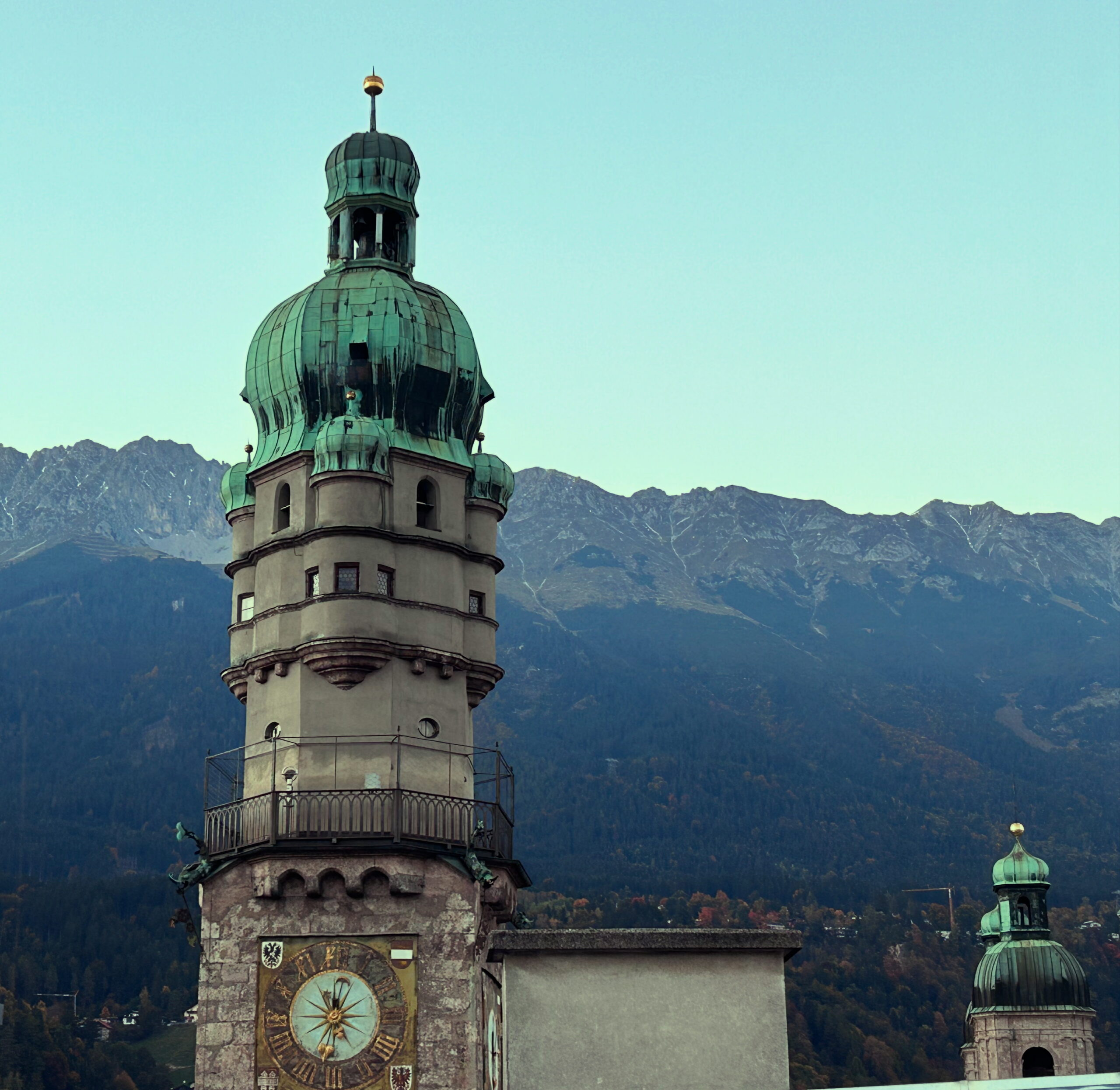
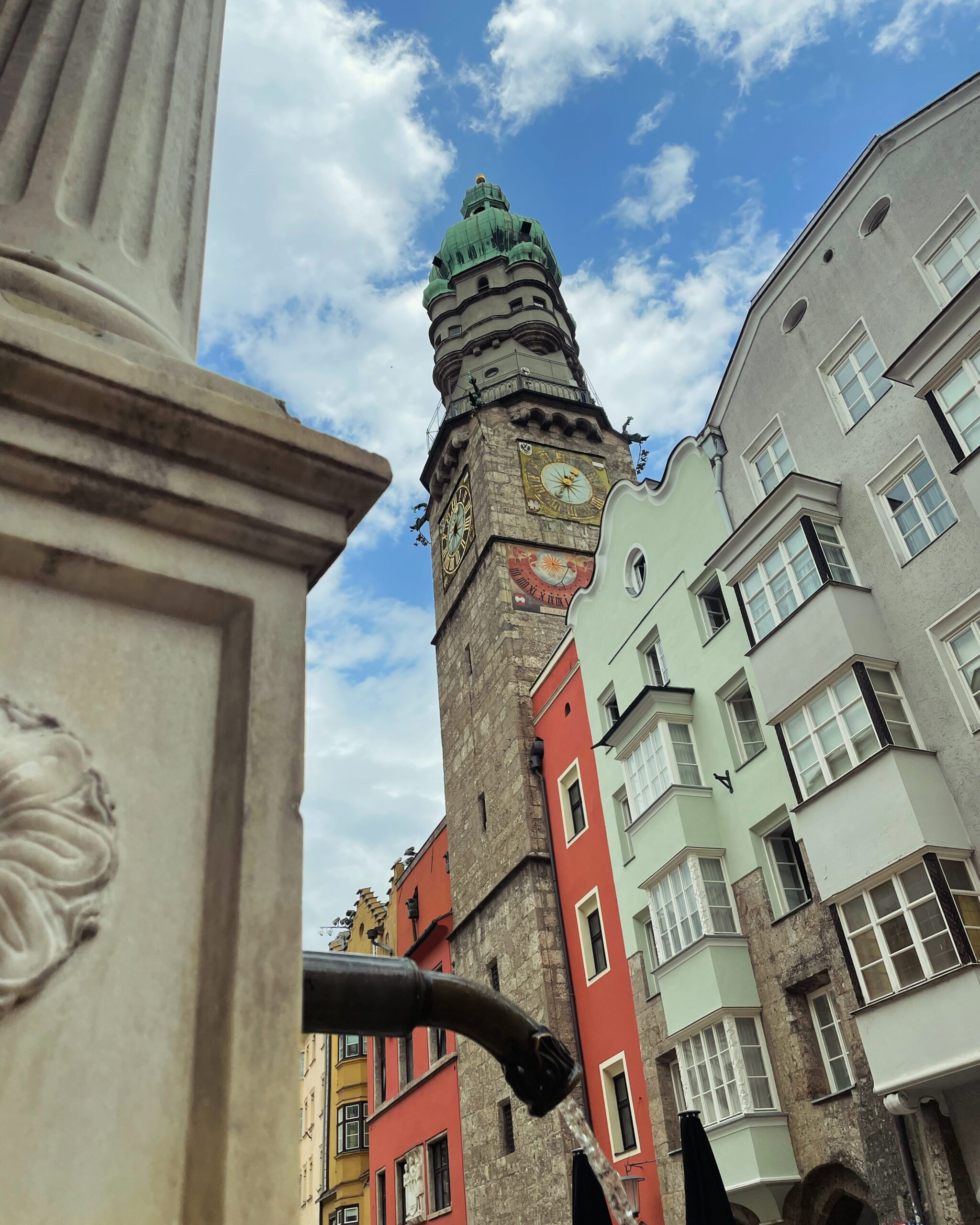
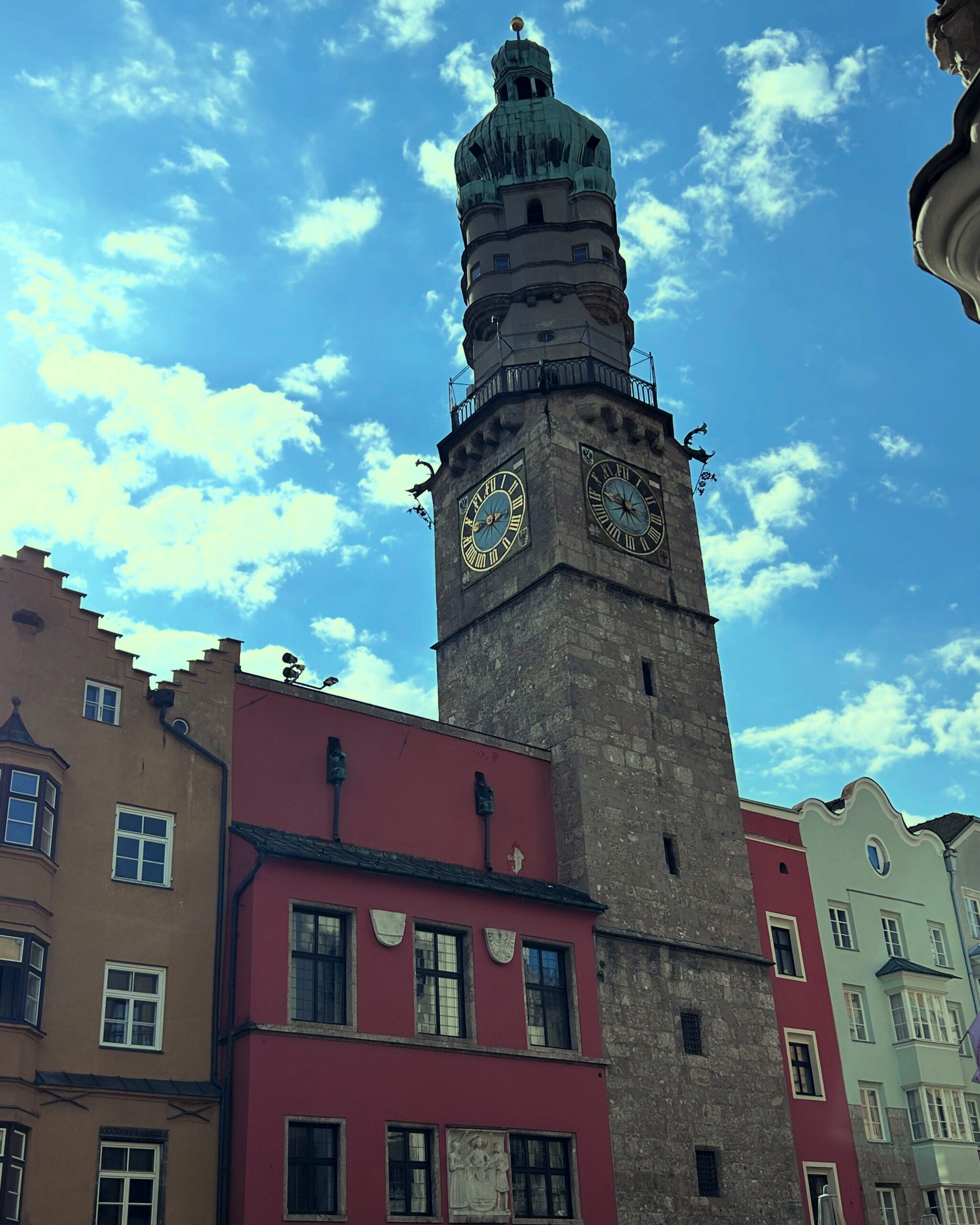
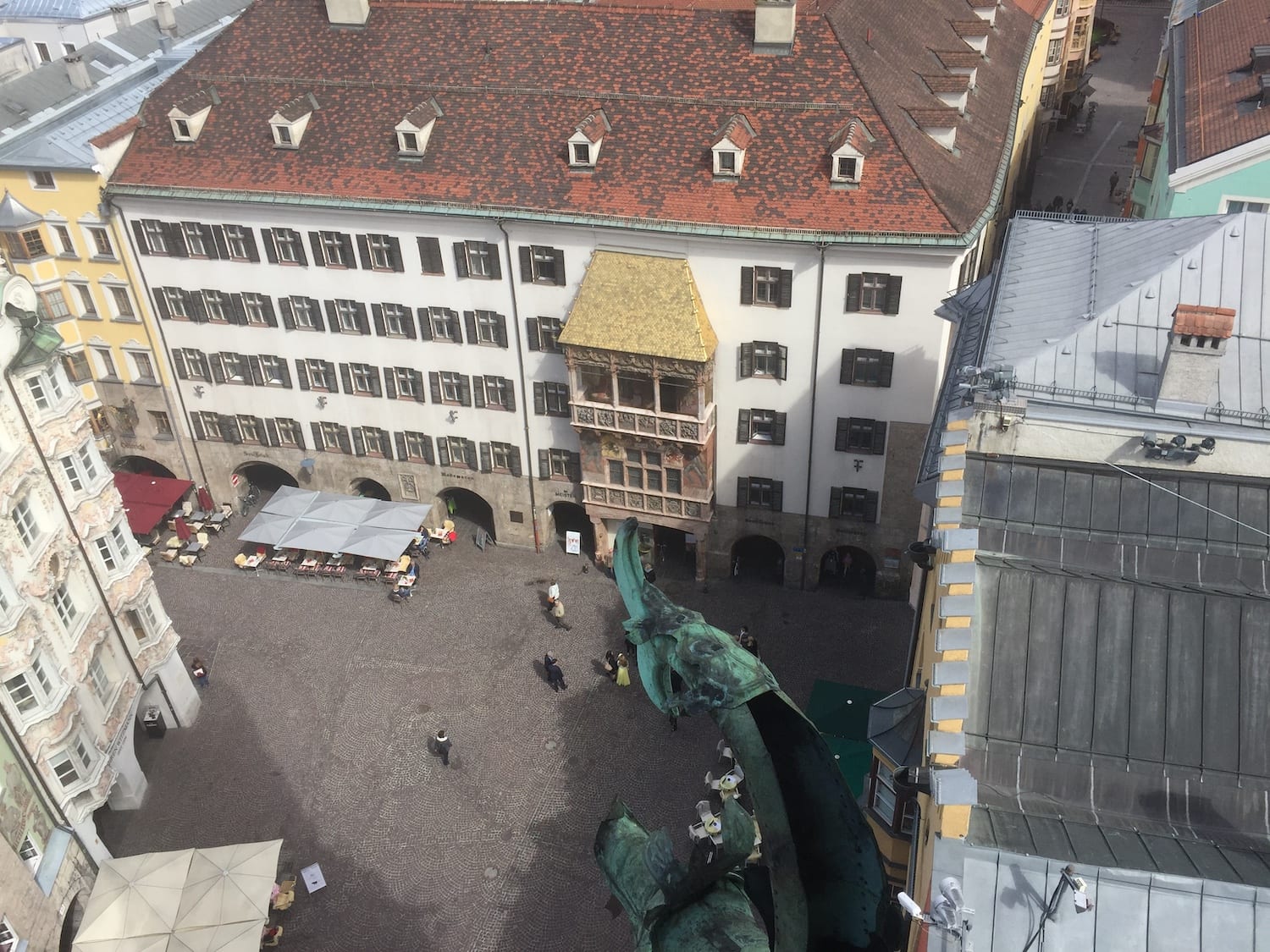
The red building flanking the City Tower is the Old Town Hall. Until the 14th century, the city’s affairs were managed in the house of the town judge or mayor. Besides a lack of transparency, these were not ideal working conditions for governing an ever-growing municipality with its own city council. Duke Ludwig of Brandenburg imposed a special tax to finance the construction of a dedicated town hall. In 1358, the building on the Upper Town Square was completed. It was the first official town hall of a Tyrolean municipality. The mayor and the community now had an appropriate home as official bodies. The modest building was erected before Innsbruck’s golden age and was not intended to display bourgeois splendour but to serve as an administrative building. The market inspectors were also based in the town hall. They oversaw the goods offered, their quantity and quality. Bread, for example, was weighed by the “bread guardian” at the bread counter in the town hall to prevent extortion and fraud. Through several renovations, extensions and repairs—the earthquake of 1689 did not spare the town hall—the building took on its present form. A relief on the façade commemorates the confirmation of city rights in 1239. The plaque was added in 1939 for the 700th anniversary of this event, based on a design by Hans Andre. Despite the anti-clerical stance of the National Socialists, the church painter Andre managed to incorporate an angel as the herald of city rights. The costumes of the figures depicted do not reflect the actual fashion of Innsbruck’s bourgeoisie in the 13th century but rather what was considered the German ideal of the German city of Innsbruck at the dawn of National Socialism.
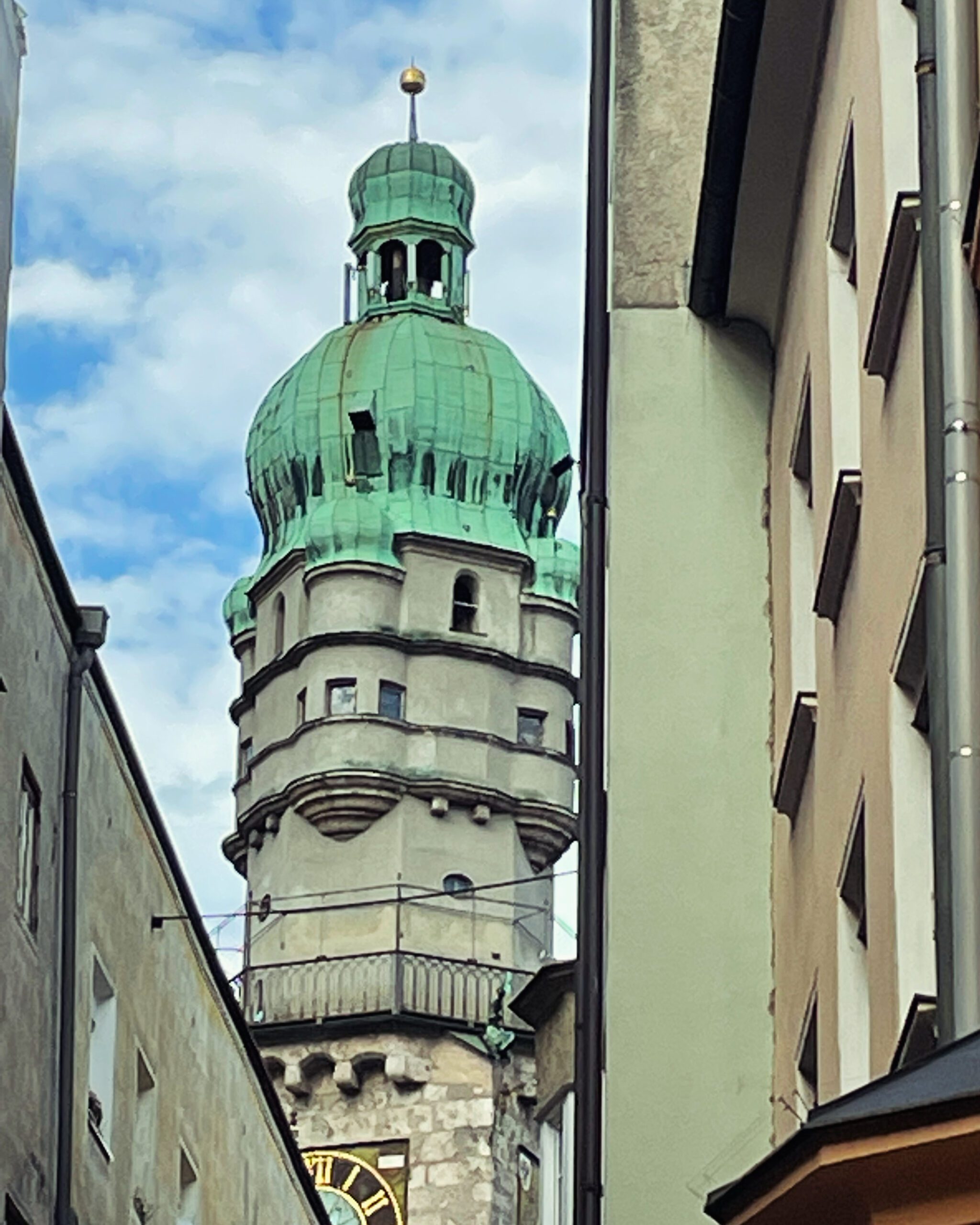
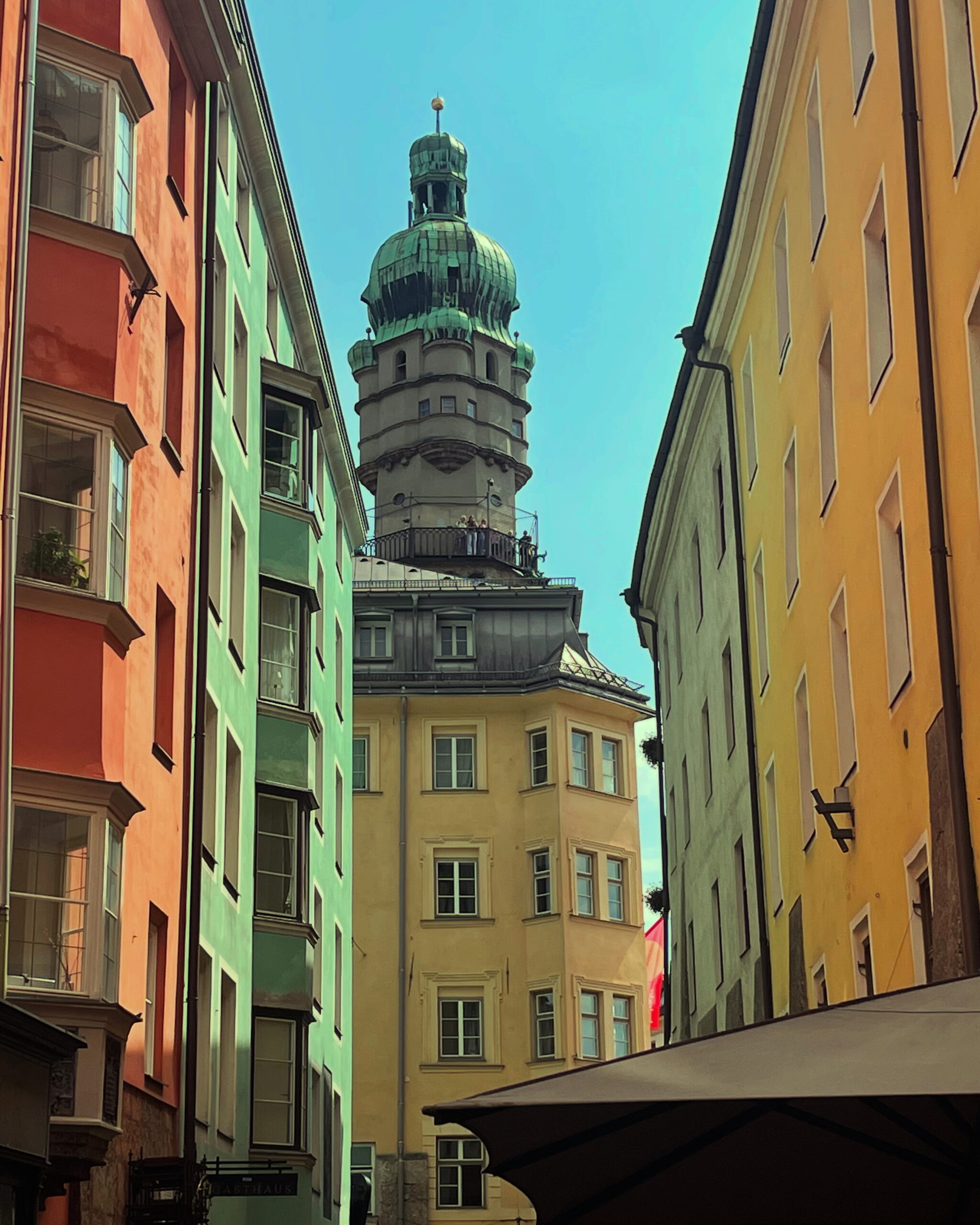
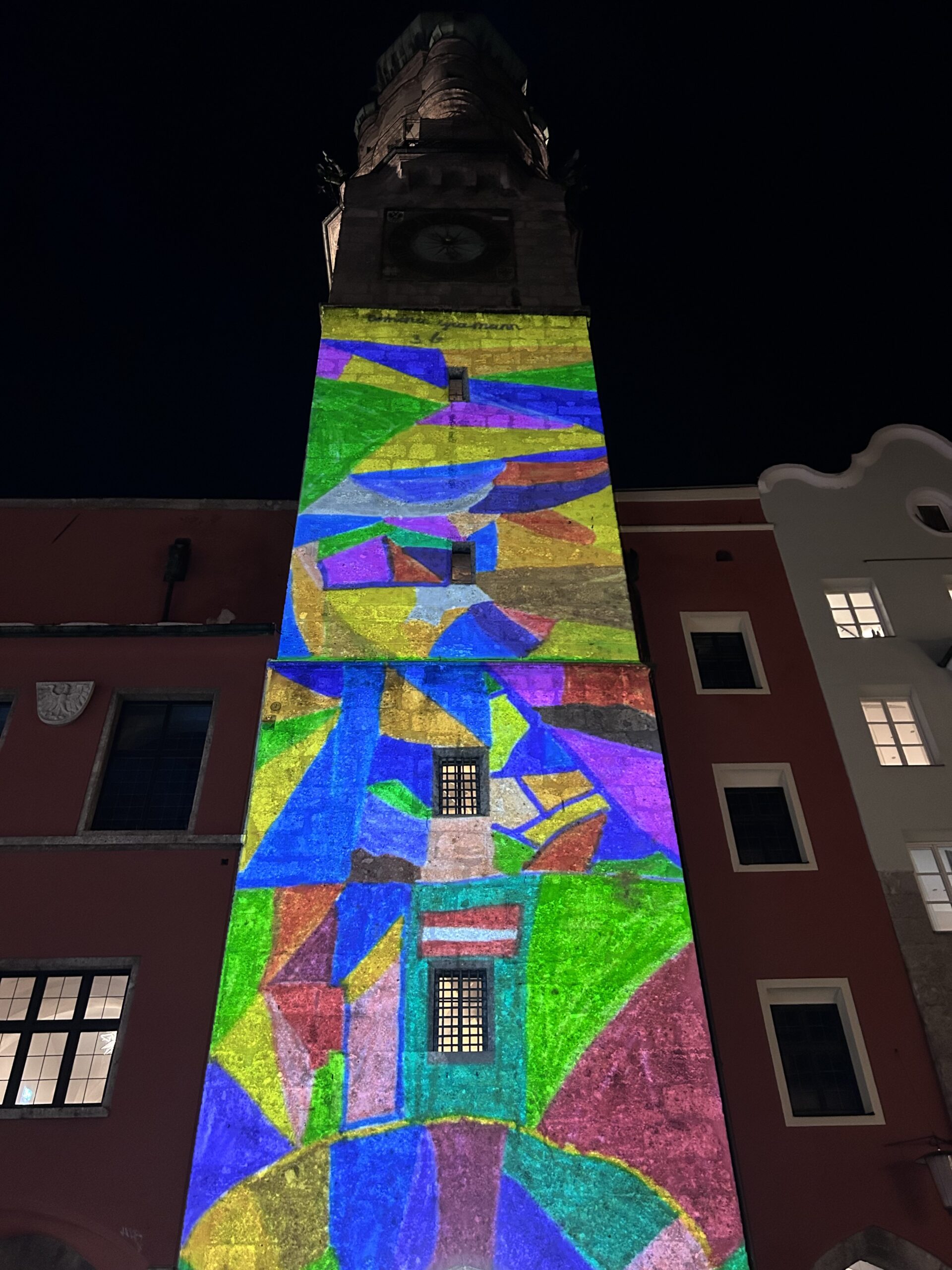
The symbolic sign of civic pride in city rights came later. The City Tower was built between 1442 and 1450 during the reign of Frederick IV. Innsbruck had meanwhile become a residence city. The increasingly wealthy citizens of Innsbruck wanted to demonstrate their newfound confidence. In 1560, the sturdy tower was crowned with an onion dome, the so-called Augsburg cap. This style was highly fashionable at the time, as Augsburg—home and business city of the merchant family Jakob Fugger—was one of Europe’s most important cities. Below the dome, skilfully crafted copper gargoyles in the shape of dolphins cluster. However, the City Tower was not merely an expression of Innsbruck’s vanity. The first floor housed a prison, and from the platform above, the tower watchman had to keep an eye out for dangers, monitor the city and, above all, sound the alarm in case of fire. Another duty of the watchman was announcing the time. Unlike today, not every citizen had a wristwatch. Besides church bells, people relied on the goodwill and precision of the man in the tower. A peculiarity of time in the Middle Ages was that it differed from village to village. Innsbruck likely had a different time than Hall or Schwaz. Only with industrialisation and the railway did synchronised time become important. Work schedules and timetables made a reinvention of time necessary.
Die Erweiterung des Alten Rathauses innerhalb der Altstadt schlug trotz mehrerer Entwurfsversuche im Laufe der zweiten Hälfte des 19. Jahrhunderts mangels Platzes fehl. Heute ist der Stadtturm beliebt, um die Altstadt von oben zu betrachten. In 55 m Höhe kann man sich wie ein mittelalterlicher Turmwächter fühlen und die ganze Altstadt überblicken. Besonders der Blick auf Helblinghaus und Goldenes Dachl mit der Nordkette im Hintergrund bildet die Kulisse für das ganz besondere Foto. Ob es gut bei den anderen Besuchern ankommt, wenn man lauthals die Uhrzeit von seinem Handy abliest, ist eine andere Frage.
Big City Life in early Innsbruck
During the Middle Ages, Innsbruck officially developed into a city. Formal recognition by the territorial prince in 1239 brought with it an entirely new system for its citizens. Market rights, building rights, customs rights, and an independent jurisdiction were gradually transferred to the city. Urban citizens were no longer subject to their feudal lord, but to the city’s jurisdiction—at least within the city walls. The well-known saying “city air makes one free” derives from the fact that after one year of residence in the city, a person was released from all obligations to their former lord. Unlike unfree peasants and servants, citizens could freely dispose of their property and determine their way of life. Naturally, they also had rights and obligations. Citizens did not pay tithes, but instead paid taxes to the city. Which group within the city was required to pay which taxes could be determined by the city government itself. The city, in turn, did not have to pass these taxes on directly, but could freely dispose of its budget after paying a fixed levy to the territorial prince. In addition to city defense, expenditures included care for the sick and the poor. Needy citizens could obtain meals from the “boiling kitchen” (Siedeküche), provided they held civic rights. The city government paid particular attention to contagious diseases such as the plague, which periodically tormented the population. In return for their rights, every citizen had to swear the civic oath. This oath included the obligation to pay taxes and perform military service. In addition to defending the city, citizens were also deployed beyond its walls. In 1406, a contingent together with mercenaries confronted an Appenzell army to defend the Upper Inn Valley. From 1511 onward, according to Emperor Maximilian’s Landlibell, the city council was also obliged to provide a contingent of conscripts for territorial defense. In addition, there were volunteers who could enlist for military service in the city’s Freifähnlein; for example, Innsbruck citizens were among the defenders of Vienna during the Ottoman siege of 1529.
In the 15th century, space became scarce in the rapidly growing city of Innsbruck. Citizenship became an exclusive commodity. Only free subjects born of legitimate birth were able to obtain city rights. To become a citizen, one had to prove either house ownership or skills in a craft in which the city's guilds were interested. The debate over who is a "true" Innsbrucker and who is not persists to this day. That migration and exchange with others have always been the guarantee for prosperity—and made Innsbruck into the livable city it is today—is often forgotten in the process. Because of these restrictions, Innsbruck had a completely different social structure than the surrounding villages. Craftsmen, merchants, civil servants, and domestic servants defined the cityscape. Traveling traders, officials, and court retainers also came to Innsbruck for short periods in the entourage of a prince and held no citizenship rights. The craftsmen exerted the greatest political power at the municipal level. Unlike peasants, they belonged to the socially mobile classes of the Middle Ages and the Early Modern Period. After completing their apprenticeship, they went on the Walz (journeyman years) before undergoing the master's examination, subsequently either returning home or settling in another city. Craftsmen were responsible not only for the transfer of technical knowledge, but also for spreading cultural, social, and political ideas. The individual trades—such as blacksmiths, coppersmiths, goldsmiths, furriers, bagmakers, cloth shearers, shoemakers, locksmiths, tanners, armorers, carpenters, bakers, and butchers—each had their own guild headed by a master. These craft guilds sometimes exercised their own jurisdiction over their members alongside the municipal court system. Wages, prices, and social life were regulated by the guilds under the supervision of the sovereign. One could speak of an early form of social partnership, as the guilds also provided security for their members in the event of illness or disability.
From the 14th century onward, Innsbruck demonstrably possessed a city council—the so-called Gemain—and a mayor. The elections, held annually after the turn of the year, were not secret, but public. Innsbruck had a population of around 5,000, of whom only a small fraction held citizenship rights. Propertyless individuals, itinerant folk, the unemployed, domestic servants, diplomats, employees, women, and later students were not eligible to vote. Casting a vote was an exclusive privilege of the male upper class. In the Innsbrucker Geschichtsalmanach of 1948, one can find records regarding the election of the year 1598.
The Feast of St. Erhard, i.e., January 8th, played a significant role in the lives of the citizens of Innsbruck each year. On this day, they gathered to elect the city officials, namely the mayor, city judge, public orator, and the twelve-member council. A detailed account of the election process between 1598 and 1607 is provided by a protocol preserved in the city archive: "... The ringing of the great bell summoned the council and the citizenry to the town hall, and once the honorable council and the entire community were assembled at the town hall, the honorable council first convened in the council chamber and heard the farewell of the outgoing mayor of the previous year, Augustin Tauscher."
The mayor represented the city to the other estates and the sovereign, who exercised supreme authority over the town with varying degrees of intensity depending on the era. Each city councilor was assigned specific, clearly defined tasks, such as overseeing market rights and the quality of offered goods, managing the hospital and poor relief, or administering the customs regulations, which were particularly vital for Innsbruck. The city council was also tasked with maintaining discipline, social order, and prevailing moral standards. The consumption of alcohol and staying in taverns were regulated differently at various times. For poorer social classes, going to inns was not only too expensive, but they were also restricted to visiting them only during specific hours. This was intended to prevent excessive drunkenness and begging directed at the upper class. Much like an early market authority, the city council monitored the quality and standard of food, as cities were keen on maintaining the reputation of their businesses to remain attractive as economic hubs and for visiting guests.
Contrary to popular belief, the Middle Ages were not a lawless era of arbitrariness. At both municipal and territorial levels, there were codes that very precisely regulated what was permitted and what was forbidden. Depending on the ruler and prevailing moral standards, these could vary significantly. Carrying weapons, swearing, prostitution, making noise, playing music, blasphemy, children playing—anything and anyone could end up in the crosshairs of law enforcement. Considering the regulations for trade, customs, professional practice by guilds, and price-fixing for all sorts of goods by the magistrate, pre- and early modern cohabitation was no less regulated than it is today. The difference lay in monitoring and enforcement power, which the authorities often lacked. If someone was caught in an unlawful or immoral act, judicial bodies existed to hand down sentences. Medieval court days were held outdoors at the "Dingstätte." The tradition of the Ding dates back to the ancient Germanic Thing, where all free men gathered to administer justice. The city council appointed a judge responsible for all offenses not subject to blood justice (Blutgericht). He was assisted by a panel of several jurors. Penalties ranged from fines to the pillory and imprisonment. The city also monitored adherence to religious order. There was no police force, but the city judge employed bailiffs, and city guards were stationed at the gates to maintain order. It was a civic duty to assist in capturing criminals; vigilantism was strictly prohibited. Law enforcement included methods far less humane than those common today, though torture was not applied randomly or arbitrarily. Torture as part of formal procedure in particularly severe cases was also regulated. Up until the 17th century, suspects and criminals in Innsbruck were detained and interrogated in the Kräuterturm (Herb Tower) at the southeastern corner of the city wall, along present-day Herzog-Otto-Ufer. Both trials and sentence executions were public affairs. Minor offenses brought mild yet humiliating punishments: in front of the City Tower stood the Narrenhäusel (fools' house), a cage in which offenders were locked up and put on display for several hours or days. On the wooden Schandesel (donkey of shame), one was paraded through the city. The pillory stood in the suburb—today's Maria-Theresien-Straße. The jurisdictional boundaries between municipal and territorial justice had been regulated in the land register (Urbarbuch) since 1288. "Heretics" and dissidents were sentenced not by the Church, but by the city government. Only severe crimes remained under the jurisdiction of the territorial court (Landesgericht). Offenses such as theft, murder, or arson fell under this high justice (Blutrecht). The territorial court for all communities south of the Inn between Ampass and Götzens was based at the Sonnenburg, situated on the hill south above Innsbruck. In the 14th century, the Sonnenburg court relocated to the Upper Town Square in front of the Innsbruck City Tower, later to the Town Hall, and in the early modern period to Götzens. With the centralization of law in the 18th century, the Sonnenburg court returned to Innsbruck, taking shelter under various names and in different buildings—such as the Leuthaus in Wilten, on the Innrain, or at the Ansitz Ettnau (known as the Malfatti-Schlössl) in Höttinger Gasse.
From the late 15th century onward, Innsbruck’s executioner was centralized and responsible for several courts, residing in Hall. Execution sites changed over time. A gallows long stood on a hill in today’s Dreiheiligen district directly by the main road. The Köpflplatz was located until 1731 at today’s corner of Fallbachgasse and Weiherburggasse in Anpruggen. In Hötting, the gallows stood behind the Chapel of the Great God. The present chapel, which alongside a Baroque crucifix features ceramic figures by the renowned artist Max Spielmann (1906–1984), was relocated during roadworks in the 1960s. While Spielmann’s Dance of Death memorial commemorates those killed in the Second World War, those sentenced to death once sent a final prayer heavenward here before the noose was placed around their necks or their heads were severed—depending on social status and the nature of the crime. It was not uncommon for the condemned to give their executioner a kind of gratuity so that he would aim as precisely as possible to make the execution as painless as possible. Much could go wrong: if the sword missed its mark, the noose was improperly placed, or the rope broke, the suffering of the condemned increased. For authorities and public order, particularly dangerous offenders such as the “heretic” Jakob Hutter or the captured leaders of the Peasants’ Revolts of 1525 and 1526 were publicly executed in front of the Golden Roof. “Aggravated” punishments such as quartering or breaking on the wheel—derived from the Latin poena—were not routine but could be ordered in special cases. Executions were public demonstrations of authority and served as a form of purification of society and as a deterrent. Large crowds gathered to accompany the condemned on their final journey. On execution days, university lectures were suspended to allow students to attend and be morally instructed. The bodies of those executed were often left hanging and buried outside consecrated cemetery grounds or handed over to the university for study purposes. The last public execution in Austrian history took place in 1868. Although executions thereafter were still far from gentle, killings by strangulation at the gallows—used until the 1950s—were no longer public spectacles.
With the centralisation of law under Maria Theresa and Joseph II in the 18th century and the General Civil Code in the 19th century under Franz I, the law passed from cities and sovereigns to the monarch and their administrative bodies at various levels. Torture was abolished. The Enlightenment had fundamentally changed the concept of law, punishment and rehabilitation. The collection of taxes was also centralised, which resulted in a great loss of importance for the local nobility and an increase in the status of the civil service. With the increasing centralisation under Maria Theresa and Joseph II, taxes and customs duties were also gradually centralised and collected by the Imperial Court Chamber. As a result, Innsbruck, like many municipalities at the time, lost a large amount of revenue, which was only partially offset by equalisation.
Innsbruck - city of bureaucrats and civil servants
Innsbrucker brüsten sich stolz der vielen Titulierungen ihrer Heimatstadt. Für jeden Geschmack ist etwas dabei: Hauptstadt der Alpen, Universitätsstadt, Österreichs Sportstadt oder Heimat des weltbesten Krankenhauses. Wirft man einen Blick auf die Liste der größten Arbeitgeber der Region oder in die Geschichte, ist Innsbruck vor allem eins: Beamtenstadt. Universität und Landeskrankenhaus sind zwar die größten einzelnen Arbeitgeber, rechnet man aber die öffentlichen Bediensteten aller Ebenen, Stadt, Land und Bund zusammen und nimmt die ausgelagerten Unternehmen im Besitz der öffentlichen Hand wie die ÖBB, TIWAG oder die Innsbrucker Kommunalbetriebe hinzu sowie Lehrer und Polizei, sind die Beamten klar in der Überzahl. Diese Titel hat auch die längste Tradition. Spätestens seit der Übersiedlung der landesfürstlichen Residenz unter Friedrich IV. machte die Beamtenschaft nicht nur einen beträchtlichen quantitativen Teil der Bürgerschaft aus, sie bestimmt die Geschicke der Stadt in einflussreicher, wenn auch unauffälliger Manier. Bis heute sind es Beamten, die den Laden am Laufen halten. Sie setzen Gesetze durch, kümmern sich um die Planung und Instandhaltung von Infrastruktur, machen eifrig Aufzeichnungen über die Bevölkerung, um Steuern ein- und Soldaten auszuheben. Die erste Welle der Bürokratie kam wohl bereits mit dem Roman Empire. Den Römern folgten im frühen Mittelalter die Brüder des Stiftes Wilten. Die schreibkundigen Männer verwalteten nicht nur die herzoglichen und eigenen Besitztümer durch ihre Urbare und hoben die Abgaben bei den bäuerlichen Untertanen ein, sondern legten Taufmatrikel, Heiratsverzeichnisse und Sterbebücher an. Die Feudalherrschaft erforderte zwar einen Panoramablick über das, was sich innerhalb ihres Herrschaftsbereichs abspielte, vor allem in der Stadt war das Leben aber eher von den Beschränkungen der Zünfte als von denen der Obrigkeit bestimmt. Ein Magistrat war nur oberflächlich vorhanden. Es gab Gesetze, aber keine Polizei, Steuern aber kein Finanzamt. Städtische Infrastruktur war praktisch nicht vorhanden, schließlich gab es weder fließend Wasser, elektrischen Strom, Kanalisation, städtische Kindergarten, ein Arbeitsamt oder eine Krankenkasse. Die zur Stadt erhobene Gemeinde Innsbruck wurde lange von einem Stadtrichter, ab dem 14. Jahrhundert von einem Bürgermeister mit Gemeinderat regiert. Es handelte sich dabei nicht um hauptberufliche Beamte, sondern Mitglieder der städtischen Elite. Nur wenige Menschen wie Zöllner, Kornmesser, Schreiber oder Turmwächter standen bei der Stadt unter Lohn und Brot.
In the 15th century, professional life and society became more differentiated, armies grew larger, and tax burdens increased. Traditional customary law was replaced by modern Roman law, which was more difficult for laypeople to understand. As the city grew, so did the bureaucratic apparatus. Between the early 15th century and the reign of Leopold V, Innsbruck had developed from a trading and transport settlement into a civil servants’ city. Of the approximately 5,500 inhabitants, more than half belonged to the court, the municipal administration, the university, or the clergy. Court life, administration, customs, taxation, long-distance trade, and finance required literate personnel. Administration had become the city’s most important economic sector, ahead of crafts, transport, and hospitality. Civil servants distinguished themselves socially. If at all, citizens usually encountered these foreign people only in unpleasant situations. The reins were tightened particularly firmly under Maximilian I. Laws decided centrally were implemented locally by the Imperial Circles. Salaried officials penetrated the lives of individuals in a way unknown in the Middle Ages. To make matters worse, these officials often came from abroad. Italians and Burgundians in particular were sought-after key personnel, but they remained alien to the local population. Not only did they often not speak German; they could read and write, were employees rather than subject peasants. They had more money, dressed differently, followed different customs, and ate different foods. Unlike the territorial prince, they did not invoke God, but rules written by humans and inspired by antiquity and reason. Depending on the fashions, customs, and moral concepts of the time, laws changed. Just as nature conservation or speed limits on motorways are repeatedly debated today despite their obvious sense, prohibitions against spitting, disposing of chamber pots, wooden buildings, and keeping livestock within the city walls were criticized at the time—even though they drastically improved hygiene and safety.
While it had long been customary for citizens to take certain liberties in the absence of the ruler—whether in logging, construction, hunting, or fishing—the bureaucracy was always present. Whereas the territorial prince was seen as a benevolent father of his subjects, and bishops and abbots, though strict landlords, could at least offer salvation in return, the new administrative authority appeared anonymous, aloof, faceless, foreign, and distant. The basis for negotiation that a subject once had in direct contact with his lord was buried by merciless law—at least if one could not pay bribes or did not know someone in a higher position. When the unconditional faith in an increasingly corrupt clergy began to crumble and Ferdinand I appointed the Spaniard Salamanca as the country’s supreme financial administrator, the simmering dissatisfaction erupted into open rebellion in 1525. The subjects did not demand the deposition of the prince, but a change in the rule of the clergy and the foreign bureaucracy. Even in the 17th century, it was the head of Wilhelm Biener, the highest-ranking official in the country, that rolled—not that of the sovereign.
Bureaucracy, the rule of the administration, also had advantages for the subjects. It established fixed rules where arbitrariness often prevailed. The law, harmonised across different territories, was more predictable. And with a bit of luck and talent, it was possible to climb the social ladder by serving the public authorities, even without belonging to the nobility. Michael Gaismair, one of the leaders of the 1525 rebellion, was the son of a mining entrepreneur and had been in the service of the provincial governor before his career as a revolutionary.
The next modernization of administration took place in the 18th century. Under the enlightened absolutist monarchs Maria Theresa and Joseph II, a new wind blew down to the municipal level. Innsbruck received a police force for the first time. The city administration was modernized in 1784. Instead of the old town council with its community assembly, a mayor now governed, supported by a council and above all by civil servants. This magistrate consisted of salaried experts who were still largely members of the lower nobility, but who now had to qualify for office through examinations. Bureaucracy gained more power at the operational political level. While the office of mayor was limited in time, civil servants enjoyed lifelong, non-terminable positions. This tenure and a renewed surge of new laws—often contradicting tradition—reinforced the image of civil servants as aloof and distant from citizens. When the element of foreign rule was added with the Bavarian occupation of Tyrol—modeled on French administration—another uprising broke out in 1809. The mass conscription of young men for military service, regulation of religious life, and compulsory vaccination, enforced by Bavarian officials, was too much for the Tyrolean psyche.
After 1809, bureaucracy expanded into ever more areas of life as part of industrialization and new technologies. Not only the state through taxation and the military, but also universities, schools, construction, railways, the postal system, and institutions such as the Chamber of Trade and Commerce required administrative staff. The city grew in population and businesses alike. New infrastructure—gas, sewer systems, and electricity—and new ideas about hygiene, food inspection, health, and education demanded new employees in the municipal administration. The old town hall in the Old Town became too small, and an extension proved impossible. In 1897, the civil servants moved into the new town hall on Maria-Theresien-Straße. The move was made possible by the generous donation of the industrialist and hotelier Leonhard Lang. He had converted the former Palais Künigl into the Hotel d’Autriche before the mayor and his entourage moved in.
When the monarchy collapsed in 1918, the transition was not seamless, but thanks to the structures in place, it was unimaginably smooth. However, it was no longer the emperor who carried the burden of the state, but a host of civil servants and guardians of order who provided water, electricity and a functioning railway network. With Eduard Klingler and Theodor Prachensky, two heads of building authorities in the first half of the 20th century left their mark on Innsbruck's cityscape, which is still clearly visible today. With agendas such as public housing, the labour office, education, urban infrastructure, road construction, public transport, registration and weddings, the Republic took over more or less all the tasks of daily life from the monarchy and the church. So for anyone who is annoyed by excessive officialdom and agonisingly slow bureaucracy on their next visit to the New Town Hall, it is worth remembering that the welfare state in the person of its civil servants manages the social welfare and public infrastructure of thousands of people from the cradle to the grave, mostly unnoticed.
Friedl with the empty pocket
The Tyrolean sovereign Frederick IV (1382–1439) lived in a turbulent period of Habsburg and Innsbruck history. The key events of his life would provide suitable material for an adventurous medieval film, as would his physical appearance as it has been handed down to us. A long, bushy beard framed Frederick’s face. In many chronicles and accounts he was described as arbitrary, power-hungry, devious, and cunning. Contemporaries regarded him as a sex addict who, if necessary, did not shy away from violence to impose his will. This, however, was not unusual when one considers the biographies of other princes of the late Middle Ages, as a glance at his ancestry reveals. On his mother’s side, he descended from the Milanese Visconti family, who had ruthlessly fought their way up to ducal rank. At the age of twenty-four, Frederick assumed not only the regency of Further Austria but also the County of Tyrol. Further Austria—does that mean Vorarlberg? Not quite. Further Austria referred to Habsburg possessions that included parts of Switzerland, Vorarlberg, Alsace, and Baden-Württemberg. From Frederick’s time onward, Tyrol and Further Austria were jointly administered as Upper Austria. This made him one of the most powerful princes of the Holy Roman Empire. From the very beginning of his reign, he was involved in costly wars both along his borders and within the empire. In the west, the Appenzell region rose up against the Habsburg ruler; in the south, an uprising broke out in Trento; and north of the River Inn, Heinrich of Rottenburg instigated a feud. These were among the last conflicts still fought in the manner of purely knightly armies. Like his predecessor on the Tyrolean throne, Margaret, and like his grandfather Bernabò Visconti, Frederick also came into conflict with the pope. At the time, there was not only a pope in Rome but also one in Avignon. This papal question was to be resolved at the Council of Constance, perhaps the most important political event of the late European Middle Ages. Frederick sided with Pope John XXIII. King Sigismund of Luxembourg, King of the Holy Roman Empire, who supported the rival pope in Avignon, retaliated by placing Frederick under the imperial ban and having him imprisoned. This entailed not only loss of freedom and excommunication, but also the forfeiture of his territories and possessions. His enemies mockingly bestowed upon him the nickname “Frederick of the Empty Pockets.” After an adventurous escape from captivity and his return to Innsbruck, Frederick was forced to grant reforms to the population—above all to the landowning lesser nobility and the towns—as recognition for their support in his hour of greatest need. In addition to the clergy, nobility, and towns, the courts responsible for administering rural communities were now also permitted to send representatives to the regional assembly (Landtag). His nickname remained in popular usage, even though by the end of his reign he was one of the wealthiest princes of his time, thanks to the rich silver deposits in Schwaz and Gossensass as well as tolls and customs duties on trade between Venice and Augsburg. The Schwaz silver mine was the largest in Europe at the time. The mining economy also permanently altered Innsbruck’s social structure. The power of the guilds increased. When Frederick died, Tyrol—owing to the silver discoveries in Schwaz—had risen to become an important territory within the Habsburg lands. This development also transformed Innsbruck. Frederick decided to make the city on the River Inn his residence. In 1420, he purchased two burghers’ houses within the city walls. Merano had been the ancestral seat of the Counts of Tyrol and officially remained the provincial capital until 1849; in practice, however, Innsbruck had clearly taken the lead ever since Frederick’s relocation. During his reign, the arcades along Herzog-Friedrich-Strasse were constructed, and the City Tower was erected. Across Europe, the fifteenth century was an economically difficult period due to a generally colder climate than in previous eras and frequent crop failures. Through trade and the stimulus generated by the relocation of the court, Innsbruck prospered in contrast to this broader European trend. Although the city depended on its surrounding countryside for food supplies, its growing prosperity made it easier to navigate this period of crisis than was the case in purely rural regions. The princely court, comprising around 400 people, brought officials, servants, merchants, financiers, and soldiers into the city—along with money and a new lifestyle. As in many German-speaking European cities, urbanization spilled over from the Italian regions, leading to greater occupational specialization and an increasingly pronounced division of labor. The craft guilds became the economic engine and the foundation for later proto-industrial production. Inns and taverns opened, offering diversion from everyday life. Traveling theaters and performers came to the city. Immigration and rapid social change also generated tensions. The xenophobia of a superstitious, often illiterate and poorly educated population did not diminish at the same pace as social conditions evolved. Conflicts between long-established residents and newcomers, artisans, merchants, peasants, and members of the court were part of daily life in Frederick’s Innsbruck.
Because of his many conflicts with other princes and the pope, his wealth from tolls and the Schwaz mines, and his likely eccentric character, Frederick IV was regarded by his contemporaries as a kind of robber baron. Only later did he receive a more favorable reputation through the many legends that grew up around his person. According to one such story, he is said to have wandered through the land disguised as a beggar in order to learn what the people truly thought of him. From the reports commissioned by the Habsburgs from the sixteenth century onward, his image becomes considerably more positive. His affectionate nickname, “Frederick of the Empty Pockets,” still carries this image of the good-natured, somewhat clumsy Tyrolean ruler. Whether he was a miserly eccentric or a shrewd politician and a friend of the common people remains a matter of debate to this day.