Städtisches Hallenbad
Amraserstraße 3
Worth knowing
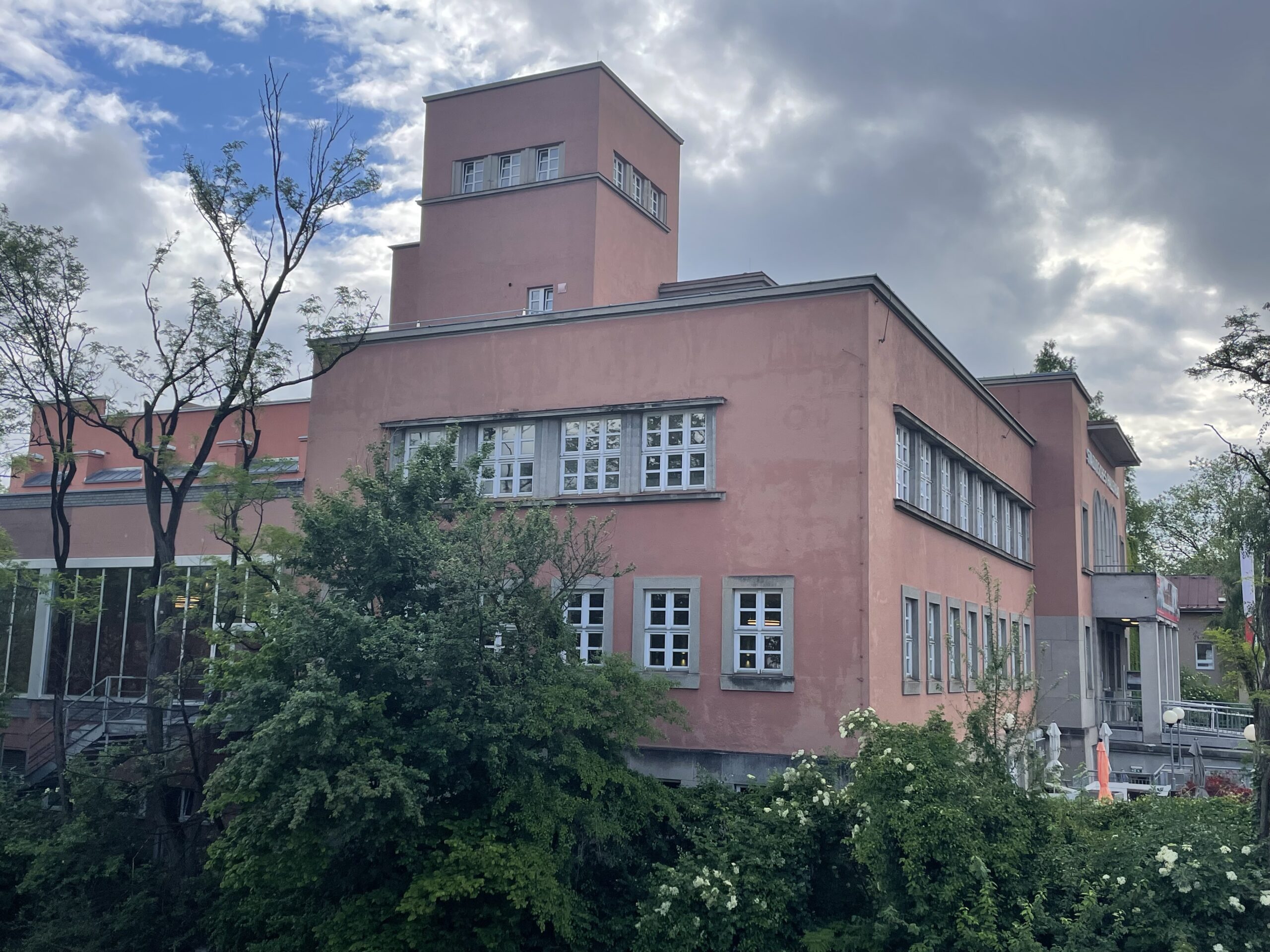
In June 1929, after many construction delays, cost overruns, and heated public disputes between the editors of the Innsbrucker Nachrichten and the city’s construction office over the ambitious project, the Municipal Indoor Swimming Pool designed by Fritz Konzert finally went into operation. During the brief period between inflation, currency reform, and economic crisis, Innsbruck still had the budget for major construction projects. The indoor pool on Amraserstraße was the second expansion of the city’s bathing infrastructure during the interwar period. In 1927, following Konzert’s plans, the Municipal Steam Bath on Salurnerstraße had opened. The striking green façade of this Art Deco building is adorned with elaborate patterns. Colorful tiles, mosaics, and wooden wall panels made the steam bath a final salute to the monarchy and to Jugendstil. Today popular for enjoying sauna and wellness in the ambience of the early 20th century, the bathhouse was, for many Innsbruck residents, the only opportunity to experience running hot water. It served a new sense of hygiene that had become established since the 19th century. With the discovery of germ theory, cleanliness had shifted from a personal virtue to a public concern, aimed at strengthening the health of the population. In theory, every citizen was supposed to have equal access to personal hygiene. “Public health” was the mantra of the day. This social development attracted interest from life reformers, social democrats, liberals, and authoritarian state actors alike—though for different reasons. Like its counterpart on Salurnerstraße, the Municipal Indoor Pool on Amraserstraße included a large area with bathtubs where families could enjoy the luxury of proper body care. In addition to functioning as a bathhouse, it was also intended to serve as a sports facility. Physical exercise and fitness had become part of everyday life in the preceding decades. International comparisons in various sports were fiercely contested and became expressions of local and national pride. In the summer of 1928, the Allgemeine Tiroler Anzeiger criticized the performance of Tyrolean swimmers and divers and expressed the hope that “once the indoor pool in Innsbruck opens its doors, winter training will show such progress that even better results can be achieved.” For fairness’ sake, newspapers always listed swimmers’ performance separately for clubs with and without an indoor pool. Expanding the steam bath into a training and sports facility—an idea many contemporaries considered ideal—was impossible due to spatial limitations on Salurnerstraße. Pradl was selected as the new location. The nearby gasworks promised a modern connection to the energy network. In contrast to the steam bath, Konzert designed the Municipal Indoor Pool in the style of New Objectivity. This architectural form is characterized by smooth, unadorned surfaces and angular, cuboid elements. The entrance is framed by columns. The most impressive view of the Municipal Indoor Pool is from the south: its block-like components make the building resemble a small fortress. In the early years after its construction, two pylons stood on the former gasworks bridge in front of the pool, further reinforcing this impression. According to the guiding principles of the reform movement—“light, air, and sun”—the architecture was intended to allow sunbathing on the flat roof and to supply the pool with daylight through large glass surfaces. Visitors could stroll along the gallery above the pool and watch the swimmers below.
Like many buildings in Pradl, the Municipal Indoor Pool became a casualty of air raids during the Second World War. After the war, the pool was rebuilt. In 1969, a small beginners’ pool and a sauna were added. Following several renovations in the 1980s and 2010s, the Municipal Indoor Pool is today the flagship facility of the Innsbrucker Kommunalbetriebe in the areas of well-being and wellness. Various saunas, Kneipp basins, and warm rooms in the newly designed, modern part of the complex attract visitors—especially on weekends—seeking relaxation. The fundamental external structure of the building and the large, light-filled swimming hall with its competition pool and gallery still retain their original style. The listed building offers first-class enjoyment with modern amenities presented in the chic of the 1920s.
Die Eröffnung des Innsbrucker Hallenschwimmbades
Erschienen: Innsbrucker Nachrichten / 10. Juni 1929
Wie uns das Direktorat des städtischen Gaswerkes mitteilt, wird das neue Hallenschwimmbad am Sonntag, den 22. November, vormittags 11 Uhr, feierlich eröffnet werden.
Das Schwimmhalle ist mit einem Umstand, der für die Stadt Innsbruck von großer Bedeutung ist, ausgestattet: Es ist das erste Hallenschwimmbad Tirols und wird nicht nur den Sportfreunden, sondern auch der gesamten Bevölkerung zur Verfügung stehen.
Die Anlage umfasst ein großes Schwimmbecken von 25 Meter Länge und 12 Meter Breite, ferner ein kleineres Becken für Nichtschwimmer, sowie Duschen und Umkleideräume. Die Wasseraufbereitung erfolgt nach den modernsten hygienischen Grundsätzen.
Die Eröffnung wird in Anwesenheit zahlreicher Vertreter der Stadtverwaltung und der Sportvereine stattfinden. Nach der offiziellen Begrüßung durch den Bürgermeister wird das Bad der Benützung übergeben.
Die Eintrittspreise sind so bemessen, dass jedermann Gelegenheit hat, die neue Einrichtung zu benützen. Für Schüler und Jugendliche sind ermäßigte Tarife vorgesehen.
Das Schwimmhall ist mit einer Umwälzanlage versehen, die eine ständige Reinigung und Erneuerung des Wassers gewährleistet. Die Temperatur des Wassers wird durch eine besondere Heizvorrichtung auf angenehme Wärme gebracht.
Die Baukosten für das Hallenschwimmbad belaufen sich auf rund 450.000 Schilling. Die Stadt Innsbruck hat damit eine Einrichtung geschaffen, die nicht nur dem Sport, sondern auch der Volksgesundheit dient.
Die Öffnungszeiten sind so festgelegt, dass sowohl Berufstätige als auch Schüler und Studenten Gelegenheit zum Besuch haben. An bestimmten Tagen sind Stunden für den Schulunterricht im Schwimmen vorgesehen.
Die Schwimmhalle ist mit einer Tribüne ausgestattet, die den Besuchern Gelegenheit gibt, die Wettkämpfe zu verfolgen. Es ist vorgesehen, dass in der Halle auch Schwimmkurse und Wettkämpfe stattfinden.
Das neue Hallenschwimmbad bedeutet für Innsbruck einen großen Fortschritt. Es wird nicht nur den Schwimmsport fördern, sondern auch zur Hebung der allgemeinen Körperkultur beitragen. Die Stadtverwaltung hofft, dass die Bevölkerung von dieser neuen Einrichtung regen Gebrauch machen wird.
Die Preise
Hauptbad: Die Eintrittspreise sind wie folgt:
- Erwachsene: 1 Schilling
- Kinder unter 14 Jahren: 60 Groschen
- Schüler und Jugendliche: 80 Groschen
Für die Benützung der Warmwasserduschen wird ein Zuschlag von 20 Groschen erhoben.
Monatskarten für Erwachsene kosten 16 Schilling, für Schüler und Jugendliche 10 Schilling.
Die Familienkarten sind besonders günstig bemessen.
Josef Prachensky: Lebensreform und Sozialdemokratie
Industrialisation and the rise of the bourgeoisie in the 19th century transformed society for better and for worse. Urbanisation was increasingly perceived by many people as a burden. Although many workers and employees in Innsbruck had, in absolute terms, more resources at their disposal than ever before, the pressure to participate socially also grew. From the 1890s onwards, several advertising columns (Litfaßsäulen) appeared in Innsbruck, on which artistically designed posters promoted the new variety of products. Department stores and fashion retailers made social differences within an increasingly differentiated society more visible than ever. Anyone who wanted to keep up in the new bourgeois class had to be able to afford membership in this emerging consumer society. At the same time, the strains of industrialisation increased. Traffic on the streets, factory emissions, cramped living conditions in tenement blocks, and the previously unknown haste brought about by the strict structuring of time—which made new illnesses such as neurasthenia socially acceptable—gave rise to counter-movements. Although Innsbruck could not be compared with Paris or London in terms of size or intensity of industrialisation, the social gap was nonetheless enormous for many residents of formerly rural villages such as Pradl and for workers who had migrated from the countryside.
„Light air and sun“ war das Motto der Lebensreform, einer Sammelbewegung alternativer Lebensmodelle, die im späten 19. Jahrhundert in Deutschland im Gleichschritt mit der Entwicklung der Sozialdemokratie ihren Anfang nahm. Beide Ideen waren Reaktionen auf die Lebensbedingungen in den rasant wachsenden Städten. Schon vor der politischen Teilhabe beeinflussten Lebensreform und Sozialdemokratie Gesellschaft, Kunst und Architektur. Man wollte sich von dem, was Max Weber als protestantische Ethik beschrieb, der Industrie, den Stechuhren, ganz allgemein dem rasenden technischen Fortschritt mit allen Auswirkungen auf den Menschen und das Sozialgefüge, abgrenzen. Der Mensch als Individuum, nicht seine Wirtschaftsleistung, sollte wieder im Mittelpunkt stehen. Was dem Arbeiter Karl Marx´ Schriften, waren der gehobenen Bürgerschaft Kunst und Architektur. Der Jugendstil war der künstlerische Ausdruck auf dieses „Back to the origin“ der Jahrhundertwende. Das verspielte Element war das Gegenteil zum stets symmetrischen und aufgeräumten Historismus. Das Winklerhaus ist eines der wenigen im Stadtbild erhaltenen Zeugnisse dieses Zeitgeistes. Seit 1869 erschien die German Quarterly Journal for Public Health Care, which focussed on improving nutrition, hygiene and living space. In 1881 the Austrian Society for Healthcare gegründet. Private Vereine veranstalteten Aufklärungsveranstaltungen zum sauberen und gesunden Leben. Man betrieb politisches Lobbying zur Errichtung von Parks im öffentlichen Raum und der Verbesserung der Infrastruktur wie Bädern, Krankenhäusern, Kanalisation und Wasserleitungen. Assanation und Sozialhygiene waren Schlagwörter einer bürgerlichen Elite, die um ihre Mitmenschen und die Volksgesundheit besorgt war. Anstelle der sozialistischen Revolution sollte der christliche Gedanke der Nächstenliebe die Gesellschaft voranbringen. Wie alle elitären Bewegungen nahm auch die Lebensreform teils absurde und sektenartige Blüten an. Bewegungen wie der Vegetarismus, FKK, Gartenstädte, verschiedene esoterische Strömungen und andere alternative Lebensformen, die sich bis heute in der einen oder anderen Form erhalten konnten, entstanden in dieser Zeit. Auch Orientalismus und Spiritismus feierten in der Upper Class ein fröhliches Dasein.
This often well-intentioned but eccentric lifestyle remained largely inaccessible to workers; however, it formed, in many respects, the ideological core of the realpolitik of a then-young political party. Early Social Democrats confronted the everyday realities of workers and sought practical improvements beyond theoretical doctrine. Their basic demands are strikingly similar to today’s, albeit at a different level. Improving working conditions and housing ranked high on most people’s wish lists. Many tenement blocks were dreary, overcrowded environments lacking infrastructure such as sports facilities or parks. Modern housing estates were to be functional, comfortable, affordable, and integrated with green spaces. These ideas had also taken hold in public institutions. In 1907, Albert Gruber, a professor at the Innsbruck vocational school, wrote:
"I've often heard people say that we don't need plants in Innsbruck, that nature provides us with everything, but that's not true. What could be nicer than when professionals can walk from their place of work to their home through a series of plants. It turns the journey to and from work into a relaxing walk. Incidentally, there are many reasons why planting trees and gardens in urban areas is beneficial. I do not want to emphasise the interaction between people and plants, which is probably well known. In another way, plants improve the air we breathe by reducing dust."
Even before the First World War, changes occurred in everyday political life. Social Democracy had existed as a political party since 1889, but under the Habsburg monarchy its scope for political influence was very limited. Socialism was considered unchristian and viewed with suspicion in the “Holy Land” of Tyrol. Nevertheless, the labour movement was significant as a secularly organised social counterweight and alternative to the Catholic structures that dominated Tyrol. In 1865, the first Tyrolean Workers’ Educational Association was founded in Innsbruck. Workers were to become aware of their position within society in preparation for the impending world revolution. For this, it was essential to possess at least a basic level of education and to be able to read and write. Ten years later, Franz Reisch founded the General Workers’ Association in Innsbruck. Two years after that, the empire-wide “General Workers’, Sick, and Invalids’ Fund” was launched. Despite state repression, considerable gatherings of “radicals” repeatedly took place. From 1893 onwards, the Social Democratic Volkszeitung für Tirol und Vorarlberg was published in Innsbruck as a countervoice to the Catholic press. It was here that a young printer from the eastern part of the Austro-Hungarian monarchy began his career in Innsbruck’s local politics. The Bohemian-born Josef Prachensky (1861–1931) had discovered the labour movement during the printers’ strike in Vienna while on his journeyman travels. It is no longer entirely clear whether he first fell in love with the city or with his future wife. What is known is that he took over the management of the printing house that published the Social Democratic workers’ newspaper. Prachensky played a key role in founding the Social Democratic Party of Tyrol in 1890. In 1899, he was a driving force behind the opening of the First Tyrolean Workers’ Bakery (Erste Tiroler Arbeiter-Bäckerei, ETAB) on what is now Maximilianstraße. This cooperative aimed to produce high-quality bread under good working and hygienic conditions at fair prices. After several relocations, the ETAB settled on Hallerstraße, where it produced fresh baked goods daily until 1999. With his views and business initiatives, Prachensky quickly gained a reputation as an anarchist—a current within the political left that enjoyed a certain popularity around the turn of the century, but was also feared and discredited due to its often violent activism. In addition to the ETAB, Prachensky supported the “Workers’ Consumers’ Association” and founded the alcohol-free beverage hall at Museumstraße 16, a venue that, in keeping with the ideals of the Lebensreform movement and socialism, sought to improve the general health of the working class. Where people had once fasted according to the Christian calendar, abstinence was now to purify body and mind according to the measure of individual reason and personal well-being. Friedrich Engels (1820–1895), co-author of the Communist Manifesto, had already recognised spirits and hard liquor as a social ill of the working class in the first half of the 19th century. The aim of steering people away from alcohol was shared by socialism and, in many respects, by various Christian organisations that preached abstinence. Alcoholics, after all, could neither launch a world revolution nor lead a God-fearing life according to church ideals—whether Catholic, Lutheran, or Calvinist. How little this approach succeeded in Innsbruck during the Belle Époque is illustrated by the rapid renaming of the establishment from Alcohol-Free to Reform, accompanied by the introduction of alcohol sales and Prachensky’s subsequent bankruptcy. One of his particular political concerns was to limit the influence of the Church within the school system, which in the 19th and early 20th centuries remained very strong even in nominally liberal Innsbruck, which was bound to follow national educational regulations. Although the liberal educational reform of 1869 was intended to push the clergy out of schools, their influence remained considerable in practice. Prachensky advocated giving children from working-class families at least a decent education, in order to provide them with a minimum chance of improving their living conditions. His demands around the turn of the century—for better and more uniform teacher salaries, a reduction in the proportion of religious instruction, support for less affluent children, and smaller class sizes—seem strikingly modern today.
The first free elections to the Imperial Council (Reichsrat) of the Austro-Hungarian monarchy for all male citizens in 1907 altered the political and social balance of power and gave Social Democrats new momentum, even though the census-based voting system still applied at the municipal level. The “common people” (Pöbel, colloquially referred to as Pofl) now had political representation. Important legislation—such as limits on working hours and improvements in working conditions—could now be demanded with greater force. The Crown Land of Tyrol, together with Upper Austria, had the longest working hours in the entire Danube Monarchy. Although trade union membership grew in number, Tyrol remained too heavily shaped by rural structures outside small urban centres to exert significant pressure. After the proclamation of the republic in 1918 and the introduction of universal suffrage at the municipal level, Social Democrats won the most votes in Innsbruck for the first time. However, the fulfilment of their demands still had to wait even after the first municipal elections following 1918. Innsbruck was “red,” but decisive authority over major political issues remained with the conservative provincial government. Although Innsbruck did not experience civil war–like conditions as seen in industrial strongholds such as Vienna, Linz, or Steyr, brawls, assassination attempts, and violence were nonetheless frequent. Prachensky—who, as a Social Democrat, had always resisted being labelled a “radical”—was drawn into the entrenched conflicts of the interwar period and founded the Tyrolean branch of the Republican Protection League (Republikanischer Schutzbund, RESCH), the counterpart to the right-wing paramilitary Heimwehr units.
Sporty Innsbruck
Anyone seeking proof that the people of Innsbruck have always been an active bunch might turn to the painting Winter Landscape by the Dutch artist Pieter Bruegel (c. 1525–1569) from the sixteenth century. On his return journey north from Italy, the master likely stopped in Innsbruck and observed the local population ice skating on the frozen Lake Ambras. In his Handbook for Travellers in Tyrol (1851), Beda Weber described the leisure habits of Innsbruck’s inhabitants, including ice skating at Lake Ambras: “The lake nearby (note: Amras), a pool in the marshy area, is used by skaters in winter.” To this day, wearing sports clothing in almost any situation is perfectly normal for Innsbruck residents. While in other cities functional clothing or hiking and sports shoes might draw raised eyebrows in restaurants or offices, at the foot of the Nordkette such attire hardly stands out. This was not always the case, however. The path from the ice-skating peasant to the active citizen was a long one. In the Middle Ages and early modern period, leisure and free time for activities such as hunting or riding were largely privileges of the aristocracy. Only with the changing living conditions of the nineteenth century did a significant portion of the population—especially in urban areas—experience something resembling leisure for the first time. Increasingly, people no longer worked in agriculture but as workers and employees in offices, workshops, and factories according to regulated schedules. Industrialised England played a pioneering role, where workers and employees gradually began freeing themselves from the excessive demands of early industrial capitalism. Sixteen‑hour workdays were not only detrimental to workers’ health; employers also realised that overwork reduced productivity. Since the 1860s, efforts had been made to introduce an eight-hour working day. In 1873, Austrian printers established a ten-hour working day, and in 1918 Austria adopted a 48-hour workweek. By 1930, a 40-hour week had become standard in industrial enterprises. People from all social classes—not just the aristocracy—now had the time and energy for hobbies, club life, and sport. English tourists, in particular, introduced new sports, disciplines, and equipment. The cost of equipment largely determined whether a sport remained reserved for the bourgeoisie or was accessible to workers. Sledding, for example, became widespread around the turn of the century, while bobsleigh and skeleton remained elite sports. Sport was not only a leisure activity but also a marker of social distinction: the working class, bourgeoisie, and aristocracy all shaped their identities through the sports they practised. Nobles maintained traditions such as riding and hunting; the bourgeoisie displayed individuality and wealth through expensive equipment like bicycles; and the working class played football or engaged in wrestling and physical contests.
By the mid-nineteenth century, athletes, like singers, museum and theatre enthusiasts, scientists, and lovers of literature, began to come together in associations. Gymnasts were the pioneers of organized club sport in Innsbruck. Gymnastics was considered the quintessential form of sport in the German-speaking world. Competition was not the primary focus; rather, members were expected to train their bodies in order to serve the national body effectively in times of war. As sedentary professions—especially academic ones—became more common, gymnastics was seen as a form of balance. Looking at historical images of gymnasts practicing and performing their exercises, one cannot fail to notice the distinctly military character of these events. Friedrich Ludwig Jahn (1778–1852), commonly known as “Turnvater Jahn,” was not only a leading advocate of physical exercise but also the intellectual founder of the Lützow Free Corps, which fought against Napoleon as a kind of all-German volunteer army. One of the best-known mottos attributed to him is: “Hatred of all foreign things is the German’s duty.” In Saggen, Jahnstraße and a small park with a monument still commemorate Friedrich Ludwig Jahn. The German gymnastics clubs, much like student fraternities, played a significant role in the emergence of the national movement. It therefore took some time before the first official gymnastics club could be established. Gymnasts, who were regarded as particularly liberal and aligned with the Greater German idea, were viewed with suspicion by the Habsburg authorities under Metternich. The founding of gymnastics clubs was banned throughout the German-speaking world. Only one year after the social upheavals of 1848 was the Innsbruck Gymnastics Club (ITV) officially founded. After a conservative backlash in 1850, during which gymnastics clubs were once again banned, the development of the Austrian Imperial Council in the 1860s spurred the formation of political parties. Sports clubs benefited from this as their precursor organisations. In 1863, the ITV was founded for the second time and continues to exist to this day. Soon, Christian, socialist, and Greater German associations emerged, with people gathering in different clubs depending on their ideological and social affiliations.
Among the earliest sports facilities were swimming baths. The first bathing establishment welcomed swimmers from 1833 onward in Hötting, at the open-air pool by the Gießen stream. Additional facilities soon followed near Büchsenhausen Castle, as well as a complex next to what is now the Sillpark site, which was divided into separate areas for women and men. Particularly beautifully situated was the Schönruh outdoor pool above Ambras Castle, which opened in 1929 shortly after the indoor swimming pool in Pradl had been built. The population had grown significantly, and so too had people’s enthusiasm for swimming as a leisure activity. In 1961, the range of sports facilities at Tivoli was expanded with the addition of the Tivoli outdoor pool. In 1883, cyclists founded the Bicycle Club. The first cycling races had been held in France and Great Britain from 1869 onward. The English city of Coventry was also a pioneer in the production of the elegant “steel steeds,” which were extremely expensive. In the same year, the Innsbruck press reported on these modern means of individual transport, when “several gentlemen ventured onto the streets with multiple velocipedes ordered from the firm Peterlongo.” In 1876, cycling was temporarily banned in Innsbruck due to repeated accidents. Cycling was also quickly recognised by the authorities as a form of physical training that could be used for military purposes. A decree from the Imperial Ministry of War was reported in the press:
“It is intended, as in previous years, to also employ cyclists in this year’s exercises involving combined arms… The commands of the infantry and Tyrolean rifle regiments, as well as the field rifle battalions, are to call upon those individuals who are registered as cyclists and are obliged to participate in military exercises this year to report for duty with their bicycles.”
Unter der Regie des Münchners Anton Schlumpeter entwickelte sich die Szene vor der Jahrhundertwende weiter. Schlumpeter deckte mit einer Fahrschule, einem Geschäft für Fahrräder samt Werkstatt und schließlich mit den in seiner Wiltener Fabrik produzierten Fahrradmarke Veldidena die Wertschöpfungskette komplett ab. Die Velocipedisten siedelten sich 1896 im Rahmen der „Internationalen Ausstellung für körperliche Erziehung, Gesundheitspflege und Sport“ im Saggen nahe der Viaduktbögen mit einer Radrennbahn samt Tribüne an. Die Innsbrucker Nachrichten berichteten begeistert von dieser Neuerung, war doch der Radsport bis zu den ersten Autorennen europaweit die beliebteste Sportdisziplin:
“The Innsbruck cycling track, which is to be opened in the coming weeks in connection with the international exhibition, will have a length of 400 metres and a width of 6 metres… The velocipede racing track, the construction of which is chiefly due to the efforts of the President of the Tyrolean Cyclists’ Association, State Railway Chief Engineer R. von Weinong, will be one of the most outstanding and best-equipped cycling tracks on the continent. On the 29th of this month (June 1896), a major international cycling competition will be held on the Innsbruck track for the first time, and in the future, regular annual velocipede prize races are to follow, which will undoubtedly be of considerable benefit to both the promotion of cycling as a sport and tourism in Innsbruck.”
The cement railway was used for daily training in the warm season. The smoke-filled air as the locomotives passed by was probably not good for the lungs. After initial enthusiasm, Schlumpeter had to step in to save the railway. The enterprising entrepreneur realised that the cyclists were not providing enough activity and, on his own initiative, began to build a kind of predecessor to today's Olympiaworld at the Tivoli with several facilities for sport. In addition to cycling races, boxers could compete in the ring. He also had tennis courts built in Saggen. Despite all his efforts, the facility was demolished again in 1901.
Football proved more sustainable than cycling in establishing itself in Innsbruck. For a long time, it was regarded as an English sport and therefore as “un-German.” Unlike gymnastics, it was considered too focused on commerce and professionalisation, and it was seen as offering too little military, educational, or societal value. It was only with the International Exhibition of 1896 in Saggen that football began to gain a certain level of acceptance. There were already interregional matches, for example a 1–1 draw between the team of the Innsbruck Gymnastics Club and Bayern Munich. In order to compete against other teams, the footballers were required to leave their parent organisation, the ITV. The “Aryan clause” embedded there not only prohibited the admission of Jewish players, but also banned matches against teams that included Jewish players. In 1903, the club Fußball Innsbruck was founded, which would later develop into SVI. Matches were played on a football field in front of the Sieberer orphanage. In Wilten, by then part of Innsbruck, SK Wilten was established in 1910. The football ground Besele, which still exists today next to the West Cemetery, was equipped with grandstands to accommodate growing numbers of spectators. In 1913, Wacker Innsbruck was officially founded, the club that remains the most successful football team in Tyrol to this day. For a long time, successful football remained largely confined to Vienna. While the Austrian “Wunderteam” gained international recognition in the 1930s and even won the precursor to today’s European Championship, football in Tyrol was played at a more modest level. It was only after the Second World War that national and international successes began to emerge. Ten Austrian championship titles and reaching the semi-finals of the European Cup testify to the deep-rooted enthusiasm for football among the people of Innsbruck.
In addition to the various summer sports, winter sports also became increasingly popular. Sledding had already become a popular leisure activity by the mid-nineteenth century on the hills surrounding Innsbruck. The first ice rink opened in 1870 as a winter alternative to swimming, on the grounds of the outdoor pool in Höttinger Au. Unlike water sports, ice skating was an activity that could be enjoyed jointly by men and women. Instead of meeting during Sunday strolls, young couples could arrange to meet at the ice rink without parental supervision. In 1884, the Ice Skating Club was founded and used the exhibition grounds as its rink. With facilities such as the ice rink in front of the Imperial and Royal shooting range in Mariahilf, Lake Lans, Lake Ambras, the swimming complex in Höttinger Au, and the Sill Canal in Kohlstatt, Innsbruck offered numerous opportunities for ice skating. As early as 1908, the first ice hockey club was established with the IEV. Skiing, initially a Nordic-style pastime practiced in the valleys, soon spread as a downhill discipline as well. The Academic Alpine Club Innsbruck was founded in 1893 and organised the first ski race on Tyrolean soil two years later, running from Sistrans to Ambras Castle. The sports shop Witting, established in 1867 on Maria-Theresien-Straße, demonstrated strong business acumen by selling ski equipment to a well-to-do clientele even before 1900. Following St. Anton and Kitzbühel, the first Innsbruck ski club was founded in 1906. Equipment remained simple for a long time, allowing skiing primarily on relatively gentle slopes, combining alpine and Nordic techniques similar to cross-country skiing. Nevertheless, skiers ventured to descend slopes in places such as Mutters or the Ferrari meadow. From 1928 onward, two cable cars led up to both the Nordkette and the Patscherkofel, making skiing significantly more attractive. Skiing achieved its breakthrough as a national sport with the World Ski Championships held in Innsbruck in February 1933. On an unmarked course, participants had to cover 10 kilometres and 1,500 metres of elevation between the Glungezer and Tulfes. The two local athletes Gustav Lantschner and Inge Wersin‑Lantschner won multiple medals in these competitions, further fuelling the growing enthusiasm for alpine winter sports in Innsbruck.
Competitions in various sports—above all cycling, boxing, athletics, and football—had become mass phenomena by the interwar period at the latest. In 1924, Joseph Roth (1894–1939) wrote his praise poem dedicated to sport:
The zeitgeist stretches the biceps and fulfils,
with knockout and belly kick the century,
if there is someone who wonders about it,
never read the newspaper Sport im Bild.
After the Second World War, sport finally became a mass phenomenon. While footballers were no longer able to build on the successes of the pre-war period, it was above all skiers who contributed to the slowly emerging sense of national identity among Austrians. Innsbruck remains strongly identified with sport to this day. With events such as the UEFA European Championship in 2008, the UCI Road World Championships in 2018, and the Climbing World Championships in 2018, the city has been able to reconnect—also at the elite level—with the “golden years” of the 1930s, which saw two World Ski Championships, as well as with the Olympic Games of 1964 and 1976. However, it is less elite sport than grassroots participation that contributes to Innsbruck’s reputation as the self-proclaimed “sports capital of Austria.” There are hardly any residents who do not at least strap on alpine skis from time to time. Mountain biking on the numerous alpine pastures around Innsbruck, ski touring, sport climbing, and hiking are exceptionally popular among the local population and are deeply embedded in everyday life.
A republic is born
Hardly any era is more difficult to grasp than the interwar period. The Roaring Twenties, jazz, and automobiles come to mind just as readily as inflation and economic crisis. In major cities like Berlin, young women carrying themselves as flappers with bobbed hair, cigarettes, and short skirts danced lasciviously to the new sounds. In Innsbruck, American drinks were served during Five O'Clock Tea at the bar in the Knights' Hall (Rittersaal) of the Cafe Gasthaus Zur Annasäule, which later became the Alt-Innsbruck. The suits of armor can still be admired in the bay window from Maria-Theresien-Straße. For the most part, however, as part of the young Republic of German-Austria, Innsbruck’s population belonged to the faction of poverty, economic crisis, and political polarization. Right from the start, the proclamation of the republic in front of the parliament in Vienna before more than 100,000 people—who were less enthusiastic than they were curious and unsettled—was anything but smooth, accompanied by riots, shootouts, two deaths, and 40 injuries. No one knew how things were supposed to continue after the end of the monarchy and the loss of a large part of the state territory. The new Austria seemed too small and incapable of surviving. The bureaucratic apparatus of the Austro-Hungarian Empire carried on seamlessly under a new flag and name. In the constitution, the federal states, as successors to the old crown lands, were granted a great deal of leeway in legislation and administration under the framework of federalism. However, enthusiasm for the new state among the population remained limited. Not only was the supply situation miserable after the loss of the vast majority of the former giant Habsburg empire, but people also distrusted the underlying concept of the republic. The monarchy had not been perfect, but very few people could relate to the idea of democracy. Instead of being subjects of the Emperor, people were now citizens, but only citizens of a dwarf state with an oversized capital that was little loved in the federal states, rather than citizens of a great empire. In the former crown lands, which were largely governed by the Christian Social Party, people frequently spoke of the "Viennese hydrocephalus" (Wiener Wasserkopf) that let itself be fed by the yields of the hardworking rural population. Other federal states also toyed with the idea of breaking away from the republic after the plan to join Germany, which was supported by all parties, was banned by the victorious powers of the First World War. The various Tyrolean plans, however, were particularly spectacular. From a neutral alpine state with other federal states, a free state consisting of Tyrol and Bavaria, or extending from Kufstein to Salurn, an annexation to Switzerland, all the way to a Catholic church-state under papal leadership, many options were considered. The most obvious solution was particularly popular. Feeling German was nothing new. So why not also attach oneself politically to the big brother to the north? This desire was highly pronounced, especially among urban elites and students. The annexation plan (Anschlussplan) received 98% approval in a vote in Tyrol, but it never came to fruition. In Innsbruck, the Tyrolean National Assembly (Tiroler Nationalversammlung) and the Tyrolean National Council (Tiroler Nationalrat)—a concentration government with members from all parties—constituted themselves in the autumn of 1918 from the members of the former provincial parliament (Landtag). The National Council had authority over the people's and citizens' militias (Volks- und Bürgerwehren), which had formed at the municipal level to maintain public order, at least on paper. Primarily between Innsbruck and the Brenner Pass, up to 50,000 soldiers were stationed at the railway stations, causing problems while waiting for their transport home.
Instead of becoming a part of Germany, Tyrol was occupied by the hated Wallsche (Italian forces). For nearly two years after the end of the war, Italian troops occupied Innsbruck. Following the complex and lengthy peace negotiations in Paris, it finally became a certainty: on October 10, 1920, the formal annexation of South Tyrol took place. At the Brenner Pass, the barrier gate went down. On the North Tyrolean side, only a few administrative and customs buildings were erected, but in the southern part of the village, large barracks shot out of the ground to secure the new border militarily. Historical Tyrol was split in two. In Innsbruck and many other Tyrolean municipalities, pompous mourning ceremonies were organized annually on this date for years. In 1924, the Innsbruck city council decided to name squares and streets around the main railway station after South Tyrolean cities. Bozner Platz as well as Brixner Straße and Salurner Straße still bear their names today. Many people on both sides of the Brenner felt betrayed. Although they had by no means won the war, they did not see themselves as losers to Italy. Hatred toward Italians reached its peak in the interwar period, even though the occupying forces acted with pronounced mildness. A passage from the 1930s short story collection "The Front Above the Peaks" (Die Front über den Gipfeln) by Karl Springenschmid reflects the general mood:
"The young girl says, 'Becoming Italian would be the worst thing.
Old Tappeiner just nods and grumbles: "I know it myself and we all know it: becoming a whale would be the worst thing."
Trouble was also brewing in domestic politics. The revolution in Russia and the subsequent civil war with millions of fatalities, expropriation, and a complete reversal of the system cast its long shadow all the way to Austria. The prospect of "Soviet conditions" terrified people. Austria was deeply divided. Capital and federal states, city and countryside, citizens, workers, and peasants—in the vacuum of the first postwar years, each group wanted to shape the future according to its own ideas. The cultural struggles of the late monarchy between conservatives, liberals, and socialists continued seamlessly. The rift existed not only on a political level. Morals, family, leisure activities, education, faith, legal understanding—every sphere of life was affected. Who should govern? How should wealth, rights, and duties be distributed? Liberals and the Tyrolean People's Party (Tiroler Volkspartei), which had emerged from the Peasants' League (Bauernbund), the People's Association (Volksverein), and the Catholic Working Class (Katholische Arbeiterschaft), were at least as hostile toward Social Democracy as they were toward the federal capital of Vienna and the Italian occupiers. A communist overthrow was not a real danger, especially in Tyrol, but it was effectively instrumentalized in the media as a threat to bring Social Democracy into disrepute. Although a workers', peasants', and soldiers' council (Arbeiter-, Bauern- und Soldatenrat) modeled on the Soviet system had proclaimed itself in Innsbruck in 1919, its influence remained minimal and it was supported by no political party. From 1920 onward, so-called soldiers' councils were officially formed, but like the rest of politics, they were dominated by the Christian Socials. The conservative peasant and bourgeois camp right of center militarized itself more professionally with the Tyrolean Homeland Guard (Tiroler Heimatwehr) and enjoyed a stronger influx of members than leftist groups, also thanks to church support. From church pulpits and in conservative media, Social Democracy was referred to as the "party of Jews" (Judenpartei) and homeless traitors to the fatherland. People were all too eager to blame them for the lost war and its consequences. The Tiroler Anzeiger summed up the public fears: "Woe to the Christian people if the Jew-Socialists win the elections!".
While the Tyrolean People's Party dominated in rural districts, Social Democracy in Innsbruck under the leadership of Martin Rapoldi always managed to win between 30% and 50% of the vote in elections from 1919 onward, despite the strong headwinds. Under the new municipal code of 1919, which provided for universal suffrage for all adults, the city council comprised 40 members. Out of 24,644 citizens called to the ballot box, an incredible 24,060 exercised their right to vote. A certain degree of emancipation also became noticeable. Right from the first city council with free elections, three women were represented. The fact that the Social Democrats did not secure the mayoral seat was due to the majorities in the city council formed by alliances among the other parties.
High politics, however, was merely the backdrop to the actual misery. Martin Rapoldi got straight to the point in September 1919: "Gentlemen, for the moment the constitutional question is completely secondary to the population, as is whether the province has more rights or fewer rights. More potatoes is the slogan in our province." Time and again, looting and hunger riots broke out in the provincial capital. Those who had money could supply themselves with food on the black market; the rest depended on charity from foreign aid shipments. Long after the war, the province of Tyrol still required outside help to feed its population. Under the headline "Significant Expansion of the American Child Relief Action in Tyrol," the Innsbrucker Nachrichten reported on April 9, 1921: "Taking into account the needs of the province of Tyrol, the American representatives for Austria have most generously increased the daily number of meals to 18,000 portions." Alongside hunger, medical care was a major issue. The epidemic that went down in history as the Spanish Flu also took its toll in Innsbruck in the years after the war. Exact numbers were not recorded; worldwide, the number of fatalities is estimated at 27 to 50 million. In Innsbruck, at the height of the Spanish Flu, around 100 victims are said to have succumbed to the disease daily. Many Innsbruckers had not returned home from the battlefields and were missing as fathers, husbands, and workers. Many of those who did make it back were wounded and scarred by the horrors of war. As late as February 1920, the "Tyrolean Committee of Siberians" (Tiroler Ausschuss der Sibirier) organized a benefit evening at the Gasthof Breinößl "…in favor of the fund for the repatriation of our prisoners of war…". On top of this came unemployment. Civil servants and public sector employees in particular had lost their jobs after the League of Nations tied its loan to harsh austerity measures. Public sector salaries were cut. Strikes occurred repeatedly. Tourism as an economic factor was nonexistent due to the problems in the surrounding countries, which were likewise ravaged by the war. The construction industry, which had been booming before the war, collapsed completely. Innsbruck’s largest company, Huter & Söhne, had over 700 employees in 1913; at the peak of the economic crisis in 1933, only 18 remained. The middle class largely collapsed. The average Innsbrucker was destitute and malnourished. Often, no more than 800 calories per day could be scraped together. In this climate of poverty, the crime rate was higher than ever before. Many people lost their homes. In 1922, 3,000 families in Innsbruck were looking for accommodation despite a municipal emergency housing program that had already been in effect for several years. Apartments were built into every available property. On February 11, 1921, a long list in the Innsbrucker Nachrichten detailing the individual projects under way included this item:
"The municipal hospital has vacated the epidemic barracks in Pradl and placed them at the disposal of the municipality for the creation of emergency housing. The necessary credit of 295 K (Editor's note: Kronen) was approved for the construction of 7 emergency apartments."
In the early years, there was hardly any improvement in people's everyday lives. The central government had little enforcement power in distant federal states like Tyrol. For a time, Innsbruck, like many other Austrian municipalities, even began printing its own money. The amount of money in circulation rose from 12 billion kronen to over 3 trillion kronen between 1920 and 1922. An epochal inflation was the result. Then, politics woke up from its lethargy. Under Chancellor Ignaz Seipel, the Republic managed to secure a League of Nations loan. The krone, a relic of the monarchy, was replaced by the schilling as the official currency of Austria on January 1, 1925. Between 1918 and 1922, the old currency had lost more than 95% of its value against the dollar relative to the pre-war exchange rate. With the currency stabilization following the League of Nations loan, however, not only did banks and citizens recover, but public sector construction orders also picked up again. Innsbruck modernized. What economists call a sham boom (Scheinblüte) occurred. This short-term economic recovery was a bubble, but it brought major residential construction and infrastructure projects to the city of Innsbruck. In Innsbruck, there are no deliberate places of remembrance dedicated to the creation of the First Republic. The heritage-protected residential complexes such as the Schlachthofblock, the Pembaurblock, the Mandelsbergerblock, the Pembaurschule, the municipal indoor swimming pool (Städtisches Hallenbad), the Höhenstraße up to the Hungerburg, and the cable cars onto the Patscherkofel and Nordkette are contemporary witnesses that remain in operation to this day. The city purchased the Achensee lake and, as the main shareholder of TIWAG, built the power plant in Jenbach. In 1930, the Universitätsbrücke bridge connected the clinic in Wilten with the Höttinger Au. On the Sill river, the Pembaurbrücke and the Prinz-Eugen-Brücke were constructed. In Reichenau, the first airfield opened on June 1, 1925, involving Innsbruck in air traffic 65 years after the opening of the railway line. Many interested onlookers gathered on the meadow east of the city to witness the event. A monument to the pilots who fell in the World War was unveiled before the German airline Aero Lloyd took off for Munich in a single-engine Fokker-Grulich F III. In the autumn, the integration of the new airfield into the Strasbourg – Zurich – Innsbruck – Vienna route by the French Compagnie Internationale de Navigation followed. Thanks to the daring efforts of pilot Raoul Stojsawljewic, remote regions and alpine mountain huts could now also be supplied with food from Innsbruck, as a report in the Innsbrucker Nachrichten from June 7, 1926, shows:
"In fine weather yesterday morning, Major Stojsawljewic from German Lufthansa took off with his aircraft and flew toward Kühtai, where he dropped free beer, donated by the 'Löwenbräu' brewery, by parachute from a low altitude. At 10 o'clock, the Patscherkofelhaus was approached and beer from the Zipf brewery was dropped..."
Trotz der kurzzeitigen Höhenflüge war die Erste Republik auch auf lokaler Ebene eine schwere Geburt und sie sollte nicht lange Bestand haben, obwohl viel Positives seinen Anfang nahm. Aus Untertanen wurden Bürger. Was in der Zeit Maria Theresias begann, wurde nun unter neuen Vorzeichen weitergeführt. Der Wechsel vom Untertanen zum Bürger zeichnete sich nicht nur durch ein neues Wahlrecht, sondern vor allem durch die verstärkte Obsorge des Staates aus. Staatliche Regelungen, Schulen, Kindergärten, Arbeitsämter, Krankenhäuser und städtische Wohnanlagen traten an die Stelle des Wohlwollens von Grundherrn, Landesfürsten, wohlhabender Bürger, der Monarchie und der Kirche. Bis heute basiert vieles im österreichischen Staatswesen sowie im Innsbrucker Stadtbild und der Infrastruktur auf dem, was nach dem Zusammenbruch der Monarchie entstanden war. Auch gesellschaftliche Bräuche und alltägliche Lebenseinstellungen veränderten sich in der Republik nach dem Zusammenbruch der Monarchie. Der 1925 eingeführte Weltspartag erinnert alljährlich an die Einführung des Schillings und die Mahnung an Kinder und Erwachsene zum verantwortungsvollen Umgang mit Geld. Die Handschrift der jungen Massenparteien und das neue Verhältnis zwischen Zentralstaat und Bürger sind bei allem Lokalpatriotismus unübersehbar.
Air raids on Innsbruck
The appearance of a city is subject to constant change. Certain eras left particularly visible changes in Innsbruck's cityscape. The political, economic, and social upheavals from the 15th century onward, as well as in the second half of the 19th century, are also reflected in buildings and monuments. However, the most drastic event with the greatest impact on the cityscape was likely the air raids on the city during World War II, when the "home front" became an actual theater of war. For centuries, its location at the foot of the Brenner Pass had been a blessing for the city; now, it became its undoing. Innsbruck was an important supply station for reinforcements for the Italian front. On the night of December 15–16, 1943, the first Allied air raid struck the ill-prepared city. 269 people fell victim to the bombs, 500 were injured, and more than 1,500 were left homeless. Over 300 buildings, primarily in Wilten and the inner city, were destroyed and damaged. On Monday, December 18, the front page of the Innsbrucker Nachrichten—the predecessor to the Tiroler Tageszeitung—featured all kinds of propagandistic reports about the successful and heroic defensive struggle of the German Wehrmacht on all fronts against the alliance of the "Anglo-Americans" and "the Russian," but made no mention of the bombing raid on Innsbruck.
"Bombing Terror over Innsbruck"
December 16 will remain recorded in the history of Innsbruck as the day on which the air terror of the Anglo-Americans struck the Gau capital with all the severity of this mean and brutal method of warfare, which can no longer be called conduct of war. In several waves, enemy bomber formations approached the city and directed their attacks with numerous high-explosive and incendiary bombs against residential areas. Severe damage to residential buildings, hospitals, and other community facilities was the sad result—exceeding all previous damage—of this criminal assault, which brought severe suffering to numerous families in our city, a heavy burden on their way of life, the bitter fate of the destruction of cherished property, the destruction of hearth and home, and homelessness. Boundless hatred and the burning desire to retaliate against this inhuman atrocity with relentless severity are the sole sentiments moving all minds, alongside dealing with personal and community hardships. We all look upon our soldiers with complete trust and await with confidence the day on which the Führer will give the command to deploy their concentrated power with new weapons against the enemy in the West, who through his terror of murder and arson against the defenseless has once again proven that he differs in no way from the Asiatic beasts in the East—unless it be through greater cowardice. The city's air-raid protection facilities have proven their worth, as has the air-raid discipline of the population. Up to this hour, 26 fallen have been reported, a number that in all likelihood should not increase significantly. Relief measures began immediately and effectively under the leadership of the Party and with the active cooperation of the Wehrmacht.
This imaginatively crafted report barely made it onto page 3. The city's poor preparation for the foreseeable bombardment was likely something they preferred not to display too prominently, given the immense scale of the damage to the city and the tragic personal losses among the population. That the mortal remains of the victims of the December 15, 1943 air raid were laid out in state on what is today's Landhausplatz, directly in front of the newly constructed *Gauhaus*—the symbol of National Socialist power—carries a sad irony of fate. In January 1944, construction began on air-raid shelters and other protective measures. A large portion of the work was carried out by prisoners from the Reichenau concentration camp.
In total, Innsbruck was attacked twenty-two times between 1943 and 1945. In the process, nearly 3,833—almost 50%—of the buildings in the city were damaged, and 504 people died. In the final months of the war, any sense of normalcy had ceased to exist. The population lived in constant fear. Schools were closed as early as the morning hours. A regular daily routine was out of the question. Fortunately, the city was only subject to targeted attacks. German cities like Hamburg or Dresden were completely flattened by Allied firestorms within a matter of hours, leaving tens of thousands dead. Nevertheless, the toll was devastating. Many buildings, such as the Jesuit Church, Wilten Abbey, the Servite Church, and the public indoor pool on Amraserstraße, were hit. The attack on December 16, 1944—one year after the first strike—devastated the Cathedral and the Town Hall. Historical buildings and monuments in Innsbruck received special care and protection. The *Golden Roof* was protected with a specialized structure, as was Maximilian's sarcophagus in the Court Church (*Hofkirche*). The statues of the Court Church, the "*Schwarze Mander*" (Black Men), were relocated to Kundl. The painting of the Virgin of Succor by Lucas Cranach from the Innsbruck Cathedral was transferred to the Ötztal during the war.
Many years after the war, the city was still characterized by the rubble and damage of the air raids; today, very little remains to remind us of these events that were traumatic for so many Innsbruck residents. The air-raid shelter south of Innsbruck along the Brennerstraße and the markings on houses indicating air-raid cellars—with their black squares, white circles, and arrows—can still be seen today. Two of the anti-aircraft gun positions, now merely overgrown masonry ruins, can be visited on the *Lanser Köpfl* above Innsbruck. In Pradl, where along with Wilten most of the buildings were damaged, bronze plaques on the affected houses point to their post-war reconstruction. On the old Innsbruck Town Hall, a wall painting commemorates the direct bomb hit in December 1944.