Wilten Abbey & Basilica
Klostergasse 7 / Pastorgasse 2
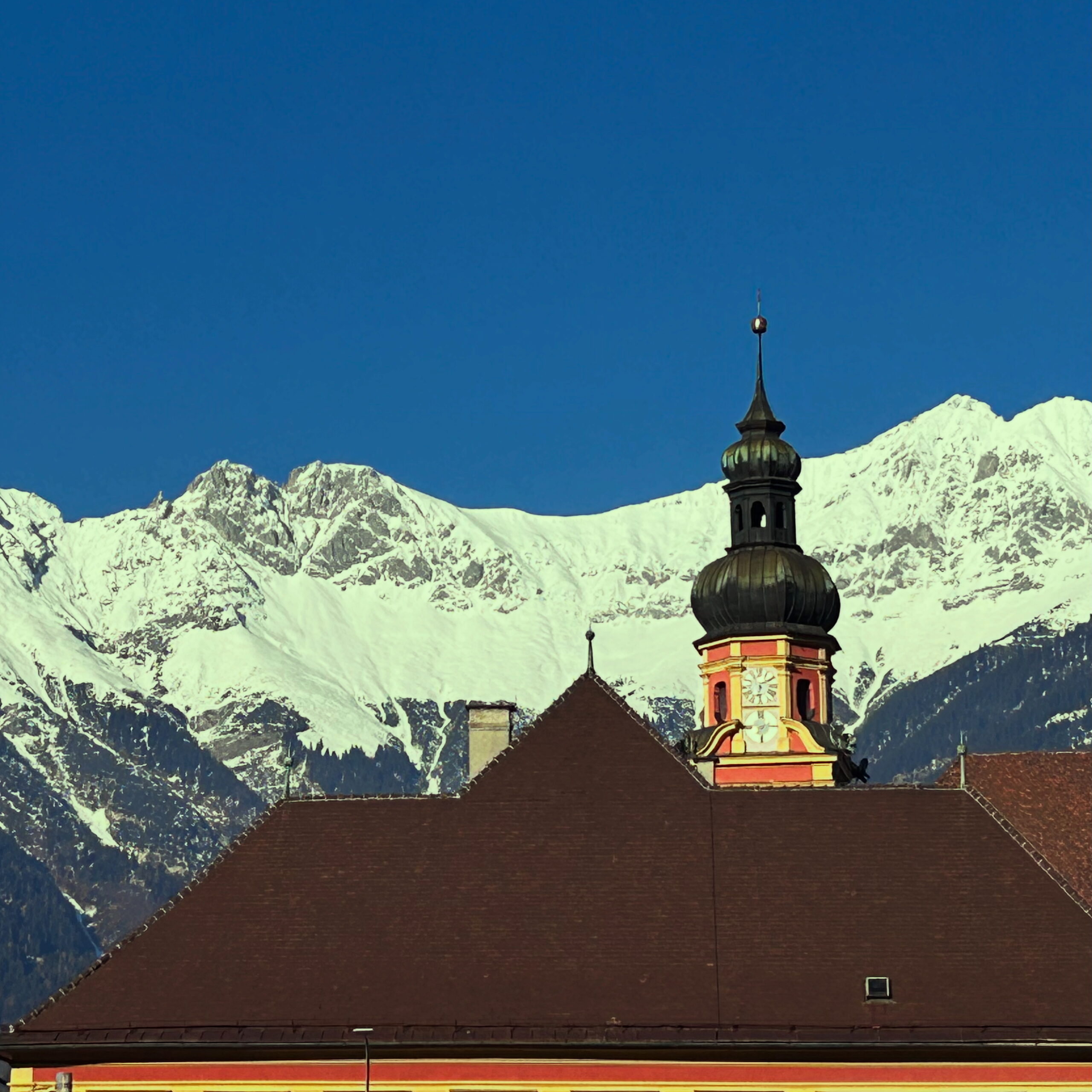
Wilten Basilica
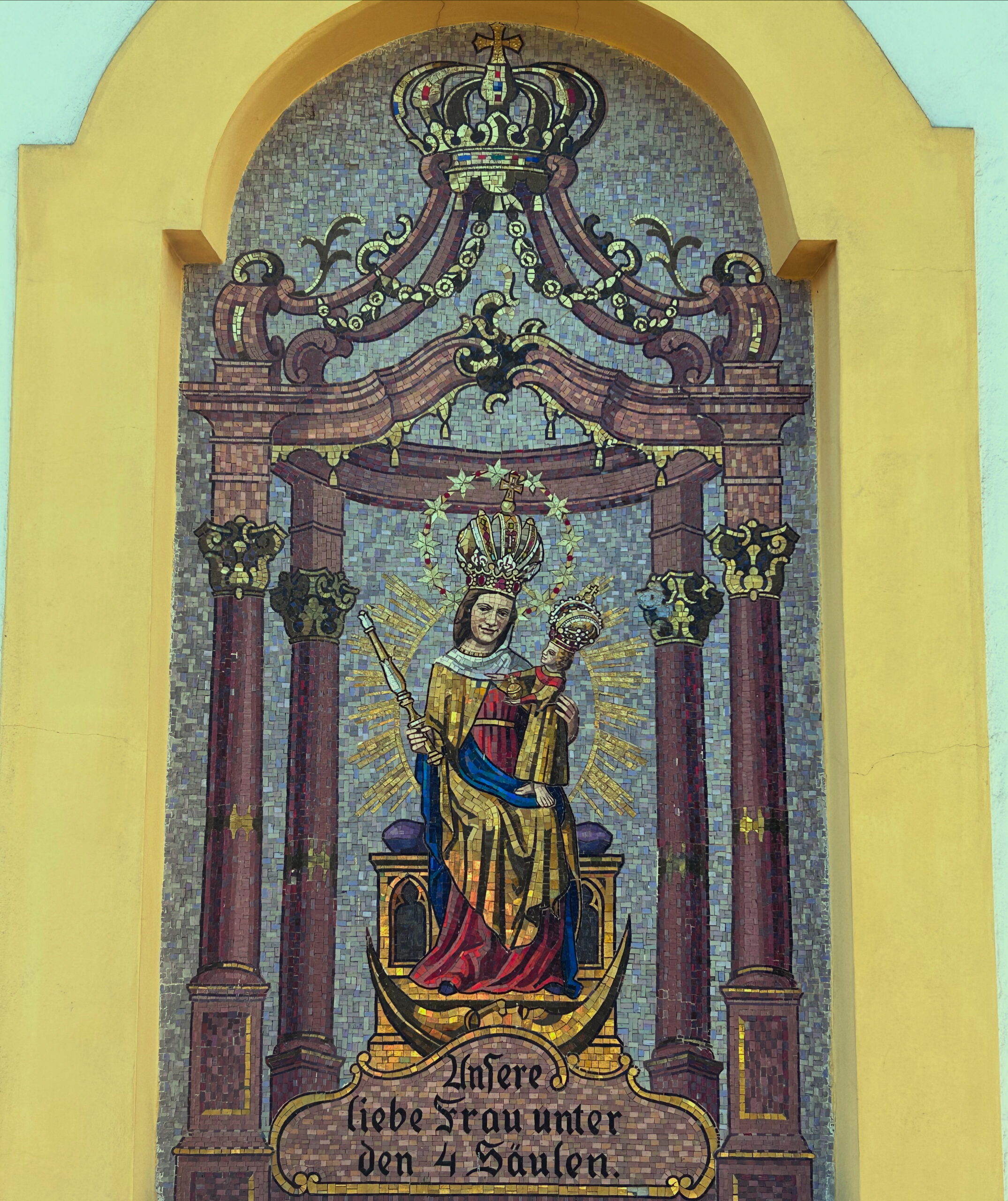
The site of today’s Wilten Abbey and Basilica is among the earliest settled areas within the present-day city of Innsbruck. With the elevation of Christianity to an institutionalized state religion, Wilten came to enjoy the status of a religious and administrative center of the region. Where the Wilten Basilica now stands, people were already praying diligently as early as the 5th century. Beneath the Baroque church and its surrounding cemetery, a building dating from the 5th century, measuring approximately 25 meters in length and 12 meters in width, has been documented. At the time, this church was among the largest in the region. A church dedicated to Saint Lawrence was first mentioned in 565. In a document dated 1140, the Premonstratensian Order assumed control of the basilica as the parish and baptismal church of the Wilten community. Research suggests, however, that this document is likely a forgery from the 13th century. Producing documents retroactively on dubious factual grounds was not uncommon in the Middle Ages. Not only was it difficult, if not impossible, to prove such forgeries, but—as in this case—there was often neither reason nor interest in uncovering the true facts. Toward the end of the 12th century, the basilica was rebuilt as a Gothic structure and, from 1259 onward, is documented as a pilgrimage church dedicated to Our Dear Lady or Mary beneath the Four Pillars. According to legend, Roman legionaries as early as the 2nd century are said to have implored the Virgin Mary beneath four pillars for aid in times of distress. The Tenth Legion of the Roman army is believed to have halted in Innsbruck in the year 137 after crossing the Alps via the Brenner Pass under Emperor Marcus Aurelius. Early Christian soldiers buried an image of the Mother of God beneath four trees. A Baroque mosaic on the exterior wall of the basilica, depicting Mary as Queen of Heaven with the infant Jesus on her lap, commemorates this legend. Until 1643, the Wilten church served as the parish church of the city of Innsbruck. This meant that major Christian rites such as weddings and baptisms could only be performed in Wilten.
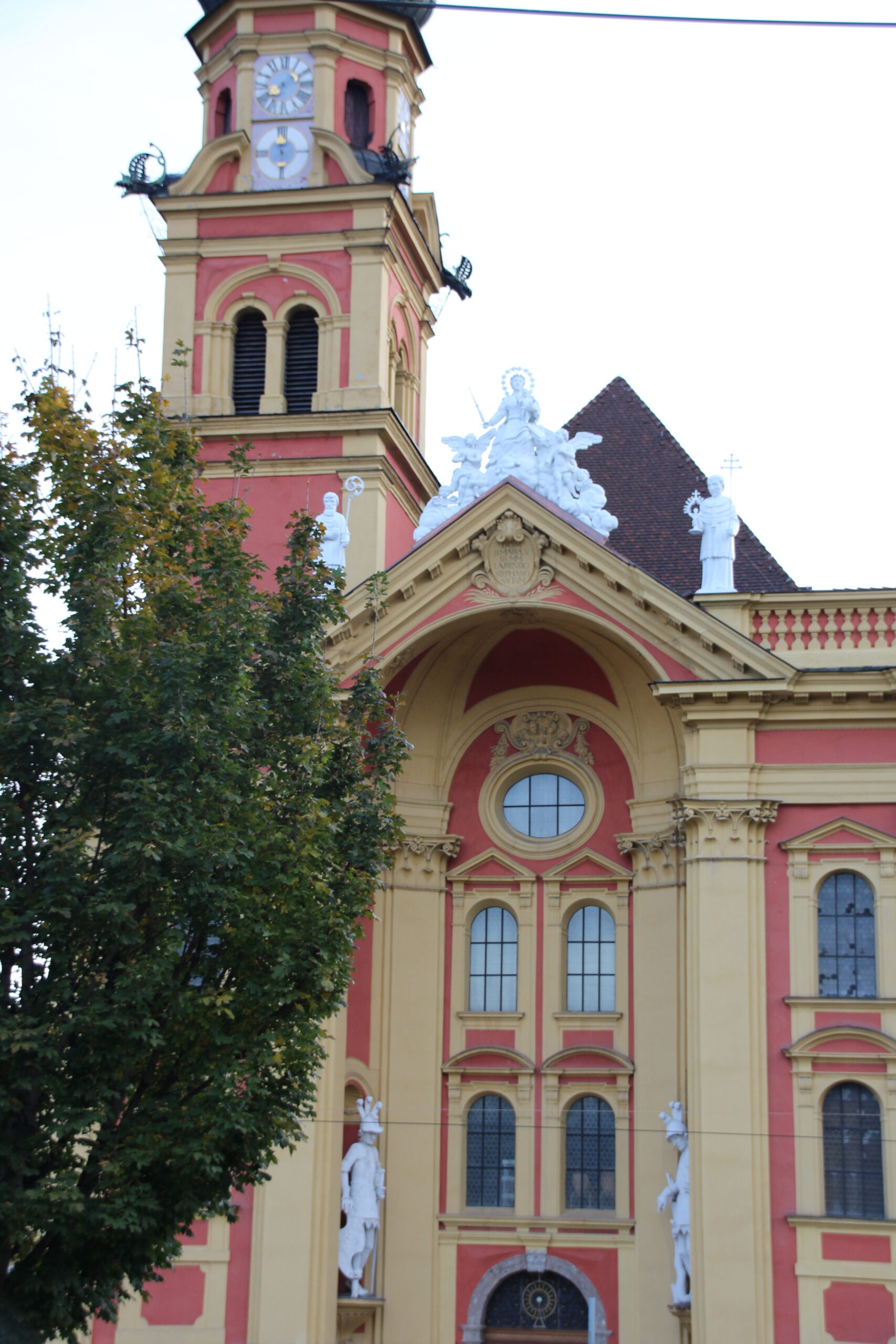
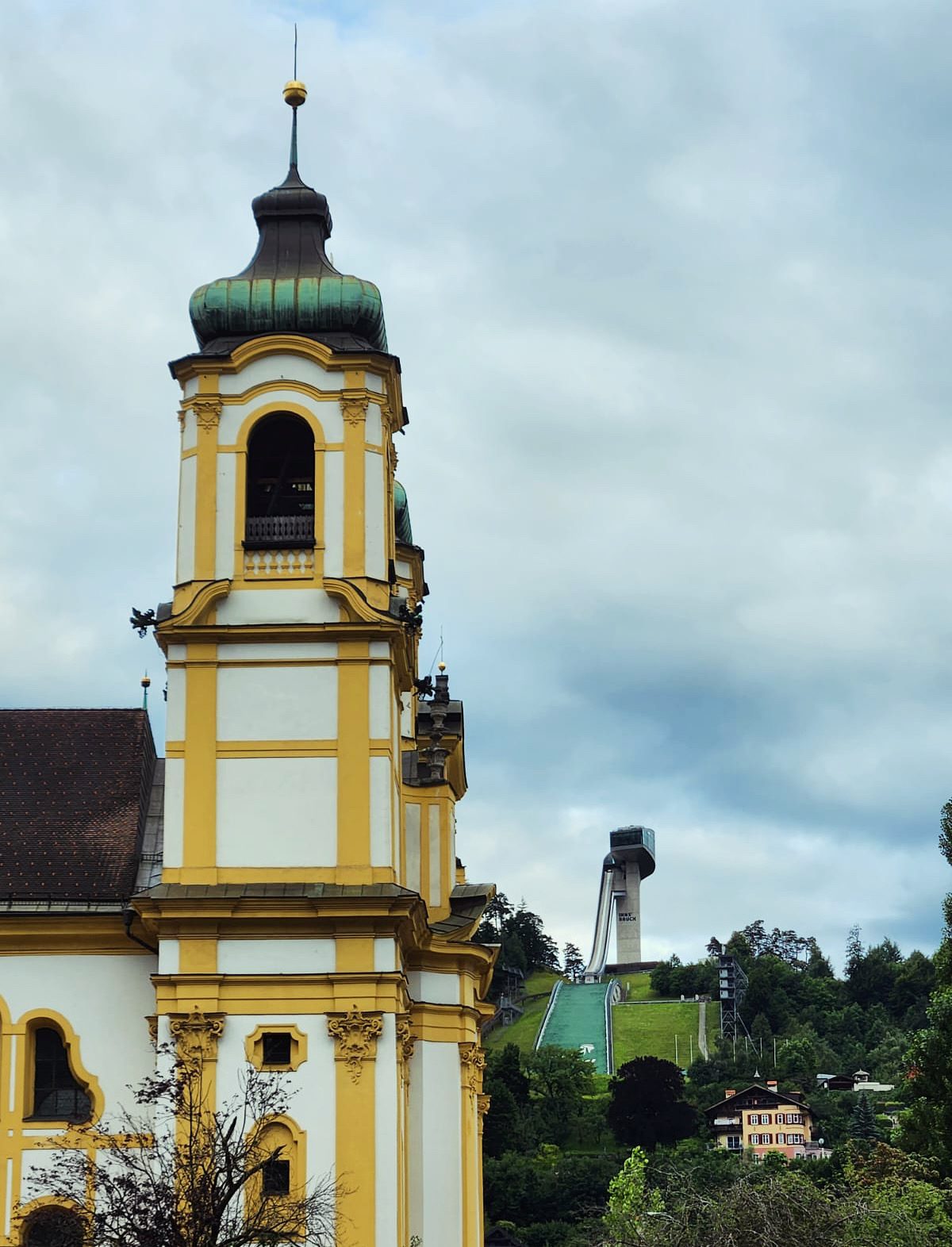
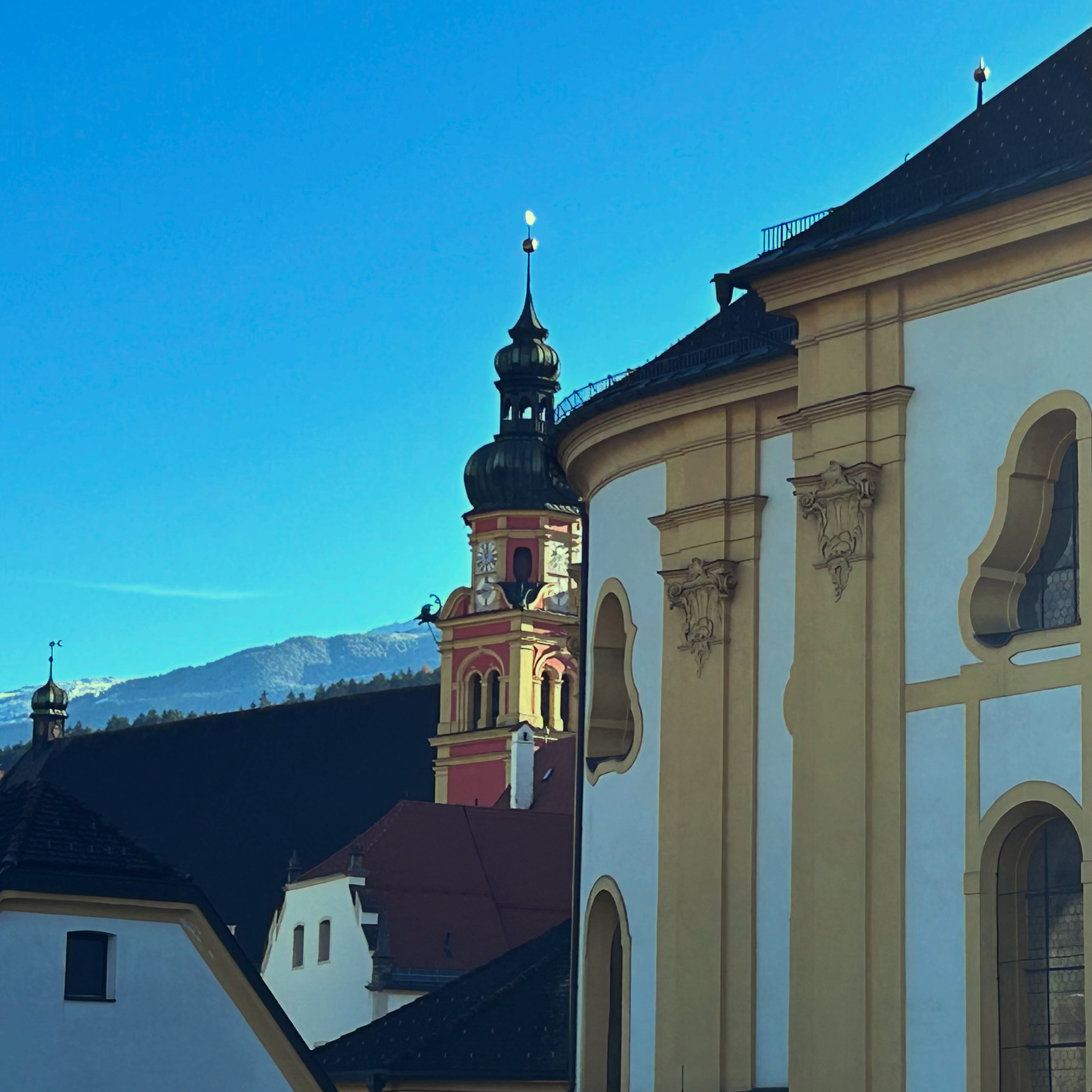
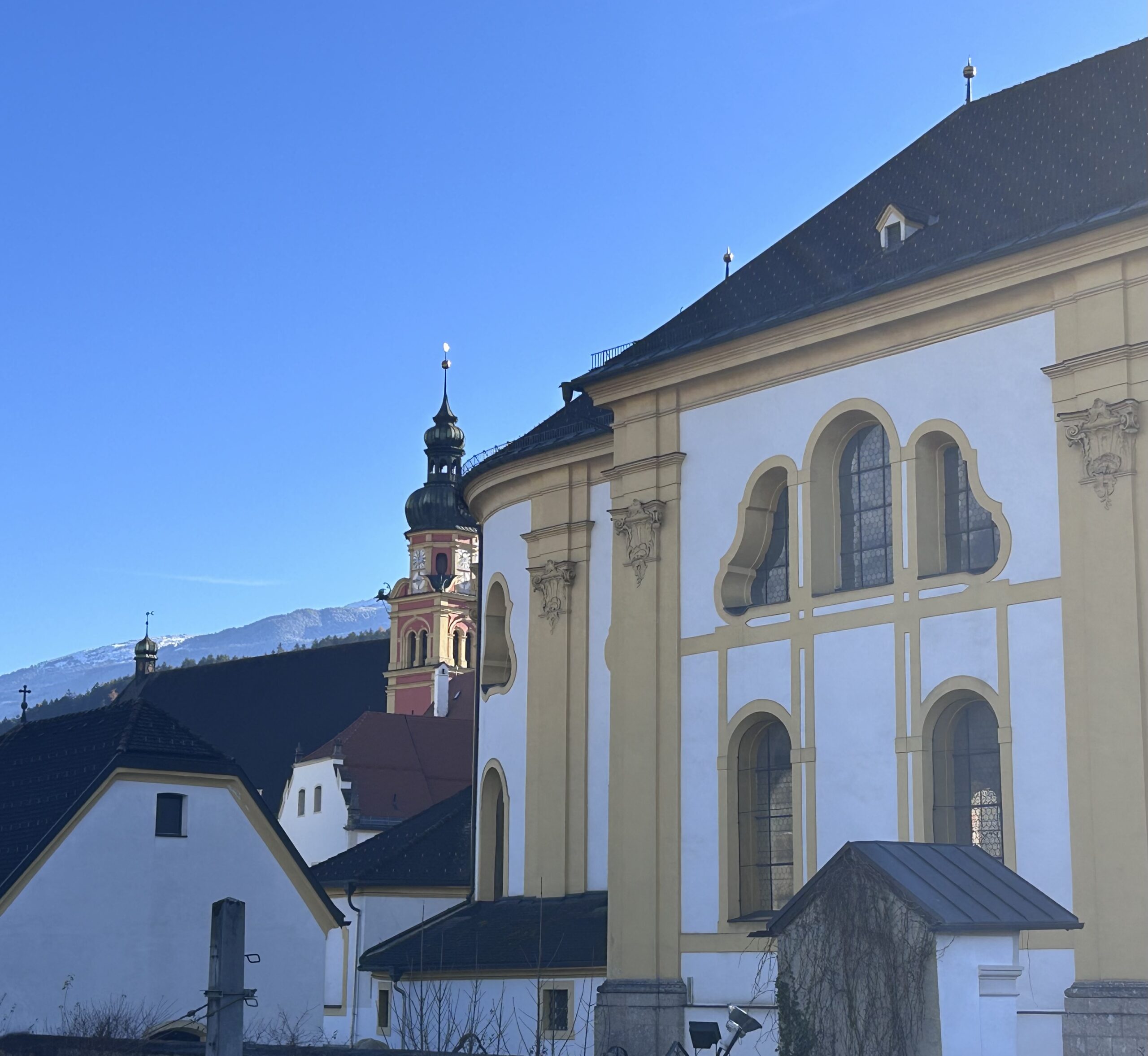
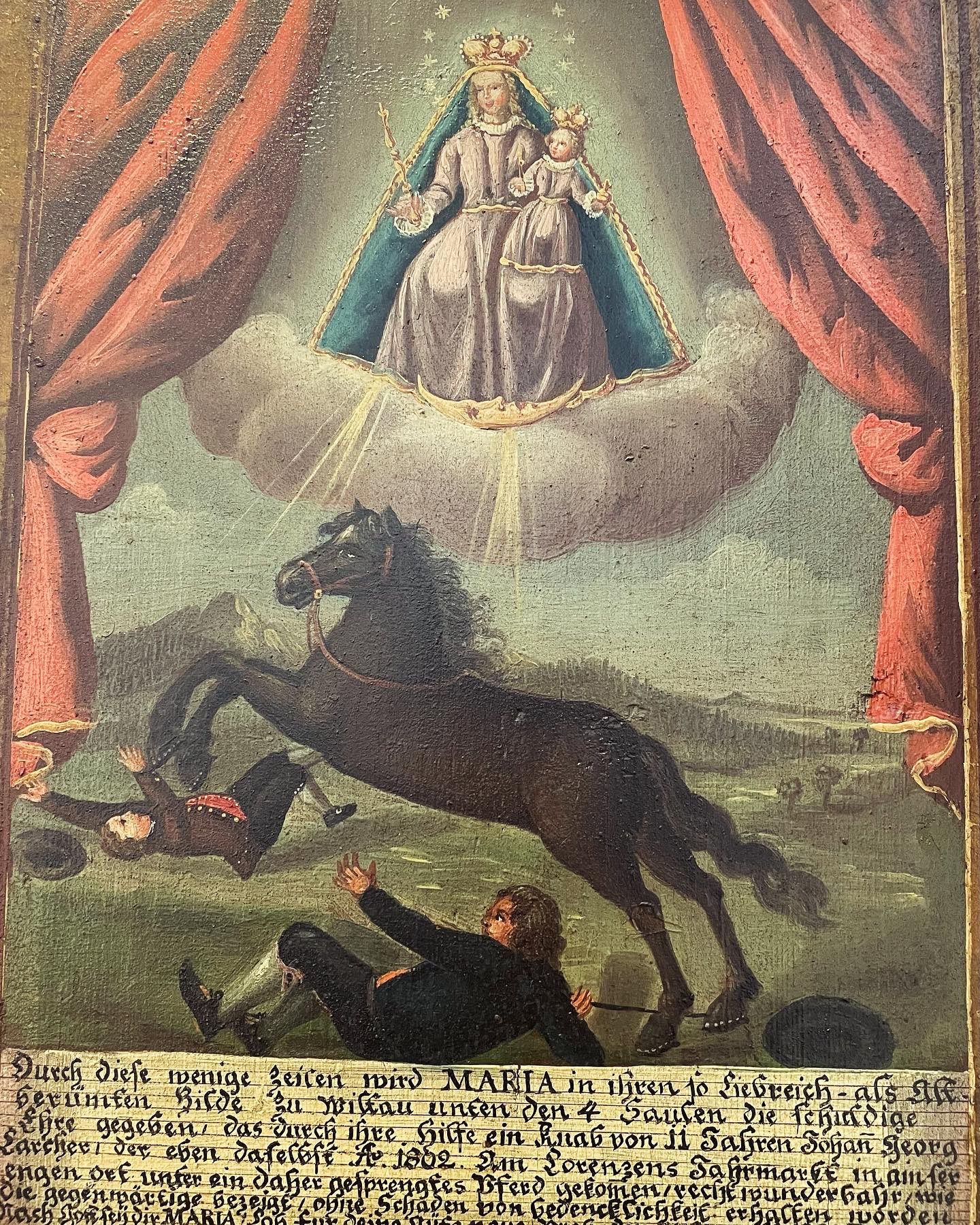
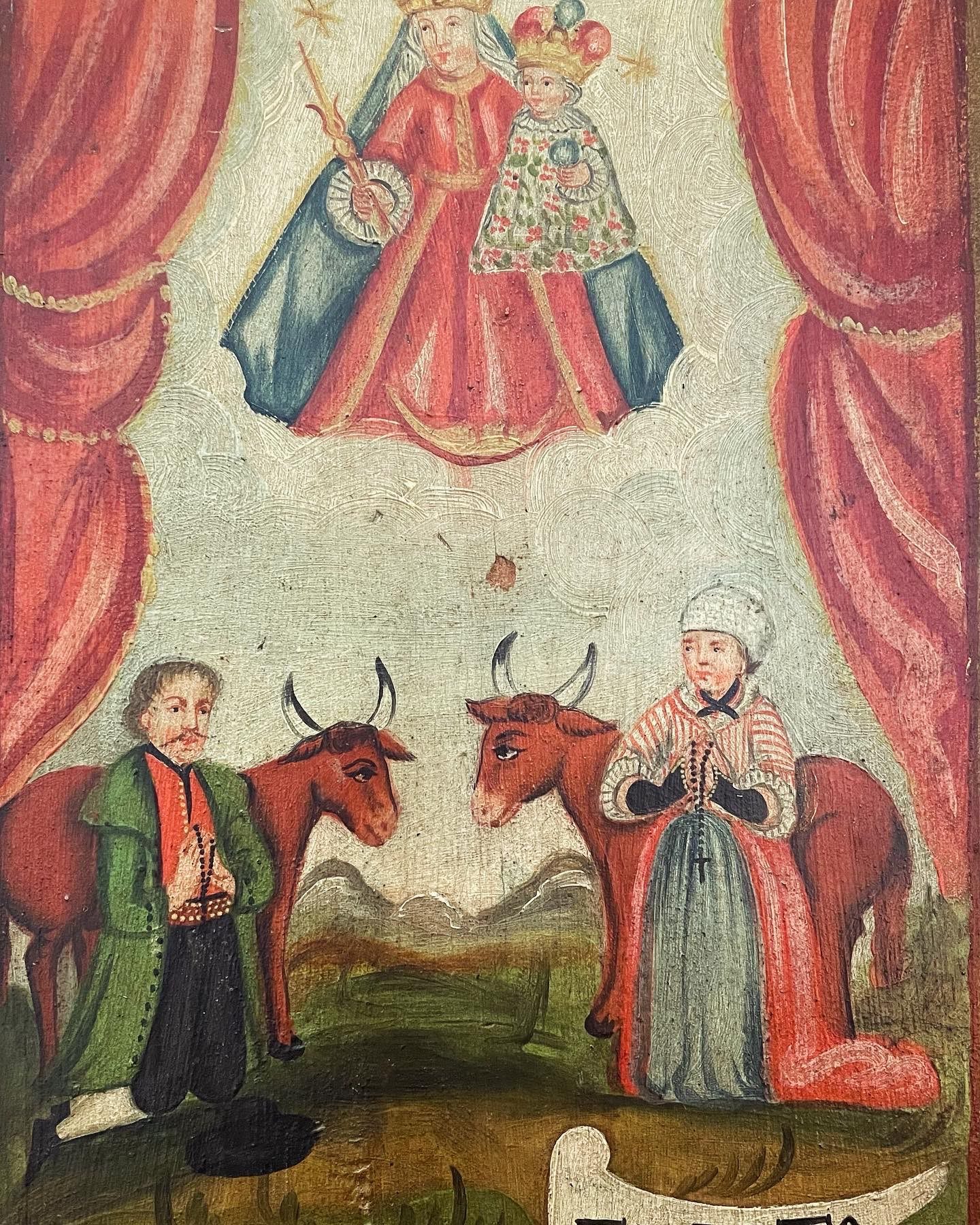
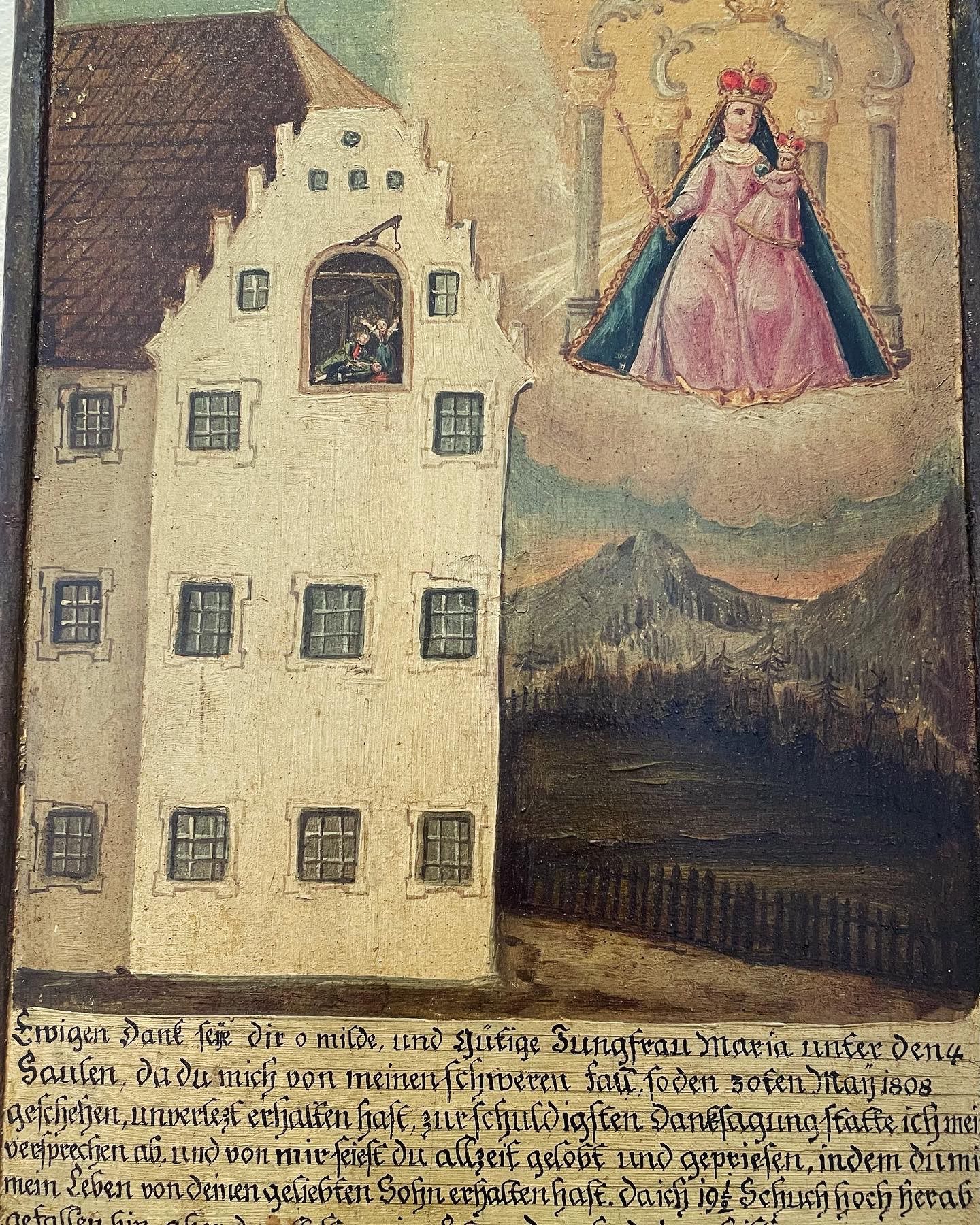
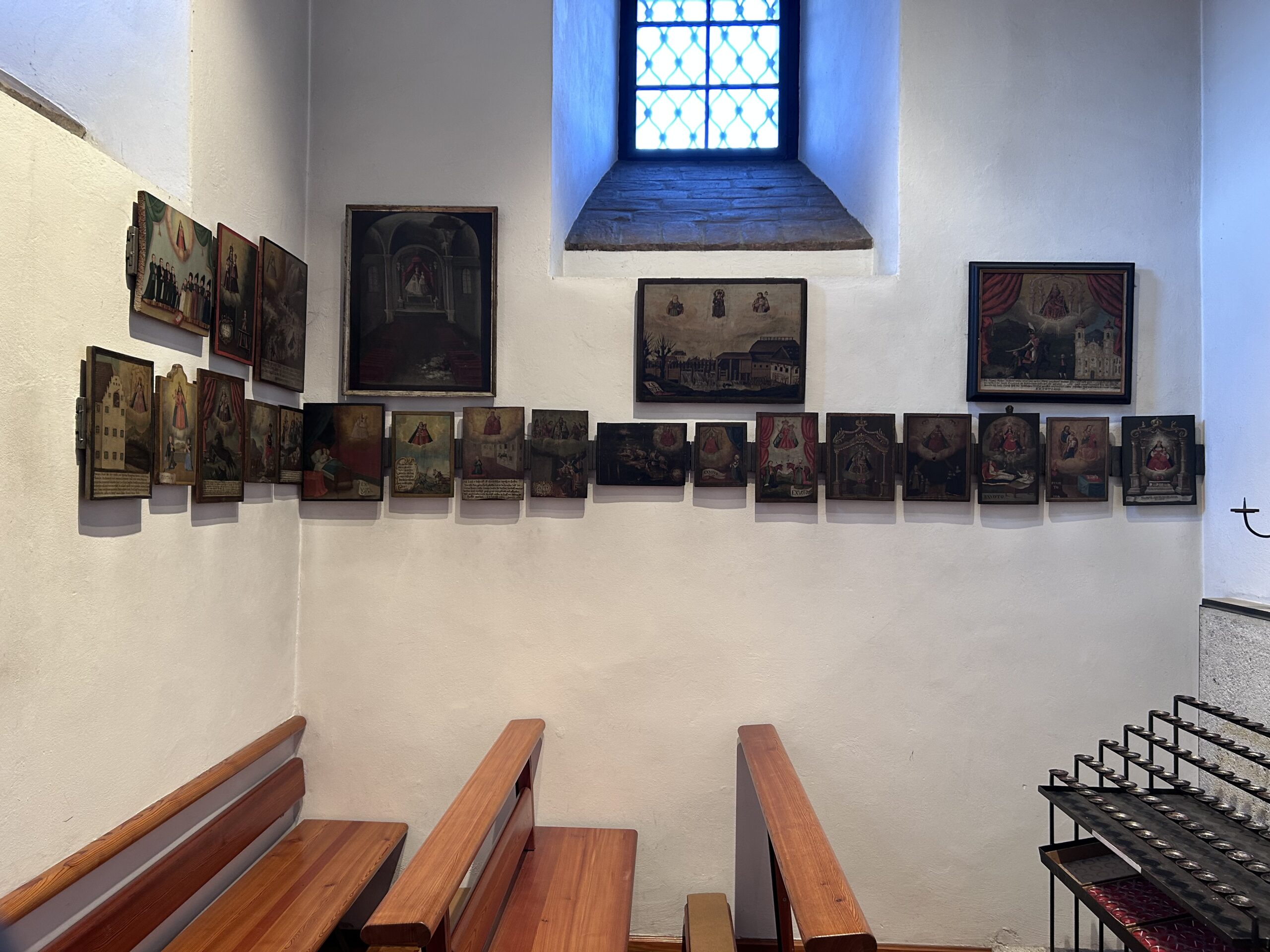
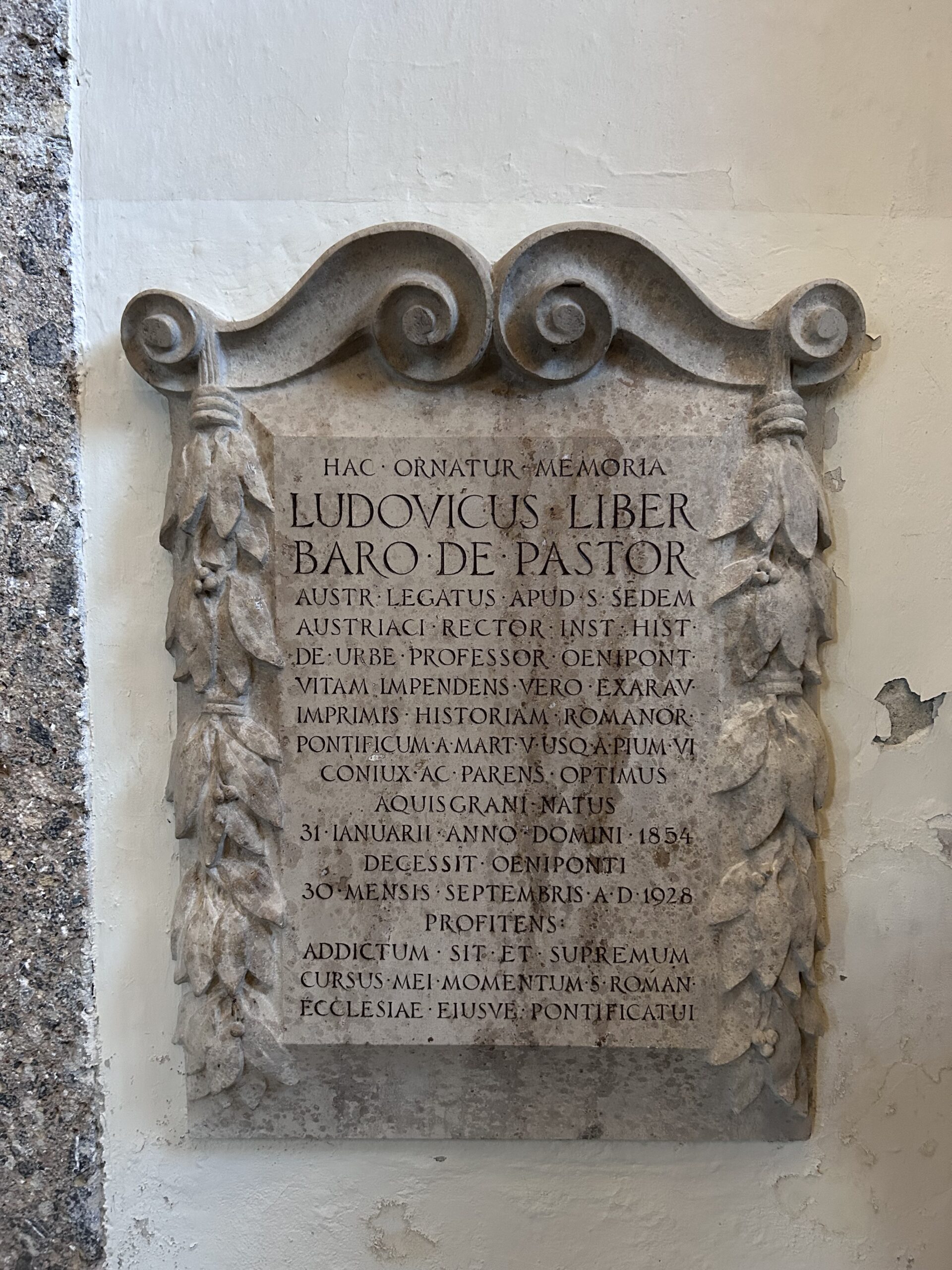
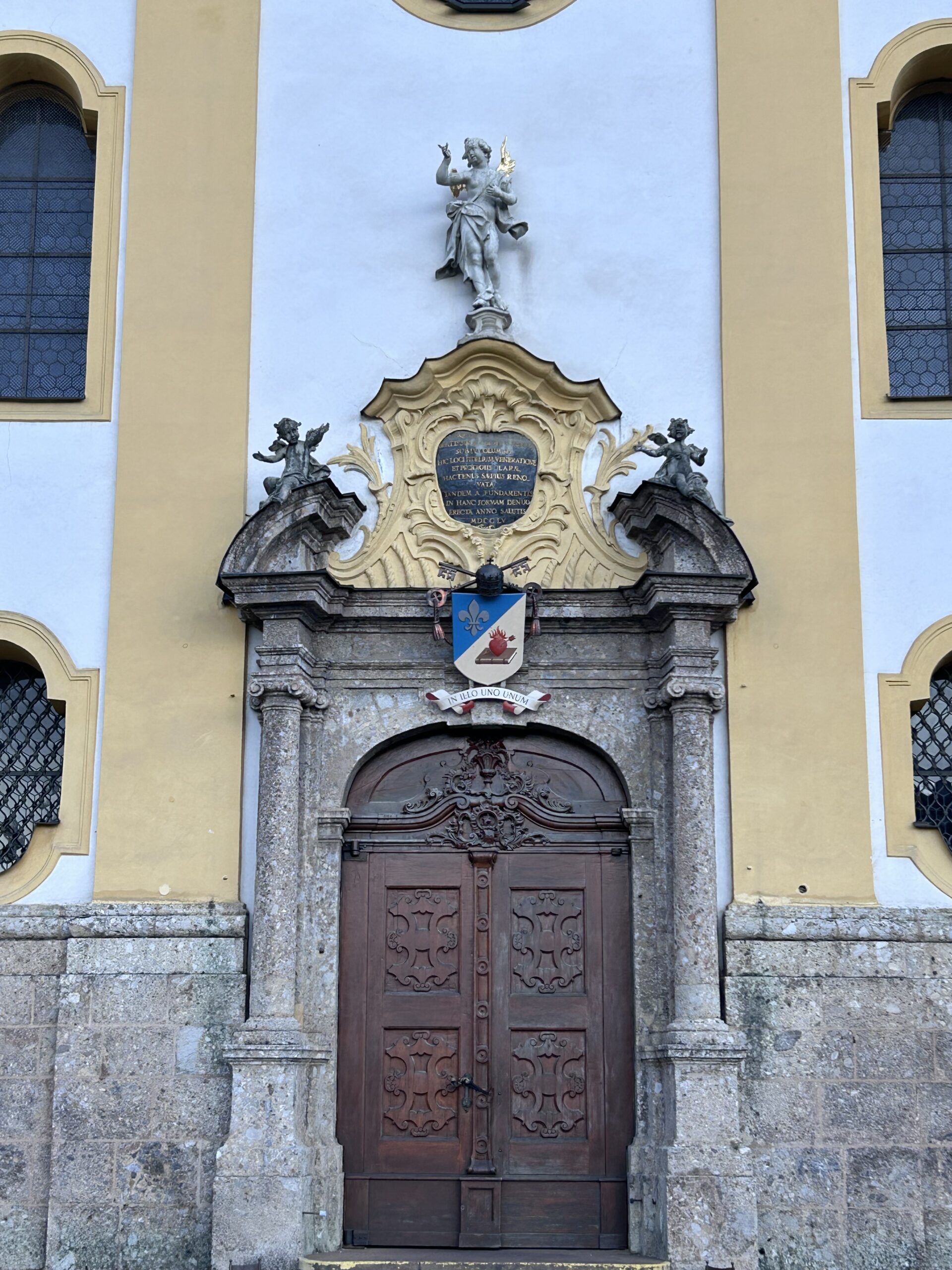
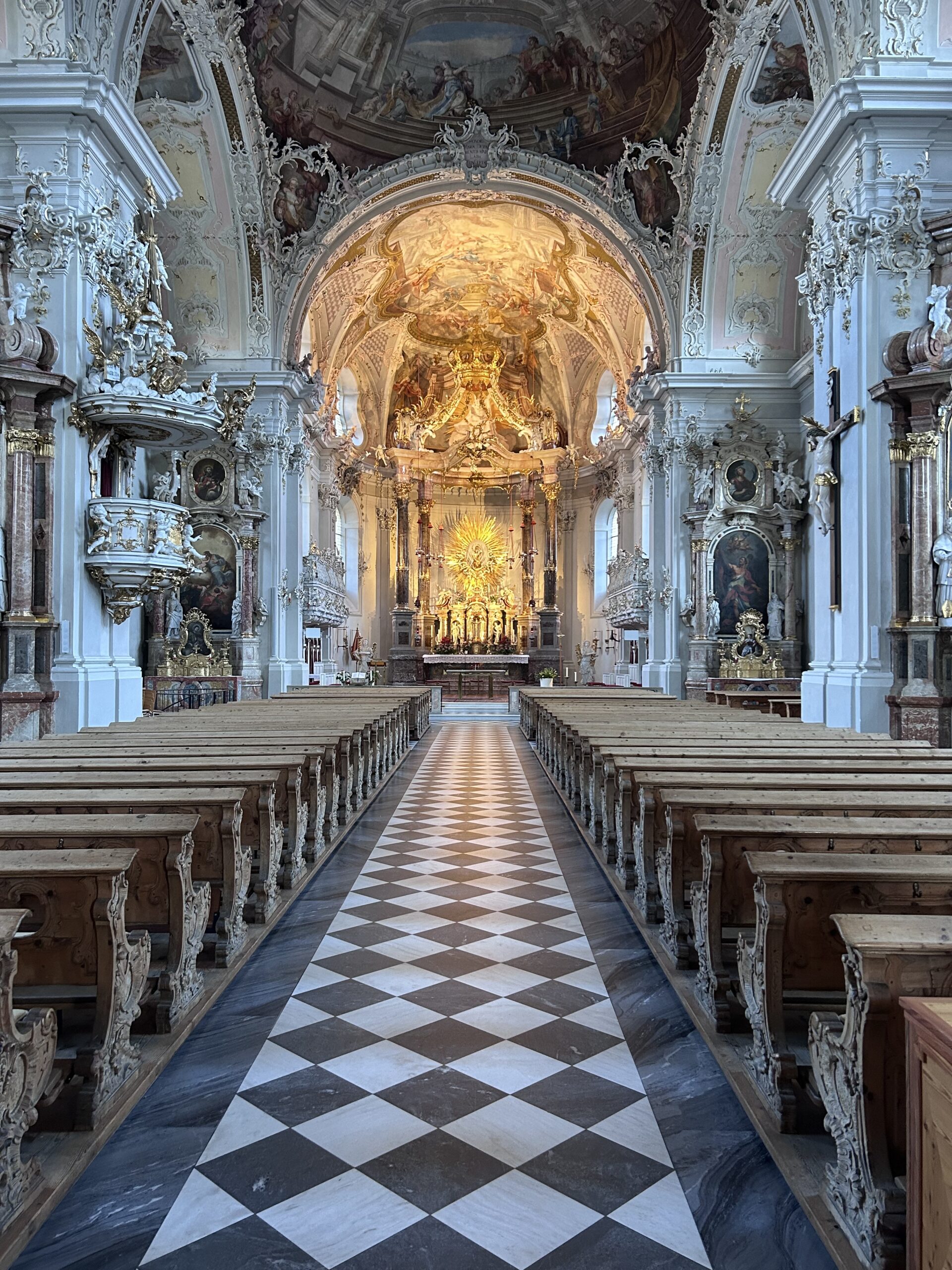
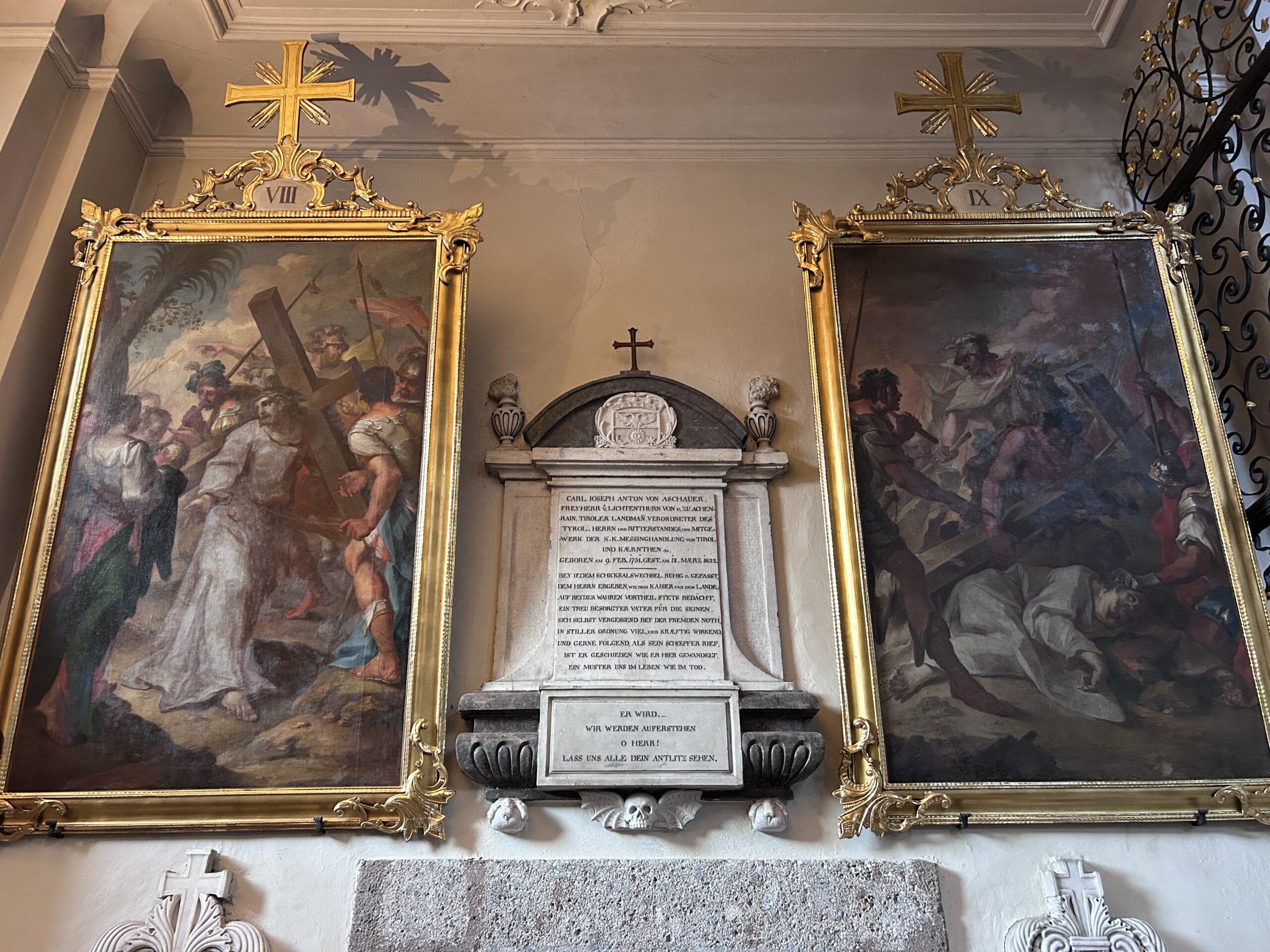
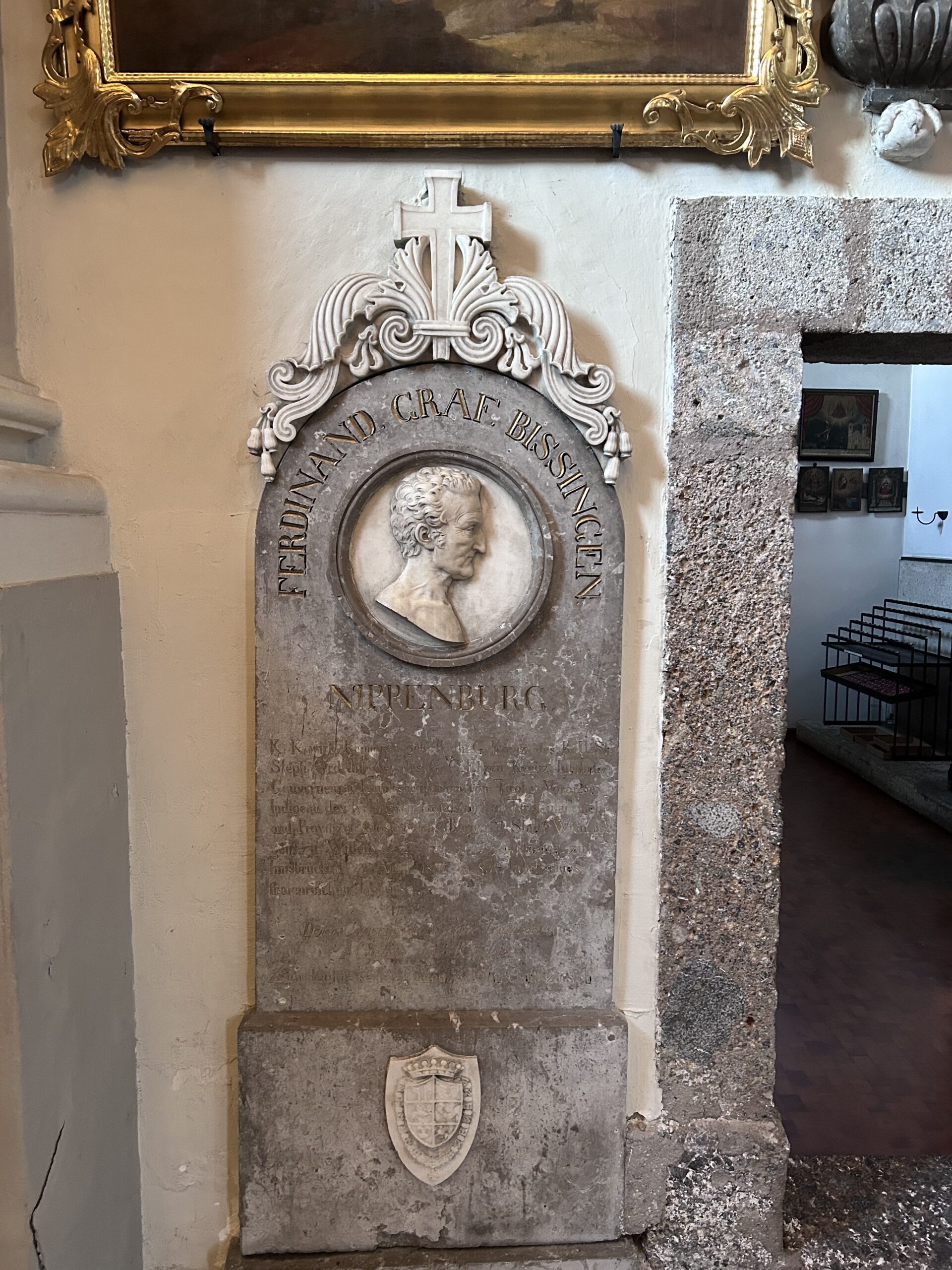
After the building had suffered damage and reconstruction several times, the Baroque structure that still stands today—on the site of Innsbruck’s earliest Christian church—was erected between 1751 and 1755 according to plans by Joseph Stapf (1711–1785) and surrounded by a small cemetery. Stapf, a sculptor, was responsible for the main portal made of Höttinger breccia. Displayed there today is the motto of the current Pope Leo XIV, “In Illo Uno Unum” (“In the One, we are one”). The silver lily in the coat of arms symbolizes the Virgin Mary; the flaming heart of Jesus pierced by an arrow, representing loving and burning divine penetration of the soul, is the emblem of the Augustinian Order. The book symbolizes the Bible and the Word of God. Towering above is a statue of the Immaculate Virgin Mary crowned with stars. The executing master builder was Franz de Paula Penz (1707–1772). The son of a farmer from the Wipptal valley, he was able to study theology thanks to his talent. Even as a young man, he developed an interest in architecture and began designing churches. As an ecclesiastical director of construction, he oversaw countless new church buildings in Tyrol during the era of extensive Baroque transformation. To the left behind the entrance lies a small side aisle displaying numerous Baroque votive paintings donated by especially devout Innsbruck residents, thanking the Virgin Mary for events that had occurred or imploring her for the fulfillment of a wish. Photographs commemorate the visit of Pope John Paul II to Innsbruck in June 1988. In front of the entrance, two memorial stones recall Ferdinand Ernst Maria Anton Count von Bissingen-Nippenburg (1749–1831), born in Wilten, and his wife. Count Ferdinand served not only as governor of Tyrol and Vorarlberg, but also as the first administrator of Salzburg after it came under Austrian rule in 1806, and later as governor of Venetia following the transfer of power in 1815. Opposite stands a monument commemorating the historian Ludwig Friedrich August von Pastor (1854–1928). Known as the chronicler of the popes, the conservative diplomat actively supported Pope Pius X in his fight against Modernism. In 1908, Emperor Franz Joseph elevated him to the rank of baron. The Pastorstraße, where the basilica is located, was named in his honor. The interior of the basilica is among the most splendid of its time. Rendered in radiant white and adorned with countless paintings and columns, the Baroque opulence is dazzling. The ceiling fresco was created by Matthäus Günther, director of the Augsburg Academy, and—entirely in the Baroque tradition—depicts an apocalyptic Madonna as well as Judith, proudly presenting the severed head of Holofernes to the viewer. The Gothic Madonna with a halo of rays above the monstrance was transferred from the predecessor church built around 1311. The high altar, with its four columns, symbolizes the founding legend.
Wilten Abbey
The history of the abbey of Wilten located opposite also traces back to a legend. According to tradition, the giant Haymon is said to have founded a monastery on the ruins of the Roman fortification of Veldidena in the late ninth century. More plausible than this version is the assumption that the Bavarian dukes had a monastery built in order to integrate their territories in the Inn Valley administratively into their domain. With God’s blessing and the diligent labour provided through compulsory service by the local population—abbots were regarded as strict feudal lords—the abbey grew, even though setbacks, such as the fire of 1304, repeatedly occurred. A Romanesque church was erected in 1311, along with the core structures of the monastery. The Leuthaus, which still exists today, served not only to accommodate secular guests of the abbey who could not be admitted to its interior. The building, whose basic structure dates back to Roman times, also functioned as the official residence of the Wilten court judge. In 1818, the regional court was transferred from Sonnenburg Castle to the Leuthaus. Despite its size and architectural significance, this impressive building is visually somewhat overshadowed by the abbey, the street, and the surrounding residential blocks. Today it houses the Wiltener Boys’ Choir.
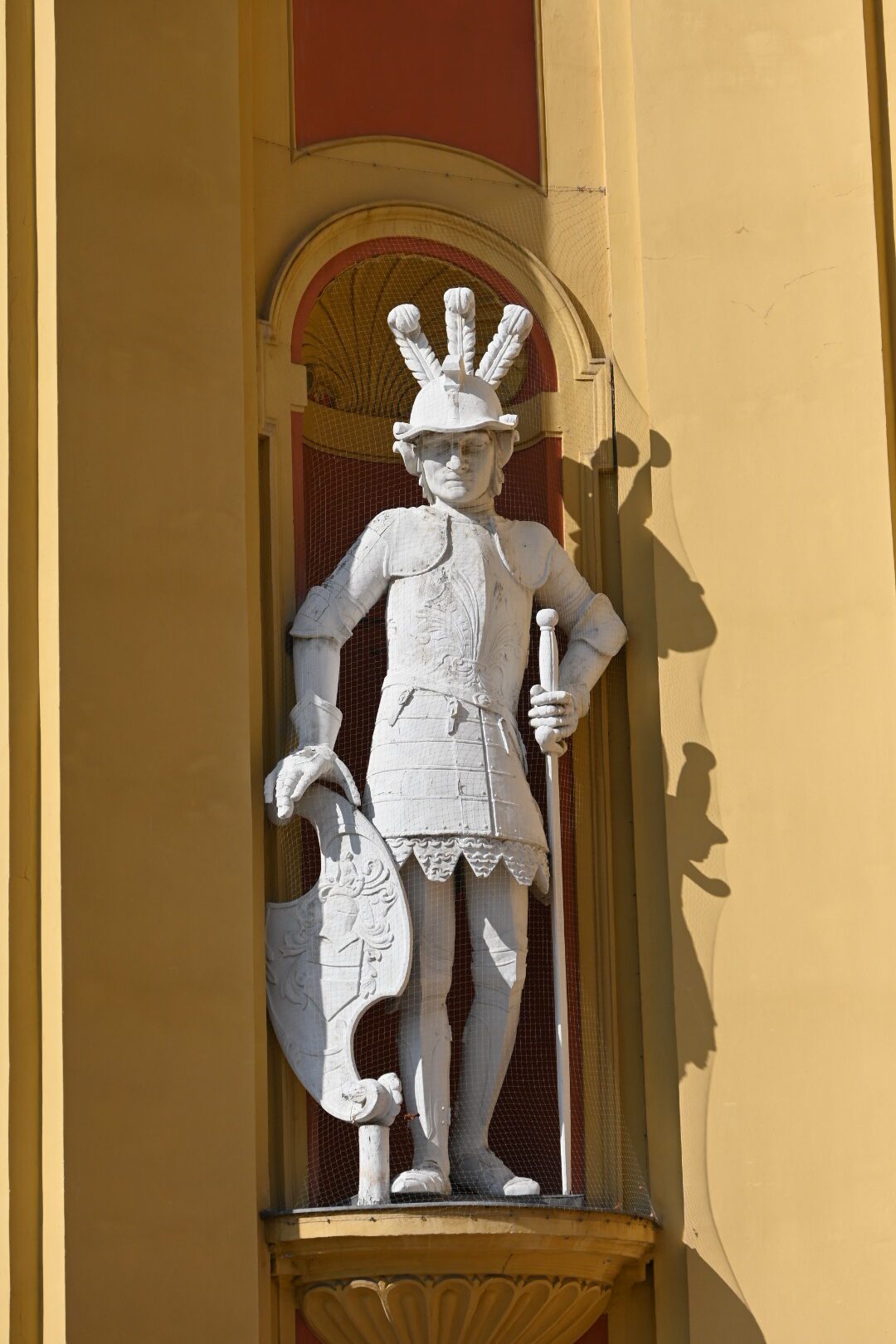
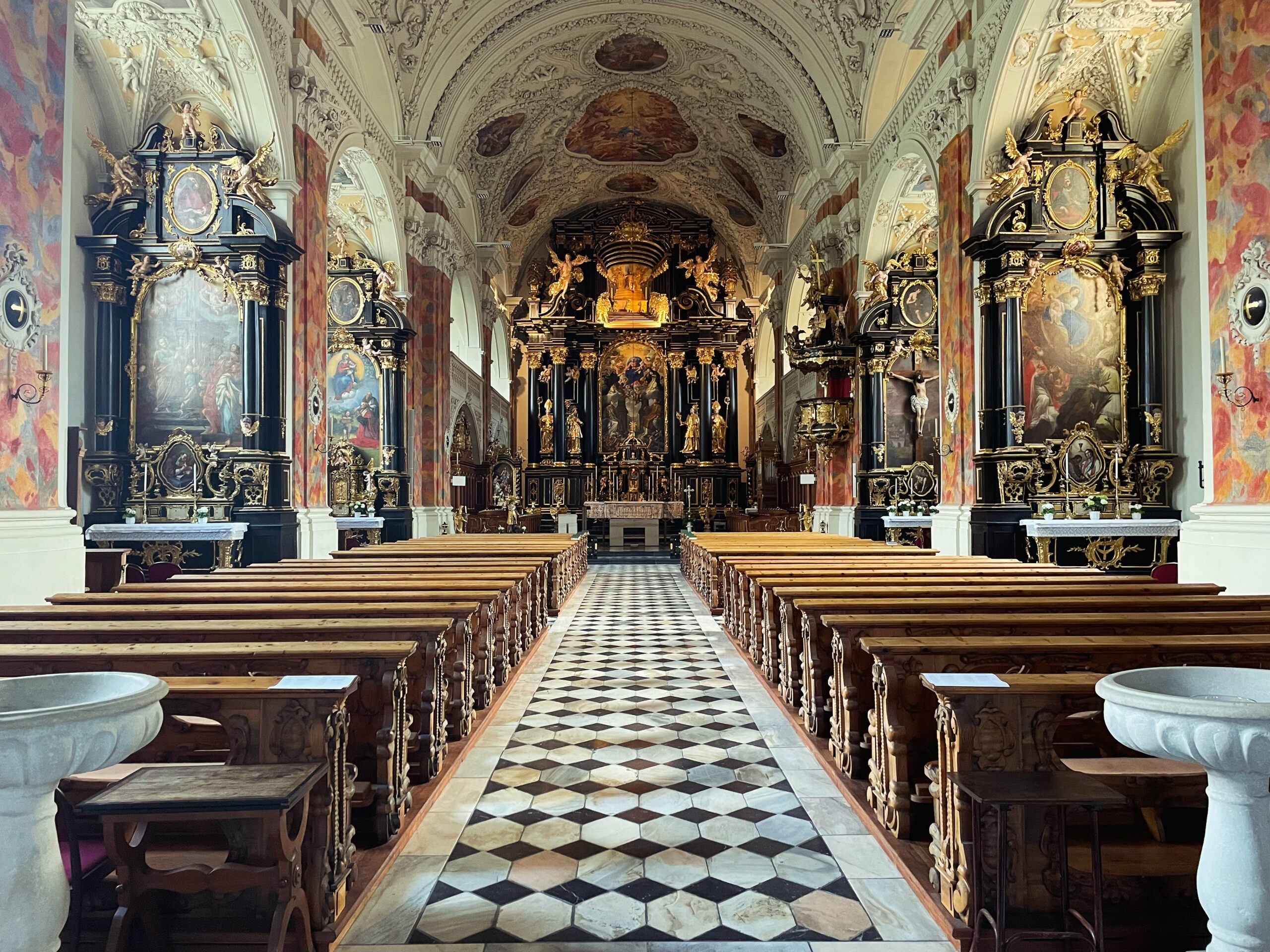
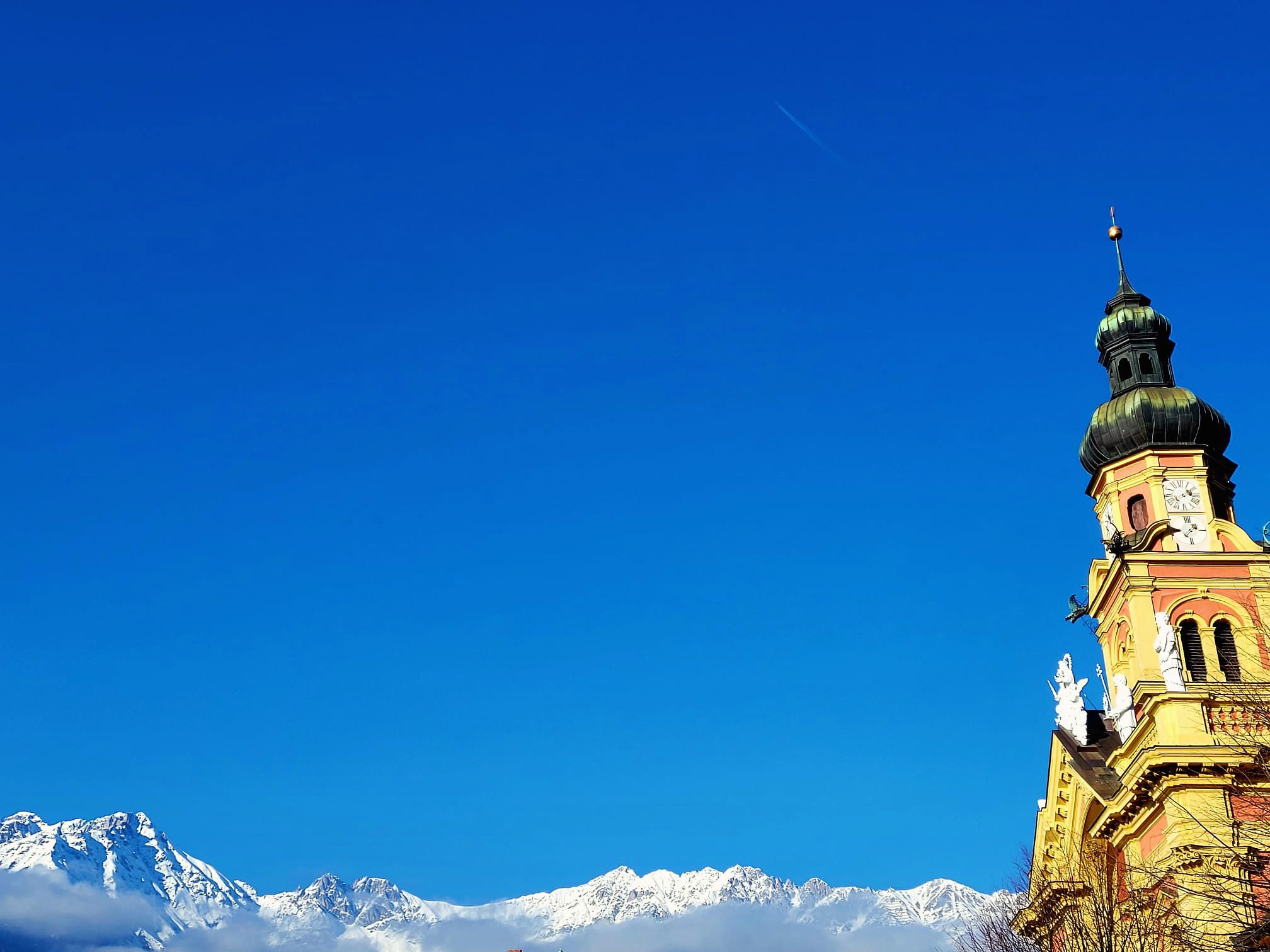
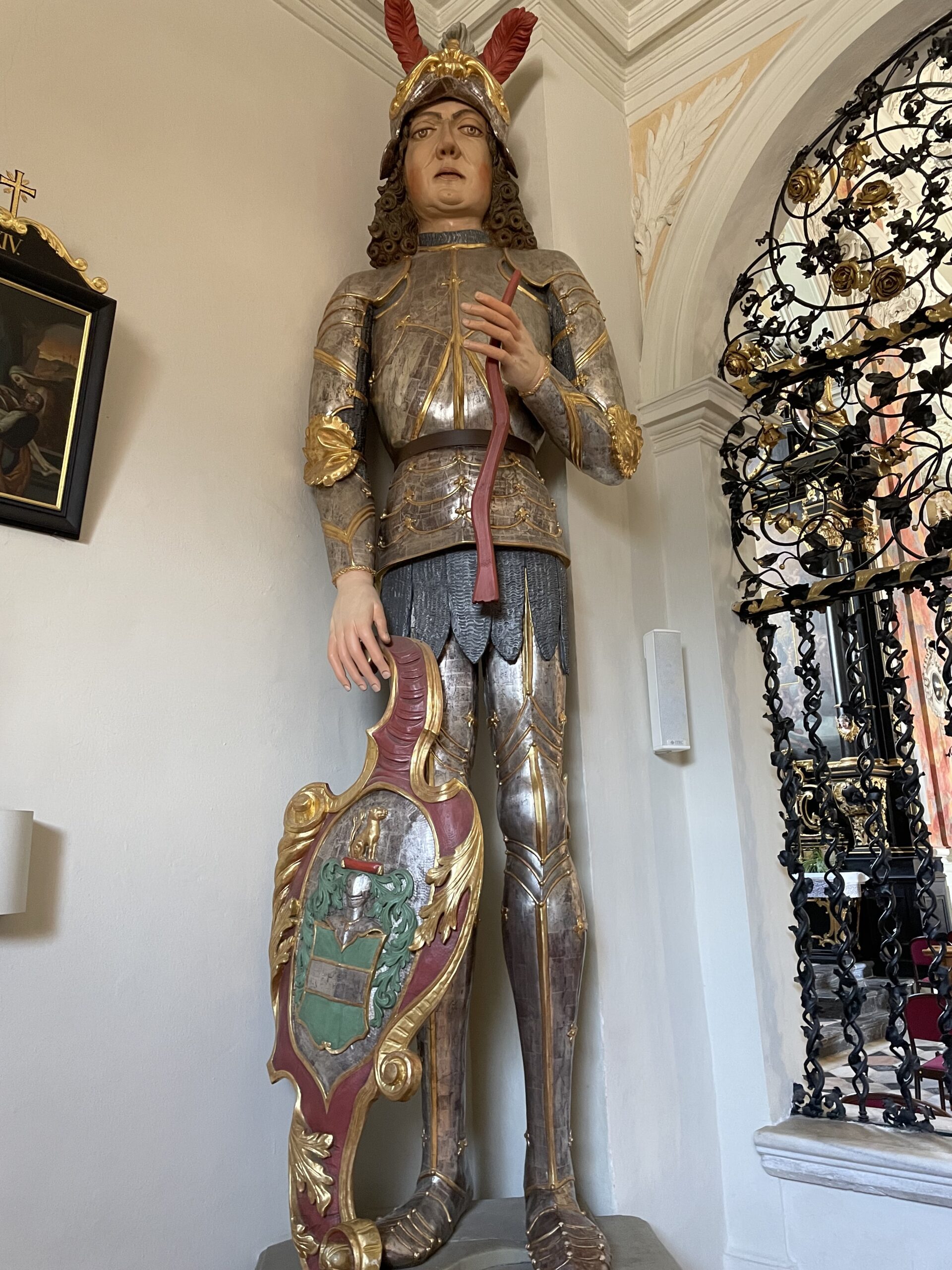
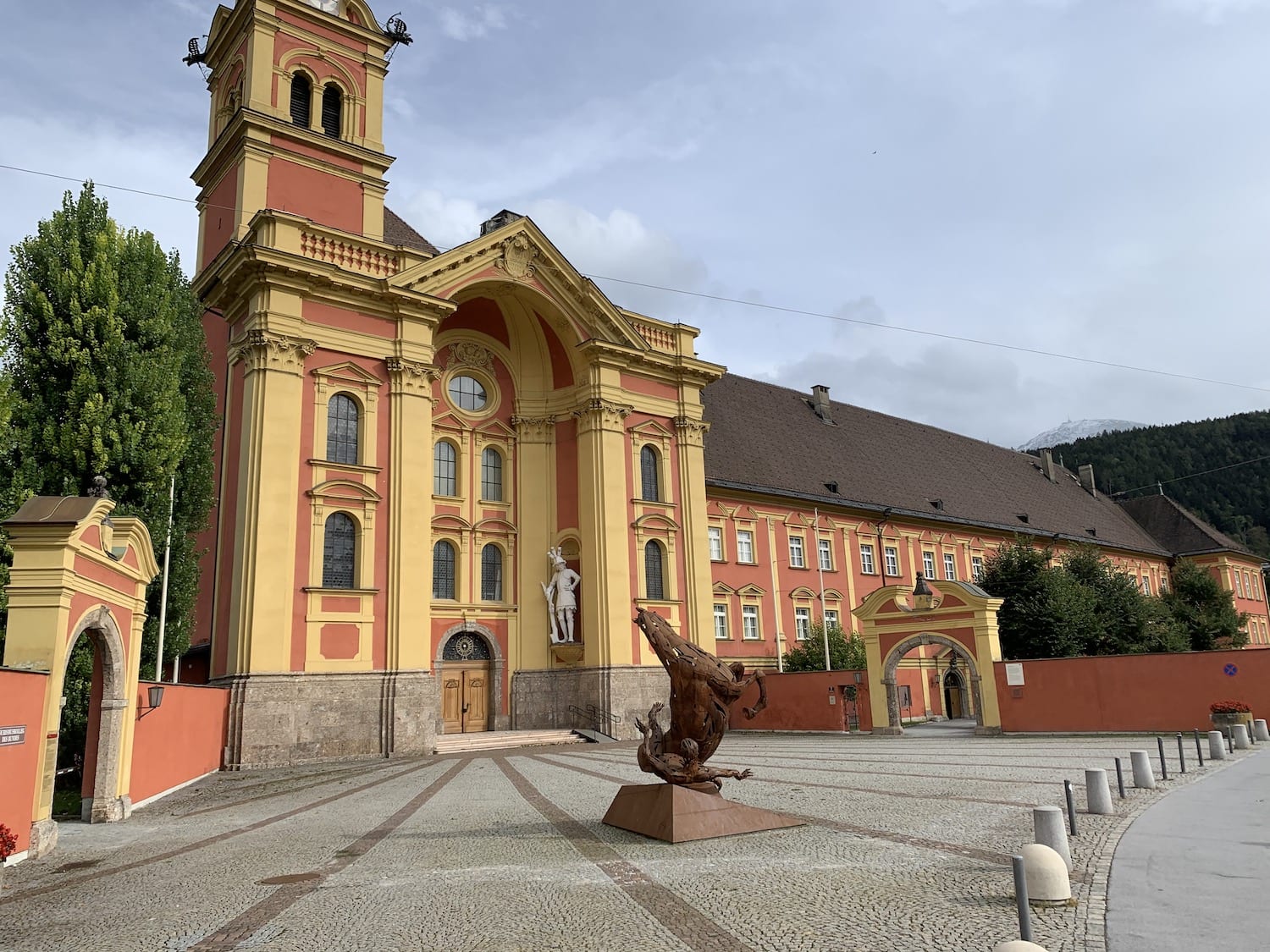
The Baroque era’s enthusiasm for reconstruction did not spare the abbey either. In the seventeenth century, the prevailing taste demanded an architectural statement worthy of representing the Premonstratensians’ pastoral responsibilities. The Baroque rebuilding of the abbey in 1665 was an event of empire‑wide significance. Emperor Leopold I personally attended the inauguration. The lavish furnishings of the church and many of the paintings were added in subsequent centuries. The radiant white stone figures on the gable depict the abbey’s patron saints Lawrence and Stephen, as well as the Virgin Mary. The entrance portal is guarded by the giants Haymon and Thyrsus, the two legendary protagonists of the abbey’s foundation myth. Inside, frescoes depict the transfer of the abbey to Saint Norbert, the stoning of Saint Stephen, and Saint Anne, the patron saint of Wilten, protecting the abbey from approaching Bavarian troops. Directly behind the imposing entrance portal stands a life‑size figure of Haymon in silver armour, holding a dragon’s tongue. Particularly magnificent are the black side altars and the high altar, which stand in striking contrast to the otherwise white interior of the church. The floor, as in the basilica opposite, is designed in black and white. Architectural elements such as the chapter house and the rib vault have been preserved from the Gothic predecessor building.
Until 1914, the abbots of Wilten were represented in the regional parliament. Even during the First Republic and the era of Dollfuss and Schuschnigg, the abbey played a political role as Innsbruck’s most important Catholic institution. The Christian Social Party relied on the influence of church pulpits, infrastructure, affiliated organisations, and ecclesiastical press outlets. In 1939, Wilten Abbey was dissolved by the National Socialists, and all associated associations and organisations were integrated into the party structure. In 1944, large parts of the abbey suffered severe damage as a result of air raids. As early as Christmas 1952, the reopening could be celebrated following successful restoration. A special story connects the abbey with the 1964 Winter Olympic Games. On the occasion of their opening, a new organ was built by Gregor Hradetzky (1909–1984), the controversial gold medallist in the single kayak event at the 1946 World Championships, whose SS membership later attracted criticism. For Hradetzky, who had taken over his father’s workshop after the war, this project represented a personal Olympic full circle.
Today, Wilten Abbey oversees 22 parishes in and around Innsbruck. The Premonstratensians remain among the city’s most influential religious orders. After the First World War, youth homes were established in Pradl, Hötting, and Wilten to support single mothers and working-class families. Above Mentlberg Castle, the abbey provided land for the Waldhüttl of the Vincentian community, where migrants live self-sufficiently and operate an open church. To this day, the abbey remains a center of art and culture. Particular pride is taken in the Wilten Boys’ Choir, first mentioned in 1235. Guided tours allow visitors to explore the abbey’s collections, archives, and library. Concerts are held regularly within the monastery, and the opulent interior furnishings are especially impressive. The abbey church houses an icon collection with works dating back to the 13th century, illustrating similarities and differences between Catholic and Orthodox traditions. Near the monastery gate, visitors can purchase small local delicacies and gifts at the Klosterladele.
Innsbruck as part of the Imperium Romanum
In the year 15 before the Common Era, the field commanders Tiberius and Drusus, both stepsons of Emperor Augustus, reached the northern Alpine region with their armies. While the modern Italian today comes to Tyrol for Christmas markets in winter and more tolerable temperatures in summer, at that time it was the power ambitions of the rising superpower that made the legionaries lace up their sandals. Drusus marched from Verona to Trient, then followed the Adige River over the Brenner Pass into the area of present-day Innsbruck. From the Roman strategic perspective, the conquest was long overdue. Roman troops stationed in Gaul in the west and Illyricum on the Adriatic in the east were to be connected, raids by barbarian peoples into northern Italian settlements prevented, and routes for trade, travelers, and the military expanded and secured. Contrary to how it is often portrayed, the mountainous land was not terra incognita for the Romans. The Inn Valley had not become a permanently inhabited zone only with the climatic warming known as the Roman Climate Optimum. Trade and cultural exchange extending as far as central Italy can be demonstrated through archaeological finds. Partly multi-storey houses with stone foundations, clustered in nucleated villages, similar linguistic idioms, burnt-offering sites such as the Goldbühel in Igls, and ceramic finds point to a shared cultural background with the Etruscans. Finds indicate economic exchange between ethnic groups and communities stretching from Vorarlberg through the Lake Garda region to Istria, even though the Romans liked to depict the militarily inferior Alpine inhabitants as wild barbarians. The conquered peoples north of the main Alpine ridge were referred to by Greek and Roman authors using the rather vague collective term “Raeti.” Today, research understands the Raeti to have been the inhabitants of Tyrol, the Lower Engadine, and Trentino—the area of the Fritzens–Sanzeno culture, named after its major archaeological sites. The tribe living in the area of present-day Innsbruck was given the name Breones by the new rulers. The settlements of the Breonic population were located in mid-mountain elevations and on higher alluvial fans such as Amras and Wilten, slightly above the Inn Valley, which at the time was a floodplain and marshland. Whether the Romans destroyed settlements and cult sites between Zirl and Wattens during their campaign of conquest is unclear. What is certain is that the burnt-offering site on the Goldbühel in Igls was no longer used after the year 15. There are also no precise sources regarding how the conquerors treated the subdued population.
Roman military power was followed by Roman administration and the legal system. Already under Augustus’ successor Tiberius, an administrative structure was rolled out and the new territory integrated into the state system. What is now Tyrol was divided along the Ziller River. The area east of the Ziller became part of the province of Noricum, while Innsbruck became part of the province Raetia et Vindelicia. This province extended from present-day central Switzerland with the Gotthard massif in the west to the Alpine foreland north of Lake Constance, from the Brenner Pass in the south to the Ziller River in the east. Remarkably, the Ziller as a boundary still persists today in ecclesiastical terms: the area east of the Ziller belongs to the Diocese of Salzburg, while Tyrol west of the Ziller is part of the Diocese of Innsbruck. It likely did not take long for the former barbarians to assimilate into Roman culture. While the Romans did not bring chewing gum, vinyl records, or silk stockings for their new subjects—as would be the case nearly 2,000 years later—the Roman lifestyle certainly introduced new possibilities. The route between what is now the Seefeld Saddle and the Brenner Pass had existed for centuries but was unsuitable for trade or troop movements. In the 3rd century CE, the Brenner route was expanded into a via publica. Slightly over five meters wide, it ran from the Brenner Pass to the Ferrariwiese above Wilten, over Mount Isel, to what is today the Gasthaus Haymon, where the Roman military camp Veldidena was located. As the Via Raetia, this road competed with the Via Claudia Augusta, which connected Italy and Bavaria via the Reschen and Fern passes. For poorly equipped merchant caravans, the Brenner route was in parts too steep to become the main route, but through the road network Veldidena was now integrated into an economic and intellectual space stretching from Britain through the Baltic region to North Africa. At intervals of 20 to 40 kilometers, way stations (mansiones) with accommodation, food, and stables were established. In Sterzing, at the Brenner, in Matrei, and in Innsbruck, villages developed around these Roman mansiones, where Roman culture gradually took hold. The local population began to exploit their role as a transit and supply region. Along the trade routes, smithies emerged as an early form of metalworking industry, as well as taverns and inns. With an imperial edict in 212 CE, the Breonic population became full Roman citizens, with all associated rights and obligations. Military service in the Roman army offered opportunities for social advancement. After Christianity became the state religion in the 4th century, the Tyrolean region was also Christianized, starting from the Diocese of Brixen. By that time, cultural achievements such as the imperial coinage system, glass and brick production, the Latin language, bathhouses, thermal baths, schools, and wine had long since become standard. There was probably no Breonic People’s Front, but the famous quote from Life of Brian could just as well have been uttered in pre-Christian Innsbruck:
"Apart from medicine, sanitation, education, wine, public order, irrigation, roads, water treatment and public health insurance, what, I ask you, have the Romans ever done for us?"
Very little of Roman Innsbruck remains visible in the modern cityscape. Exhibits can be seen at the Tyrolean State Museum Ferdinandeum. Various excavation projects around the present-day Wilten Abbey uncovered graves and remains such as walls, coins, bricks, and everyday objects from the Roman period in Innsbruck. The core of the Leuthaus next to the abbey dates back to Roman times. One of the Roman milestones from the former main route over the Brenner can be seen in Wiesengasse near the Tivoli Stadium. Even less has survived of the Breones themselves. Near Lake Lans, visitors can explore remains of Raetian houses, and just below Mount Isel, the former cult site Goldbühel welcomes interested visitors.
Thyrsus, Haymon and the Bavarians
After the disappearance of the Western Roman Empire and its associated administrative structures, Germanic tribes took control of the territory of what is now Innsbruck. In North Tyrol, between the rule of the Imperium Romanum and that of Emperor Charles (748–814)—that is, during the period known as the Migration Period, Late Antiquity, or the Early Middle Ages—a whole range of different peoples were active. Alongside the Romanised Breones, Goths, Lombards, Bavarians (Bajuwarians), Suebi, and Slavs settled in the regions north of the Brenner Pass, living alongside, behind, and intermingled with one another. In the central Inn Valley, the Bavarians were able to establish themselves as the dominant regional power. Although the Roman fort of Veldidena was destroyed during the process of settlement, the transition for the Breonic‑Romanised population was probably less sudden and violent than gradual and fluid. The Bavarians were not barbaric destroyers; rather, they had been in contact with the Roman world for centuries in one form or another. Armed conflict was likely the exception. Over time, the cultures merged during a period in which political authority was relatively loose in nature. The everyday spoken language was a form of Germanic, while Latin had already established itself early on as the written language. The most important legacy of Rome—and soon a unifying element—was Christianity. From the 8th century onward, the Bavarians were Christianised. Under Emperor Charles, the “barbarian” Bavarians became Christian dukes of Bavaria, and with them the Inn Valley became part of the Holy Roman Empire, which extended over large parts of Central Europe and northern Italy. In administration, they relied on the church structures inherited from the Romans, as clerics were often the only literate members of society. Instead of the regional magistrates of the Roman emperors, an armoured aristocracy now ruled as feudal lords of the Frankish king Charles, anointed by the Pope, governing in God’s name over subjects who continued—largely undisturbed—to toil in agriculture. The Christian Church Father Paul had laid the theological foundation for this system in his Letter to the Romans:
Let everyone be subject to the governing authorities, for there is no authority except that which God has established. The authorities that exist have been established by God. Consequently, whoever rebels against authority is rebelling against what God has instituted, and those who do so will bring judgment on themselves. For rulers hold no terror for those who do right, but for those who do wrong. Do you want to be free from fear of the authority? Then do what is right and you will be commended. For the one in authority is God’s servant for your good. But if you do wrong, be afraid, for rulers do not bear the sword for no reason. They are God’s servants, agents of wrath to bring punishment on the wrongdoer. Therefore, it is necessary to submit to the authorities, not only because of possible punishment but also as a matter of conscience. This is also why you pay taxes, for the authorities are God’s servants, who give their full time to governing.
Culturally, Christianity in the Alpine region proved adaptable to existing traditions and customs. Christian martyrs and saints replaced pagan polytheism. Ancient festivals such as the winter solstice, harvest celebrations, or the beginning of spring were integrated into the Christian calendar and replaced by Christmas, All Saints’ Day, and Easter. Popular legends surrounding miraculous plants, ominous mountain peaks, magical beings such as the Salige Fräulein, enchanted kings, and other mythical figures could continue to be revered alongside Christianity without difficulty.
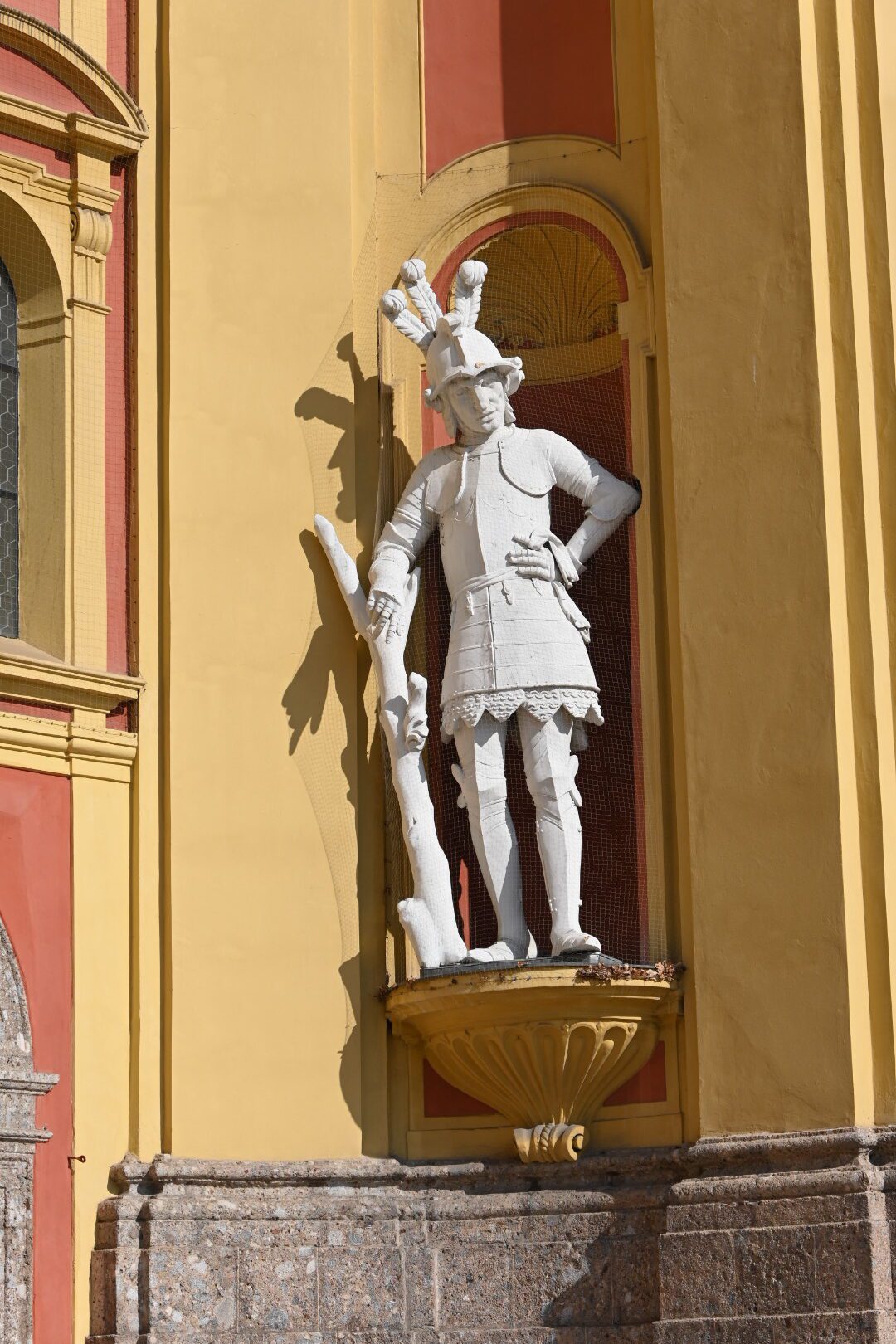
Two of the most popular legendary figures in Innsbruck to this day play the central roles in the foundation myth of Wilten Abbey. An extraordinarily strong knight, known as the giant Haymon, travelled to Tyrol at some point between Late Antiquity and the Early Middle Ages. There he encountered the long‑established giant Thyrsus of Seefeld. While the Germanic Haymon was equipped in modern fashion with sword and shield, Thyrsus—who bore a Romanised name but is portrayed in legend as a wild Alpine inhabitant—had only a tree trunk as his weapon. As fate would have it, the sword struck down the wooden club, and Thyrsus lay slain on the ground in his own blood. Filled with remorse over his deed, Haymon converted to Christianity and was baptised by the Bishop of Chur. Instead of constructing a military fortress as originally planned, the repentant warrior built a monastery on the ruins of the Roman fort of Veldidena. Despite his newfound piety, his time of heroic deeds was not yet over. In the nearby Sill Gorge there dwelled a fearsome dragon that not only devastated the new construction every night but also made meaningful settlement of the region impossible. Haymon slew the monster, cut out its tongue, and bequeathed it to his own foundation. After his career as a dragon slayer, Haymon handed the monastery over to the Benedictine monks from Tegernsee and himself entered the order as a lay brother. The people of the region were so grateful to the giant for liberating them from the dragon that they willingly placed themselves under the tithe‑paying protection of Wilten Abbey, cultivating the formerly wild land as farmers. And the moral of the story? Haymon represents the initially violent but later noble and benevolent Germanic settlers; Thyrsus stands for the brave and wild, yet ultimately defeated inhabitants of the region between the Seefeld Plateau and the Brenner Pass. The dragon symbolises the evil, destructive, and unchristian paganism that is eradicated by the converted German. The monastery brothers—richly endowed by the valiant knight—are the organising force without which nothing would function. Over the centuries, the Haymon legend and its moral proved just as flexible as Christianity itself during its introduction in Late Antiquity. At times, Haymon was portrayed as a nobleman from the Rhine who came to Tyrol after the death of Charlemagne; at other times, he appeared as a follower of the Ostrogothic king Theoderic—better known as Dietrich of Bern—travelling between Ravenna and Germany. From the Middle Ages until the 19th century, the focus lay on Haymon’s conversion, the protection of the peasant subjects by Christian knighthood, and the foundation of the monastery, all serving to legitimise the benevolent feudal system. In an article in the Innsbrucker Nachrichten of 2 October, however, the author Dr Franz Wöß almost entirely set aside the Catholic aspect of the monastery’s construction and instead emphasised the heroic German element, before turning to the healing properties of Thyrsus oil, which the farmers of Seefeld had extracted from oil‑bearing shale stones since the Middle Ages. In this version of the legend, after his heroic deeds Haymon withdrew into the wilderness of Seefeld as a hermit rather than ending his life as a cleric at Wilten Abbey. After the Second World War, there was once again a desire to distance oneself as much as possible from Germanic identity. The mural created in 1956 on the façade of the “Gasthaus zum Riesen Haymon” depicts the defeated Thyrsus, bearing the Austrian coat of arms—entirely in keeping with the post‑war victim narrative.
Wilten Abbey as a Structuring Authority
“Austria is a democratic republic. Its law emanates from the people,” as stated today in Article 1 of the Austrian Federal Constitutional Law. Ministries and their local representatives, the magistrates, are representatives of a secular republic. Unlike in many other regions, church and state are separated in Austria. This was not always the case. For centuries, it was the clergy who exercised jurisdiction and administration. Ecclesiastical institutions such as monasteries, thanks to their educated and literate brethren, were the most important administrative units in Late Antiquity, orchestrating structures of power, governance, law, property ownership, infrastructure, and public order. In Wilten, a small community of pastors managed the affairs of the region between the Nordkette mountain range and the Brenner Pass. As early as the sixth century, a church can be documented in what is now Wilten. The Bavarian dukes, who counted the Inn Valley among their dominions in the early Middle Ages, were more than willing to make use of these educated churchmen to keep the administration of the territory on an orderly footing. In 1128, Bishop Reginbert of Brixen transferred the monastery to the then newly founded Premonstratensian Order. The charter confirming the transfer to the Premonstratensians in 1138 has been preserved in the archive of Wilten Abbey to this day. Considering that the mother monastery in Prémontré in France was founded only in 1120 by the order’s founder, Norbert of Xanten, the spread of the order to Tyrol occurred remarkably quickly. Originating in France, the order managed to establish itself throughout Europe within just a few decades. The ideal of poverty was less pronounced among the Premonstratensians than among the contemporaneously emerging Franciscans or Dominicans. Norbert, venerated as a saint from 1582 onward, was indeed a church reformer; yet, despite all his spirituality, he could not deny his noble lineage or his political role as Archbishop of Magdeburg and advisor to the king. With the assumption of ecclesiastical rights and duties came lordship over extensive lands at the abbey’s disposal. In 1140, the Prince-Bishopric of Brixen transferred all its landholdings between Bergisel, the Sill River, and the Inn River to Wilten Abbey. The powerful Bavarian Duke Henry the Lion donated a hereditary farm from his own possessions to the abbey. In addition, Mentlberg and lands in the Sellrain Valley were added. One of Tyrol’s most beautiful valley termini, Lüsens, remains in ecclesiastical ownership to this day, as does the Heiligwasser inn in Igls.
Thanks to its extensive landholdings, the abbey also became a political actor. On these lands, the abbey held lower jurisdiction, encompassing all matters not subject to blood justice. In 1180, it was Wilten Abbey that transferred the lands south of the Inn to the Counts of Andechs—lands on which Innsbruck was founded. Not only in 1180, but also in 1339 and 1453, the expansion of Innsbruck was possible only after the acquisition of land from Wilten. In matters of pastoral care and liturgical service, the city was dependent on the abbot. Thus, for a long time, the right to conduct burials was a privilege of Wilten Abbey. Only in the late Middle Ages did Innsbruck acquire this privilege itself. The parish church of St James was merely a filial church. With considerable foresight, Wilten Abbey secured not only ecclesiastical but also secular special rights contractually in return for the sale of land. The Kleine Sill, a canal constructed in the High Middle Ages, supplied the city with water indispensable to its craft workshops. As the canal ran through abbey lands, the abbot retained authority over its use rights—along with many other matters—until the sixteenth century. The abbey also possessed the important milling rights. During the Middle Ages, farmers from Amras, Pradl, and Innsbruck were required to bring their grain to the Wilten mills along the Sill to have it ground. When medieval cities ran out of bread, unrest and uprisings threatened, as grain formed the staple of the daily diet. The well-being of Innsbruck’s city council depended on Wilten; in many respects, the city relied on the abbot’s goodwill. The relationship between ecclesiastical authority in Wilten, embodied by the abbot, and secular power in Innsbruck, embodied by the territorial prince, resembled the enduring struggle between pope and emperor in the Middle Ages.
In addition to economic matters, Innsbruck also remained dependent on Wilten Abbey in educational affairs for a long time. A monastic school is mentioned as early as 1313. Ruedger the schoolmaster appears in Wilten’s chronicles even ten years earlier, noted as village schoolmaster. Alongside lively panel painting, the pupils likely also copied books. The city school at the Church of St James, a filial church of Wilten Abbey, likewise stood indirectly under the abbot’s authority. Until 1561, the abbots successfully prevented the settlement of further religious orders in Innsbruck in order to maintain the abbey’s sphere of influence within the city. Only during the Counter-Reformation did the territorial prince—originating from Spain, disregarding many local customs, and later Emperor Ferdinand I—succeed, together with the Jesuits, in establishing a religious order in the city itself, thereby making the residential city more independent. Nevertheless, masses on major feast days such as Christmas and Easter, as well as baptisms, continued to be celebrated in Wilten. From the sixteenth century onward, the influence of the church gradually began to wane, even though it persisted in one form or another for centuries. Well into the twentieth century, disputes between church and state over supremacy in various aspects of subjects’ and citizens’ lives shaped power structures and social policy. During the interwar period, the Catholic faith was still raison d’état of the corporative state under Federal Chancellors Dollfuss and Schuschnigg, and even today, in many fundamental questions of education policy, the church remains unavoidable. Today, the abbots of Wilten no longer wield political power; however, the landownership and the wealth reflected in the abbey’s buildings have by no means been lost.
Article: The Giant Haymon
Published: Neue Tiroler Stimmen / 15 April 1875
(The giant Haymon), who - 13 feet tall and weighing 7 hundredweights - had been standing in front of the collegiate church in Wilten for about 150 years, like his opponent Thyrſus (of Seefeld).
had been standing in a niche in the wall, but accidentally suffered a fall due to a gust of wind on the 20th of March, early at 7 o'clock, so that it was smashed into many pieces, has now been put back together again by skilful hands, and the day before yesterday was raised safely to its old position by means of a pulley. Of course, it was secured against similar misfortune in present and future stormy times! May he henceforth keep faithful vigil over the - before
The church of St Laurentius, founded 1000 years ago, and the canons' monastery responsible for it - under God's gracious care!
The Counts of Andechs and the foundation of Innsbruck
The 12th century brought economic, scientific, and social growth to Europe and is regarded as a kind of early medieval Renaissance. Through the indirect route of the Crusades, intensified exchange took place with the cultures of the Near East, which were more highly developed in many respects. Via southern Spain and Italy, Arab scholars brought translations of Greek thinkers such as Aristotle to Europe. Roman law was rediscovered at the first universities south of the Alps. New agricultural knowledge, technical innovations, and a favourable climate—which was to last until the mid‑14th century—enabled the emergence of towns and larger settlements. One of these settlements lay between the Roman road over the Brenner Pass, the River Inn, and the Nordkette mountain range. Politically and economically, the importance of the Inn Valley was largely limited to transit. The two relatively low and therefore easily passable Alpine crossings—the Reschen Pass and the Brenner Pass—between the German lands and the possessions of the German kings in Italy converged in the wide valley basin. A dispute over control of this part of the Holy Roman Empire gave rise to the political constellation that would shape Tyrol and Innsbruck well into the modern era. In 1024, Conrad II of the Salian dynasty was elected king. He found himself in competition with the Bavarian dukes of the House of Wittelsbach, under whose control the coveted Alpine passes lay at the time. In order to wrest the territory away from his Bavarian rivals and place it under the control of the Reich Church loyal to him, Conrad II granted the territory of Tyrol as a fief in 1027 to the bishops of Brixen and Trento. The bishops, in turn, required so‑called Vögte (advocates) to administer these lands and exercise jurisdiction. These advocates of the Bishop of Brixen were the Counts of Andechs. Although today the Andechs family stands in the shadow of the Welfs, Hohenstaufen, Wittelsbachs, and Habsburgs, they were a powerful dynasty in the High Middle Ages. They originated from the region around Lake Ammersee in Bavaria and owned estates in Upper Bavaria between the Lech and Isar rivers as well as east of Munich. Through skilful marriage policies, they acquired the titles of Dukes of Merania—a region on the Dalmatian coast—and Margraves of Istria, thereby rising in rank within the Holy Roman Empire. To secure both administration and eventual salvation, they founded Dießen Abbey and the monastery on the Holy Mountain of Andechs above Lake Ammersee in the 12th century. In 1165, Otto V of Andechs ascended to the episcopal seat of Brixen and granted the advocacy over this prince‑bishopric to his brother. In this way, the Andechs family gained control over the administration of the central Inn Valley, the Wipp Valley, the Puster Valley, and the Eisack Valley.
But this was far from the end of the dynastic entanglements and political complications that stood in the way of Innsbruck’s founding. Today, the city stretches across both sides of the River Inn. In the 12th century, however, this area was under the influence of two different landlords. Much of the Inn Valley was densely forested, and the banks of the broad river consisted of marshy terrain. South of the Inn, manorial authority was exercised by Wilten Abbey, while the land north of the river was administered by the Counts of Andechs. Whereas the southern part of the later city around the abbey had been used for agriculture for centuries, the floodplain around the unregulated river remained largely unsettled before the High Middle Ages. The region was not one of the hotspots of Europe’s cultural landscape. Most people worked in agriculture under their landlord’s control. They lived in poor huts made of clay and wood. Medical care was almost non‑existent, child mortality was high, and few people lived beyond the age of fifty.
As every good property developer is keen to point out even today, location already mattered greatly when it came to the potential of a new construction project. Around the year 1133, the Counts of Andechs founded the market settlement of Anbruggen in what is now St. Nikolaus, taking advantage of the site’s excellent transport connections, and linked the northern and southern banks of the Inn with a bridge. What had been agriculturally unusable land at the foot of the Nordkette was transformed into a trading hub by this transport link. The small wooden bridge facilitated the movement of goods across the Eastern Alps between Italian and German trading cities. The Brenner route, long considered too steep for large trading convoys, became more attractive thanks to one of the innovations of the medieval Renaissance: new harness systems made it possible for wagons to negotiate steep inclines. The shorter Via Raetia replaced the Via Claudia Augusta over the Reschen Pass as the main Alpine transit route. The farsighted Andechs market benefited from this development. Toll revenues generated by trade between German and Italian cities allowed the settlement to prosper. Soon blacksmiths, innkeepers, wagon operators, tailors, carpenters, rope makers, wheelwrights, and tanners settled there. Horses, merchants, and their retinues had to be fed and accommodated, wagons repaired. Larger enterprises employed workers and servants. What had once been a remote, swampy wasteland became a service centre. The transformation from a purely agrarian area into a town could begin. Anbruggen grew rapidly, but space between the Nordkette and the Inn was limited. In 1180, Berchtold V of Andechs acquired a parcel of land on the southern side of the Inn from Wilten Abbey to expand his trading post. The abbot was unwilling to relinquish his foothold entirely, as the new settlement was flourishing thanks to toll revenues. The deed mentions three houses within the new settlement that were reserved for Wilten Abbey. As part of the construction of the city walls, the Counts of Andechs built Andechs Castle and moved their ancestral seat from Merano to Innsbruck. At some point between 1187 and 1204, the citizens of Innsbruck were granted town privileges. The year 1239 is often cited as the official founding date, when the last count of the Andechs dynasty, Otto VIII, formally confirmed the town charter in a document. At this time, Innsbruck was already the minting site of the Andechs family and would likely have become the capital of their principality. However, events took a different turn. In 1246, the Bavarian Wittelsbachs—the Andechs’ greatest rivals in southern Germany—destroyed their ancestral castle on Lake Ammersee. Otto, the last count of the House of Andechs‑Merania, died in 1248 without heirs. Twelve years earlier, he had married Elisabeth, the daughter of Count Albert VIII of Tyrol. This noble family, whose ancestral seat lay in Merano, thus inherited the fiefs and parts of the Andechs possessions, including the city on the Inn—along with the longstanding enmity with the Bavarian Wittelsbachs.
Believe, Church and Power
The abundance of churches, chapels, crucifixes, statues, and paintings in public spaces strikes many visitors to Innsbruck from other countries as unusual. Not only places of worship, but also many private houses are decorated with depictions of Jesus, Mary, saints, and biblical scenes. For centuries, the Christian faith and its institutions shaped everyday life throughout Europe, and Innsbruck—as a residence city of the strictly Catholic Habsburgs and the capital of the self-proclaimed Holy Land of Tyrol—was particularly richly endowed with ecclesiastical buildings. In terms of number and scale relative to the conditions of earlier times, churches appear as gigantic features in the cityscape. In the 16th century, Innsbruck, with its approximately 5,000 inhabitants, possessed several churches whose splendor and size surpassed every other building, including the palaces of the aristocracy. Wilten Abbey was a vast complex in the midst of a small farming village that had developed around it.
The spatial dimensions of these places of worship reflect their importance within the political and social structure. For many inhabitants of Innsbruck, the Church was not only a moral authority but also a secular landowner. The Bishop of Brixen was formally equal in rank to the territorial prince. Peasants worked on the bishop’s estates just as they did on those of a secular ruler. The clergy exercised both taxation and judicial authority over their subjects, and ecclesiastical landowners were often regarded as particularly demanding. At the same time, it was also the clergy in Innsbruck who were largely responsible for social welfare, healthcare, care for the poor and orphans, food distribution, and education. The Church’s influence extended into the material world in a way comparable to how the modern state operates today through tax offices, police, schools, and employment services. What democracy, parliament, and the market economy represent for us today, bishops, the Bible, Christian devotional literature, and parish priests represented for people of earlier centuries: a reality that maintained order.
It would be incorrect to believe that all clergymen were cynical power-hungry figures who exploited their uneducated subjects. The majority of both clergy and nobility were devout and God-fearing, albeit in a manner that is difficult to comprehend from today’s perspective. It was not the case that every superstition was blindly accepted or that people were arbitrarily executed based on anonymous accusations. In the early modern period, violations of religion and morals were tried before secular courts and punished severely. Charges were brought under the term heresy, which encompassed a wide range of offenses. Sodomy—meaning any sexual act not serving reproduction—sorcery, witchcraft, and blasphemy, in short any deviation from the correct faith, could be punished by burning. The act of burning was intended both to purify the condemned and to destroy them and their sinful behavior completely, thereby removing evil from the community. For a long time, the Church regulated everyday social life down to the smallest details. Church bells structured people’s daily schedules. Their sound called people to work or worship, or informed the community of a death through tolling. People were able to distinguish individual bell signals and their meanings. Sundays and holidays structured time. Fasting days regulated diet. Family life, sexuality, and individual behavior were expected to conform to Church-prescribed morality. For many people, salvation in the afterlife was more important than happiness on earth, which was seen as predetermined by the course of time and divine will. Purgatory, the Last Judgment, and the torments of hell were real and served to frighten and discipline even adults.
While parts of the Innsbruck bourgeoisie were at least gently awakened by Enlightenment ideas after the Napoleonic Wars, the majority of the population remained committed to a mixture of conservative Catholicism and superstitious popular piety. Religiosity was not necessarily a matter of origin or social class, as repeatedly demonstrated by social, media, and political conflicts along the fault line between liberals and conservatives. Although freedom of religion was legally enshrined in the December Constitution of 1867, the state and religion remained closely linked. The Wahrmund Affair, which originated at the University of Innsbruck in the early 20th century and spread throughout the Austro-Hungarian Empire, was just one of many examples of the influence the Church exercised well into the 1970s. Shortly before the First World War, this political crisis, which would affect the entire monarchy, began in Innsbruck. Ludwig Wahrmund (1861–1932) was Professor of Canon Law at the Faculty of Law of the University of Innsbruck. Originally selected by the Tyrolean governor to strengthen Catholicism at what was considered an overly liberal university, Wahrmund was a proponent of enlightened theology. Unlike conservative representatives in the clergy and politics, reform Catholics viewed the Pope as a spiritual leader but not as a secular authority. In Wahrmund’s view, students should reduce the gap and tensions between Church and modernity rather than cement them. Since 1848, divisions between liberal-national, socialist, conservative, and reform-oriented Catholic interest groups and parties had deepened. Greater German nationalist-minded Innsbruck citizens oriented themselves toward the modern Prussian state under Chancellor Bismarck, who sought to curtail the influence of the Church or subordinate it to the state. One of the fiercest fault lines ran through the education and higher education system, centered on the question of how the supernatural practices and views of the Church—still influential in universities—could be reconciled with modern science. Liberal and Catholic students despised one another and repeatedly clashed. Until 1906, Wahrmund was a member of the Leo Society, which aimed to promote science on a Catholic basis, before becoming chairman of the Innsbruck local branch of the Association for Free Schools, which advocated complete de-clericalization of the education system. He evolved from a reform Catholic into an advocate of a complete separation of Church and state. His lectures repeatedly attracted the attention of the authorities. Fueled by the media, the culture war between liberal German nationalists, conservatives, Christian Socials, and Social Democrats found an ideal projection surface in the person of Ludwig Wahrmund. What followed were riots, strikes, brawls between student fraternities of different political orientations, and mutual defamation among politicians. The “Away from Rome” movement of the German radical Georg Ritter von Schönerer (1842–1921) collided on the stage of the University of Innsbruck with the political Catholicism of the Christian Socials. German nationalist academics were supported by the likewise anti-clerical Social Democrats and by Mayor Greil, while the Tyrolean provincial government sided with the conservatives. The Wahrmund Affair reached the Imperial Council as a culture-war debate. For the Christian Socials, it was a “struggle of liberal-minded Jewry against Christianity,” in which “Zionists, German culture warriors, Czech and Ruthenian radicals” presented themselves as an “international coalition,” a “liberal ring of Jewish radicalism and radical Slavic movements.” Wahrmund, on the other hand, in the generally heated atmosphere, referred to Catholic students as “traitors and parasites.” When Wahrmund had one of his speeches printed in 1908, in which he questioned God, Christian morality, and Catholic veneration of saints, he was charged with blasphemy. After further, sometimes violent assemblies on both conservative and anti-clerical sides, student riots, and strikes, university operations even had to be suspended temporarily. Wahrmund was first placed on leave and later transferred to the German University in Prague. Even in the First Republic, the connection between Church and state remained strong. Ignaz Seipel, a Christian Social politician known as the “Iron Prelate,” rose in the 1920s to the highest office of the state. Federal Chancellor Engelbert Dollfuss viewed his corporative state as a construct based on Catholicism and as a bulwark against socialism. After the Second World War, Church and politics in Tyrol were still closely linked in the persons of Bishop Rusch and Chancellor Wallnöfer. Only then did a serious separation begin. Faith and the Church still have a fixed place in the everyday life of Innsbruck’s residents, even if often unnoticed. Church withdrawals in recent decades have dented official membership numbers, and leisure events are better attended than Sunday Mass. Nevertheless, the Roman Catholic Church still owns extensive land in and around Innsbruck, including outside the walls of monasteries and educational institutions. Numerous schools in and around Innsbruck are also influenced by conservative forces and the Church. And anyone who enjoys a public holiday, taps Easter eggs together, or lights a candle on a Christmas tree does not need to be Christian to act—disguised as tradition—in the name of Jesus.
Big City Life in early Innsbruck
During the Middle Ages, Innsbruck officially developed into a city. Formal recognition by the territorial prince in 1239 brought with it an entirely new system for its citizens. Market rights, building rights, customs rights, and an independent jurisdiction were gradually transferred to the city. Urban citizens were no longer subject to their feudal lord, but to the city’s jurisdiction—at least within the city walls. The well-known saying “city air makes one free” derives from the fact that after one year of residence in the city, a person was released from all obligations to their former lord. Unlike unfree peasants and servants, citizens could freely dispose of their property and determine their way of life. Naturally, they also had rights and obligations. Citizens did not pay tithes, but instead paid taxes to the city. Which group within the city was required to pay which taxes could be determined by the city government itself. The city, in turn, did not have to pass these taxes on directly, but could freely dispose of its budget after paying a fixed levy to the territorial prince. In addition to city defense, expenditures included care for the sick and the poor. Needy citizens could obtain meals from the “boiling kitchen” (Siedeküche), provided they held civic rights. The city government paid particular attention to contagious diseases such as the plague, which periodically tormented the population. In return for their rights, every citizen had to swear the civic oath. This oath included the obligation to pay taxes and perform military service. In addition to defending the city, citizens were also deployed beyond its walls. In 1406, a contingent together with mercenaries confronted an Appenzell army to defend the Upper Inn Valley. From 1511 onward, according to Emperor Maximilian’s Landlibell, the city council was also obliged to provide a contingent of conscripts for territorial defense. In addition, there were volunteers who could enlist for military service in the city’s Freifähnlein; for example, Innsbruck citizens were among the defenders of Vienna during the Ottoman siege of 1529.
Im 15. Jahrhundert wurde der Platz eng im rasch wachsenden Innsbruck. Das Bürgerrecht wurde zu einem exklusiven Gut. Nur noch freien Untertanen aus ehelicher Geburt war es möglich, das Stadtrecht zu erlangen. Um Bürger zu werden, mussten entweder Hausbesitz oder Fähigkeiten in einem Handwerk nachgewiesen werden, an der die Zünfte der Stadt interessiert waren. Der Streit darum, wer ein „echter“ Innsbrucker ist, und wer nicht, hält sich bis heute. Dass Migration und Austausch mit anderen immer schon die Garantie für Wohlstand waren und Innsbruck zu der lebenswerten Stadt gemacht haben, die sie heute ist, wird dabei oft vergessen.
Because of these restrictions, Innsbruck had a completely different social composition from the surrounding villages. Craftsmen, merchants, officials, and servants shaped the cityscape. Merchants were often itinerant, while officials and courtly retinues also came to Innsbruck temporarily in the entourage of a prince and did not possess civic rights. It was the craftsmen who exercised a large part of political power within the citizenry. Unlike peasants, they belonged to the mobile social strata of the Middle Ages and the early modern period. After completing their apprenticeship, they went on their journeyman’s travels before taking the master craftsman’s examination and either returning home or settling in another city. Craftsmen were not only vectors of technical knowledge; cultural, social, and political ideas also spread through them. The craft guilds partly exercised their own jurisdiction alongside the municipal courts over their members. They were social structures within the urban framework that exerted considerable influence on politics. Wages, prices, and social life were regulated by the guilds under the supervision of the territorial prince. One could speak of an early form of social partnership, as the guilds also provided social security for their members in cases of illness or occupational disability. Each trade—such as locksmiths, tanners, armorers, carpenters, bakers, butchers, or blacksmiths—had its own guild headed by a master.
From the 14th century, Innsbruck demonstrably had a city council, the so-called Gemainand a mayor who was elected annually by the citizens. These were not secret but public elections, which were held every year around Christmas time. In the Innsbrucker Geschichtsalmanach von 1948 findet man Aufzeichnungen über die Wahl des Jahres 1598.
The Feast of St. Erhard, i.e., January 8th, played a significant role in the lives of the citizens of Innsbruck each year. On this day, they gathered to elect the city officials, namely the mayor, city judge, public orator, and the twelve-member council. A detailed account of the election process between 1598 and 1607 is provided by a protocol preserved in the city archive: "... The ringing of the great bell summoned the council and the citizenry to the town hall, and once the honorable council and the entire community were assembled at the town hall, the honorable council first convened in the council chamber and heard the farewell of the outgoing mayor of the previous year, Augustin Tauscher."
The mayor represented the city vis-à-vis the other estates and the territorial prince, who exercised supreme authority over the city with varying intensity depending on the period. Each councilor had clearly assigned duties, such as overseeing market rights and the quality of goods offered, managing the hospital and poor relief, or regulating customs—particularly important for Innsbruck. The city council was also responsible for discipline, ensuring social order and adherence to prevailing moral standards. Alcohol consumption and time spent in taverns were regulated differently at various times. Poorer segments of the population not only could not afford frequent visits, they were also permitted to enter taverns only at certain times. This was intended to prevent excessive drunkenness and begging from the upper classes. The council monitored the quality and safety of food in a manner similar to an early market authority, as cities had an interest in maintaining quality businesses to remain attractive as economic centers and destinations for visitors. In all these political processes, it should be borne in mind that in the 16th century Innsbruck had around 5,000 inhabitants, only a small proportion of whom possessed civic rights. The propertyless, itinerant people, the unemployed, servants, diplomats, employees, women, and students were not enfranchised citizens. Voting was a privilege of the male upper class.
Contrary to popular belief, the Middle Ages were not a lawless era of arbitrariness. At both municipal and territorial levels, there were legal codes that regulated in detail what was permitted and what was forbidden. Depending on the ruler and prevailing moral standards, these regulations could vary considerably. Carrying weapons, swearing, prostitution, noise, making music, blasphemy, children playing—everything and everyone could fall under the scrutiny of the authorities. If one also considers regulations on trade, customs, professional practice by guilds, and price controls imposed by the magistrate, pre- and early modern life was no less regulated than today. The difference lay in oversight and enforcement, which authorities often lacked. If someone was caught committing an unlawful or immoral act, there were courts that passed judgment. Medieval court days were held outdoors at the Dingstätte. The tradition of the Ding goes back to the ancient Germanic Thing, where all free men gathered to administer justice. The city council appointed a judge responsible for all offenses not subject to capital jurisdiction, assisted by a panel of sworn jurors. Punishments ranged from fines to the pillory and imprisonment. The observance of religious order was also monitored by the city. “Heretics” and dissenters were not disciplined by the Church but by the municipal authorities. Punishment involved methods less humane than those customary today, though torture was not applied arbitrarily. Its use as part of judicial procedure in particularly serious cases was regulated. Until the 17th century, suspects and criminals in Innsbruck were imprisoned and interrogated in the Kräuterturm at the southeastern corner of the city wall, at today’s Herzog-Otto-Ufer. Both trials and punishments were public events. Opposite the city tower stood the Narrenhäusel, a cage in which people were imprisoned and displayed. For lesser offenses, offenders were paraded through the city on the wooden “shame donkey.” The pillory stood in the suburb that is today Maria-Theresien-Straße. There was no police force, but the city judge employed assistants, and guards were stationed at the city gates to maintain order. It was a civic duty to assist in the apprehension of criminals. Vigilante justice was forbidden.
Jurisdiction between municipal and territorial courts was regulated as early as 1288 in the Urbarbuch. Serious crimes remained under the authority of the territorial court. Capital jurisdiction covered offenses such as theft, murder, or arson. The territorial court for all communities south of the Inn between Ampass and Götzens was located at Sonnenburg, south above Innsbruck. In the 14th century, the Sonnenburg court moved to the Upper City Square in front of the Innsbruck city tower, later into the town hall, and in the early modern period to Götzens. With the centralization of justice in the 18th century, the Sonnenburg court returned to Innsbruck and found accommodation under changing names and in various buildings, such as the Leuthaus in Wilten, on Innrain, or at the Ettnau manor, known as the Malfatti-Schlössl, on Höttinger Gasse.
From the late 15th century onward, Innsbruck’s executioner was centralized and responsible for several courts, residing in Hall. Execution sites changed over time. A gallows long stood on a hill in today’s Dreiheiligen district directly by the main road. The Köpflplatz was located until 1731 at today’s corner of Fallbachgasse and Weiherburggasse in Anpruggen. In Hötting, the gallows stood behind the Chapel of the Great God. The present chapel, which alongside a Baroque crucifix features ceramic figures by the renowned artist Max Spielmann (1906–1984), was relocated during roadworks in the 1960s. While Spielmann’s Dance of Death memorial commemorates those killed in the Second World War, those sentenced to death once sent a final prayer heavenward here before the noose was placed around their necks or their heads were severed—depending on social status and the nature of the crime. It was not uncommon for the condemned to give their executioner a kind of gratuity so that he would aim as precisely as possible to make the execution as painless as possible. Much could go wrong: if the sword missed its mark, the noose was improperly placed, or the rope broke, the suffering of the condemned increased. For authorities and public order, particularly dangerous offenders such as the “heretic” Jakob Hutter or the captured leaders of the Peasants’ Revolts of 1525 and 1526 were publicly executed in front of the Golden Roof. “Aggravated” punishments such as quartering or breaking on the wheel—derived from the Latin poena—were not routine but could be ordered in special cases. Executions were public demonstrations of authority and served as a form of purification of society and as a deterrent. Large crowds gathered to accompany the condemned on their final journey. On execution days, university lectures were suspended to allow students to attend and be morally instructed. The bodies of those executed were often left hanging and buried outside consecrated cemetery grounds or handed over to the university for study purposes. The last public execution in Austrian history took place in 1868. Although executions thereafter were still far from gentle, killings by strangulation at the gallows—used until the 1950s—were no longer public spectacles.
With the centralisation of law under Maria Theresa and Joseph II in the 18th century and the General Civil Code in the 19th century under Franz I, the law passed from cities and sovereigns to the monarch and their administrative bodies at various levels. Torture was abolished. The Enlightenment had fundamentally changed the concept of law, punishment and rehabilitation. The collection of taxes was also centralised, which resulted in a great loss of importance for the local nobility and an increase in the status of the civil service. With the increasing centralisation under Maria Theresa and Joseph II, taxes and customs duties were also gradually centralised and collected by the Imperial Court Chamber. As a result, Innsbruck, like many municipalities at the time, lost a large amount of revenue, which was only partially offset by equalisation.
The master builders Gumpp and the baroqueisation of Innsbruck
The works of the Gumpp family still strongly characterise the appearance of Innsbruck today. The baroque parts of the city in particular can be traced back to them. The founder of the dynasty in Tyrol, Christoph Gumpp (1600-1672), was actually a carpenter. However, his talent had chosen him for higher honours. The profession of architect or artist did not yet exist at that time; even Michelangelo and Leonardo da Vinci were considered craftsmen. After working on the Holy Trinity Church, the Swabian-born Gumpp followed in the footsteps of the Italian master builders who had set the tone under Ferdinand II. At the behest of Leopold V, Gumpp travelled to Italy to study theatre buildings and to learn from his contemporary style-setting colleagues his expertise for the planned royal palace. Comedihaus aufzupolieren. Seine offizielle Tätigkeit als Hofbaumeister begann 1633. Neue Zeiten bedurften eines neuen Designs, abseits des architektonisch von der Gotik geprägten Mittelalters und den Schrecken des Dreißigjährigen Krieges. Über die folgenden Jahrzehnte wurde Innsbruck unter der Regentschaft Claudia de Medicis einer kompletten Renovierung unterzogen. Gumpp vererbte seinen Titel an die nächsten beiden Generationen innerhalb der Familie weiter. Die Gumpps traten nicht nur als Baumeister in Erscheinung. Sie waren Tischler, Maler, Kupferstecher und Architekten, was ihnen erlaubte, ähnlich der Bewegung der Tiroler Moderne rund um Franz Baumann und Clemens Holzmeister Anfang des 20. Jahrhunderts, Projekte ganzheitlich umzusetzen. Auch bei der Errichtung der Schanzwerke zur Landesverteidigung während des Dreißigjährigen Krieges waren sie als Planer beteiligt. Christoph Gumpps Meisterstück aber war die Errichtung des Comedihaus im ehemaligen Ballhaus. Die überdimensionierten Maße des damals richtungsweisenden Theaters, das in Europa zu den ersten seiner Art überhaupt gehörte, erlaubte nicht nur die Aufführung von Theaterstücken, sondern auch Wasserspiele mit echten Schiffen und aufwändige Pferdeballettaufführungen. Das Comedihaus war ein Gesamtkunstwerk an und für sich, das in seiner damaligen Bedeutung wohl mit dem Festspielhaus in Bayreuth des 19. Jahrhunderts oder der Elbphilharmonie in Hamburg heute verglichen werden muss.
His descendants Johann Martin Gumpp the Elder, Georg Anton Gumpp and Johann Martin Gumpp the Younger were responsible for many of the buildings that still characterise the townscape today. The Wilten collegiate church, the Mariahilfkirche, the Johanneskirche and the Spitalskirche were all designed by the Gumpps. In addition to designing churches and their work as court architects, they also made a name for themselves as planners of secular buildings. Many of Innsbruck's town houses and city palaces, such as the Taxispalais or the Altes Landhaus in Maria-Theresien-Straße, were designed by them. With the loss of the city's status as a royal seat, the magnificent large-scale commissions declined and with them the fame of the Gumpp family. Their former home is now home to the Munding confectionery in the historic city centre. In the Pradl district, Gumppstraße commemorates the Innsbruck dynasty of master builders.
Baroque: art movement and art of living
Anyone traveling through Austria is familiar with the domes and onion-shaped towers of churches in towns and villages. They are the characteristic hallmark of the Baroque architectural style, which reached its peak during the Counter-Reformation and continues to shape the cityscape of Innsbruck to this day. The most prominent churches—such as the Cathedral, St. John’s Church, or the Jesuit Church—are built in the Baroque style. Places of worship were meant to be splendid and magnificent, symbols of the triumph of the true faith. The exuberant, all-encompassing piety of elites and subjects alike was reflected in art and culture: great drama, pathos, suffering, splendor, and glory combined to form the Baroque—a style that left a lasting imprint on the entire Catholic sphere of influence of the Habsburgs and their allies between Spain and Hungary. From the seventeenth century onward, the Gumpp family of master builders and Johann Georg Fischer fundamentally transformed Innsbruck’s cityscape. The Old Provincial Government Building in the Old Town, the New Provincial Government Building on Maria-Theresien-Strasse, countless palazzi, paintings, and sculptures—the Baroque was the defining stylistic force of the House of Habsburg in the seventeenth and eighteenth centuries and became embedded in everyday life. The bourgeoisie did not wish to lag behind the nobility and princes and therefore had their private residences built in the Baroque style as well. Farmhouses were adorned with images of saints, depictions of the Virgin Mary, and representations of the Sacred Heart of Jesus.
Yet the Baroque was more than an architectural style; it was a way of life that emerged in the aftermath of the Thirty Years’ War. The Ottoman threat from the east, culminating in the two sieges of Vienna, dominated the empire’s foreign policy, while the Reformation shaped domestic affairs. Baroque culture became a central element of Catholicism and its political self-representation in public space—a countermodel to the austere and rigorous way of life advocated by Calvin and Luther. Christian holidays were introduced to brighten everyday life. Architecture, music, and painting were rich, full, and exuberant. In theatres such as the Comedihaus in Innsbruck, dramas with religious themes were performed. Ways of the Cross with chapels and representations of the crucified Christ crisscrossed the landscape. Popular piety, expressed through pilgrimages and the veneration of Mary and the saints, became firmly embedded in everyday church life. Multiple crises shaped daily existence. In addition to war and famine, plague epidemics occurred particularly frequently in the seventeenth century. Baroque piety was used as a means of educating subjects, teaching them to interpret these calamities as expressions of God’s dissatisfaction—misfortunes that could be remedied through a devout and virtuous way of life. Although the sale of indulgences was no longer common practice in the Catholic Church after the sixteenth century, vivid notions of heaven and hell persisted. Through a virtuous life—that is, living in accordance with Catholic values and displaying proper conduct as a subject within the divine order—one could come significantly closer to paradise. So-called Christian devotional literature became the most popular reading material following the educational reforms of the eighteenth century and the rising literacy of the population. The suffering of the Crucified for humanity was regarded as a symbol of the hardship endured by subjects on earth within the feudal system. Through votive paintings, people sought assistance in times of hardship or expressed gratitude—most often to the Virgin Mary—for surviving dangers and illnesses. Particularly impressive votive paintings can be admired in the Wilten Basilica. The historian Ernst Hanisch described the Baroque and its influence on the Austrian way of life as follows:
“Austria emerged in its modern form as a crusading imperialism—externally against the Turks and internally against the Reformers. This brought bureaucracy and the military, and externally a multiethnic society. State and Church attempted to control the intimate sphere of citizens’ lives. Everyone had to reform themselves through the confessional; sexuality was restricted, norm-compliant sexuality enforced. People were systematically trained to dissemble.”
Rituals and submissive behavior toward authority left deep traces in everyday culture, distinguishing Catholic countries such as Austria and Italy to this day from Protestant-influenced regions such as Germany, England, or Scandinavia. Austrians’ passion for academic titles has its roots in Baroque hierarchies. The term Baroque prince refers to a particularly patriarchal and patronizing politician who knows how to captivate an audience with grand gestures. While political sobriety is valued in Germany, the style of Austrian politicians remains theatrical—entirely in keeping with the Austrian adage “Schaumamal” (“let’s see”).
The Reformation in Tyrol
The Reformation may appear today primarily as a matter of personal belief. Thanks to the liberal legislation we enjoy in this respect, everyone is free to choose their own confession. If, however, religion is viewed as an essential component of everyday life and personal identity in past centuries, it becomes clear that it was far more than merely an expression of spirituality. The Reformation, which erupted with particular violence between the fifteenth and seventeenth centuries, represented a comprehensive social rupture comparable to the years 1848 or 1968. The accompanying social and political transformation did not come to a halt at the borders of the Holy Land of Tyrol.
It is a chicken-and-egg question whether the Reformation changed the image of humankind or whether a changing perception of existence transformed Christianity. Around 1500, new discoveries and modes of thought began to usher in the end of the Middle Ages. Artists, scholars, and clerics across Europe started to question hierarchies, order, and systems of legitimacy. With the theological reformers of the fifteenth and sixteenth centuries, the feudal system—placing Church and nobility above the people and bourgeoisie—began to crumble. The Bohemian cleric Jan Hus was among the first on the European mainland to question the pope’s omnipotence in the fifteenth century and was burned at the stake for it at the Council of Constance. In France and Switzerland it was Jean Calvin (1509–1564), in the Holy Roman Empire Martin Luther (1483–1546) and Thomas Müntzer (1489–1525), who challenged the Roman Church in the sixteenth century. Reform-minded clergymen and pamphlets spread the new doctrines. In Tyrol, the mining towns of Hall and Schwaz were the main centers of the Reformation in the early sixteenth century. Many miners came from Saxony and brought their own ideas about faith and Church with them. The old liturgy, with sermons delivered in incomprehensible Latin, did not align with these expectations. Preachers such as Dr. Jacob Strauß addressed the population with Lutheran ideas, which also included criticism of the clergy and the system of rule. The religious crisis thus led to problems in the secular sphere beyond the walls of the churches as well. Faith and worldly matters were not separate domains. If miners were dissatisfied with pastoral care, they went on strike. Public order was endangered—not only because miners were permitted to carry weapons, but also because they were well connected among themselves. A general strike could trigger an economic crisis. Fugger capital and Habsburg political power were eager to prevent this and therefore granted the miners special rights. Not only miners, but also progressive segments of the bourgeoisie and the nobility took an interest in the new ways of living one’s faith, which was an important part of lifestyle. The new doctrines became a symbol of a new sense of self and of the social significance that craftsmen, skilled workers, and entrepreneurs in this emerging industry claimed in opposition to the old feudal system.
Ferdinand I and his successors were able to successfully push back the Reformation in Tyrol. Although the religious mandates with their numerous prohibitions were one of the reasons for the peasant wars, in the long term and with many coercive measures, the princely strategy bore fruit. Power politics may have been one reason, but in fact the ruling Habsburgs were pious people who, at least to a large extent, favoured Catholicism out of conviction. Ferdinand II described his motives with the words:
“…through the inspiration of God and the prompting of His Holy Spirit. All [done] to the glory of the Most High, out of a true and fervent zeal devoted to the holy, Catholic, and alone salvific religion.”
It was primarily priests of the Jesuit order who were to bring apostate parishes and citizens back into the fold of the Catholic Church. They began with reform measures such as better training for the clergy. Concubinage and post haggling were to be abolished. Priests and bishops were to concern themselves less with worldly matters and more with the salvation of their flocks. However, as this measure could not be implemented overnight - capable priests first had to be found and educated - coercive measures were introduced. The possession of Protestant books and pamphlets was punishable by law. The lower the status of the citizen, the more severe the punishment. Nobles, counsellors and key workers were often able to practise their Protestant faith discreetly. Under Ferdinand II, underlings had to confess at Easter. The priest drew up a list with the names of those who fulfilled their duty. Anyone who did not appear in the confessional despite repeated reminders could be expelled from the country.
In the seventeenth century, so-called religious reform commissions were established in Austria. If these “missionaries” discovered Protestant-leaning priests or subjects in possession of forbidden literature, they were arrested and expelled from the country, and not infrequently their houses and all possessions were set ablaze. Protestant officials were barred from practicing their professions and were forced either to convert or to emigrate. Particularly obstinate subjects were publicly chained. Maximilian III instituted a special religious surveillance agency that primarily monitored craftsmen and merchants. To prove their Catholic loyalty, they were required to regularly submit proof of confession. Under Maria Theresa in the eighteenth century, Tyrolean Protestants were forcibly resettled to distant parts of the Habsburg Empire. These relocations posed problems not only for the affected individuals. Labor and population numbers were key indicators of development in modern states, leading to what we would today call a brain drain: competencies and military strength were lost in the name of the Lord. In 1781, Enlightenment-minded Emperor Joseph II issued the Edict of Tolerance, partly for this reason, permitting the construction of Protestant churches—albeit under strict conditions. These prayer houses were not allowed to have towers or other architectural features; even windows facing the street were prohibited. In Tyrol, resistance arose against the Edict of Tolerance, as people feared for moral order and sought to avoid foreign religions, discord, and unrest of any kind. Converts were denied marriage and burial in Catholic cemeteries.
To this day, Tyrol regards itself as the self-proclaimed “Holy Land,” with “holy” referring explicitly to the Catholic faith. In 1837, Protestants were expelled from the Zillertal. The descendants of the so-called Zillertal “Inklinanten,” who emigrated under official pressure, still live in Germany today. Although tolerance gradually gained a foothold in the empire and its lands, the close bond between authority and the Catholic Church persisted well into the twentieth century in many areas of life, such as education. When it became known during the constitutional debates of 1848 that free exercise of religion was planned for the entire monarchy, public outrage in Tyrol was enormous. After media campaigns opposing this liberalization of faith, more than 120,000 signatures were collected. In 1861, Emperor Franz Joseph issued the Protestant Patent, which granted the Evangelical Church rights largely equivalent to those of the Catholic Church. The Tyroleans, however, remained steadfast. With the exception of two liberals, all members of the regional parliament voted to maintain confessional unity. The argument stated that there were no adherents of other faiths in Tyrol anyway, and therefore no tolerance toward non-Catholics was necessary. It was not until 1876 that an official Protestant parish was established in Innsbruck.
Reform and rebellion: Jakob Hutter and Michael Gaismair
The first years of rule of the later Emperor Ferdinand I (1503–1564) as sovereign of Tyrol were marked by unrest. The costly courtly lifestyle of Sigismund and Maximilian’s wars, combined with the pledging of a large part of the country’s assets to foreign entrepreneurs and financiers, had thrown Tyrol’s finances dangerously out of balance. Under Ferdinand, who was of Spanish descent and spent little time at the court in Innsbruck, the city lost much of its importance. Many imperial officials left the city again, taking with them the capital they had brought as well-paid servants of the state and members of the aristocracy. What they left behind, at least in the subjective and individual perception of many citizens, were disadvantages. The increased prices of everyday necessities did not fall again, even though incomes declined. The new legal system introduced through the administrative reforms of Maximilian conflicted with traditional customary law. Hunting in the forests and collecting firewood thus became illegal for large parts of the population. The loss of these common rights and the ever-increasing burden of taxes had severe consequences for small farmers, day laborers, servants, and other members of the lower classes. At this time, two men appeared in Tyrol—Jakob Hutter (1500–1536) and Michael Gaismair (1490–1532)—who called for greater social justice, threatened the existing order, and paid for it with their lives.
Jakob Hutter was the figurehead of the Anabaptists, who were particularly active in Tyrol in the Lower Inn Valley and the Puster Valley. The time in which he grew up seemed tailor-made for an apocalyptic preacher of change. The first signs of the Little Ice Age caused more frequent crop failures. Some people interpreted this as God’s punishment for the sinful lives of humankind. Sects such as the Anabaptists preached the pure doctrine of religion in order to free themselves from this guilt and thus restore order. People, they argued, should join Christianity as free and responsible adults rather than being baptized immediately after birth. Their attitude toward secular property, infant baptism, and their openly displayed aversion to both secular and ecclesiastical authorities aroused particular displeasure among the Roman Church and Ferdinand I. For the deeply pious and pope-loyal territorial ruler, the Anabaptists represented a threat to public order. For a considerable part of the population, these eccentrics were welcome scapegoats. What anarchists and communists were to the nineteenth century, groups such as the Hutterites represented in the age of confessional conflict. The fact that debt and financial hardship were not the result of the godless lives of the Anabaptists, but rather of the expensive regency and policies of the Habsburgs, was of little interest to anyone. The witch craze passed Innsbruck by, but as early as 1524 three Anabaptists were burned at the stake for heresy in front of the Golden Roof. Five years later, thousands of them were expelled from the country and emigrated to Moravia—today’s Czech Republic—where they were tolerated. One of those exiled was Jakob Hutter. Raised in South Tyrol, his years of apprenticeship and travel as a hatmaker took him to Prague and Carinthia, where he probably first came into contact with the Anabaptists and their teachings. When this religious community was also expelled from Moravia in 1535, Hutter returned to Tyrol. The Peasants’ Wars, which lay only ten years in the past, still weighed heavily on the authorities. Agitators were met with uncompromising severity. Hutter was arrested and brought to Innsbruck. In the Kräuterturm, a prison integrated into the city walls, he was interrogated according to the customs of the time—under torture. As the leader of the heretics, he was burned at the stake in 1536 in front of the Golden Roof for his activities. After their final expulsion from the German lands and long years of wandering and flight across Europe, the community named after him, the Hutterian Brethren, arrived in North America in the nineteenth century. Even today, there are several hundred Hutterite colonies in Canada and the United States that continue to live according to the precept of the Jerusalem community of goods, in a form of communal early Christianity. Like the Mennonites and the Amish, the Hutterites mostly live isolated from the outside world and have preserved their own form of a language derived from German. In Innsbruck, a small plaque at the Golden Roof and a street in the western part of the city commemorate Jakob Hutter. In 2008, the bishops of Brixen and Innsbruck, together with the governors of North and South Tyrol, acknowledged the injustice committed nearly 500 years earlier against the Anabaptist community in a letter to the Council of Elders of the Hutterian Brethren. In 2015, the Hutterer Park was opened in the Saggen district, a few steps southwest of the Panorama Building, where the memorial Übrige Brocken (“Remaining Fragments”) commemorates the fate and suffering of the persecuted.
The greatest upheaval during the Reformation in Tyrol was the Peasants’ Revolt of 1525, which is closely associated with the name Michael Gaismair. Unlike Hutter, who primarily called for spiritual renewal, Gaismair also sought to bring about social change. The Tyrolean uprising was part of what became known as the German Peasants’ War, which shook large parts of the Holy Roman Empire. It was driven in part by reformist theological fervor, and in part by dissatisfaction with social conditions and the distribution of property. Gaismair was not a theologian. As the son of a mining entrepreneur, he came from a household that would today be described as the bourgeois upper class. He probably studied law at an Italian university before becoming a mining clerk at the Schwaz mines. In 1518 he entered the service of the Tyrolean governor Leonhard von Völs, where he gained military and administrative experience. In 1524, presumably following a kind of corruption scandal, he transferred to the service of the Bishop of Brixen. The bishop was both the ecclesiastical and secular ruler of his diocese. He was highly unpopular among his subjects, as he was regarded as a harsh lord who demanded more compulsory labor and corvée than the Tyrolean territorial prince. Here Gaismair witnessed firsthand how the clerical administration oppressed its subjects through strict jurisdiction.
In May 1525, after long simmering, popular anger boiled over. News of peasant uprisings from southern Germany had also incited the Tyrolean subjects. Many of them had served as mercenaries in Maximilian’s Italian wars and possessed military experience. Discontented townspeople, craftsmen, and other members of the lower classes joined them. One of these bands of peasants stormed the Neustift Monastery. Not only episcopal property and wine supplies were plundered, but also the registers recording jurisdiction, ownership, debts, and the peasants’ obligations to their lords were destroyed. Michael Gaismair, who should actually have stood on the bishop’s side, was also involved. The day after the monastery was taken, the insurgents elected Gaismair as their captain. It was likely his military experience, education, and knowledge of the strengths and weaknesses of both the Tyrolean governor and the bishops of Brixen and Trent that earned him their trust. In the following days, the uprising gained uncoordinated momentum and spread across large parts of Tyrol. Attacks occurred against church institutions and the detested foreign trading houses such as the Fugger family. While some divisions and groups put forward serious demands and posed a genuine threat to the authorities, others were motivated more by the thrill of rebellion and plundering. In Innsbruck, the Wilten Abbey, as a seat of manorial authority, was besieged, but the peasants soon abandoned their plans after receiving wine and meat from the abbot’s storehouses.
In order to gain time and regroup, the government under Ferdinand convened a provincial assembly in Innsbruck. The subjects’ grievances were collected in a catalogue of complaints, the 62 Merano Articles, later expanded into the 96 Innsbruck Articles. During the negotiations between the territorial prince, the nobility, the clergy, townspeople, and peasants, Gaismair remained in Brixen and attempted to establish his rule in the Eisack Valley region. Only in the course of the summer did he travel to Innsbruck for negotiations with Ferdinand. Although he was promised safe conduct, he was arrested as the ringleader. It seems unlikely that he was actually imprisoned in the Kräuterturm, given his rather unspectacular escape in October 1525. Via Sterzing, he fled to Switzerland. In Zurich he encountered Huldrych Zwingli, who likely inspired him to write a draft constitution for Tyrol. The clergy were to concern themselves with the salvation of souls rather than with politics. Land and property, including mining revenues, were to be distributed socially, and interest was to be abolished. The restrictions on hunting and fishing imposed on Tyroleans by Ferdinand’s predecessor Maximilian I were to be lifted. One article stated:
“As for the tithe, each shall give it according to God’s command, and it shall be used as follows: each parish shall have a priest according to the teaching of the Apostle Paul, who proclaims the word of God to the people… what remains is to be given to the poor.”
Meanwhile, the rebellions in the County of Tyrol and the prince-bishoprics of Brixen and Trent collapsed. The leaders of the uprisings either fled or were executed cruelly and demonstratively. Some points from the catalogues of grievances were incorporated by the prince into the provincial code in order to pacify the population. For Gaismair, however, there was no turning back. The radicalized former official moved with some of his men from Graubünden into southern Salzburg and participated in the Salzburg Peasants’ Revolt of 1526. Reports of his military successes reached the Republic of Venice, which had been in constant conflict with the Habsburgs since the war of 1477 with Sigismund the Rich in Coin. Gaismair was hired as a condottiere—a military commander—probably also because the Venetians wished to make use of the knowledge of the former official of the bishop of Brixen and the Tyrolean governor regarding conditions in their enemy’s lands. Soon, however, he also fell out of favor there. Not only did the Doge of Venice make peace with the Habsburgs, but Gaismair’s anti-Catholic stance and unconventional lifestyle also provoked envy and resentment. In 1532 he was murdered with more than forty stab wounds on his country estate near Venice. Which of the many powers he had antagonized was responsible remains unclear; however, it is likely that the hired killers were commissioned by the territorial court in Innsbruck.
No less interesting than his life is his posthumous reputation. Gaismair never achieved the widespread fame of Andreas Hofer in Tyrol. Unlike Hofer, who rose up as a devout Catholic against a foreign power, Gaismair was a rebel against his own rulers—an inconvenient thinker and nonconformist. In 1899, a play about the peasant leader by Franz Kranewitter was published. In the twentieth century, Gaismair was interpreted according to contemporary needs: as a fighter against monarchy and clergy, by the National Socialists as a German hero and liberator of the peasants, or by the political left as an early communist. The generation of 1968 celebrated the fundamentally devout and God-fearing revolutionary for his ideas on the communal ownership of property. The Tyrolean journalist and historian Claus Gatterer wrote about the constant reinterpretation of Gaismair’s figure:
“How much truth may a people learn about its past, about the growth and development of its present? … In accordance with the prevailing ideology, long-established heroes and saints are toppled from their pedestals and replaced by others previously disregarded; or an established saint is simply assigned a new biography that, particularly in its motivations, fits current needs.”
There are hardly any memorials or monuments to Michael Gaismair and the peasant uprising of 1525 in Innsbruck. In Wilten, a street and a secondary school named after him commemorate him.
Air raids on Innsbruck
Wie der Lauf der Geschichte der Stadt unterliegt auch ihr Aussehen einem ständigen Wandel. Besonders gut sichtbare Veränderungen im Stadtbild erzeugten die Jahre rund um 1500 und zwischen 1850 bis 1900, als sich politische, wirtschaftliche und gesellschaftliche Veränderungen in besonders schnellem Tempo abspielten. Das einschneidendste Ereignis mit den größten Auswirkungen auf das Stadtbild waren aber wohl die Luftangriffe auf die Stadt im Zweiten Weltkrieg, als aus der „Heimatfront“ der Nationalsozialisten ein tatsächlicher Kriegsschauplatz wurde. Die Lage am Fuße des Brenners war über Jahrhunderte ein Segen für die Stadt gewesen, nun wurde sie zum Verhängnis. Innsbruck war ein wichtiger Versorgungsbahnhof für den Nachschub an der Italienfront. In der Nacht vom 15. auf den 16. Dezember 1943 erfolgte der erste alliierte Luftangriff auf die schlecht vorbereitete Stadt. 269 Menschen fielen den Bomben zum Opfer, 500 wurden verletzt und mehr als 1500 obdachlos. Über 300 Gebäude, vor allem in Wilten und der Innenstadt, wurden zerstört und beschädigt. Am Montag, den 18. Dezember fanden sich in den Innsbrucker Nachrichten, dem Vorgänger der Tiroler Tageszeitung, auf der Titelseite allerhand propagandistische Meldungen vom erfolgreichen und heroischen Abwehrkampf der Deutschen Wehrmacht an allen Fronten gegenüber dem Bündnis aus Anglo-Amerikanern und dem Russen, nicht aber vom Bombenangriff auf Innsbruck.
Bombenterror über Innsbruck
Innsbruck, 17. Dez. Der 16. Dezember wird in der Geschichte Innsbrucks als der Tag vermerkt bleiben, an dem der Luftterror der Anglo-Amerikaner die Gauhauptstadt mit der ganzen Schwere dieser gemeinen und brutalen Kampfweise, die man nicht mehr Kriegführung nennen kann, getroffen hat. In mehreren Wellen flogen feindliche Kampfverbände die Stadt an und richteten ihre Angriffe mit zahlreichen Spreng- und Brandbomben gegen die Wohngebiete. Schwerste Schäden an Wohngebäuden, an Krankenhäusern und anderen Gemeinschaftseinrichtungen waren das traurige, alle bisherigen Schäden übersteigende Ergebnis dieses verbrecherischen Überfalles, der über zahlreiche Familien unserer Stadt schwerste Leiden und empfindliche Belastung der Lebensführung, das bittere Los der Vernichtung liebgewordenen Besitzes, der Zerstörung von Heim und Herd und der Heimatlosigkeit gebracht hat. Grenzenloser Haß und das glühende Verlangen diese unmenschliche Untat mit schonungsloser Schärfe zu vergelten, sind die einzige Empfindung, die außer der Auseinandersetzung mit den eigenen und den Gemeinschaftssorgen alle Gemüter bewegt. Wir alle blicken voll Vertrauen auf unsere Soldaten und erwarten mit Zuversicht den Tag, an dem der Führer den Befehl geben wird, ihre geballte Kraft mit neuen Waffen gegen den Feind im Westen einzusetzen, der durch seinen Mord- und Brandterror gegen Wehrlose neuerdings bewiesen hat, daß er sich von den asiatischen Bestien im Osten durch nichts unterscheidet – es wäre denn durch größere Feigheit. Die Luftschutzeinrichtungen der Stadt haben sich ebenso bewährt, wie die Luftschutzdisziplin der Bevölkerung. Bis zur Stunde sind 26 Gefallene gemeldet, deren Zahl sich aller Voraussicht nach nicht wesentlich erhöhen dürfte. Die Hilfsmaßnahmen haben unter Führung der Partei und tatkräftigen Mitarbeit der Wehrmacht sofort und wirkungsvoll eingesetzt.
Diese durch Zensur und Gleichschaltung der Medien fantasievoll gestaltete Nachricht schaffte es gerade mal auf Seite 3. Prominenter wollte man die schlechte Vorbereitung der Stadt auf das absehbare Bombardement wohl nicht dem Volkskörper präsentieren. Ganz so groß wie 1938 nach dem Anschluss, als Hitler am 5. April von 100.000 Menschen in Innsbruck begeistert empfangen worden war, war die Begeisterung für den Nationalsozialismus nicht mehr. Zu groß waren die Schäden an der Stadt und die persönlichen, tragischen Verluste in der Bevölkerung. Dass die sterblichen Überreste der Opfer des Luftangriffes vom 15. Dezember 1943 am heutigen Landhausplatz vor dem neu errichteten Gauhaus als Symbol nationalsozialistischer Macht im Stadtbild aufgebahrt wurden, zeugt von trauriger Ironie des Schicksals.
Im Jänner 1944 begann man Luftschutzstollen und andere Schutzmaßnahmen zu errichten. Die Arbeiten wurden zu einem großen Teil von Gefangenen des Konzentrationslagers Reichenau durchgeführt. Insgesamt wurde Innsbruck zwischen 1943 und 1945 zweiundzwanzig Mal angegriffen. Dabei wurden knapp 3833, also knapp 50%, der Gebäude in der Stadt beschädigt und 504 Menschen starben. In den letzten Kriegsmonaten war an Normalität nicht mehr zu denken. Die Bevölkerung lebte in dauerhafter Angst. Die Schulen wurden bereits vormittags geschlossen. An einen geregelten Alltag war nicht mehr zu denken. Die Stadt wurde zum Glück nur Opfer gezielter Angriffe. Deutsche Städte wie Hamburg oder Dresden wurden von den Alliierten mit Feuerstürmen mit Zehntausenden Toten innerhalb weniger Stunden komplett dem Erdboden gleichgemacht. Viele Gebäude wie die Jesuitenkirche, das Stift Wilten, die Servitenkirche, der Dom, das Hallenbad in der Amraserstraße wurden getroffen. Besondere Behandlung erfuhren während der Angriffe historische Gebäude und Denkmäler. Das Goldene Dachl was protected with a special construction, as was Maximilian's sarcophagus in the Hofkirche. The figures in the Hofkirche, the Schwarzen Mannder, wurden nach Kundl gebracht. Die Madonna Lucas Cranachs aus dem Innsbrucker Dom wurde während des Krieges ins Ötztal überführt.
Der Luftschutzstollen südlich von Innsbruck an der Brennerstraße und die Kennzeichnungen von Häusern mit Luftschutzkellern mit ihren schwarzen Vierecken und den weißen Kreisen und Pfeilen kann man heute noch begutachten. Zwei der Stellungen der Flugabwehrgeschütze, mittlerweile nur noch zugewachsene Mauerreste, können am Lanser Köpfl oberhalb von Innsbruck besichtigt werden. In Pradl, wo neben Wilten die meisten Gebäude beschädigt wurden, weisen an den betroffenen Häusern Bronzetafeln mit dem Hinweis auf den Wiederaufbau auf einen Bombentreffer hin.
Innsbruck - city of bureaucrats and civil servants
Innsbrucker brüsten sich stolz der vielen Titulierungen ihrer Heimatstadt. Für jeden Geschmack ist etwas dabei: Hauptstadt der Alpen, Universitätsstadt, Österreichs Sportstadt oder Heimat des weltbesten Krankenhauses. Wirft man einen Blick auf die Liste der größten Arbeitgeber der Region oder in die Geschichte, ist Innsbruck vor allem eins: Beamtenstadt. Universität und Landeskrankenhaus sind zwar die größten einzelnen Arbeitgeber, rechnet man aber die öffentlichen Bediensteten aller Ebenen, Stadt, Land und Bund zusammen und nimmt die ausgelagerten Unternehmen im Besitz der öffentlichen Hand wie die ÖBB, TIWAG oder die Innsbrucker Kommunalbetriebe hinzu sowie Lehrer und Polizei, sind die Beamten klar in der Überzahl. Diese Titel hat auch die längste Tradition. Spätestens seit der Übersiedlung der landesfürstlichen Residenz unter Friedrich IV. machte die Beamtenschaft nicht nur einen beträchtlichen quantitativen Teil der Bürgerschaft aus, sie bestimmt die Geschicke der Stadt in einflussreicher, wenn auch unauffälliger Manier. Bis heute sind es Beamten, die den Laden am Laufen halten. Sie setzen Gesetze durch, kümmern sich um die Planung und Instandhaltung von Infrastruktur, machen eifrig Aufzeichnungen über die Bevölkerung, um Steuern ein- und Soldaten auszuheben. Die erste Welle der Bürokratie kam wohl bereits mit dem Roman Empire. Den Römern folgten im frühen Mittelalter die Brüder des Stiftes Wilten. Die schreibkundigen Männer verwalteten nicht nur die herzoglichen und eigenen Besitztümer durch ihre Urbare und hoben die Abgaben bei den bäuerlichen Untertanen ein, sondern legten Taufmatrikel, Heiratsverzeichnisse und Sterbebücher an. Die Feudalherrschaft erforderte zwar einen Panoramablick über das, was sich innerhalb ihres Herrschaftsbereichs abspielte, vor allem in der Stadt war das Leben aber eher von den Beschränkungen der Zünfte als von denen der Obrigkeit bestimmt. Ein Magistrat war nur oberflächlich vorhanden. Es gab Gesetze, aber keine Polizei, Steuern aber kein Finanzamt. Städtische Infrastruktur war praktisch nicht vorhanden, schließlich gab es weder fließend Wasser, elektrischen Strom, Kanalisation, städtische Kindergarten, ein Arbeitsamt oder eine Krankenkasse. Die zur Stadt erhobene Gemeinde Innsbruck wurde lange von einem Stadtrichter, ab dem 14. Jahrhundert von einem Bürgermeister mit Gemeinderat regiert. Es handelte sich dabei nicht um hauptberufliche Beamte, sondern Mitglieder der städtischen Elite. Nur wenige Menschen wie Zöllner, Kornmesser, Schreiber oder Turmwächter standen bei der Stadt unter Lohn und Brot.
In the 15th century, professional life and society became more differentiated, armies grew larger, and tax burdens increased. Traditional customary law was replaced by modern Roman law, which was more difficult for laypeople to understand. As the city grew, so did the bureaucratic apparatus. Between the early 15th century and the reign of Leopold V, Innsbruck had developed from a trading and transport settlement into a civil servants’ city. Of the approximately 5,500 inhabitants, more than half belonged to the court, the municipal administration, the university, or the clergy. Court life, administration, customs, taxation, long-distance trade, and finance required literate personnel. Administration had become the city’s most important economic sector, ahead of crafts, transport, and hospitality. Civil servants distinguished themselves socially. If at all, citizens usually encountered these foreign people only in unpleasant situations. The reins were tightened particularly firmly under Maximilian I. Laws decided centrally were implemented locally by the Imperial Circles. Salaried officials penetrated the lives of individuals in a way unknown in the Middle Ages. To make matters worse, these officials often came from abroad. Italians and Burgundians in particular were sought-after key personnel, but they remained alien to the local population. Not only did they often not speak German; they could read and write, were employees rather than subject peasants. They had more money, dressed differently, followed different customs, and ate different foods. Unlike the territorial prince, they did not invoke God, but rules written by humans and inspired by antiquity and reason. Depending on the fashions, customs, and moral concepts of the time, laws changed. Just as nature conservation or speed limits on motorways are repeatedly debated today despite their obvious sense, prohibitions against spitting, disposing of chamber pots, wooden buildings, and keeping livestock within the city walls were criticized at the time—even though they drastically improved hygiene and safety.
While it had long been customary for citizens to take certain liberties in the absence of the ruler—whether in logging, construction, hunting, or fishing—the bureaucracy was always present. Whereas the territorial prince was seen as a benevolent father of his subjects, and bishops and abbots, though strict landlords, could at least offer salvation in return, the new administrative authority appeared anonymous, aloof, faceless, foreign, and distant. The basis for negotiation that a subject once had in direct contact with his lord was buried by merciless law—at least if one could not pay bribes or did not know someone in a higher position. When the unconditional faith in an increasingly corrupt clergy began to crumble and Ferdinand I appointed the Spaniard Salamanca as the country’s supreme financial administrator, the simmering dissatisfaction erupted into open rebellion in 1525. The subjects did not demand the deposition of the prince, but a change in the rule of the clergy and the foreign bureaucracy. Even in the 17th century, it was the head of Wilhelm Biener, the highest-ranking official in the country, that rolled—not that of the sovereign.
Bureaucracy, the rule of the administration, also had advantages for the subjects. It established fixed rules where arbitrariness often prevailed. The law, harmonised across different territories, was more predictable. And with a bit of luck and talent, it was possible to climb the social ladder by serving the public authorities, even without belonging to the nobility. Michael Gaismair, one of the leaders of the 1525 rebellion, was the son of a mining entrepreneur and had been in the service of the provincial governor before his career as a revolutionary.
The next modernization of administration took place in the 18th century. Under the enlightened absolutist monarchs Maria Theresa and Joseph II, a new wind blew down to the municipal level. Innsbruck received a police force for the first time. The city administration was modernized in 1784. Instead of the old town council with its community assembly, a mayor now governed, supported by a council and above all by civil servants. This magistrate consisted of salaried experts who were still largely members of the lower nobility, but who now had to qualify for office through examinations. Bureaucracy gained more power at the operational political level. While the office of mayor was limited in time, civil servants enjoyed lifelong, non-terminable positions. This tenure and a renewed surge of new laws—often contradicting tradition—reinforced the image of civil servants as aloof and distant from citizens. When the element of foreign rule was added with the Bavarian occupation of Tyrol—modeled on French administration—another uprising broke out in 1809. The mass conscription of young men for military service, regulation of religious life, and compulsory vaccination, enforced by Bavarian officials, was too much for the Tyrolean psyche.
After 1809, bureaucracy expanded into ever more areas of life as part of industrialization and new technologies. Not only the state through taxation and the military, but also universities, schools, construction, railways, the postal system, and institutions such as the Chamber of Trade and Commerce required administrative staff. The city grew in population and businesses alike. New infrastructure—gas, sewer systems, and electricity—and new ideas about hygiene, food inspection, health, and education demanded new employees in the municipal administration. The old town hall in the Old Town became too small, and an extension proved impossible. In 1897, the civil servants moved into the new town hall on Maria-Theresien-Straße. The move was made possible by the generous donation of the industrialist and hotelier Leonhard Lang. He had converted the former Palais Künigl into the Hotel d’Autriche before the mayor and his entourage moved in.
When the monarchy collapsed in 1918, the transition was not seamless, but thanks to the structures in place, it was unimaginably smooth. However, it was no longer the emperor who carried the burden of the state, but a host of civil servants and guardians of order who provided water, electricity and a functioning railway network. With Eduard Klingler and Theodor Prachensky, two heads of building authorities in the first half of the 20th century left their mark on Innsbruck's cityscape, which is still clearly visible today. With agendas such as public housing, the labour office, education, urban infrastructure, road construction, public transport, registration and weddings, the Republic took over more or less all the tasks of daily life from the monarchy and the church. So for anyone who is annoyed by excessive officialdom and agonisingly slow bureaucracy on their next visit to the New Town Hall, it is worth remembering that the welfare state in the person of its civil servants manages the social welfare and public infrastructure of thousands of people from the cradle to the grave, mostly unnoticed.