Triumphpforte
Maria-Theresienstrasse 46
Worth knowing
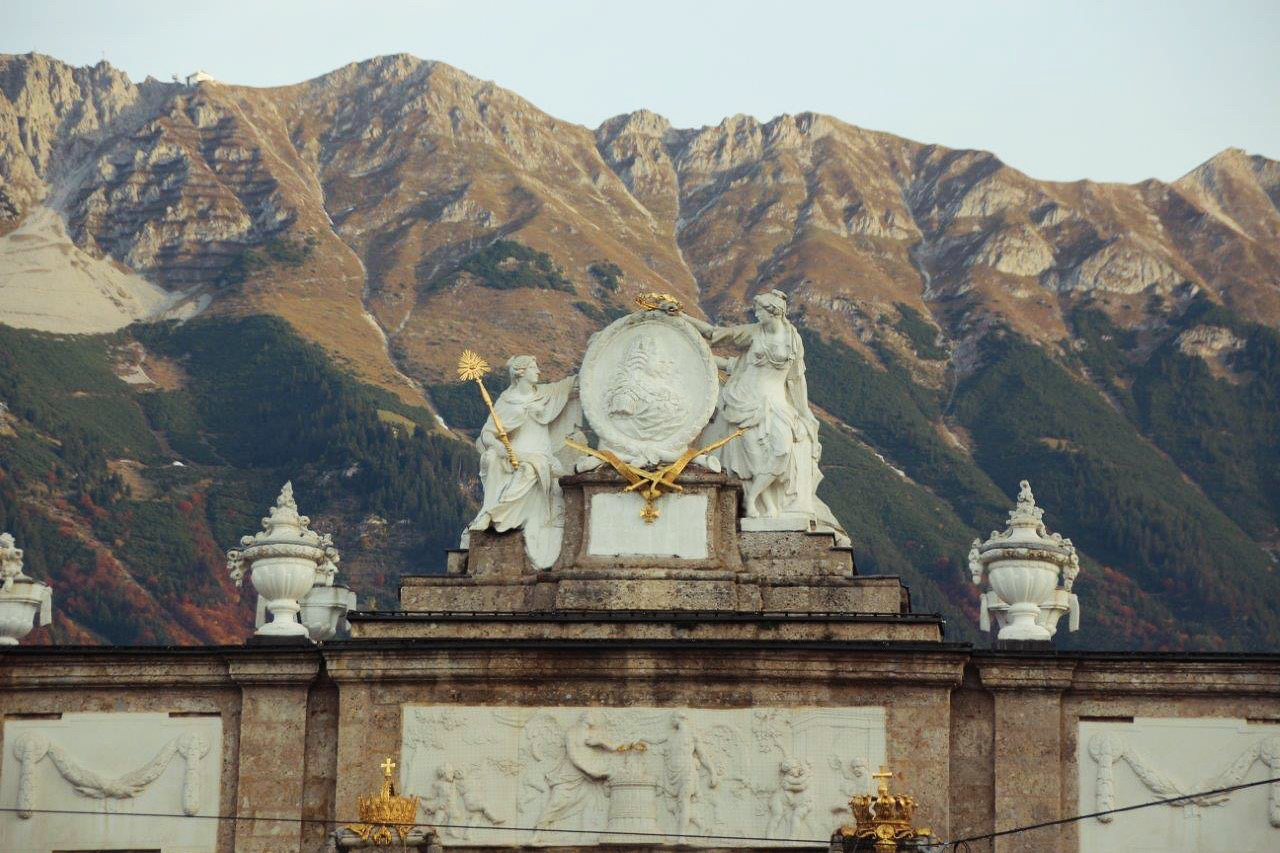
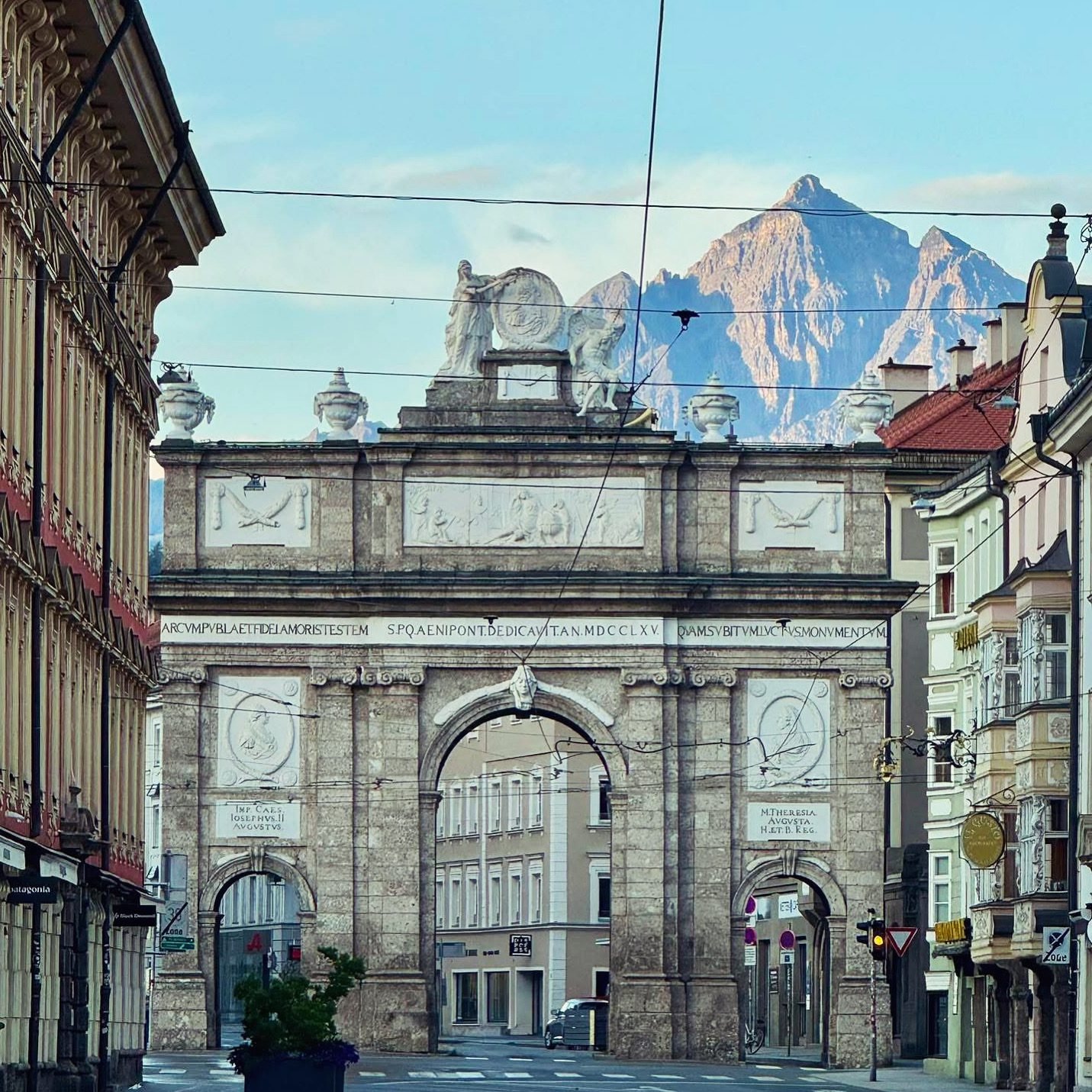
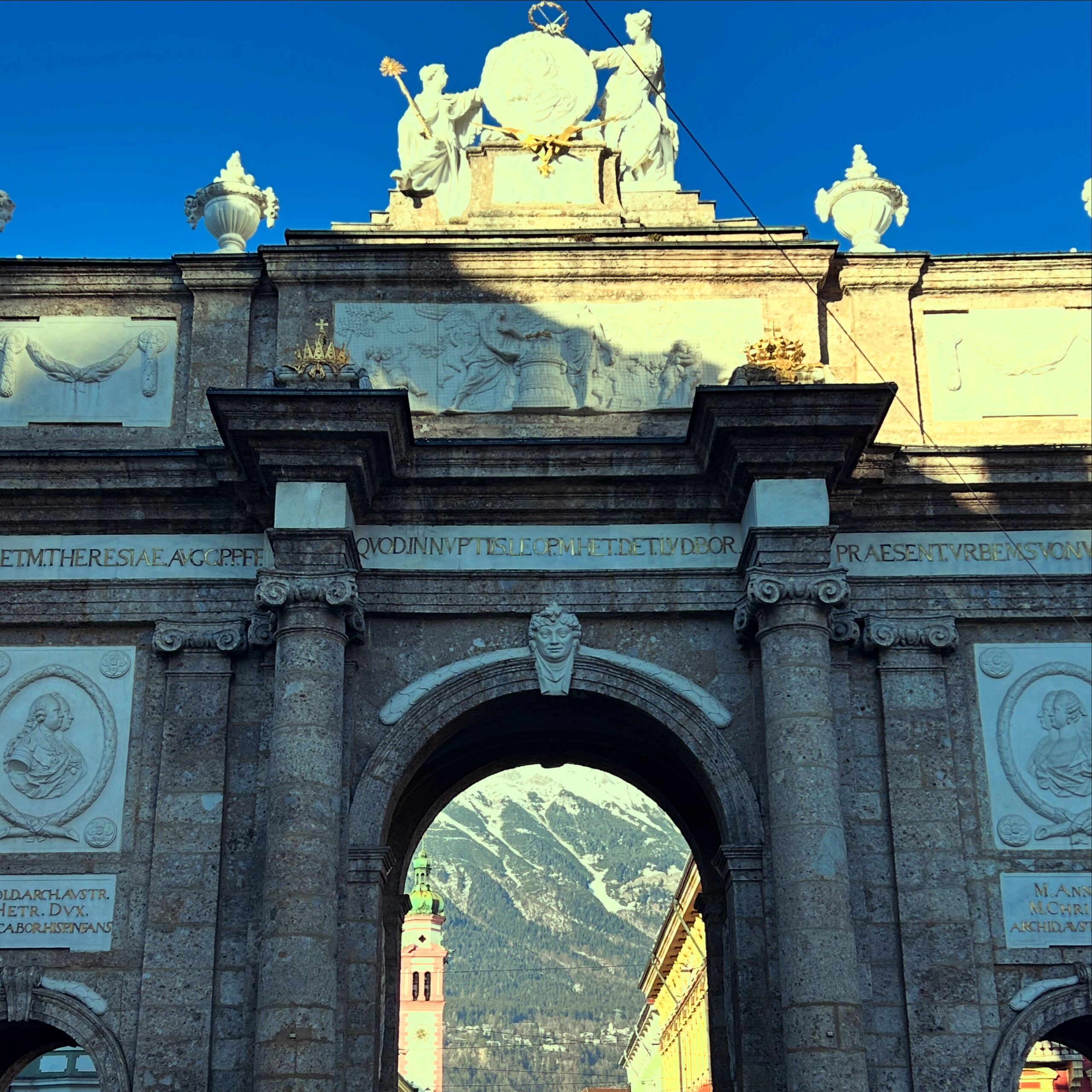
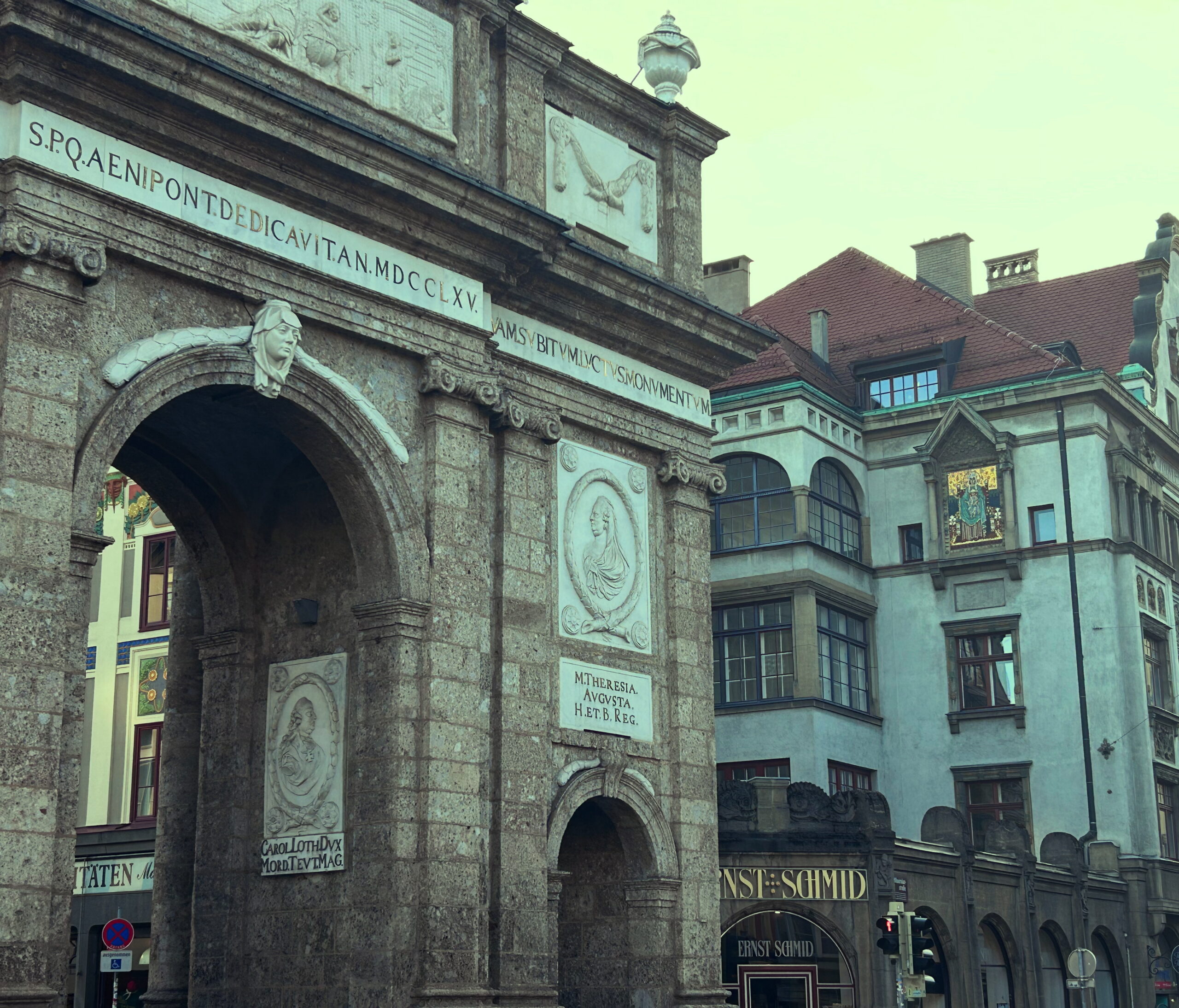
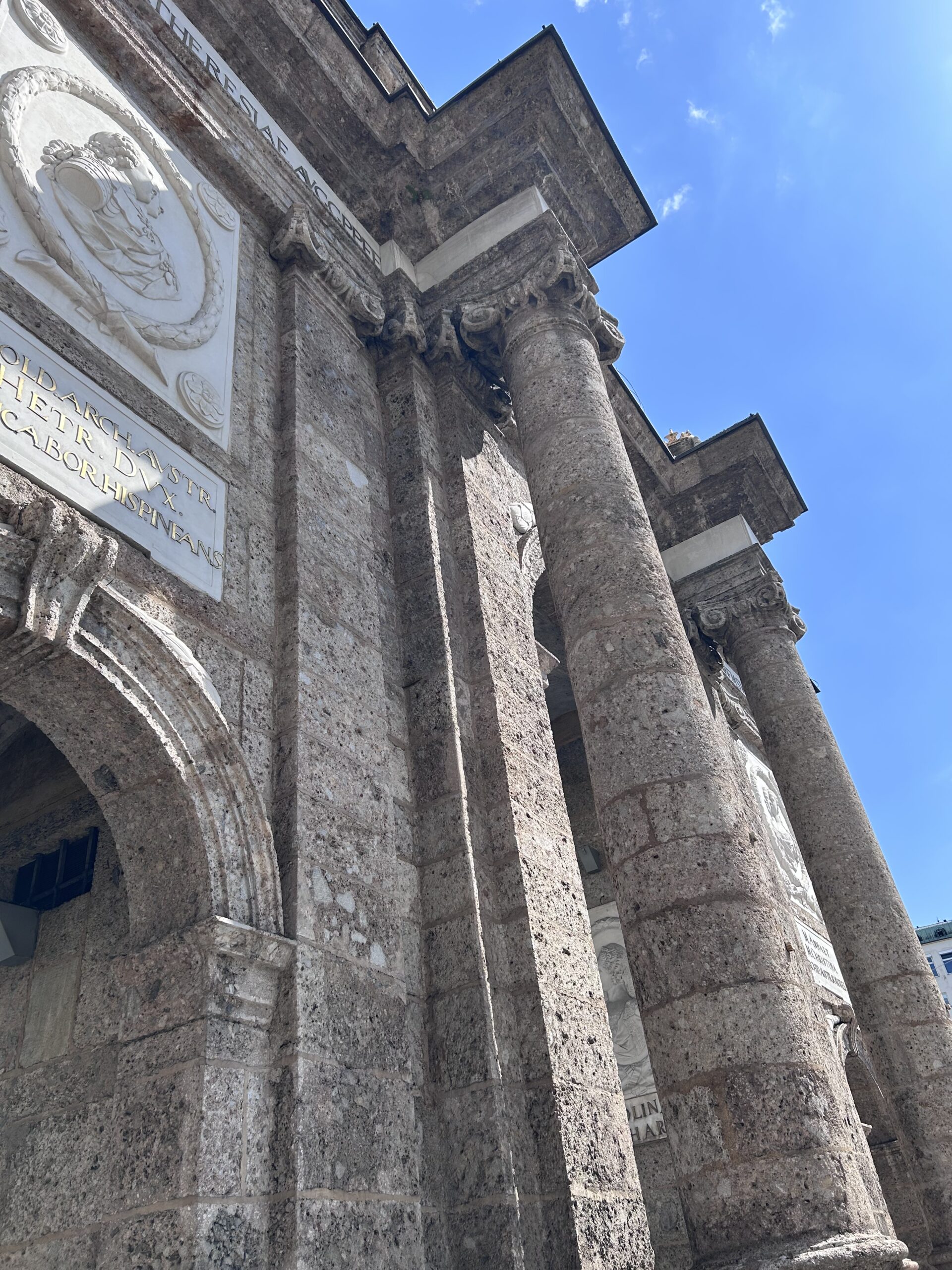
An imperial wedding and an imperial death within just a few days in the summer of 1765 briefly made Innsbruck the center of Europe. The Triumphal Arch (Triumphpforte) commemorates the events that took place in Innsbruck. On August 5, Maria Theresa’s son Leopold married the Spanish princess Maria Ludovica in Innsbruck. For the wedding party arriving from southwestern and eastern Europe, Innsbruck was an ideal meeting point to seal the union, as the former residence city already had experience hosting royal and princely weddings. But this time, everything that could go wrong did go wrong. Despite all efforts, the cultural program in the small city could not match the tastes of the noble society. Innsbruck, despite its glorious past as a residence city, had been little more than a provincial town for nearly 100 years. Unstable weather and the groom’s bout of gastroenteritis dampened the mood. News of the bride’s uncle’s death did not help either. The greatest misfortune came shortly after the wedding: on August 18, the groom’s father, Emperor Francis Stephen I of Habsburg-Lorraine, died of a stroke.
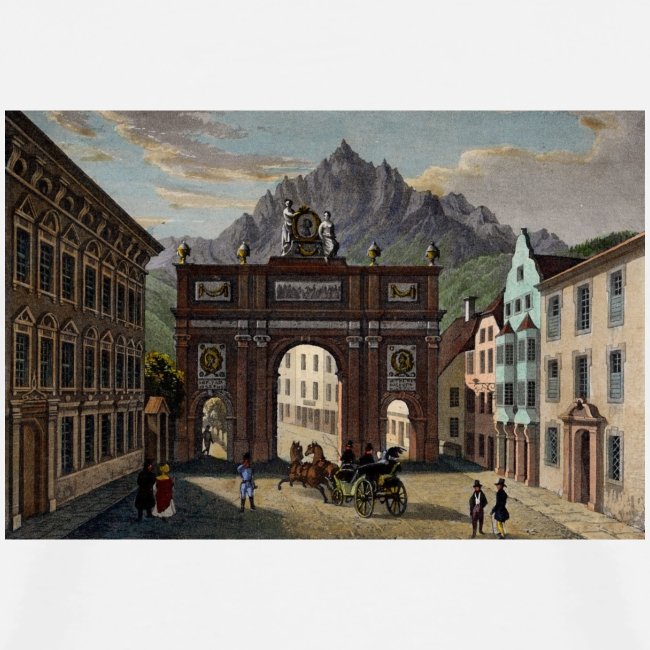
Originally, the wooden arch was intended only as a temporary, festively decorated entrance to the city for the wedding. Reviving the Roman custom of triumphal arches for major events of the imperial family was not unusual. A similar arch had been erected for Emperor Charles VI’s ceremonial entry into the city. In 1774, Maria Theresa had her triumphal arch built permanently in stone, modeled after the ancient Emperor Constantine’s arch, to commemorate both her husband’s death and her son’s wedding forever. The southern side of the arch, facing Leopoldstraße, expresses joy over the wedding of the future Emperor Leopold II. The portrait of the couple is flanked by figures of Providentia Divina (Divine Providence) and Constantia (Constancy). These two virtues were considered essential by the Habsburgs, legitimizing their power over their subjects through divine right, which ensured the stability of the realm for the common good. On the northern side, facing Maria-Theresien-Straße, the angel of death looms in baroque grandeur, symbolizing grief over the emperor’s sudden death. The arch was built using remnants of the city wall and demolition material from the suburban gate at today’s southern Old Town entrance, which had been removed in 1765 during modernization. With the Nordkette mountains to the south, Palais Sarnthein to the west, and the Winklerhaus to the east in the background, the Triumphal Arch today is no longer a memorial to the most disastrous wedding in the city’s history but a stunning photo spot. It’s worth getting up early, as daytime traffic can be quite disruptive if you want to capture a perfect shot.
Maria Theresia, Mother of the Nation and Reformer
Maria Theresa ranks among the most important figures in Austrian history. Particularly significant were her domestic reforms, many of which had a tangible impact on the everyday lives of Innsbruck’s inhabitants and are still visible today in the city’s built environment. Together with her most influential advisers—Friedrich Wilhelm von Haugwitz, Joseph von Sonnenfels, and Wenzel Anton Kaunitz—she succeeded in transforming the so‑called Austrian hereditary lands into a modern state. Instead of governing her territories through the local nobility, she relied on a centralized, professional administration. In keeping with Enlightenment thought, her advisers recognized that the welfare of the state depended on the health and level of education of its individual subjects. An early healthcare reform of 1742 obliged the professors of medicine at the University of Innsbruck not only to teach but also to ensure the operation of the municipal hospital in the Neustadt district. A school reform likewise reshaped the educational landscape within the city walls, both spatially and conceptually. Due to a lack of space, the school was relocated from Domplatz to Kiebachgasse, and its educational mission was redefined. Subjects were expected to remain Catholic, but their loyalty was to be directed toward the state. Education was placed under centralized state control in order to develop talents in a targeted manner. The aim was not to raise critical, humanistic intellectuals, but rather to train personnel for the state administrative apparatus. This reform laid the foundation for later social mobility. Through military service and civil administration, non‑nobles were now able to pursue careers and climb the social ladder. Any improvement of the individual was regarded as a gain for the whole. Further measures followed that affected not only the national economy but also the daily lives of most people. The standardization of weights and measures made the tax system more precise and less susceptible to abuse. For farmers, the harmonization of laws meant that their livelihoods were less dependent on local landlords and their arbitrary decisions. The Robot—the unpaid compulsory labor owed by peasants to their landlords—was also abolished under Maria Theresa. A shift in thinking likewise took place in criminal prosecution and the judicial system. In 1747, a small police force was established in Innsbruck to oversee market regulation, trade and guild regulations, control of foreigners, and public morals. Above all, this served to regulate the provision of goods in favor of consumers. Not only poor quality but also price gouging was punished. The strictness of early food inspections is illustrated by a police record from 1748, in which a butcher from Pradl was fined for exceeding the legally fixed meat prices. This denser network of regulations and improved law enforcement went hand in hand with a more humane system of punishment. Although the criminal code Constitutio Criminalis Theresiana did not abolish torture, it did strictly regulate its use. Yet despite Maria Theresa’s self‑presentation as a pious mother of the land and her reputation today as an Enlightenment ruler, the devoutly Catholic sovereign was uncompromising when it came to power and religion. In keeping with Enlightenment thought, she ordered critical investigations into superstitions such as vampirism, which was widespread in the eastern parts of her realm, and initiated the final end of the witch trials. At the same time, however, Protestants were ruthlessly expelled from the country. Many Tyroleans were forced to leave their homeland and resettle in more remote regions of the Habsburg monarchy.
In crown lands such as Tyrol, which had previously enjoyed a high degree of autonomy, Maria Theresa’s reforms were met with little approval. Centralization remains a sensitive issue in Austrian politics to this day. With the exception of a few liberals, people saw themselves more as an independent, autonomous land and less as part of a modern territorial state. The clergy also resented their new subordinate role, which was further intensified under Joseph II. For the local nobility, the reforms meant not only a loss of status and autonomy but also higher taxes and levies. Taxes, duties, and customs revenues that had long provided Innsbruck with reliable income were now collected centrally and only partially returned through fiscal redistribution. To mitigate the social decline of sons from impoverished noble families and prepare them for state service, Maria Theresa founded the Theresianum, which also had a branch in Innsbruck from 1775 onward. As so often, time smoothed over former conflicts, and today Innsbruck’s inhabitants take pride in having hosted one of the most significant rulers in Austrian history. Not only the Triumphal Arch and the Imperial Palace (Hofburg), but also the Turnvereinshaus and the New City School recall the Theresian era, a period in which the state began to intervene ever more deeply in the lives of its citizens from the moment they entered school.
Holy Roman Empire
The state of Austria is a relatively young invention, as is citizenship. For more than 1,000 years, Innsbruck was part of the Holy Roman Empire. The people of Innsbruck were subjects of the Emperor—and subjects of the Tyrolean territorial prince—and of their feudal lord. If they possessed civic rights, they were also citizens of Innsbruck. And very likely they were Christians as well. What they were not, at least until 1806, was Austrian. But what exactly was this Holy Roman Empire? And who was the Emperor? And was he really more powerful than a king? The French philosopher Voltaire is said to have mocked it in 1761 with the words: “The Holy Roman Empire was neither holy, nor Roman, nor an empire.” He was probably not entirely wrong. In reality, it was an association of individual territories, shaped by conflicts and disputes over power—both among the princes of the Empire themselves and between the princes and the Emperor. It had no capital. The center of the Empire was wherever the Emperor happened to be, as he frequently changed his residences. Emperor Maximilian I. made Innsbruck one of his residences, which acted like a turbo boost for the city’s development. Nationality and a sense of belonging played a much smaller role in political affiliation until the 19th century than they do today. The bond that held much together was Christianity. Institutions such as the Imperial Chamber Court or the Imperial Diet were introduced only in the late Middle Ages and the Early Modern period to facilitate administration and to settle disputes among the territorial princes. The Golden Bull, which among other things regulated the election of the Emperor, was a very simple form of an early constitution. Three ecclesiastical and four secular prince-electors chose their head. The princes had seat and vote in the Imperial Diet, and the Emperor depended on them. To assert himself, he required a strong dynastic power base. The Habsburgs were able to draw on Tyrol for this, among other territories. Tyrol repeatedly became a bone of contention between the Habsburgs and the Dukes of Bavaria, even though both belonged to the Holy Roman Empire. Innsbruck was several times administered by Bavarian princely dynasties.
The hierarchy within the feudal system was strictly ordered, from the Emperor down to the peasant. Emperors and kings received power and legitimacy directly from God. The feudal system was divinely ordained. Peasants—more than 90 percent of the medieval population—worked in agriculture to sustain the clergy, who prayed for salvation, and the aristocracy, who fought for the defenseless and protected the clergy. It was a three-part relationship: one side provided order and prayers for the salvation of humankind, another provided protection of life and limb, and the third contributed obedience, loyalty, and labor. This concept of loyalty may seem alien to modern citizens, as today’s obligations—taxes, compliance with laws, elections, or compulsory service—are more abstract and far less personal. Yet well into the 20th century, the feudal system was built precisely on this principle. Loyalty was not based on a birthright comparable to modern citizenship. The “Austrian” military commander Prince Eugene may have been of French origin, yet he fought in the army of Leopold I., Emperor of the Holy Roman Empire, against France. He was a subject of the Archduke of Austria, with residences in Vienna and Hungary. While today one must be a native-born U.S. citizen to become President of the United States, rulers in earlier times were likewise not bound to an inherited nationality. Emperor Charles V. was born in what is now Ghent in Belgium, grew up at the Burgundian court, became King of Spain, inherited the Archduchy of Austria, and was later elected Emperor. To be “Germanic” did not mean to be German; it usually referred to the everyday language a person spoke.
The “Roman” element in the German imperial title was a centuries-old concept. When Charlemagne was crowned Roman-German Emperor in Rome in the year 800, he assumed the legacy of the Roman emperors with divine legitimacy through papal anointing—and at the same time became the secular protector of the Pope. In return, the Emperor was the earthly protector of the Holy Father. The Holy Roman Empire under the mantle of the Emperor ceased to exist in 1806 during the Napoleonic Wars. From this point onward, Central Europe slowly began to transform into a collection of nation-states modeled on France and England. The idea of the Roman Empire was rooted in the adventurous ancient notion that ancient Rome had to continue to exist. For devout Christians, according to the doctrine of the Four World Empires, it was of immense importance that the Empire endured. This doctrine was based on the Book of Daniel in the Old Testament. According to the story, the Babylonian king Nebuchadnezzar dreamed of four successive world empires. With the end of the fourth empire, the prophet foretold, the world would also come to an end. Around the year 400, the Church Father Jerome interpreted these four empires as Babylon, Persia, Greece, and the Roman Empire. In medieval belief, the end of Roman rule would therefore also mean the end of the world—and so Rome must not fall. Through the so-called translatio imperii, the transfer of the legal claim of the ancient Roman Empire to the Roman-German emperors after Charlemagne, Rome’s continuity was formally preserved, and the world was allowed to endure. Thanks to the Emperor, humanity still exists today.
Innsbruck and the House of Habsburg
Innsbrucks Innenstadt wird bis heute von Gebäuden und Denkmälern geprägt, die an die Familie Habsburg erinnern. Unzählige Touristen bewundern die stummen Hinterlassenschaften der Dynastie, die als mindestens ebenso ur-österreichisch gilt wie Schnitzel, Mozartkugeln und Mehlspeisen. Diese Darstellung ist allerdings nicht korrekt, auch wenn die Habsburger die Landesgeschichte über Jahrhunderte mitprägten. Sie waren ein europäisches Herrscherhaus, zu dessen Einflussbereich verschiedenste Territorien gehörten. Am Zenit ihrer Macht waren ihre Mitglieder die Herrscher über ein „Reich, in dem die Sonne nie untergeht“. Durch Kriege und geschickte Heirats- und Machtpolitik saßen sie in verschiedenen Epochen an den Schalthebeln der Macht zwischen Südamerika und der Ukraine. Ob der internationalen Ausrichtung des Hauses Habsburg verwundert es nicht, dass so mancher CEO der Grafschaft Tirol aus dieser Dynastie zumindest am Anfang etwas fremdelte mit der alpinen Provinz und ihren Einwohnern. Einige der Tiroler Landesfürsten hatten weder eine besondere Beziehung zu Tirol noch brachten sie diesem deutschen Land besondere Zuneigung entgegen. Ferdinand I. (1503 – 1564) wurde am spanischen Hof erzogen. Maximilians Enkel Karl V. war in Burgund aufgewachsen. Als er mit 17 Jahren zum ersten Mal spanischen Boden betrat, um das Erbe seiner Mutter Johanna über die Reiche Kastilien und Aragorn anzutreten, sprach er kein Wort spanisch. Als er 1519 zum Deutschen Kaiser gewählt wurde, sprach er kein Wort Deutsch. Es waren auch nicht alle Habsburger glücklich in Innsbruck sein zu „dürfen“. Angeheiratete Prinzen und Prinzessinnen wie Maximilians zweite Frau Bianca Maria Sforza oder Ferdinand II. zweite Frau Anna Caterina Gonzaga strandeten ungefragt nach der Hochzeit in der rauen, deutschsprachigen Bergwelt. Stellt man sich zudem vor, was ein Umzug samt Heirat von Italien nach Tirol zu einem fremden Mann für einen Teenager bedeutet, kann man erahnen, wie schwer das Leben der Prinzessinnen war. Kinder der Aristokratie wurden bis ins 20. Jahrhundert vor allem dazu erzogen, politisch verheiratet zu werden. Widerspruch dagegen gab es keinen. Man mag sich das höfische Leben als prunkvoll vorstellen, Privatsphäre war in all dem Luxus nicht vorgesehen.
Innsbruck repeatedly became a place of destiny for this ruling dynasty. Thanks to its strategically favorable location between Italian cities and German centers such as Augsburg and Regensburg, Innsbruck gained a special status within the empire at the latest after being elevated to a residence city under Emperor Maximilian. Innsbruck experienced its Habsburg heyday when it served as the main residence of the Tyrolean sovereigns. Ferdinand II, Maximilian III, and Leopold V, together with their wives, shaped the city during their reigns. When Sigismund Franz of Habsburg (1630–1665) died childless as the last provincial ruler, Innsbruck also lost its status as a residence city, and Tyrol was governed by a governor. Tyrolean mining had lost much of its importance and no longer required special attention. Shortly thereafter, the Habsburgs lost their possessions in Western Europe, including Spain and Burgundy, which pushed Innsbruck from the center to the periphery of the empire.
Despite this decline in favor and the increasing centralization of government affairs, Tyrol, as a conservative region, generally remained loyal to the dynasty. Even after the period as a residence city, the births of new members of the ruling family were dutifully celebrated with parades and processions; deaths were mourned with memorial masses; and archdukes, kings, and emperors were immortalized in public spaces with statues and paintings. In the nineteenth century, the Jesuit Hartmann Grisar wrote the following about the celebrations marking the birth of Archduke Leopold in 1716:
„But what an imposing sight it was when, as night fell, the Abbot of Wilten held the final religious function in front of St Anne's Column, which had been consecrated by the blood of the country, surrounded by rows of students and the packed crowd; when, by the light of thousands of burning lights and torches, the whole town, together with the studying youth, the hope of the country, implored heaven for a blessing for the Emperor's newborn first son.“
The Habsburgs valued the Nibelung-like loyalty of their alpine subjects. The region’s difficult accessibility made it a perfect refuge in turbulent and crisis-ridden times. Charles V (1500–1558) fled to Innsbruck for a time during a conflict with the Protestant Schmalkaldic League. Ferdinand I (1793–1875) had his family stay in Innsbruck to keep them far from the Ottoman threat in eastern Austria. Shortly before his coronation, Franz Joseph I enjoyed the seclusion of Innsbruck during the turbulent summer of the 1848 revolution together with his brother Maximilian, who was later executed by nationalist insurgents as Emperor of Mexico. A plaque at the Alpine inn Heiligwasser above Igls commemorates the fact that the monarch spent the night there during his ascent of the Patscherkofel. In the Austro-Hungarian Monarchy of the nineteenth century, Innsbruck was the western outpost of a vast empire that extended as far as present-day Ukraine. Franz Joseph I (1830–1916) ruled a multiethnic empire between 1848 and 1916. His neo-absolutist understanding of rule, however, was outdated. Although Austria had had a parliament and a constitution since 1867, the emperor regarded this government as “his.” Ministers were accountable to the emperor, who stood above the government.
In the second half of the nineteenth century, the ailing empire began to crumble increasingly. On October 28, 1918, the Republic of Czechoslovakia was proclaimed; on October 29, Croats, Slovenes, and Serbs withdrew from the monarchy. The last emperor, Charles, abdicated on November 11. On November 12, “German-Austria declared itself a democratic republic in which all power emanates from the people.” The Habsburg chapter had come to an end. Even though only very few Austrians today can imagine a monarchy as a form of government, the view of the ruling family remains ambivalent. Despite all the national, economic, and democratic problems that existed in the multiethnic states that— in various forms and configurations—were subject to the Habsburgs, the successor nation-states in some cases proved far less successful at reconciling minority interests and cultural differences within their territories. Since the EU’s eastward enlargement, the Habsburg Monarchy has not infrequently been portrayed by well-meaning historians as a precursor to the European Union. The list of Habsburg legacies in Innsbruck is long. Together with the Catholic Church, the Habsburgs shaped public space through architecture, art, and culture. The Golden Roof, the Imperial Palace, the Triumphal Arch, Ambras Castle, the Leopold Fountain, and many other structures still bear witness today to the presence of what was arguably the most significant ruling dynasty in European history in Innsbruck.