University of Innsbruck
Innrain 52
Worth knowing
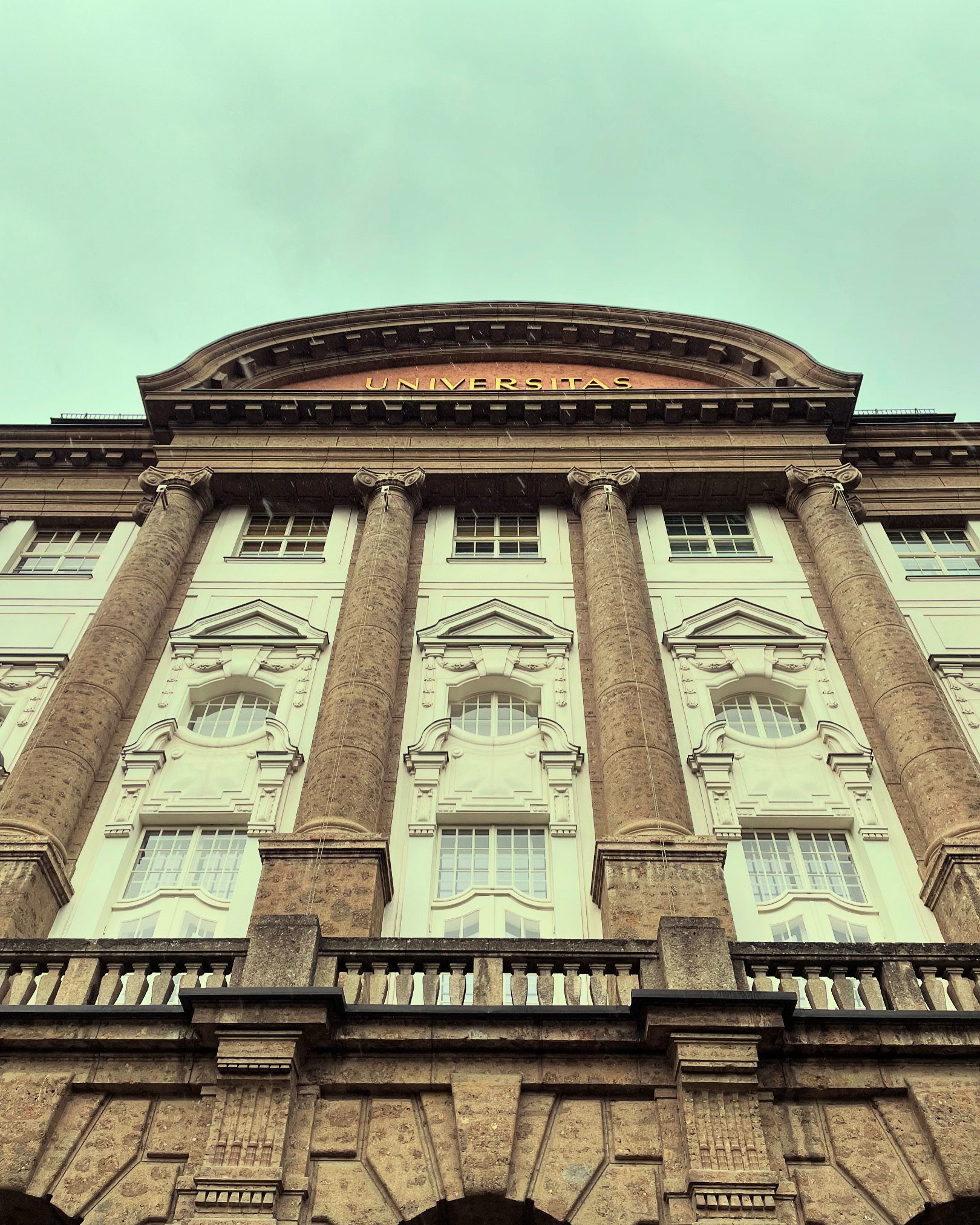
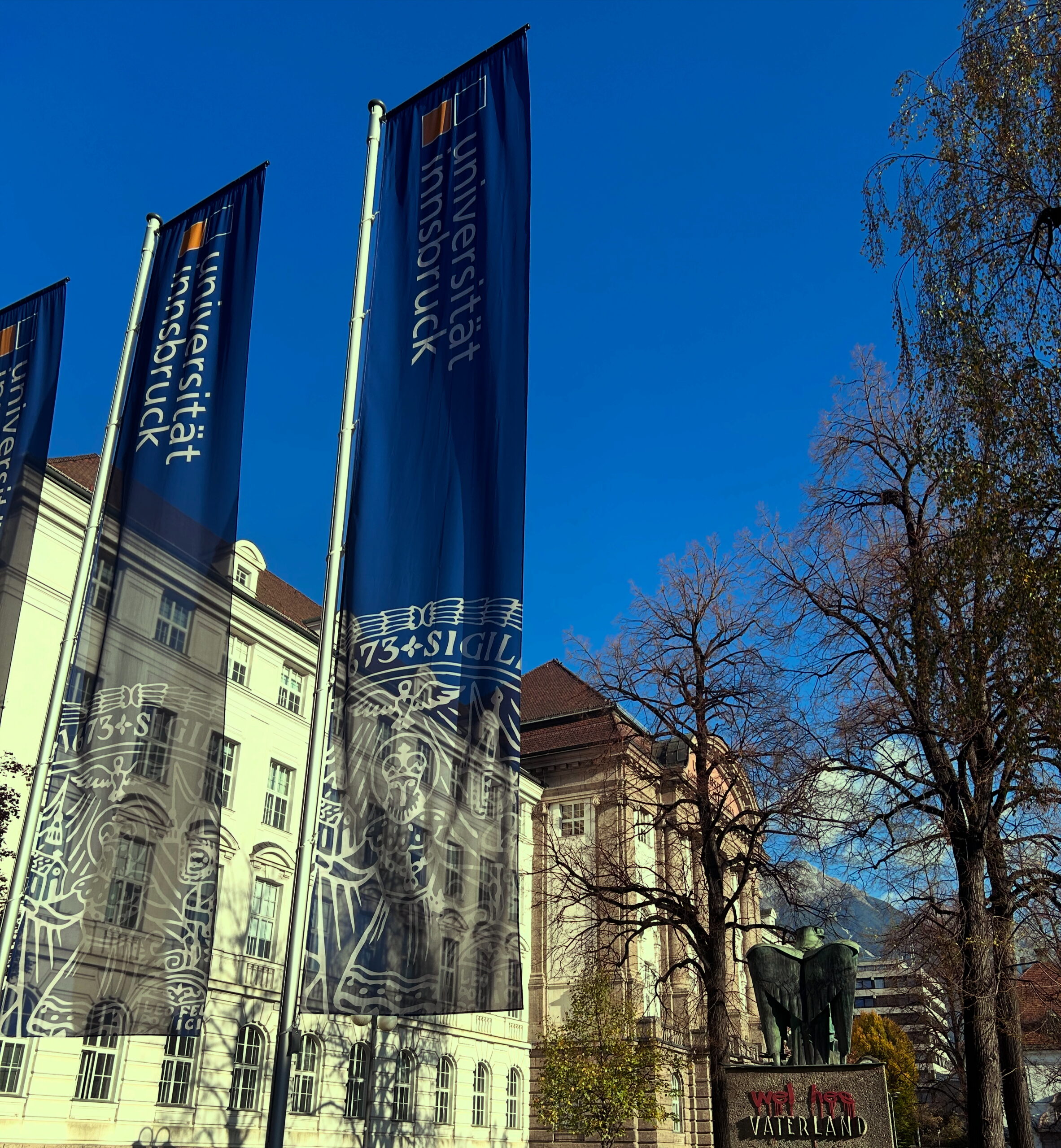
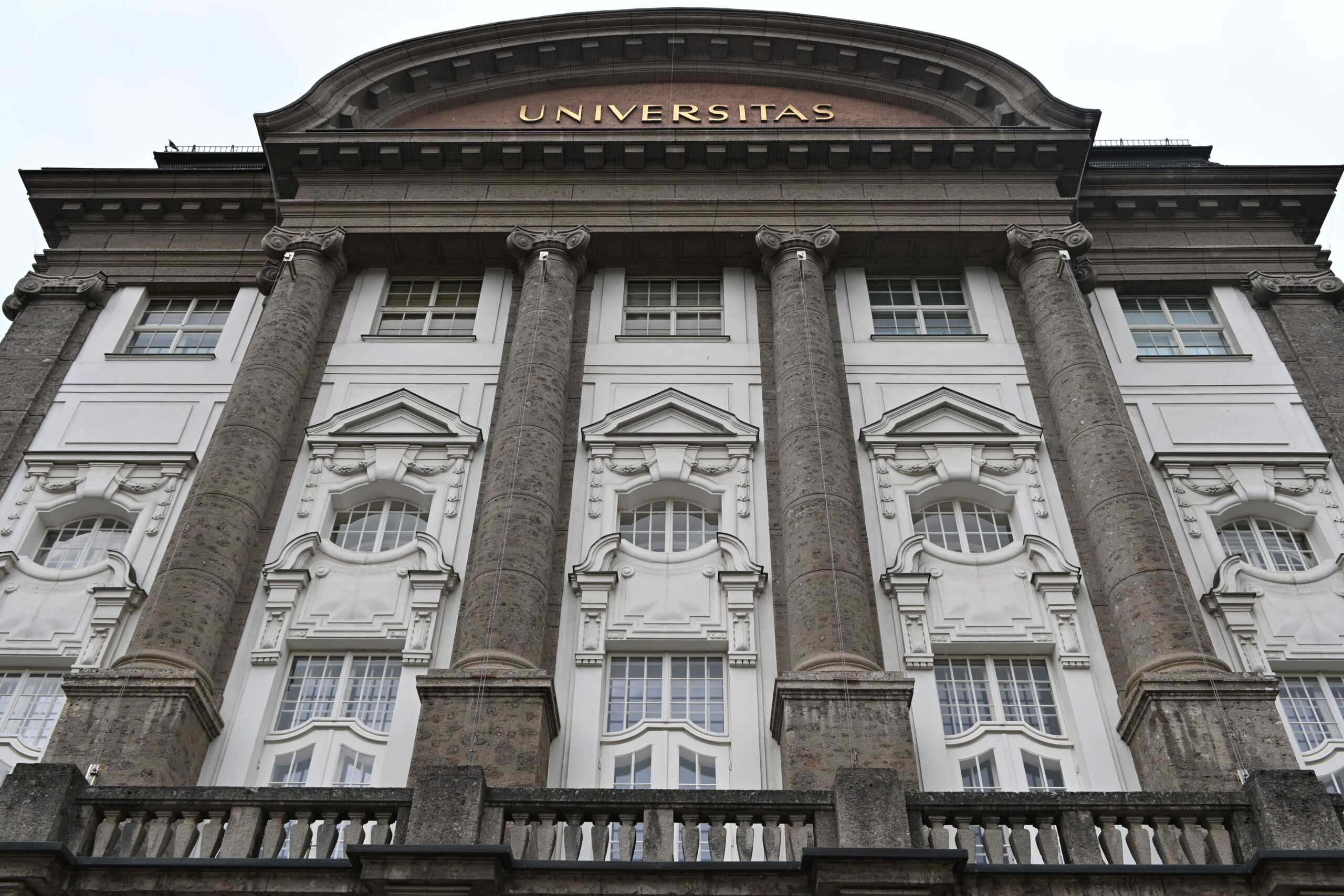
When the university began its work in 1669, it consisted of only a handful of professors and students pursuing their studies in Innsbruck. The number grew steadily, and by the mid‑eighteenth century around 600 students were already enrolled. Today, the university is one of the city’s largest employers and, with its many locations between the airport and Rossau, the largest user of real estate in Innsbruck. The university’s first location was not on Innrain but on Herrengasse, near the parish church of St. James. A lack of space forced students and professors to move to what was then the edge of the city. After three years of construction, the first completed building was the university library. In 1914, construction of the main building began according to plans by Josef Retter. Ionic columns adorn the entrance area of the palace‑like complex in the historicist style, whose construction dragged on for more than ten years due to delays caused by the war. Even before its completion, the university was used for other purposes for the first time: during the war years, the half‑finished rooms served as a military hospital. Only after 1918 did the historicist main building begin its service as an educational institution. While the double‑headed eagle still adorned the entrance of the library opened in 1914, after the abolition of the monarchy the main building had to make do with the inscription Universitas Leopoldino‑Franciscea as a gesture of reverence to the House of Habsburg. The old reading room in the library is particularly worth seeing.
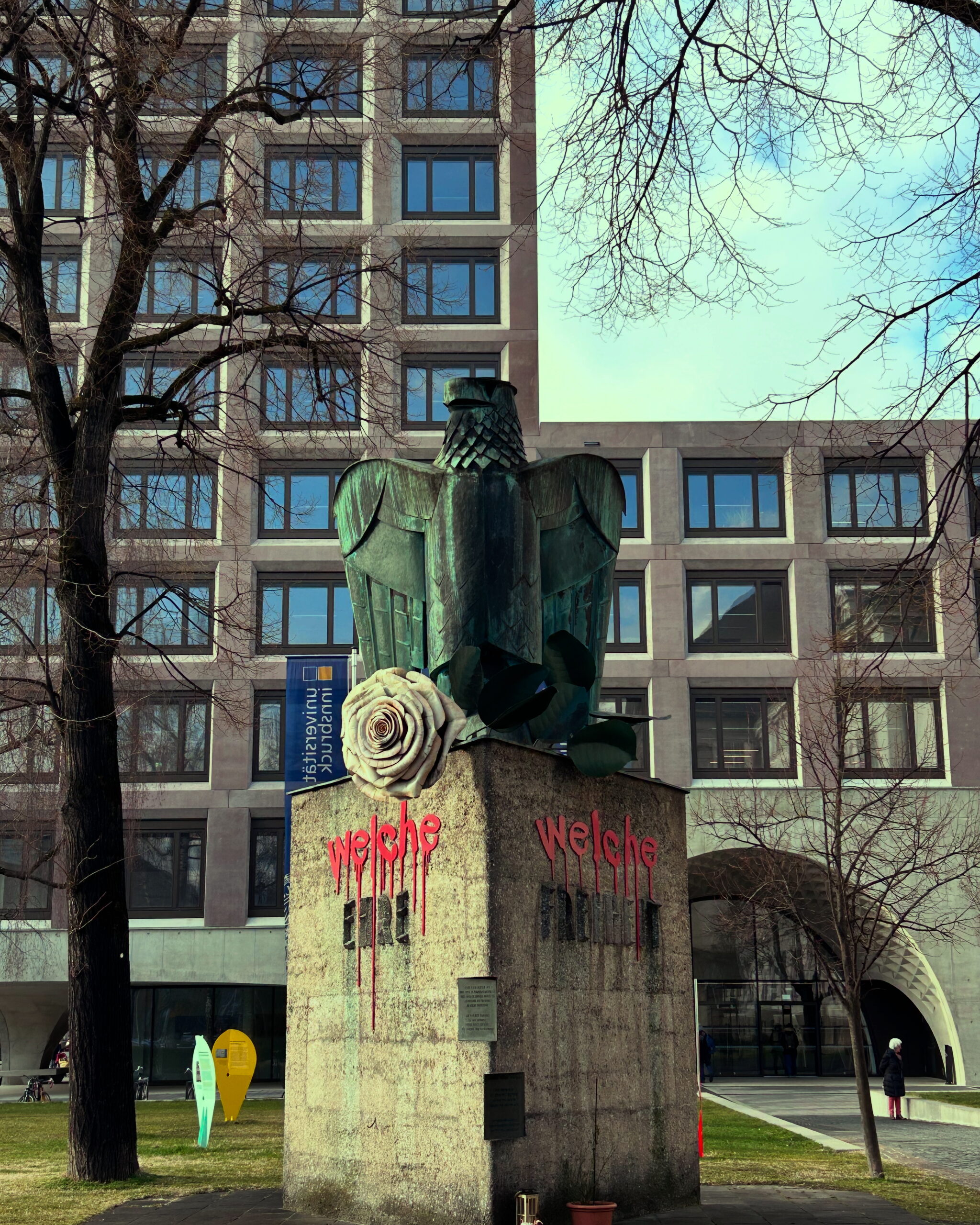
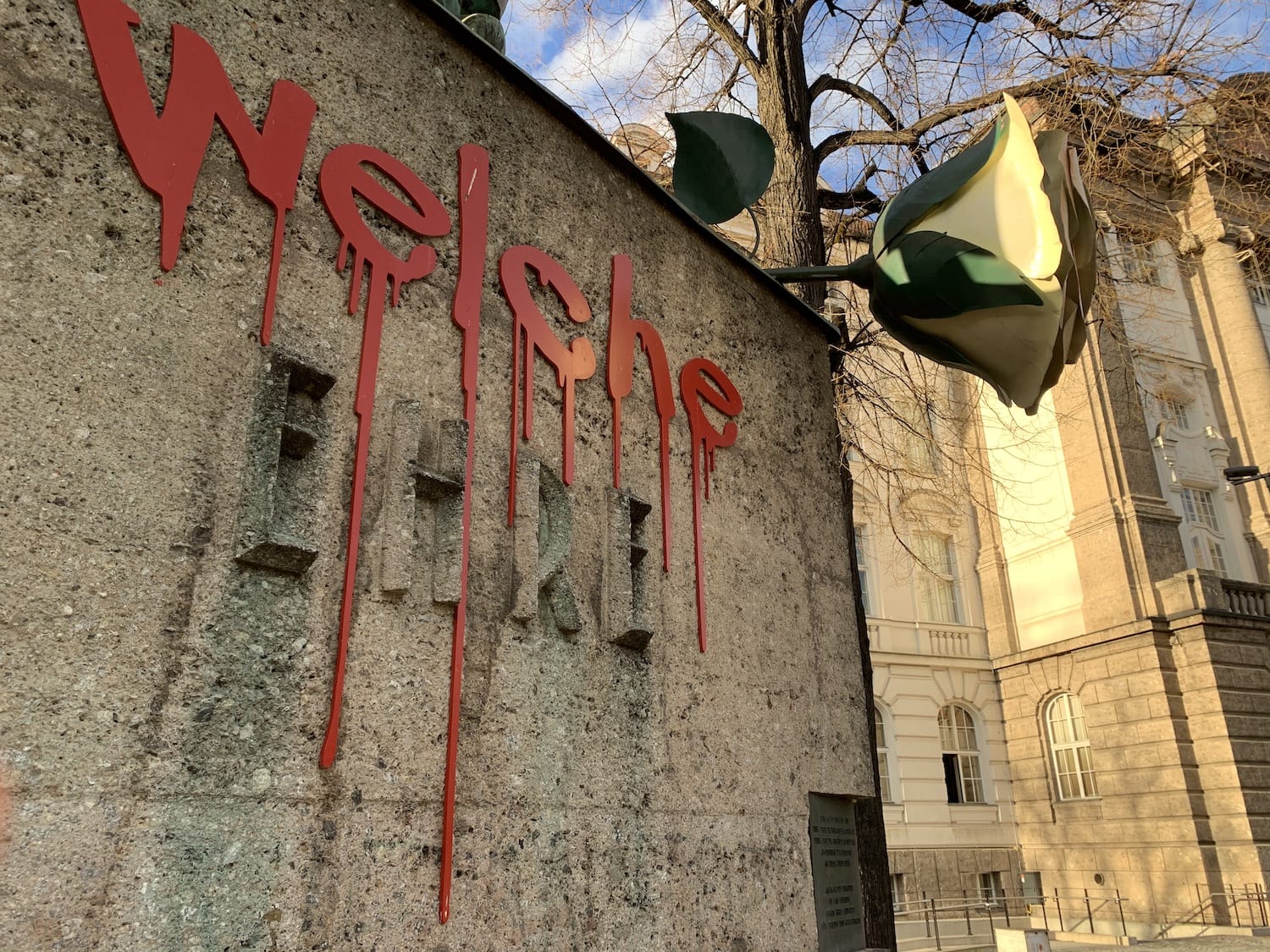
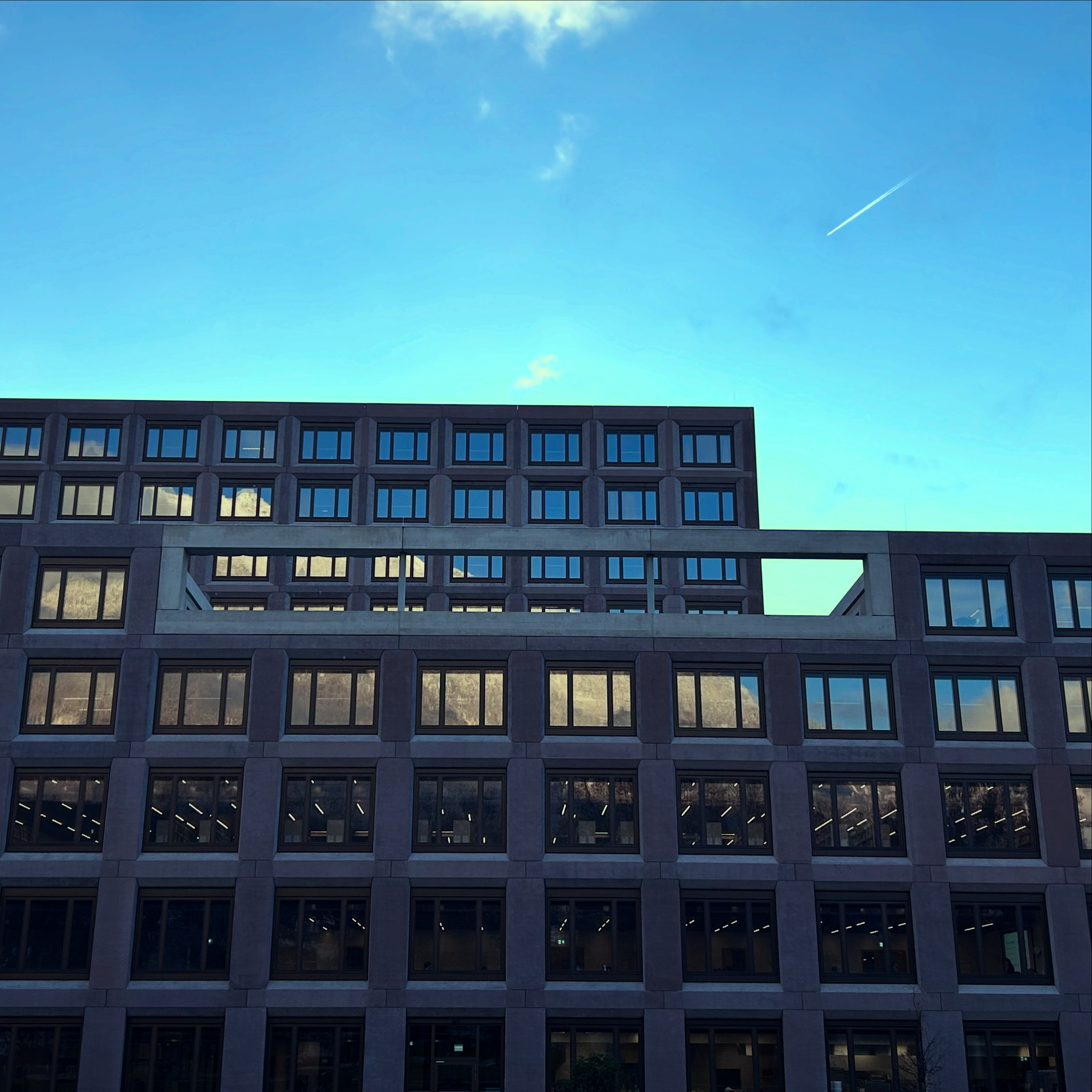
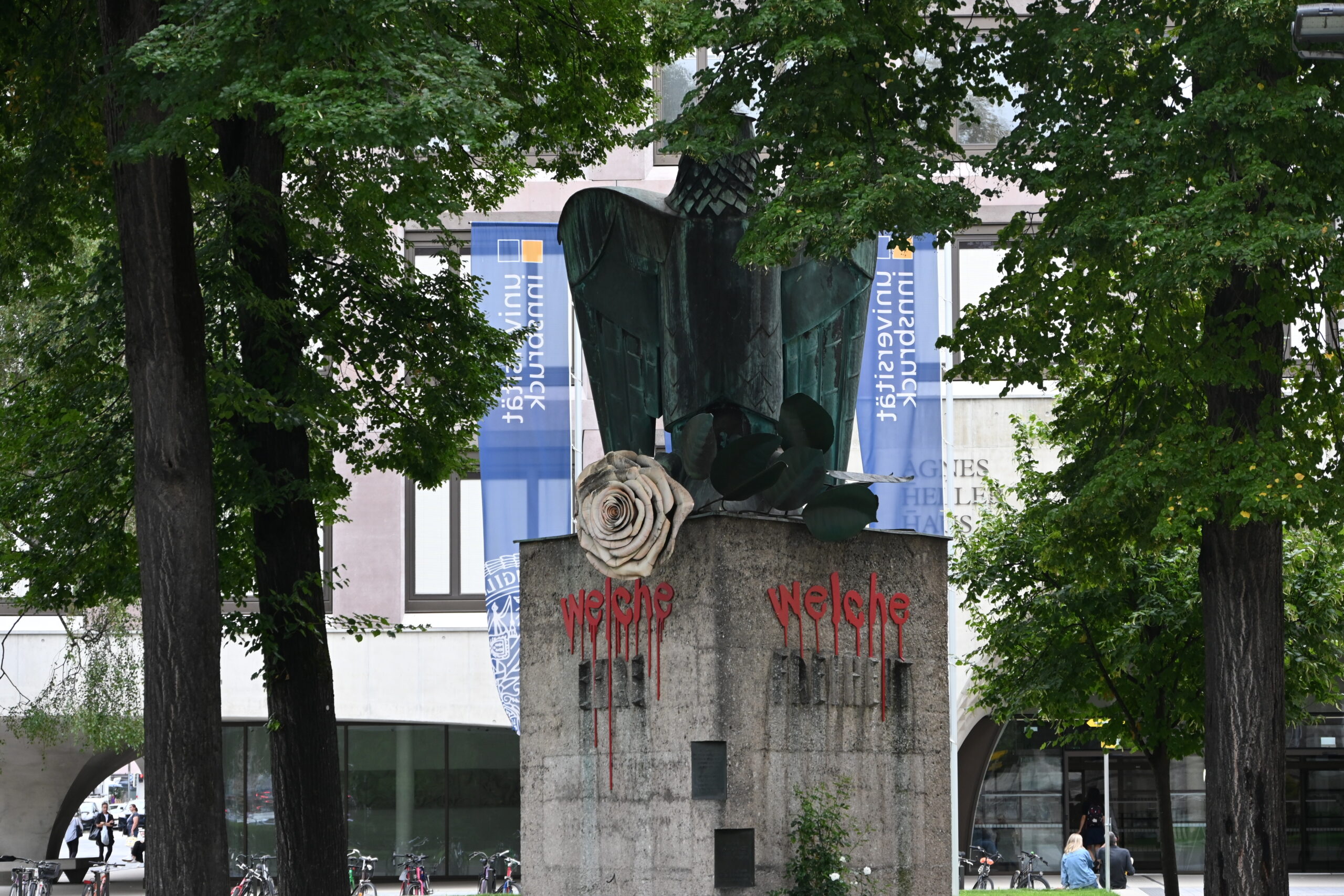
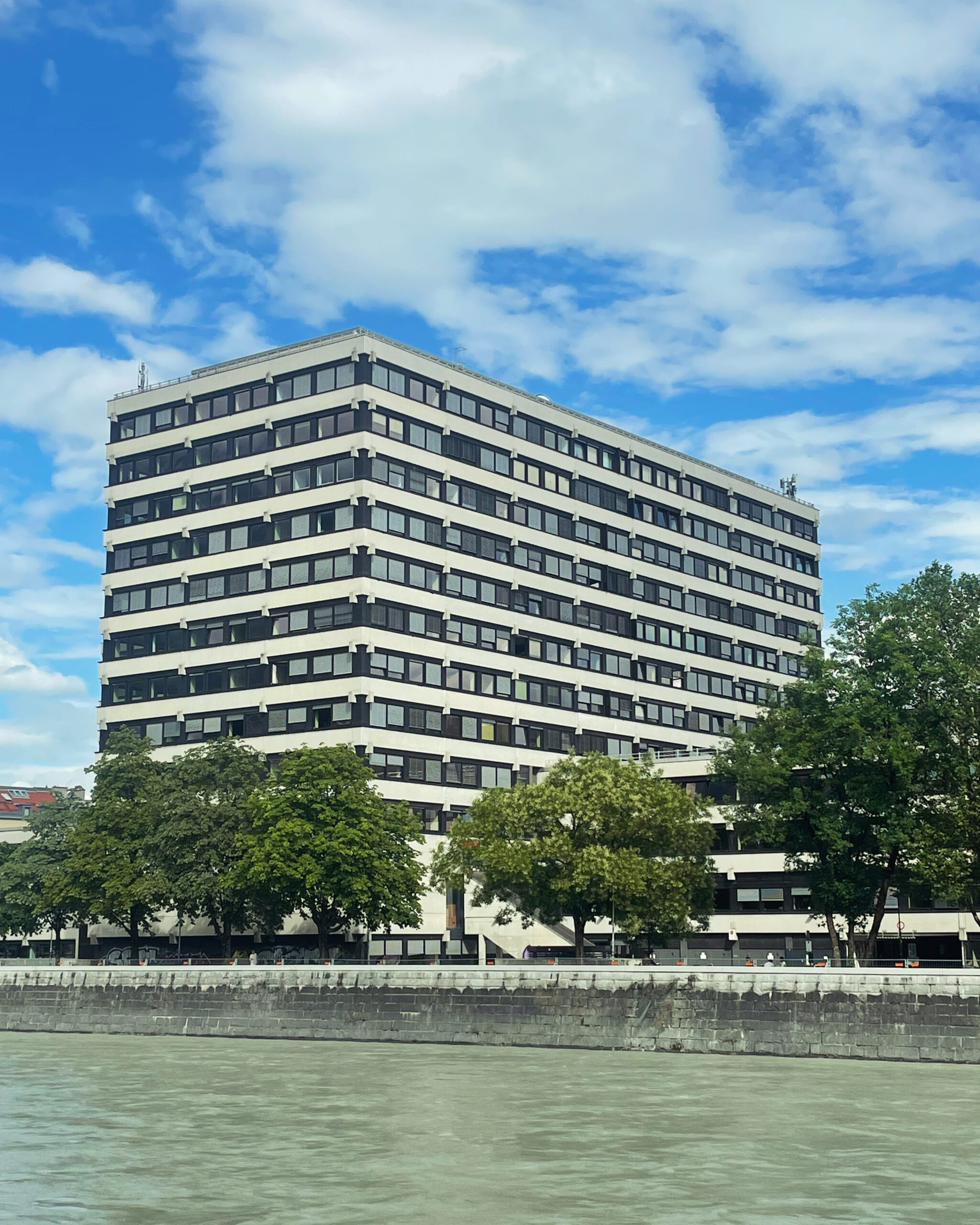
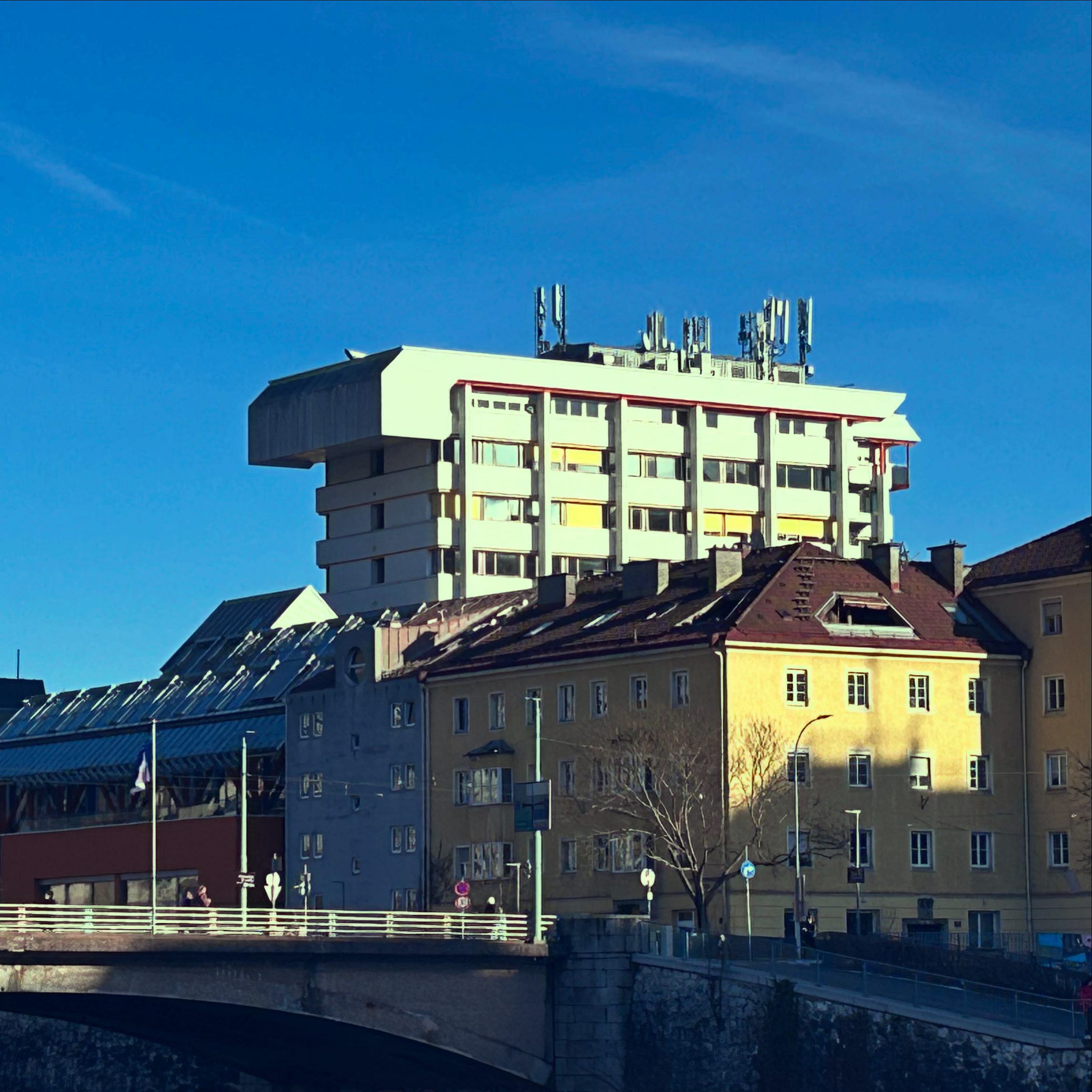
Over the course of the twentieth century, the university grounds on Innrain were steadily expanded to accommodate the growing number of faculties and students. Today, the entire campus forms a loosely connected yet interesting composition of architectural styles from the twentieth and twenty‑first centuries. The modern Agnes Heller House connects surprisingly harmoniously with the neo‑Baroque buildings beside the GeWi Tower. To the west of these lies a student residence. The University Bridge, opened in 1931 to relieve traffic congestion on the Inn Bridge near the Ottoburg during a time of increasing private car use, separates the modern parts of the university on Herzog‑Otto‑Ufer from the main buildings. The bulky Georg Trakl Tower looms with its daring roof construction over the orange building section below, which houses the New Mensa. In 2023, the building was named after the poet Georg Trakl (1887–1914), who lived in Innsbruck for a short time and is buried in Mühlau, and who took his own life in Galicia under the horrific impressions of the First World War. The ten‑storey building houses the Brenner Archive. Particularly controversial is the forecourt of the main university on Christoph‑Probst‑Platz, with the memorial designed by Lois Welzenbacher commemorating members of the university who fell in the First World War. Like many representatives of modern architecture and art of the 1920s, Welzenbacher was drawn to the excitement and novelty emanating from fascist movements. At least on paper, Mussolini and his associates aimed to completely reshape society in the spirit of Futurism. Welzenbacher’s enthusiasm in this regard was not exceptional. Young, ambitious people with aspirations for advancement, disappointed by the bleak post‑war situation, in particular felt addressed and reassured by the promise of renewal in all areas of life. A pan‑German mindset was widespread in the population anyway. Members of various student fraternities positioned themselves ideologically between pan‑German nationalism, conservative Catholic Austrofascism, and National Socialism. Scientific antisemitism and anti‑socialism were socially acceptable among academics of the time. Vice‑Rector Theodor Rittler inaugurated the memorial with the words: “Germany, may your Reich come!” The fraternity slogan “Honour – Freedom – Fatherland” was only expanded in 2019 by adding the word “Which” to each element. The renaming of the square as Christoph‑Probst‑Platz commemorates the Innsbruck medical student who was executed in 1943 as a member of the resistance group White Rose. A memorial plaque on the monument also recalls Probst and the university’s less commendable period between 1938 and 1945. A second plaque commemorates the liberation theologians Ignacio Ellacuría and Segundo Montes, two alumni of the University of Innsbruck who were murdered by the regime in San Salvador in 1989.
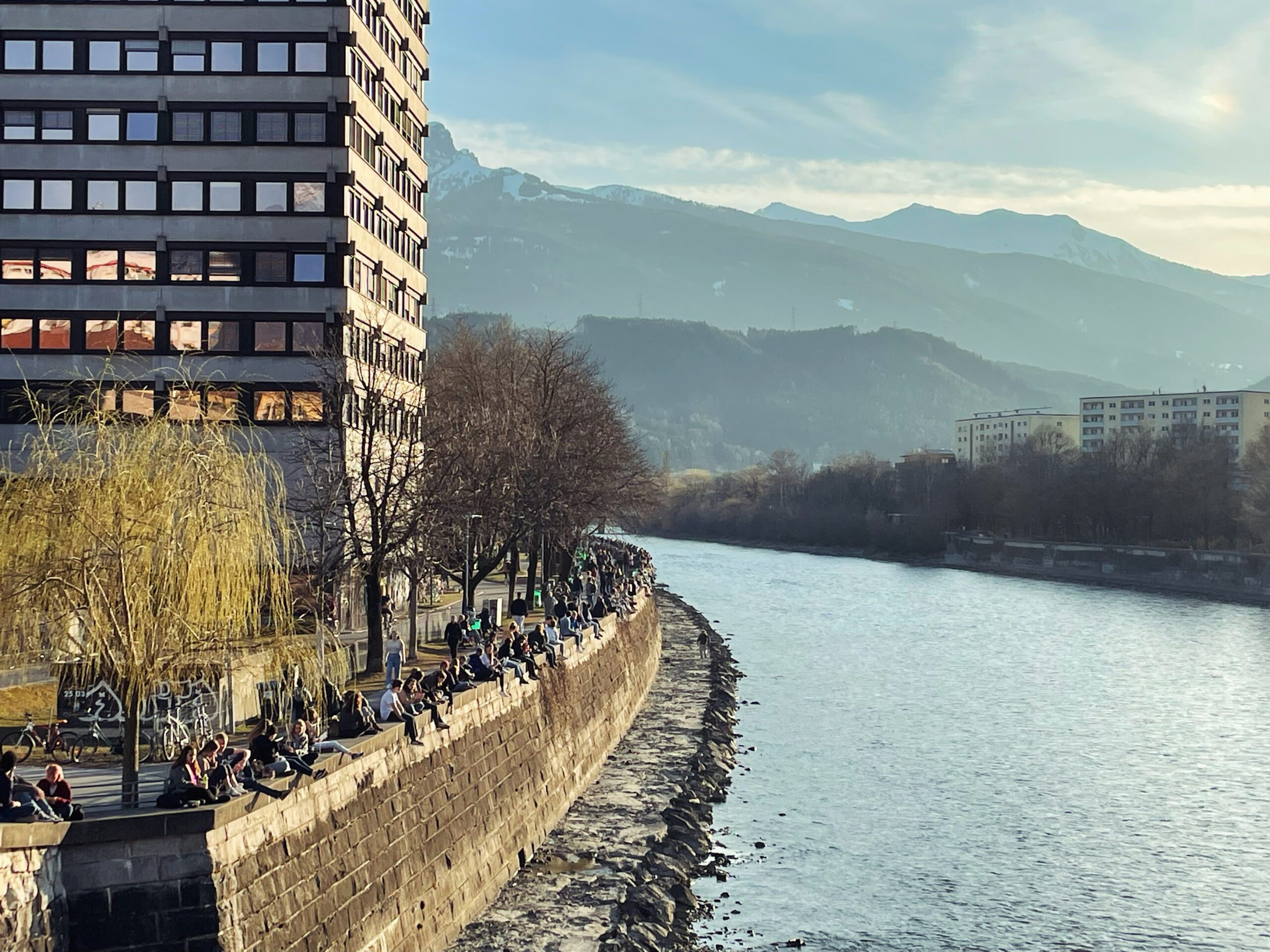
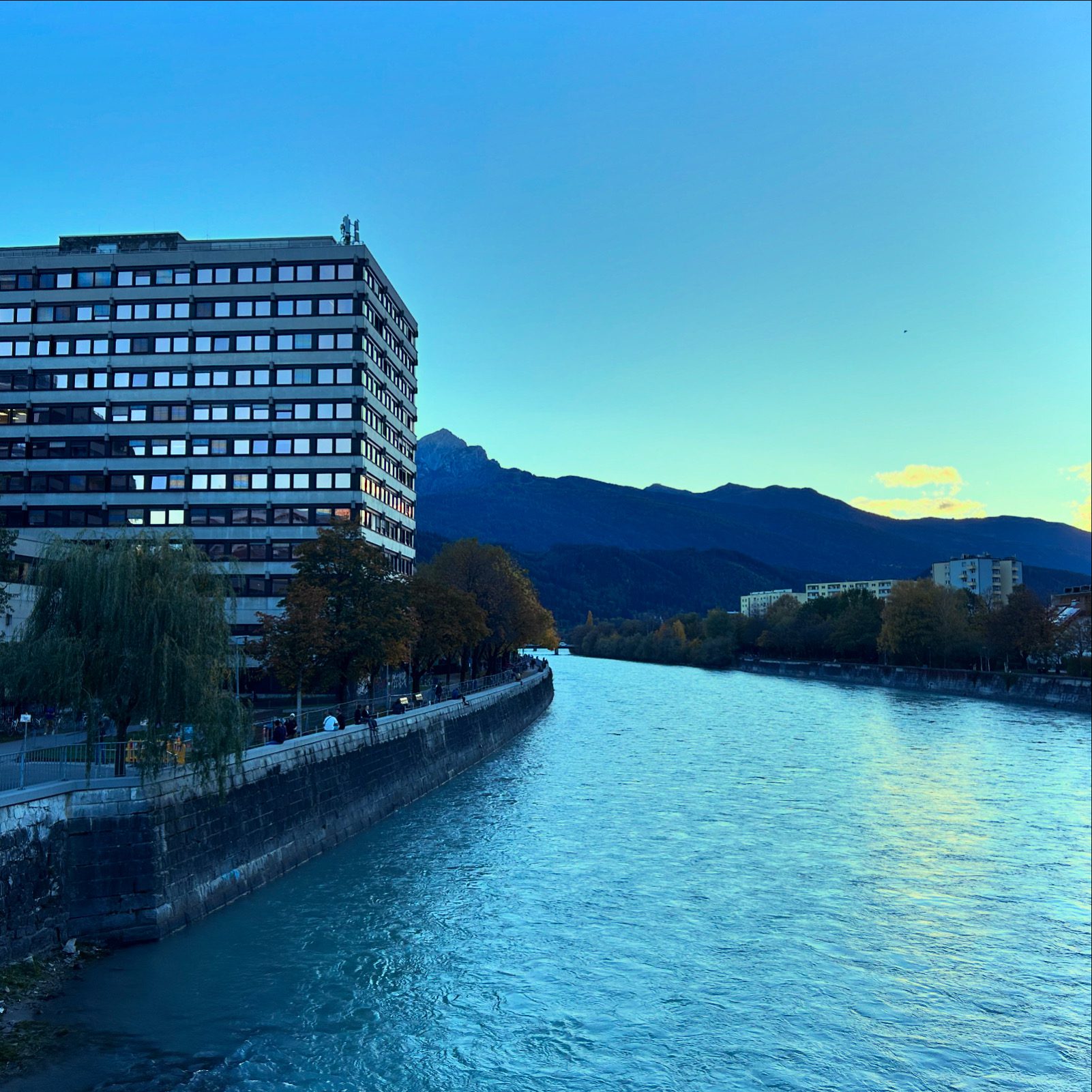
On the riverside facing the Inn, young people gather today in a relaxed atmosphere. The low wall above the river, better known as the Sonnendeck, has in recent years become a genuine point of contention in city politics. The student‑driven concept of meeting in public space without mandatory consumption clashes with the regulatory zeal of municipal officials and politicians.
University City of Innsbruck
1669 is considered the official founding year of one of the most important institutions in Innsbruck's city history. On 15 October, Emperor Leopold I granted the Tyroleans the privilege of „Haller Salzaufschlags“. Diese Steuer auf die begehrte Handelsware aus der hauseigenen Saline machte es möglich, eine Universität zu finanzieren. Die Basis für eine Hochschule war zu diesem Zeitpunkt bereits gelegt. Die Universität ging aus der Lateinschule hervor, die von den Jesuiten etwas mehr als hundert Jahre zuvor unter Ferdinand I. gegründet worden war. Der Schwerpunkt am Gymnasium lag auf der klassischen humanistischen Bildung. Latein und Griechisch waren notwendige Schwerpunkte im Unterricht, um dem intellektuellen und politischen Diskurs folgen zu können. Wissenschaftliche Bücher und viele andere Schriftstücke wurden in der Frühen Neuzeit noch immer auf Latein verfasst. Auch für höhere Posten im öffentlichen Dienst war Latein Voraussetzung. Die Universität brachte neue Ausbildungsmöglichkeiten nach Innsbruck. Die erste Fakultät, die den Lehrbetrieb aufnahm, war die Philosophie. Theologie, Recht und Medizin folgten kurz darauf. Als Papst Innozenz XI. der Universität 1677 seinen Segen gab, war der Betrieb schon voll angelaufen. Professoren und Studenten verschiedenster Nationalität tummelten sich in Innsbruck. Der Jesuitenorden war mit mehreren Lehrstühlen vertreten, andere Professoren wurden von der Diözese Brixen bestellt. Das führte zu Spannungen innerhalb der Universität, vertraten doch die Jesuiten vor allem die Interessen des Landesfürsten und Monarchen, während die Professoren der Diözese die politischen Interessen des Bischofs wahren wollten. Von einer Trennung von Staat, Kirche und Wissenschaft war man in dieser frühen Phase der Aufklärung noch weit entfernt. Dabei ging es um Posten, Macht, Geld und Einfluss, nicht nur innerhalb der Stadt.
A university degree usually took seven years before the graduate was permitted to slip a ring onto his finger as a symbol of his doctoral status. During the first two years, every student had to dedicate himself to philosophy before selecting a specialized field. In addition to humanities coursework, church services, theatrical performances, music-making, and practical pursuits like fencing and horseback riding were integral components of an educated young man's life. The university, however, was far more than an educational institution. In 1665, Innsbruck lost its status as a residence city, relinquishing much of its prestige and splendor. The university's presence offset this downgrade to some extent, ensuring that the aristocracy remained present in the city, at least in the form of students. Students and professors reshaped the city's social fabric. In the first decade following its founding, roughly 50 different men from all corners of the world taught philosophy in Innsbruck to a student body of over 300. These intellectuals were a remarkable group. Internally, they organized themselves into Landsmannschaften—fraternities based on nationality or language group. Every Landsmannschaft with sufficient members had its own distinct attire, badges, and insignia, and maintained its own unique traditions. At public and social occasions such as processions, delegations like the Congregation of the Blessed Virgin, drawn from the Jesuit-influenced university, stood out prominently. Professors made a habit of appearing in velvet gowns, color-coded according to their respective faculties. Carrying a sword, the gladius deambulatoris, was granted to students upon completing their first year at the university. Unlike the strictly and demurely dressed locals of Innsbruck, these young men of privileged backgrounds made colorful, flamboyant appearances reminiscent of medieval dandies. They conversed in a jargon that sounded strange and unintelligible to outsiders, while official matters were conducted entirely in Latin.
The strictly supervised daily life of students in the assembly hall and lecture halls was lightened by booze-filled evening entertainment, excursions into the countryside surrounding Innsbruck, music-making, church processions, and theatrical performances. Time and again, friction arose between ordinary citizens and members of the university. Despite their social standing, students were frequently far from diligent model pupils; rather, they were young men accustomed to a certain lifestyle and status. To keep them under control, a dedicated legal system was required. Students were subject to university law, which was entirely separate from municipal law. The university itself could impose imprisonment, fines, and even banishment from the territory. Only cases involving capital punishment required appealing to the regional government. For instance, students were officially forbidden from drinking to excess. If this occurred in one of Innsbruck's taverns anyway, the young offender received an admonition. Should he be unable or unwilling to settle his bill, the aggrieved innkeeper could not file a formal complaint with the courts, as serving excessive amounts of alcohol to the student body was prohibited. Insults to honor within university circles could lead to duels, much like in the military. Especially when combined with alcohol, riots and disturbances were not uncommon. Thus, in January 1674, "not only were nuisances, rumors, and absurd acts committed at night," but "students of the university were apprehended carrying all kinds of forbidden weapons such as matchlocks, pistols, pocket pistols, stilettos, sabers, and knives..." To enforce the law, the university rectorate maintained its own force. The Scharwache (watchmen) was armed with halberds and tasked with preventing student disturbances as effectively as possible. Six armed men were on duty day and night to maintain order. There was even a dedicated university prison (Carcer) to detain wrongdoers on bread and water. The costs for this were split between the city of Innsbruck and the university.
The university has always served as a political focal point and a reflection of the prevailing zeitgeist. Since the mid-18th century, its primary purpose was to train loyal, Catholic civil servants for the state. The name Leopold-Franzens-Universität traces back to the two emperors, Leopold I and Francis I, under whom it was originally founded and re-established, respectively. On two separate occasions, the university was downgraded to a lyceum or abolished entirely. Emperor Joseph II closed the gates of the Jesuit-influenced educational institution, as did the Bavarian administration during the Napoleonic Wars. Emperor Francis I, who pivoted back to the traditionally Catholic line of the Habsburgs during the Restoration, re-founded the institution in 1826. However, the university remained under close surveillance during Metternich's police state, as authorities feared nationalistic and liberal students who were beginning to form fraternities. Secret state police operated in lecture halls and student circles alike to nip the problematic ideas of young agitators in the bud as early as possible. Industrialization and its accompanying economic, political, and societal demands on education reshaped university life. Reflecting the spirit of the era, the inaugural address by the Dean of the Faculty of Philosophy, Prof. Dr. Joachim Suppan (1794–1864), addressed a practical physics problem aimed at achieving "a more precise knowledge of the so important and useful invention of the steam engine, also for domestic industry, where it has so far found no application." The fact that Suppan was an ordained priest alongside his degrees in philosophy and mathematics highlights the continuing influence of the Church on education during the 19th century. Suppan's closing admonition to the students—urging them "to one day render fruitful services to the fatherland through knowledge and virtue"—underscores how closely bound the university remained to state authority alongside ecclesiastical power. The nationalistic conflicts of the late monarchy were similarly mirrored in the university's history. Academic life in the late 19th century was defined by competing student corps, Burschenschaften, and fraternities. Students and professors grew increasingly radicalized, leading to recurring clashes between different factions and changing alliances. The only issues on which liberals, conservatives, and Pan-German nationalists could consistently agree were antisemitism and a shared hostility toward Italians. The interwar period brought a continuation of these old conflicts. Many students and faculty members had served in the First World War and were accustomed to resolving disputes through force. The apparatus of the Corporate State (Ständestaat) in the 1930s drew its ranks from Catholic fraternities, whereas Pan-German Burschenschaften served as a major pillar for National Socialism. The democratic Republic of Austria and the broader emancipation that accompanied it held little appeal for the traditionally elitist academics on both sides. Young men suddenly no longer had academia to themselves. While women and the sons of working-class artisan families had long been barred from university studies, it now became theoretically possible to advance socially through higher education. The university celebrated its first female Doctor of Law five years after the founding of the Republic. The press noted:
“This coming Saturday, Miss Mitzi Fischer will be awarded the degree of Doctor of Law at the University of Innsbruck. Miss Fischer is a native of Vienna. She also completed her secondary education in Vienna. After her matriculation examination, she pursued the study of law at the University of Innsbruck. The future doctor passed all examinations with distinction and would therefore, according to former custom, have to be promoted sub auspiciis imperatoris. In any case, Miss Fischer is the first woman to earn the doctoral degree in law at the University of Innsbruck.”
With the annexation to the German Reich in 1938, the university was renamed once again. After the war, the Deutsche Alpenuniversität reverted back to Leopold-Franzens-Universität. Surprisingly quiet, much like in 1848, were the students in Innsbruck during the year 1968. While students were the drivers of change in other European cities, Innsbruck remained calm. In Paris, cobblestones flew; in Innsbruck, people settled for boycotts and sit-ins. Although there were individual groups in the late 1960s and 1970s such as the Kommunistische Gruppe Innsbruck, the Committee for Solidarity with Vietnam, the socialist VSStÖ, or the liberal-Catholic Aktion within the ÖH (Austrian Students' Association), no mass movement materialized. The vast majority of students came from the upper class and had completed their Matura at a Catholic-oriented grammar school. Beethoven's old adage that "as long as the Austrian still has brown beer and sausages, he does not revolt" proved true. Only a few students could summon enthusiasm for solidarity with Vietnam, Mao Zedong, or Fidel Castro. Who wanted to risk their own career in a region dominated by the holy trinity of the Tiroler Tageszeitung, Bishop Paulus Rusch, and the regional parliament (Landtag) with an absolute majority held by the ÖVP? Anyone who dared to distribute rebellious flyers or leftist literature anyway had to expect media defamation, a reprimand from the rectorate, or even a visit from state authorities. The professors—who in the 20th century often still exuded the detachment and aloof aura of the Early Modern era or made little secret of their political leanings—were rarely criticized. Rather, criticism was directed at the inadequate equipment of the modest lecture halls for the ever-increasing number of students. The major transformation in universities was not fought for in Austria, but voted for. Under Chancellor Bruno Kreisky, tuition fees were abolished. Education became affordable and conceivable for a larger number of young people. As a result, the number of students at Austrian universities rose from 50,000 to over 73,000 between 1968 and 1974.
Despite all adversities and curiosities over the centuries, the University of Innsbruck has, since its earliest days, generally enjoyed an excellent reputation. In the 20th and 21st centuries, faculty and students repeatedly achieved internationally acclaimed research results. Victor Franz Hess was awarded the Nobel Prize in Physics for his work on cosmic radiation. Quantum physicist Anton Zeilinger was also associated with the University of Innsbruck, though not at the time of his award in 2022. Professors Fritz Pregl, Adolf Windaus, and Hans Fischer likewise received the Nobel Prize in Chemistry, though none of them were active in Innsbruck at the time. The university hospital has likewise delivered outstanding achievements in both research and education, as well as in the daily medical care of the city, and is considered one of Innsbruck’s flagship institutions. The university is of great importance to the city not only intellectually and economically. Around 30,000 students populate and shape life between the Nordkette mountain range and the Patscherkofel.
Innsbrucker Kulturkampf
Media and politicians never tire of pointing out the societal division and polarization that characterize the 21st century. Usually, the culprit is delivered right along with the diagnosis: social media. Yet a look back at the late 19th century demonstrates just how long division and polarization accompanied society well before the invention of Facebook, Twitter, and the like. Simplified, the parliament of the late Austro-Hungarian Monarchy was shaped by Christian Socials, Social Democrats, and liberal-nationalist parties representing the individual ethnic groups of the multi-ethnic empire. The Social Democrats, Christian Socials, and Pan-German Nationalists were the predecessors of today's parliamentary parties SPÖ, ÖVP, and FPÖ. In the Tyrolean Landtag (regional parliament), Social Democrats played no role; the Catholic-conservative party had lost some of its influence, but formed a coalition block with the reform-Catholic Christian Socials in Tyrol. The Innsbruck city council, on the other hand, was dominated by Pan-German liberals thanks to the wealth-based census suffrage. The rivalry between Liberals, Conservatives, and the Social Democrats—who were disadvantaged by electoral law—created a highly explosive atmosphere in Innsbruck. As in other cities of the Habsburg Monarchy and the German Empire, this *Kulturkampf* (cultural struggle) rarely remained limited to verbal skirmishes. Politicians, intellectuals, and journalists fought especially bitterly over dominance at the universities, as these were the institutions training the elites of tomorrow. Yet the conflict did not stop at the higher education institutions. Following the press reforms of 1867, newspapers reached unprecedented levels of circulation. Conservatives, Catholics, Pan-German Nationalists, Liberals, and Social Democrats each had their own partisan papers. Readers of these publications lived in their own echo chambers. The polemical articles reached an audience willing to emphasize their opinions with physical force. Although dueling was officially prohibited by law, it was tolerated until well into the 20th century as a means of satisfaction in accordance with military and aristocratic notions of honor, serving as a common practice. Fencing student fraternities (*Burschenschaften*) adopted dueling and continue this tradition as an honorable duel, the *Mensur*, to this day. In other respects as well, fraternities had their origins in the military. The first corps emerged at German universities as seedbeds of nationalist thought following the Napoleonic Wars. While conservative subjects organized themselves into paramilitary units within the marksmen companies (*Schützen*), these student fraternities enjoyed immense popularity among academics. Like other associations, they increasingly took clear political stances. In doing so, two distinct poles emerged: Catholic, conservative, loyal to the Emperor; and liberal, Pan-German, nationalist. What appears contradictory today—liberal and nationalist—was a standard political pair of ideas in the 19th century. *Pan-Germanism* was not the peculiar political ideology of a far-right minority. Anyone who wished to be seen as modern did not view themselves as a subject of the traditional multi-ethnic state of the Habsburg Monarchy, but instead aspired toward the All-German *Nation*: a militarily and economically strong, not necessarily democratic, and ethnically uniform state that united all German-speaking lands after the Prussian model. In Innsbruck, students joined together in 1859 to form a corps in order to perform border service during the Second Italian War of Independence. The Corps *Rhaetia*, *Chinisia*, and *Athesia* were the first fraternities at the university to appear in public. Shortly thereafter, Catholic students gathered under the academic fraternity *Austria*, which exists to this day. Around the turn of the century, one-third of the students at the University of Innsbruck belonged to a fraternity, a corps, or a *Burschenschaft*. Unlike today, it was not unusual for them to appear in public in full regalia (*Wichs*) wearing their colors—uniforms complete with sabers, berets, and sashes. They were also frequently armed with walking sticks, brass knuckles, and revolvers. Half of the fraternities held a Pan-German nationalist orientation and bore telling names such as *Suevia* or *Germania*. They derived their ideology from the *Los-von-Rom* ("Away from Rome") movement led by the German radical Georg Ritter von Schönerer (1842–1921), who personally attended events in Innsbruck on several occasions. At the secular faculties, the majority of professors held Pan-German nationalist views. Relative to the city's total population—which in 1910 remained 96% Catholic—they constituted a numerical minority, but owing to their social influence, a highly powerful one. In the 1880s, later than at other Austrian universities, racial antisemitism spread in Innsbruck amid this climate, even though there were hardly any Jewish students or professors at the Leopold-Franzens-University. As radical opposition to the monarchy and clergy mounted at the university, the situation escalated irreversibly from the 1890s onward. Provocations and disagreements among professors made headlines and reached parliament, while conflicts between Catholic and Pan-German nationalist students frequently ended in outright brawls.
The *Wahrmund Affair*, which radiated outward from the University of Innsbruck across the entire Austro-Hungarian Monarchy in the early 20th century, was just one of many examples of this intense polarization. Ludwig Wahrmund (1860–1932) was a professor of canon law at the Faculty of Law at the University of Innsbruck. Originally chosen by the Governor of Tyrol to strengthen Catholicism at the University of Innsbruck—which was deemed too liberal—Wahrmund turned out to be a proponent of an enlightened theology. In contrast to conservative representatives in the clergy and politics, he was a reform Catholic who viewed the Pope solely as a spiritual leader rather than a worldly authority. In Wahrmund's view, students ought to narrow and reconcile the gaps between the Church and the modern world rather than cement them. Until 1906, Wahrmund was part of the *Leo-Gesellschaft*, which aimed to promote science and scholarship on a Catholic basis. In a transformation from a moderate Saul to a liberal Saul, he became chairman of the Innsbruck local chapter of the *Freie Schule* association, which advocated for the complete secularization of the entire educational system. From a reform Catholic, he evolved into a champion of the total separation of church and state. Amplified by the media, his lectures repeatedly drew the attention of the authorities. Conservative politicians and press outlets raged against his questioning of the indissolubility of marriage, while liberals and his supporters among professors and students applauded him. Pan-German nationalist academics received backing from Mayor Greil and the likewise anti-clerical Social Democrats, whereas the Tyrolean regional government stepped into the breach on the conservative side. The *Wahrmund Affair* reached the Imperial Council (*Reichsrat*) as a core debate of the *Kulturkampf*. For the Christian Socials, it was a *"struggle of freethinking Jewry against Christianity,"* in which *"Zionists, German cultural fighters, Czech and Ruthenian radicals"* presented themselves in an *"international coalition"* as a *"freethinking ring of Jewish radicalism and radical Slavdom."* Wahrmund, on the other hand, referred to Catholic students in the generally heated atmosphere as *"traitors and parasites."* When Wahrmund published one of his speeches in 1908 in which he questioned Christian morality and the Catholic veneration of saints, he was charged with blasphemy. Following further—and at times violent—rallies on both the conservative and anti-clerical sides, along with student riots and strikes, university operations briefly had to be suspended entirely. Wahrmund was initially placed on leave and later transferred to the German University in Prague.
In February 1910, civil-war-like scenes unfolded in Innsbruck, entering the city's history as the *Breinößlschlacht* (Battle of the Breinößl). The Catholic fraternities *Tirolia*, *Raeto Bavaria*, and *Leopoldina* had their headquarters in the *Gasthof Breinößl* on Maria-Theresien-Straße. Members of the rival Corps *Gothia* attacked several *Tirolia* students inside the inn. The innkeeper Franz Hofer—father of the future Gauleiter and himself likely holding Pan-German nationalist views—called the police to have the Catholic students thrown out of his establishment. The following day, fresh provocations erupted among the fraternities, culminating in a mass brawl involving over 100 combatants. Students fought each other and summoned police officers in a street battle that left several people injured and the interior of *Gasthof Breinößl* devastated. The next day, the wave of violence reached its end following a brawl involving 250 people, which resulted in the destruction of *Café Central* and the neighboring *Akademikerhaus* belonging to the Catholic fraternity. The tragic climax of the *Innsbruck Kulturkampf* turned fatal two years later. On the night of November 4, students from the *Raeto Bavaria* and *Austria* fraternities were walking home from a dance when they were attacked by Pan-German nationalist fraternity members. During the ensuing brawl in front of *Gasthof Breinößl* on Maria-Theresien-Straße, medical student Max Ghezze (1889–1912) suffered a blow to the back of his head. Police officers brought the unconscious student to a drunk tank, where he was found hours later by his fellow classmates. Ghezze died shortly thereafter at the Innsbruck hospital, due in part to his mistreatment by the police. The members of *Gothia* suspected of the crime were released for lack of evidence. Protests sent from Cortina to the governor's office criticized the city administration and the police, even demanding universal empire-wide suffrage at the municipal level. Such a reform likely would have brought an end to the exclusive rule of the *Deutsche Volkspartei* and Wilhelm Greil's corresponding influence over executive power on the city council.
The First World War brought a brief pause in the struggle for ideological supremacy at the university. The politics of the 1920s and 30s—characterized by civil-war-like tensions between Christian Socials, Social Democrats, and Pan-German Nationalists, which culminated first in the Catholic Corporate State (*Ständestaat*) and subsequently in the annexation (*Anschluss*) to National Socialist Germany—had their roots in the *Kulturkampf*. The fraternity students of the past had since become professors, lawyers, historians, teachers, and doctors. To their youthful political extremism, they had added the experiences of a world war, inflation, and multiple economic and political crises. What remained was authoritarian subservience to authority, a readiness for violence, and antisemitism, which were passed down to the next generation of young men.
The Wallschen and the Fatti di Innsbruck
Prejudice and racism toward immigrants were and remain common practice in Innsbruck, as in all societies. Whether Syrian refugees since 2015 or Turkish guest workers in the 1970s and 80s, 'the foreign' usually generates little goodwill in the average Tyrolean. Today, Italy may be the favorite travel destination of Innsbruckers and pizzerias a part of everyday dining, but for a long time, our southern neighbors were the most suspiciously eyed population group. What Jews and Bohemian brickmakers ('Ziegelböhmen') were to the Viennese around 1900, the 'Wallsche' (Italians) were to the Tyrolean. The aversion to Italians in Innsbruck can look back on a long tradition. Although Italy did not exist as an independent state—instead, many small counties, city-states, and principalities between Lake Garda and Sicily shaped the political landscape, with individual regions also differing linguistically and culturally—people gradually began to see themselves as Italians over time and were perceived as such abroad. Most of those with whom Innsbruckers interacted belonged to the upper class, which automatically generated a certain resentment. During the Middle Ages and the Early Modern period, they resided in Innsbruck as members of the civil service, the court staff, bankers, wholesalers, or wives of various local rulers. The mutual dislike between 'Italians' and 'Germans' went both ways: one side viewed the other as dishonorable, unreliable, arrogant, vain, morally corrupt, and lazy; the other side viewed them as uncivilized, barbaric, uneducated, and 'pigs.' With the wars between 1848 and 1866, hatred of all things Italian reached a new peak in the 'Holy Land of Tyrol,' even though many 'Wallsche' served in the Imperial-Royal (k.u.k.) Army and the rural Italian-speaking Tyrolean population largely remained loyal to the monarchy. Italians—especially Garibaldi's troops—were considered godless insurgents and republicans, and were lambasted from church pulpits between Kufstein and Riva del Garda in both Italian and German. The Tyrolean press landscape played a major role in the conflict. The Innsbrucker Nachrichten, with a circulation of around 15,000 copies, was Tyrol's widest-reaching media outlet at the turn of the century; while it had no explicit political orientation, it was considered Pan-German liberal-leaning. On the Italian side, Cesare Battisti (1875–1916) stood out—he was later executed by hanging for high treason by the Austrian military during the war. The publicist and politician from Trento had begun studying at the German-language university in Vienna before transferring to the University of Florence. With a sharp pen in the two Italian newspapers Il Popolo and L’Avvenire, he repeatedly fueled the nationalities conflict within the country's borders. Thanks to his blend of socialist ideology and Italian patriotism, he was considered public enemy and traitor number one by many Tyroleans. Clubs and associations also played a supporting role in the hardening of positions. In 1867, not only were the press laws liberalized, but so was the right of association, triggering a genuine boom in new foundations. Sports clubs, gymnastics societies, theater groups, marksmen companies (Schützen), or the Innsbrucker Liedertafel often served not just for recreation, but as political front organizations. Student fraternities were particularly extreme. Facing them were the Italian-speaking students, who were inferior both in terms of numbers and organization. Due to the loss of Padua, Italian-descended Tyroleans no longer had the opportunity to complete university studies in their native language within the empire, leading many to orient themselves toward Innsbruck—where they met with little affection. One of the main political bones of contention between Italian- and German-speaking students was the opening of an Italian faculty or university. The discussion over whether to target a university in Trieste (the preferred location for Italian-speaking representatives), Innsbruck, Trento, or Rovereto played out over years. Although attending university was actually a matter for a small elite, irredentist, anti-Austrian-minded Tyrolean deputies from the Trentino were able to repeatedly inject emotional charge into the issue as a symbol for sought-after autonomy—given that by law, all language groups within the monarchy were to be treated equally after 1867. Pan-German nationalist politicians, such as Innsbruck Mayor Wilhelm Greil (who was repeatedly admonished by Tyrol's Imperial-Royal Governor for his improper conduct toward the Italian population), used the emotions surrounding the issue to whip up sentiment about impending 'foreign infiltration' (Überfremdung). Added to the ethnic and racial resentment toward their southern neighbors—especially among conservatives—was the fear of figures like Cesare Battisti, who as a socialist embodied living evil anyway.
Demographic data shows how inflated the fear of Innsbruck being "Italianized" by Trentino students actually was. As is so often the case, facts back then were replaced by gut feeling and racially motivated populism. After the incorporation of Pradl and Wilten in 1904, Innsbruck had just over 50,000 inhabitants. With slightly over 1,000 students, the student population accounted for less than 2%. Of the roughly 3,000 people of Italian descent—most of them Welschtiroler from the Trentino—only just over 100 were enrolled at the university. The vast majority of the Wallsche consisted of workers, innkeepers, merchants, and soldiers. Many had been living in and around Innsbruck for a long time. In the somewhat cheaper district of Wilten, a sort of Little Italy had emerged. Anton Gutmann sold Italian wines at his winery cooperative Riva at Leopoldstraße 30, while across the street one could eat well and affordably at Gasthaus Steneck. As subjects of the monarchy, most immigrants spoke excellent German; only a small fraction came from Dalmatia or Trieste and was genuinely foreign-speaking. The differences were socio-cultural. There were separate associations such as the Club Ciclistico and the Unione Ginnastica, socialist-oriented workers' and consumer organizations, music societies, and student fraternities. Although students made up only a small fraction among the Italian population, disproportionate attention was focused on them and their demand for an institute with Italian as the language of examination and instruction. After much back-and-forth, it was decided in September 1904 to establish a provisional faculty of law in Innsbruck. This was intended to separate the students without alienating either group. From the outset, however, the project was ill-fated. No one was willing to rent the necessary premises to the university. Finally, the enterprising builder Anton Fritz made an apartment available in one of his tenement buildings at Liebeneggstraße 8. At the inaugural lecture and the festive evening event at Gasthaus zum Weißen Kreuz on November 3, prominent figures such as Battisti and the future Italian Prime Minister Alcide De Gasperi were present. As the night wore on, the mood grew increasingly boisterous. When taunts such as "Porchi tedeschi" and "Abbasso Austria" ("German pigs" and "Down with Austria") were shouted, the situation escalated. A mob of German-speaking students armed with sticks, knives, and revolvers besieged the Weißen Kreuz, where the Italians—likewise largely armed—had barricaded themselves. A squad of Kaiserjäger successfully dispersed the initial turmoil, and several Italians were detained. In the process, the painter August Pezzey (1875–1904) was mistakenly fatally wounded by a bayonet thrust from an overly nervous soldier. Following the night's events, the Innsbrucker Nachrichten appeared on November 4 under the headline: "German Blood Has Flowed!". The reporter on site claimed that 100 to 200 revolver shots were fired by the Italians at the "host of German students," reporting Pezzey's death. News of what transpired sparked a wave of revenge acts and violence. Joining those who were politically motivated—as in any riot—were onlookers and rioters who simply enjoyed causing havoc under the cover of the crowd, without holding any genuine political convictions. While the detained Italians sang the martial song Inno di Garibaldi in the city's hopelessly overcrowded prison, severe riots broke out across the city against Italian establishments and businesses. The premises of Gasthaus zum Weißen Kreuz were completely devastated in monarchist fashion, leaving nothing intact except a portrait of Emperor Franz Joseph. Rioters threw stones at the residence of the already unpopular Governor at Palais Trapp because his wife had Italian roots. The building on Liebeneggstraße provided to the university by Anton Fritz was destroyed, as was his private home. Once the initial turmoil had settled, myth-making around the event began rapidly. August Pezzey, who hailed from a Ladin family and died in the chaos, was proclaimed a "German Hero" in a nationalistic frenzy by politicians and the press. He was given an honorary grave at Innsbruck's Westfriedhof cemetery. At his funeral, attended by thousands of mourners, Mayor Greil delivered a melodramatic speech:
"...A gloriously beautiful death was granted to you on the field of honour for the German people... In the fight against impudent acts of violence you breathed your last as a martyr for the German cause..."
Reports of the Fatti di Innsbruck reached the international press and contributed significantly to the resignation of the Austrian Minister-President Ernest von Koerber. Depending on the medium, Italians were portrayed either as dishonorable bandits or as courageous national heroes, while Austrians were depicted as pangermanist barbarians or as a bulwark against the “Welsch.” On 17 November, just two weeks after its ceremonial opening, the Italian faculty in Innsbruck was dissolved again. A university of their own remained denied to this linguistic group within Austria-Hungary until the end of the monarchy in 1918. The long tradition of viewing Italians as dishonorable and lazy was further intensified by Italy’s entry into the war in 1915 on the side of France and England. To this day, many Tyroleans continue to maintain negative prejudices toward their southern neighbors with great persistence.
Petrus Canisius and the Jesuits
Franciscans, Premonstratensians, Carmelites, Servites, Capuchins, Ursulines. Anyone visiting Innsbruck strolls past numerous monasteries—usually without realizing it. Yet the most politically and socially influential order in the city’s history since the sixteenth century was the Jesuits. These “Soldiers of Christ” were founded in 1540 by the Spanish nobleman Ignatius of Loyola (1491–1556). Loyola was a morally rigorous reformer and an influential church politician with access to the highest circles of power of his time. His aim was to reform the Church—not, like Luther, without the Pope as its supreme authority. Nor did he consider dissolving monastic property. Renewal of faith from the top down, rather than the destruction of the existing order, was the guiding principle of the Societas Jesu. The order rapidly gained influence. Its military-inspired organization and structure, the combination of humanist learning with Catholic tradition, its affinity for science and education paired with a form of popular piety imbued with mysticism—all this made the Jesuits attractive to many people who were disillusioned by the moral decay of the late medieval clergy. In these respects, the Jesuits were very much attuned to an era shaped by new political, social, and economic structures. Like the Protestant reformers, they skilfully exploited the new medium of print to disseminate their writings. They represented the confessional continuation of a societal transformation characterized by the growing power of the state, new media, and double-entry bookkeeping. In this environment, spiritual guidance was in high demand. Politically, the Holy Roman Empire in the mid-sixteenth century was steeped in crisis. Italy had been severely affected by the wars between France and the Habsburgs. Major trading houses such as the Fuggers and the Welsers amassed ever greater influence. The German territories were still reeling from the Peasants’ Wars. Inflation posed a serious threat, and the many technological innovations around 1500 inspired fear among broad segments of the population. How, then, could the wrath of God—provoked by the failings of the Renaissance popes—and the looming end of the world be averted, if not through moral reform and a life lived according to the teachings of Christ?
A zealous patron of the Jesuits in Tyrol was the territorial prince and later Emperor Ferdinand I. Like Ignatius of Loyola, he had grown up in Spain. He struggled with German customs, the Reformation movement—unknown in Spain—and even the German language itself. The Tyrolean population, for its part, regarded their sovereign with suspicion, easily mistaking his foreign courtly entourage for an occupying power. A unifying element between these two worlds was the Roman Church, and in particular the modern Jesuit order. Probably the most important Jesuit theologian was Petrus Canisius (1521–1597). Born Peter Kanis into an upper-middle-class household in the Netherlands—his father was mayor of Nijmegen—he was exposed to high politics from an early age and learned courtly manners before studying in Cologne. Canisius became the first member of the order active within the Holy Roman Empire. Intelligent and highly educated, he rose swiftly through the ranks. Ferdinand appointed him to Vienna, where he was tasked with restoring order both as episcopal administrator and at the university. Alongside teaching and research, one of his main duties was to identify and interrogate university members suspected of Protestant sympathies. Canisius also spent several years in Innsbruck. Initially, the Jesuits were supposed to move into the newly completed Court Church (Hofkirche) and assume responsibility for the choral prayers at the tomb of Maximilian I. Canisius, as the highest-ranking representative of the order north of the Alps, politely but firmly declined. In 1563, however, the Emperor succeeded in luring him to the Alps after all. The scholar was needed as an adviser during a dispute with the Pope at the Council of Trent. For Ferdinand, Canisius composed a prayer manual intended to guide the ruler along the right spiritual path. The presence of Petrus Canisius made Innsbruck one of the theological centres of the German‑speaking world in the sixteenth century. In October 1571, he informed the parish of Wilten of the victory of the papal‑imperial fleet over the Ottomans at Lepanto. From the pulpit, Canisius proclaimed the triumph of Christian forces over the looming pagan threat in the greatest naval battle in history, adopting a tone reminiscent of a Catholic news broadcaster. His role as preacher and scholar in the city would be comparable to Albert Einstein holding a teaching post at a university in the 1930s. Canisius himself was deeply impressed by the piety of the Alpine population.
"Tyrol deserves our special attention, because it is even more Catholic than any other region of Germany and has not yet allowed itself to be ensnared by the heretics like the other countries. Even if many places have already been corrupted [...]. Innsbruck is ... the heart and life of the whole country."
Beyond courtly circles, the court preacher also cut a fine figure. While many Innsbruck residents eyed other foreign preachers and advisers at court with suspicion, Canisius was a man of the people. On behalf of his spiritual—and even more so his secular—masters, he travelled across Europe. Like Martin Luther, he “listened to the people’s speech.” Canisius is said to have travelled more than 100,000 kilometres between the Netherlands, Rome, and Poland, usually staying in modest inns. He understood how vital it was to win over the rural population. While his fellow Jesuits evangelised in distant India, he fought Protestantism in the German lands. He recognized that sermons in Latin were ill‑suited to immunise peasants, farmhands, and maids against the threat posed to the Roman Church by Luther’s Protestantism.
The strongest and most enduring pillar in the struggle against the Reformers was education. Canisius regarded many bishops and politicians as corrupt, morally depraved, and sinful. Instead of eliminating them, however, they were to reform themselves under the protective wings of the Soldiers of Christ. By founding new colleges, the Jesuits sought to improve the education of civil servants, the nobility, and the clergy, and to raise moral standards rooted in Christian principles. To this end, they established colleges throughout the Empire. In Protestant regions, German schools, academies, and grammar schools were founded with the aim of enabling as many subjects as possible to read the Bible for themselves in pursuit of piety and salvation. The Jesuits, by contrast, concentrated on educating elites and thus attained lasting influence within the power centres of Catholic states. With his Catechism, Petrus Canisius created a foundational German‑language compendium for the Catholic struggle against the Reformation. Translated into all major European languages, it long served as a guiding text of the Catholic Church. Between 1555 and 1558, three versions of varying complexity were produced for different audiences. Resourceful publishers even created an illustrated catechism for the illiterate. Well into the nineteenth century—and in some regions even beyond the Second World War—the Kanisi, as it was affectionately known, remained the most influential religious‑philosophical work in Tyrol and the foundation of religious instruction in schools. Canisius also made use of the new medium of the pamphlet to reach as wide an audience as possible. Together with those of Luther, his writings were probably the most widely read of the sixteenth century. In Innsbruck, the Jesuits founded the Latin School from which the university later emerged. This new educational institution had a profound impact on urban development, training the intelligentsia that enabled Innsbruck’s rise as an administrative and economic centre. In addition to university chairs, the Jesuits also oversaw the Theresianum. From 1775 to 1848, noble pupils and students housed in the Franciscan monastery were instructed in courtly etiquette and virtuous conduct in preparation for their careers. The Theresian Knightly Academy provided instruction in diplomatic skills such as foreign languages and dance, as well as military disciplines like fencing. Under Joseph II, Jesuit activities were temporarily interrupted. He stripped ecclesiastical orders of power and property, including the Jesuits—an order he personally disliked and which was also banned by the Pope for being too powerful. In 1781, the University of Innsbruck was downgraded to a lyceum. The vacated Jesuit College was used to establish the city’s first botanical garden, which was expanded further after the Theresianum was dissolved in 1808 during Bavarian administration. The Jesuits were recalled to Innsbruck in 1838. In 1910, the garden was relocated to Hötting as part of new school construction.
Through a dense network of influential positions and control over the education system, the order expanded rapidly. Especially during the Counter‑Reformation, the Jesuits succeeded in forging a close alliance with the Habsburg dynasty. The influence of Jesuit education is evident in the governance of many Habsburg rulers. Jesuits such as Bartholomäus Viller and Wilhelm Lamormaini wielded considerable political influence as confessors and advisers in the Early Modern period. It is no coincidence that Jesuits continue to feature as adversaries of Freemasons in countless conspiracy theories and novels, often cast as the modern equivalent of a James Bond villain. At the same time, the Jesuits were remarkably open to research, knowledge accumulation, and education, striving to understand the world as part of Christian creation. To Catholics, this made them a fashionable counterpoint both to traditional, ossified orders and to Protestantism. Faith and empiricism merged into a kind of pre‑modern science seeking to explain nature and physics. The collection of Ferdinand II at Ambras Castle testifies to this spirit of inquiry, as do the alchemical experiments of Emperor Matthias (1557–1619), which now appear rather absurd.
Despite their rational leanings, the Jesuits also re‑introduced mysticism into everyday church life. Passion plays, Holy Sepulchres, processions, and feast days wrapped strict doctrinal principles in spectacle and performance. Work hard – play hard was the motto. Festivities during processions often escalated into exuberant celebrations, not unlike today’s tent festivals, occasionally erupting into brawls and even violent riots. Bread and wine were celebrated in the style of Roman panem et circenses. On behalf of Ferdinand I, Petrus Canisius authored a book promoting a miracle in Seefeld—On the Highly Celebrated Miraculous Sign that Occurred with the Most Holy Sacrament of the Altar at Seefeld in the Princely County of Tyrol in the Year 1384—to stimulate pilgrimage to the site.
The Jesuit order, fully committed to popular belief, was also highly motivated when it came to persecuting witches and people of other faiths. Peter Canisius was one of the masterminds behind the early modern witch hunts:
"Witches are being punished everywhere, and they are multiplying strangely.... They envy children the grace of baptism and deprive them of it. There are large numbers of child murderers among them... Never before in Germany have you seen people so devoted and dedicated to the devil..."
Canisius also attracted attention as an exorcist, particularly in cases involving noblewomen allegedly afflicted by the “virus” of Protestantism. He exploited the public fascination with witches and demoniacs to promote the power and authority of the Catholic Church. At the same time, the Jesuits were highly active in missionary efforts in the then newly discovered New World of the Americas as well as in Asia. Saint Francis Xavier, one of Ignatius of Loyola’s earliest companions, died during a missionary journey in China. An altar dedicated to this Soldier of Christ can be found in a side chapel of the Jesuit Church in Innsbruck.
To this day, the Jesuits continue to exert an educational influence over Innsbruck. When the city was elevated to an independent diocese in 1964 under the Jesuit Paulus Rusch, Petrus Canisius was chosen as its patron saint. Karl‑Rahner‑Platz today is home not only to the Jesuit Church but also to the Faculty of Theology of the University of Innsbruck. In the Saggen district, the Collegium Canisianum remains under Jesuit administration. The principle of broad‑based societal influence aimed at mass audiences has endured on many levels. The Marian Congregation, known in Innsbruck as the MK, was once one of the largest youth centres in Europe and, in a modern sense, stands in the tradition of the Jesuit approach to the gentle introduction into faith and the education of youth within the Church.
A republic is born
Hardly any era is more difficult to grasp than the interwar period. The Roaring Twenties, jazz, and automobiles come to mind just as readily as inflation and economic crisis. In major cities like Berlin, young women carrying themselves as flappers with bobbed hair, cigarettes, and short skirts danced lasciviously to the new sounds. In Innsbruck, American drinks were served during Five O'Clock Tea at the bar in the Knights' Hall (Rittersaal) of the Cafe Gasthaus Zur Annasäule, which later became the Alt-Innsbruck. The suits of armor can still be admired in the bay window from Maria-Theresien-Straße. For the most part, however, as part of the young Republic of German-Austria, Innsbruck’s population belonged to the faction of poverty, economic crisis, and political polarization. Right from the start, the proclamation of the republic in front of the parliament in Vienna before more than 100,000 people—who were less enthusiastic than they were curious and unsettled—was anything but smooth, accompanied by riots, shootouts, two deaths, and 40 injuries. No one knew how things were supposed to continue after the end of the monarchy and the loss of a large part of the state territory. The new Austria seemed too small and incapable of surviving. The bureaucratic apparatus of the Austro-Hungarian Empire carried on seamlessly under a new flag and name. In the constitution, the federal states, as successors to the old crown lands, were granted a great deal of leeway in legislation and administration under the framework of federalism. However, enthusiasm for the new state among the population remained limited. Not only was the supply situation miserable after the loss of the vast majority of the former giant Habsburg empire, but people also distrusted the underlying concept of the republic. The monarchy had not been perfect, but very few people could relate to the idea of democracy. Instead of being subjects of the Emperor, people were now citizens, but only citizens of a dwarf state with an oversized capital that was little loved in the federal states, rather than citizens of a great empire. In the former crown lands, which were largely governed by the Christian Social Party, people frequently spoke of the "Viennese hydrocephalus" (Wiener Wasserkopf) that let itself be fed by the yields of the hardworking rural population. Other federal states also toyed with the idea of breaking away from the republic after the plan to join Germany, which was supported by all parties, was banned by the victorious powers of the First World War. The various Tyrolean plans, however, were particularly spectacular. From a neutral alpine state with other federal states, a free state consisting of Tyrol and Bavaria, or extending from Kufstein to Salurn, an annexation to Switzerland, all the way to a Catholic church-state under papal leadership, many options were considered. The most obvious solution was particularly popular. Feeling German was nothing new. So why not also attach oneself politically to the big brother to the north? This desire was highly pronounced, especially among urban elites and students. The annexation plan (Anschlussplan) received 98% approval in a vote in Tyrol, but it never came to fruition. In Innsbruck, the Tyrolean National Assembly (Tiroler Nationalversammlung) and the Tyrolean National Council (Tiroler Nationalrat)—a concentration government with members from all parties—constituted themselves in the autumn of 1918 from the members of the former provincial parliament (Landtag). The National Council had authority over the people's and citizens' militias (Volks- und Bürgerwehren), which had formed at the municipal level to maintain public order, at least on paper. Primarily between Innsbruck and the Brenner Pass, up to 50,000 soldiers were stationed at the railway stations, causing problems while waiting for their transport home.
Instead of becoming a part of Germany, Tyrol was occupied by the hated Wallsche (Italian forces). For nearly two years after the end of the war, Italian troops occupied Innsbruck. Following the complex and lengthy peace negotiations in Paris, it finally became a certainty: on October 10, 1920, the formal annexation of South Tyrol took place. At the Brenner Pass, the barrier gate went down. On the North Tyrolean side, only a few administrative and customs buildings were erected, but in the southern part of the village, large barracks shot out of the ground to secure the new border militarily. Historical Tyrol was split in two. In Innsbruck and many other Tyrolean municipalities, pompous mourning ceremonies were organized annually on this date for years. In 1924, the Innsbruck city council decided to name squares and streets around the main railway station after South Tyrolean cities. Bozner Platz as well as Brixner Straße and Salurner Straße still bear their names today. Many people on both sides of the Brenner felt betrayed. Although they had by no means won the war, they did not see themselves as losers to Italy. Hatred toward Italians reached its peak in the interwar period, even though the occupying forces acted with pronounced mildness. A passage from the 1930s short story collection "The Front Above the Peaks" (Die Front über den Gipfeln) by Karl Springenschmid reflects the general mood:
"The young girl says, 'Becoming Italian would be the worst thing.
Old Tappeiner just nods and grumbles: "I know it myself and we all know it: becoming a whale would be the worst thing."
Trouble was also brewing in domestic politics. The revolution in Russia and the subsequent civil war with millions of fatalities, expropriation, and a complete reversal of the system cast its long shadow all the way to Austria. The prospect of "Soviet conditions" terrified people. Austria was deeply divided. Capital and federal states, city and countryside, citizens, workers, and peasants—in the vacuum of the first postwar years, each group wanted to shape the future according to its own ideas. The cultural struggles of the late monarchy between conservatives, liberals, and socialists continued seamlessly. The rift existed not only on a political level. Morals, family, leisure activities, education, faith, legal understanding—every sphere of life was affected. Who should govern? How should wealth, rights, and duties be distributed? Liberals and the Tyrolean People's Party (Tiroler Volkspartei), which had emerged from the Peasants' League (Bauernbund), the People's Association (Volksverein), and the Catholic Working Class (Katholische Arbeiterschaft), were at least as hostile toward Social Democracy as they were toward the federal capital of Vienna and the Italian occupiers. A communist overthrow was not a real danger, especially in Tyrol, but it was effectively instrumentalized in the media as a threat to bring Social Democracy into disrepute. Although a workers', peasants', and soldiers' council (Arbeiter-, Bauern- und Soldatenrat) modeled on the Soviet system had proclaimed itself in Innsbruck in 1919, its influence remained minimal and it was supported by no political party. From 1920 onward, so-called soldiers' councils were officially formed, but like the rest of politics, they were dominated by the Christian Socials. The conservative peasant and bourgeois camp right of center militarized itself more professionally with the Tyrolean Homeland Guard (Tiroler Heimatwehr) and enjoyed a stronger influx of members than leftist groups, also thanks to church support. From church pulpits and in conservative media, Social Democracy was referred to as the "party of Jews" (Judenpartei) and homeless traitors to the fatherland. People were all too eager to blame them for the lost war and its consequences. The Tiroler Anzeiger summed up the public fears: "Woe to the Christian people if the Jew-Socialists win the elections!".
While the Tyrolean People's Party dominated in rural districts, Social Democracy in Innsbruck under the leadership of Martin Rapoldi always managed to win between 30% and 50% of the vote in elections from 1919 onward, despite the strong headwinds. Under the new municipal code of 1919, which provided for universal suffrage for all adults, the city council comprised 40 members. Out of 24,644 citizens called to the ballot box, an incredible 24,060 exercised their right to vote. A certain degree of emancipation also became noticeable. Right from the first city council with free elections, three women were represented. The fact that the Social Democrats did not secure the mayoral seat was due to the majorities in the city council formed by alliances among the other parties.
High politics, however, was merely the backdrop to the actual misery. Martin Rapoldi got straight to the point in September 1919: "Gentlemen, for the moment the constitutional question is completely secondary to the population, as is whether the province has more rights or fewer rights. More potatoes is the slogan in our province." Time and again, looting and hunger riots broke out in the provincial capital. Those who had money could supply themselves with food on the black market; the rest depended on charity from foreign aid shipments. Long after the war, the province of Tyrol still required outside help to feed its population. Under the headline "Significant Expansion of the American Child Relief Action in Tyrol," the Innsbrucker Nachrichten reported on April 9, 1921: "Taking into account the needs of the province of Tyrol, the American representatives for Austria have most generously increased the daily number of meals to 18,000 portions." Alongside hunger, medical care was a major issue. The epidemic that went down in history as the Spanish Flu also took its toll in Innsbruck in the years after the war. Exact numbers were not recorded; worldwide, the number of fatalities is estimated at 27 to 50 million. In Innsbruck, at the height of the Spanish Flu, around 100 victims are said to have succumbed to the disease daily. Many Innsbruckers had not returned home from the battlefields and were missing as fathers, husbands, and workers. Many of those who did make it back were wounded and scarred by the horrors of war. As late as February 1920, the "Tyrolean Committee of Siberians" (Tiroler Ausschuss der Sibirier) organized a benefit evening at the Gasthof Breinößl "…in favor of the fund for the repatriation of our prisoners of war…". On top of this came unemployment. Civil servants and public sector employees in particular had lost their jobs after the League of Nations tied its loan to harsh austerity measures. Public sector salaries were cut. Strikes occurred repeatedly. Tourism as an economic factor was nonexistent due to the problems in the surrounding countries, which were likewise ravaged by the war. The construction industry, which had been booming before the war, collapsed completely. Innsbruck’s largest company, Huter & Söhne, had over 700 employees in 1913; at the peak of the economic crisis in 1933, only 18 remained. The middle class largely collapsed. The average Innsbrucker was destitute and malnourished. Often, no more than 800 calories per day could be scraped together. In this climate of poverty, the crime rate was higher than ever before. Many people lost their homes. In 1922, 3,000 families in Innsbruck were looking for accommodation despite a municipal emergency housing program that had already been in effect for several years. Apartments were built into every available property. On February 11, 1921, a long list in the Innsbrucker Nachrichten detailing the individual projects under way included this item:
"The municipal hospital has vacated the epidemic barracks in Pradl and placed them at the disposal of the municipality for the creation of emergency housing. The necessary credit of 295 K (Editor's note: Kronen) was approved for the construction of 7 emergency apartments."
In the early years, there was hardly any improvement in people's everyday lives. The central government had little enforcement power in distant federal states like Tyrol. For a time, Innsbruck, like many other Austrian municipalities, even began printing its own money. The amount of money in circulation rose from 12 billion kronen to over 3 trillion kronen between 1920 and 1922. An epochal inflation was the result. Then, politics woke up from its lethargy. Under Chancellor Ignaz Seipel, the Republic managed to secure a League of Nations loan. The krone, a relic of the monarchy, was replaced by the schilling as the official currency of Austria on January 1, 1925. Between 1918 and 1922, the old currency had lost more than 95% of its value against the dollar relative to the pre-war exchange rate. With the currency stabilization following the League of Nations loan, however, not only did banks and citizens recover, but public sector construction orders also picked up again. Innsbruck modernized. What economists call a sham boom (Scheinblüte) occurred. This short-term economic recovery was a bubble, but it brought major residential construction and infrastructure projects to the city of Innsbruck. In Innsbruck, there are no deliberate places of remembrance dedicated to the creation of the First Republic. The heritage-protected residential complexes such as the Schlachthofblock, the Pembaurblock, the Mandelsbergerblock, the Pembaurschule, the municipal indoor swimming pool (Städtisches Hallenbad), the Höhenstraße up to the Hungerburg, and the cable cars onto the Patscherkofel and Nordkette are contemporary witnesses that remain in operation to this day. The city purchased the Achensee lake and, as the main shareholder of TIWAG, built the power plant in Jenbach. In 1930, the Universitätsbrücke bridge connected the clinic in Wilten with the Höttinger Au. On the Sill river, the Pembaurbrücke and the Prinz-Eugen-Brücke were constructed. In Reichenau, the first airfield opened on June 1, 1925, involving Innsbruck in air traffic 65 years after the opening of the railway line. Many interested onlookers gathered on the meadow east of the city to witness the event. A monument to the pilots who fell in the World War was unveiled before the German airline Aero Lloyd took off for Munich in a single-engine Fokker-Grulich F III. In the autumn, the integration of the new airfield into the Strasbourg – Zurich – Innsbruck – Vienna route by the French Compagnie Internationale de Navigation followed. Thanks to the daring efforts of pilot Raoul Stojsawljewic, remote regions and alpine mountain huts could now also be supplied with food from Innsbruck, as a report in the Innsbrucker Nachrichten from June 7, 1926, shows:
"In fine weather yesterday morning, Major Stojsawljewic from German Lufthansa took off with his aircraft and flew toward Kühtai, where he dropped free beer, donated by the 'Löwenbräu' brewery, by parachute from a low altitude. At 10 o'clock, the Patscherkofelhaus was approached and beer from the Zipf brewery was dropped..."
Trotz der kurzzeitigen Höhenflüge war die Erste Republik auch auf lokaler Ebene eine schwere Geburt und sie sollte nicht lange Bestand haben, obwohl viel Positives seinen Anfang nahm. Aus Untertanen wurden Bürger. Was in der Zeit Maria Theresias begann, wurde nun unter neuen Vorzeichen weitergeführt. Der Wechsel vom Untertanen zum Bürger zeichnete sich nicht nur durch ein neues Wahlrecht, sondern vor allem durch die verstärkte Obsorge des Staates aus. Staatliche Regelungen, Schulen, Kindergärten, Arbeitsämter, Krankenhäuser und städtische Wohnanlagen traten an die Stelle des Wohlwollens von Grundherrn, Landesfürsten, wohlhabender Bürger, der Monarchie und der Kirche. Bis heute basiert vieles im österreichischen Staatswesen sowie im Innsbrucker Stadtbild und der Infrastruktur auf dem, was nach dem Zusammenbruch der Monarchie entstanden war. Auch gesellschaftliche Bräuche und alltägliche Lebenseinstellungen veränderten sich in der Republik nach dem Zusammenbruch der Monarchie. Der 1925 eingeführte Weltspartag erinnert alljährlich an die Einführung des Schillings und die Mahnung an Kinder und Erwachsene zum verantwortungsvollen Umgang mit Geld. Die Handschrift der jungen Massenparteien und das neue Verhältnis zwischen Zentralstaat und Bürger sind bei allem Lokalpatriotismus unübersehbar.
The First World War
An Innsbruck student nearly changed the course of world history instead of Gavrilo Princip. In 1913, the young man boasted to a waitress about his plans to shoot the heir to the throne, but he was arrested before he could carry them out. Only when the world-changing shots were actually fired in Sarajevo a year later did an article appear in the Innsbrucker Nachrichten on June 30 about the events. The consequences that the First World War, which subsequently broke out, would have for the world and for people's everyday lives could not yet be foreseen after the assassination of Franz Ferdinand on June 28. Two days after the murder of the Habsburg heir in Sarajevo, readers in Innsbruck were already reading prophetic words in their newspaper: “We have arrived at a turning point – perhaps the turning point – in the destiny of this empire.” In Innsbruck, too, enthusiasm for war was widespread in 1914. Driven by the slogan of the time, “God, Emperor, and Fatherland,” the vast majority of people unanimously welcomed the attack on Serbia. Politicians, the clergy, and the press fuelled the general jubilation. Particularly “deserving” in promoting the war were the two theologians Joseph Seeber (1856–1919) and Anton Müllner, known as Brother Willram (1870–1919), who, through their sermons and writings such as The Bloody Year, elevated the war into a crusade against France and Italy. In addition to the imperial proclamation To My Peoples, which appeared throughout the media of the Empire, the Innsbrucker Nachrichten published an article on July 29, the day after Austria-Hungary declared war on Serbia, about Prince Eugene's capture of Belgrade in 1717. The tone in the media was celebratory, although not entirely without dark forebodings of what was to come.
"The Emperor's appeal to his people will be deeply felt. The internal strife has been silenced and the speculations of our enemies about unrest and similar things have been miserably put to shame. Above all, the Germans stand by the Emperor and the Empire in their old and well-tried loyalty: this time, too, they are ready to stand up for dynasty and fatherland with their blood. We are facing difficult days; no one can even guess what fate will bring us, what it will bring to Europe, what it will bring to the world. We can only trust with our old Emperor in our strength and in God and cherish the confidence that, if we find unity and stick together, we must be granted victory, for we did not want war and our cause is that of justice!"
Many Innsbruck residents volunteered for the campaign against Serbia, which was believed to be a matter of only a few weeks or months. So many volunteers poured into Innsbruck from outside the city to report to the recruitment commissions that the city was almost bursting at the seams. No one could imagine how differently things would turn out. After the first battles in distant Galicia, it became clear that this would not be over within a few months. The Imperial Riflemen (Kaiserjäger) and other Tyrolean troops were effectively sacrificed. Poor equipment, inadequate supplies, and the catastrophic leadership of the High Command under Conrad von Hötzendorf led thousands either to their deaths or into captivity, where hunger, abuse, and forced labour awaited them. In 1915, Italy entered the war on the side of France and Britain. Under the infamous secret Treaty of London, the young kingdom had been promised generous territorial gains in return for supporting the Entente against Germany and Austria. On May 23, the former ally declared war on the Habsburg Empire. Until regular troops could be transferred from the Eastern Front, regional defence depended on the Standschützen, a force consisting of men under 21, over 42, or those deemed unfit for regular military service. Correspondingly, casualties were high. Fighting in the mountain war stretched from the Ortler in the west across the northern shore of Lake Garda to the Sexten Dolomites. Innsbruck itself was not directly affected by military operations. At the very least, however, the sounds of war could be heard in the provincial capital, as reported in the newspaper of July 7, 1915:
“Soon after the Italians commenced hostilities, cannon fire could clearly be heard in the region of the Serles peak, coming from one of the battlefields in southern Tyrol, probably the Vielgereut plateau. In recent days, the sound of artillery fire has also undoubtedly been detected in Innsbruck itself and in the northeastern parts of the city — individual powerful blasts, dull rather than rolling and resonant, echoing across the Brenner Pass. There can be no mistake. In Innsbruck itself, the thunder of the guns is more difficult to detect because of the noise of the city, but on one occasion, around 9 p.m., when there was some degree of quiet, this unmistakable thunder, originating from our mortars, was clearly heard.”
Although the front was far away, the war increasingly penetrated civilian life. This total involvement of society in warfare was a new phenomenon. The mass mobilization of a large proportion of the working male population brought many businesses to a complete standstill. Shop shelves remained empty, public transport services ceased, and craftsmen and labourers were called up for military service. Companies still able to operate were subordinated to the wartime economy. By the “Hunger Winter” of 1917, Innsbruck’s economy had almost completely collapsed. Food, coal, and firewood were in short supply, and hunger and cold became bitter enemies of women, children, the wounded, and those unfit for military service. During the final years of the war, provisions were distributed through ration cards. The basic weekly allowance per person amounted to 500 grams of meat, 60 grams of butter, and 2 kilograms of potatoes. Archive photographs show long queues of desperate and hungry people outside food shops. Protests and strikes repeatedly broke out. Politicians, trade unionists, workers, and returning soldiers saw an opportunity for change. Under the slogan “Peace, Bread, and Suffrage,” parties of many different political backgrounds united in opposition to the war. The cityscape also changed. Barracks were erected in Höttinger Au to house prisoners of war. Wounded soldiers arrived in such large numbers that civilian buildings, including the university library then under construction and Ambras Castle, were converted into military hospitals. A predecessor of today’s Tram Line 3 was established to transport the wounded from the railway station to the new garrison hospital, today’s Conrad Barracks in Pradl. To cope with the large number of fallen soldiers, the Pradl Military Cemetery was created.
As the war neared its end, the front also drew closer. In February 1918, the Italian air force succeeded in dropping three bombs on Innsbruck. The Neue Freie Presse reported for the first time on the secret Treaty of London, heightening Tyrolean anxiety over the threatened loss of territory south of the Brenner Pass. By then, most people already knew the war was lost and sensed the fate that awaited Tyrol, as this article of October 6, 1918, demonstrates:
“External and internal enemies are gambling today with the land of Andreas Hofer. The latest throw of the dice is even more cruel; never before has a free land been bartered away so disgracefully. The blood of our fathers, sons, and brothers has been shed in vain if this shameful plan becomes reality. The final throw has not yet been made. Therefore, Tyroleans, attend the Tyrolean People’s Assembly in Brixen on October 13, 1918 (next Sunday). German soil must remain German; Tyrolean soil must remain Tyrolean. Tyroleans, decide your own future!”
On November 4, Austria-Hungary and the Kingdom of Italy finally agreed to an armistice. Part of the agreement granted Italy the right to occupy territory of the monarchy. Alarm bells immediately rang among Austria-Hungary’s allies in the German Empire. On the very next day, Bavarian troops entered Innsbruck. Germany was still at war with Italy and feared that the front might shift into North Tyrol, bringing it closer to German territory. Fortunately for Innsbruck and the surrounding region, Germany also capitulated one week later on November 11. As a result, major military engagements between regular armies were avoided.
Nevertheless, Innsbruck remained in danger. Massive convoys of military vehicles, trains packed with soldiers, and thousands of exhausted troops making their way home on foot passed through the city. Anyone who could jumped onto overcrowded trains or military vehicles to leave the front behind and return home. In November 1918 alone, more than 270 soldiers lost their lives during these reckless attempts or had to be admitted to one of the city’s hospitals. The city not only had to maintain order among its own citizens and ensure food supplies but also protect itself against looting. To preserve public order, the Tyrolean National Council established a citizens’ militia on November 5 composed of pupils, students, workers, and ordinary citizens. On November 23, 1918, Italian troops occupied the city and its surroundings. More than 80,000 Italian soldiers were stationed in Tyrol, around 5,000 of whom required accommodation in the starving and destitute city. Schools were turned into barracks. Mayor Greil’s conciliatory appeal to surrender the city peacefully succeeded. There were isolated disturbances, food riots, and incidents of looting, but there were no armed clashes with the occupation troops and no Bolshevik revolution such as the one that occurred in Munich.
The consequences of the First World War for Innsbruck’s population were devastating. More than 1,200 people lost their lives on battlefields or in military hospitals, while approximately 600 were wounded. Memorials to the First World War and its victims can be found throughout Innsbruck, particularly at churches and cemeteries. The Kaiserjäger Museum on Bergisel displays uniforms, weapons, and photographs from the war. The theologians Anton Müllner and Josef Seeber have streets named after them in Innsbruck. A street was also named after Archduke Eugene, commander-in-chief of the Austro-Hungarian Army on the Southern Front. A monument to the unsuccessful military leader stands in front of the Hofgarten. The eastern section of the Amras Military Cemetery commemorates the Italian occupation.