Viaduct arches / Mile of arches
Ing.-Etzel-Straße
Worth knowing
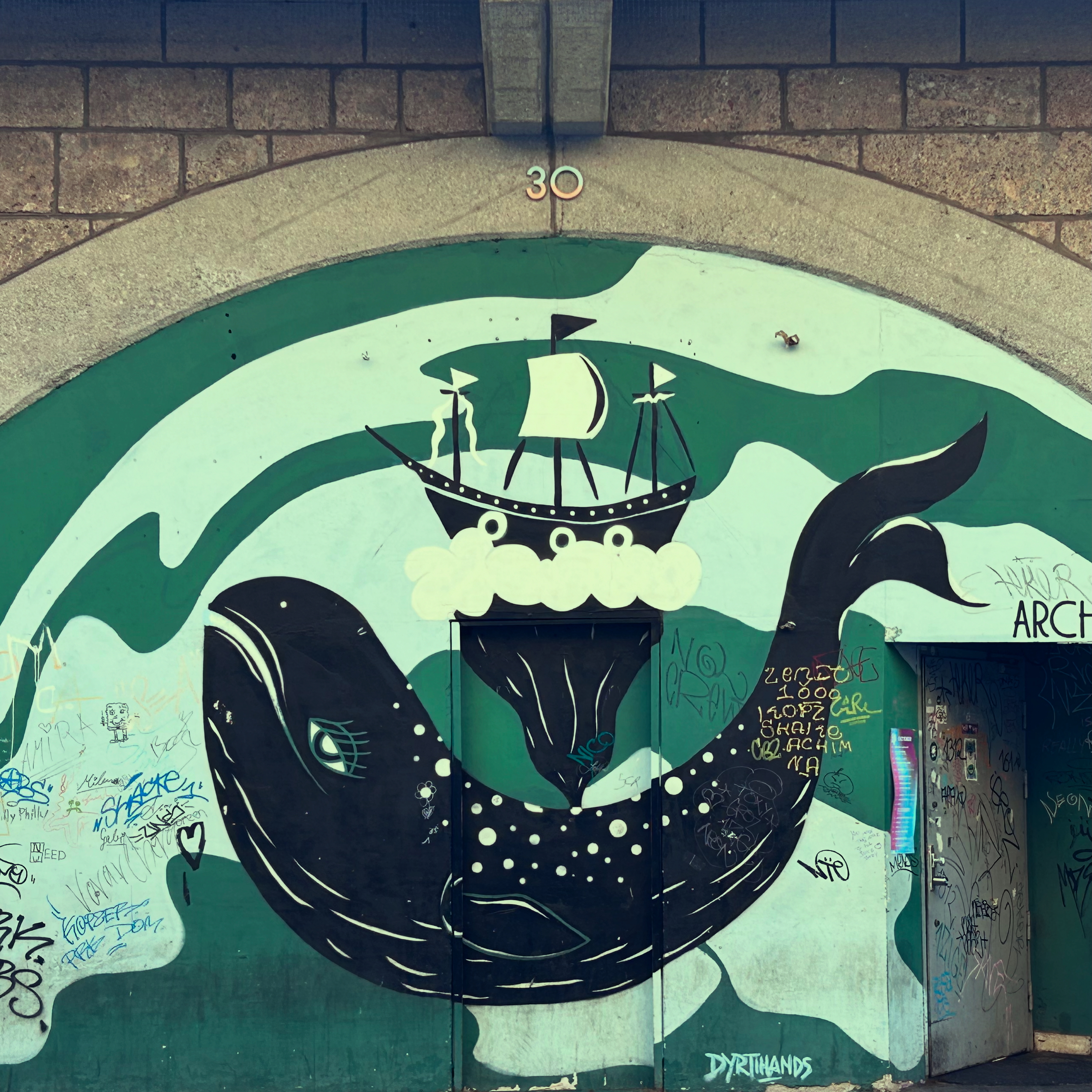
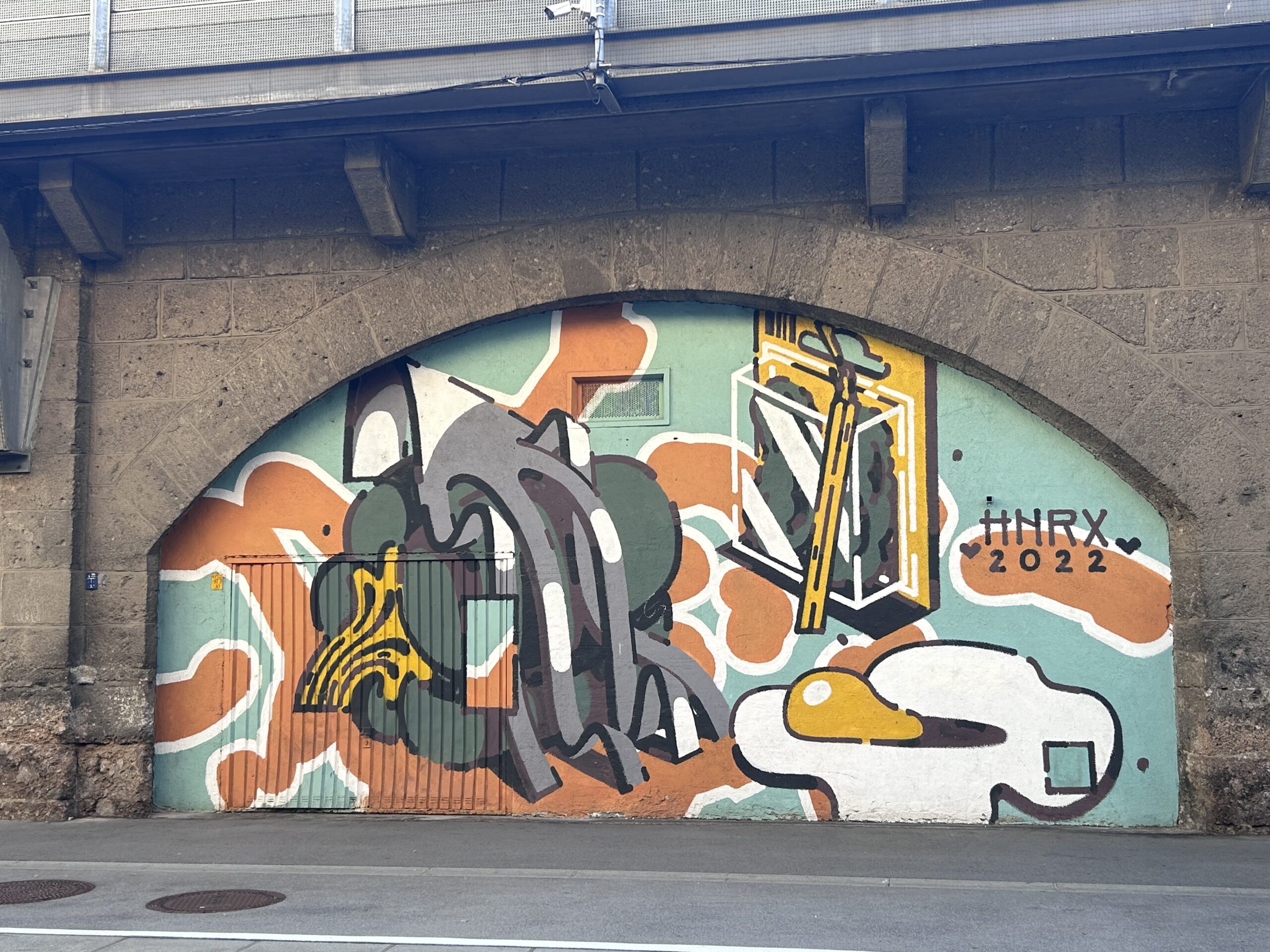
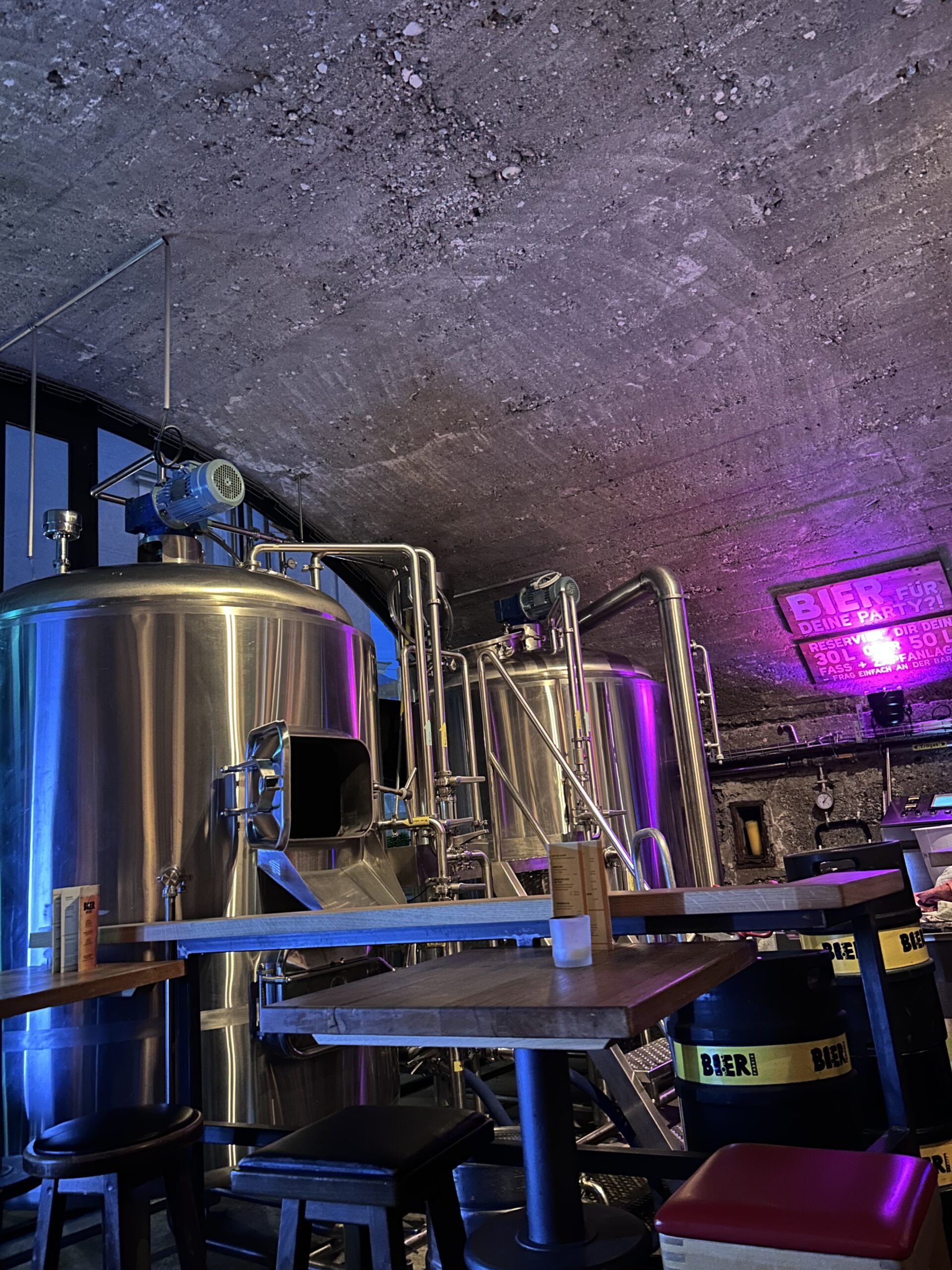
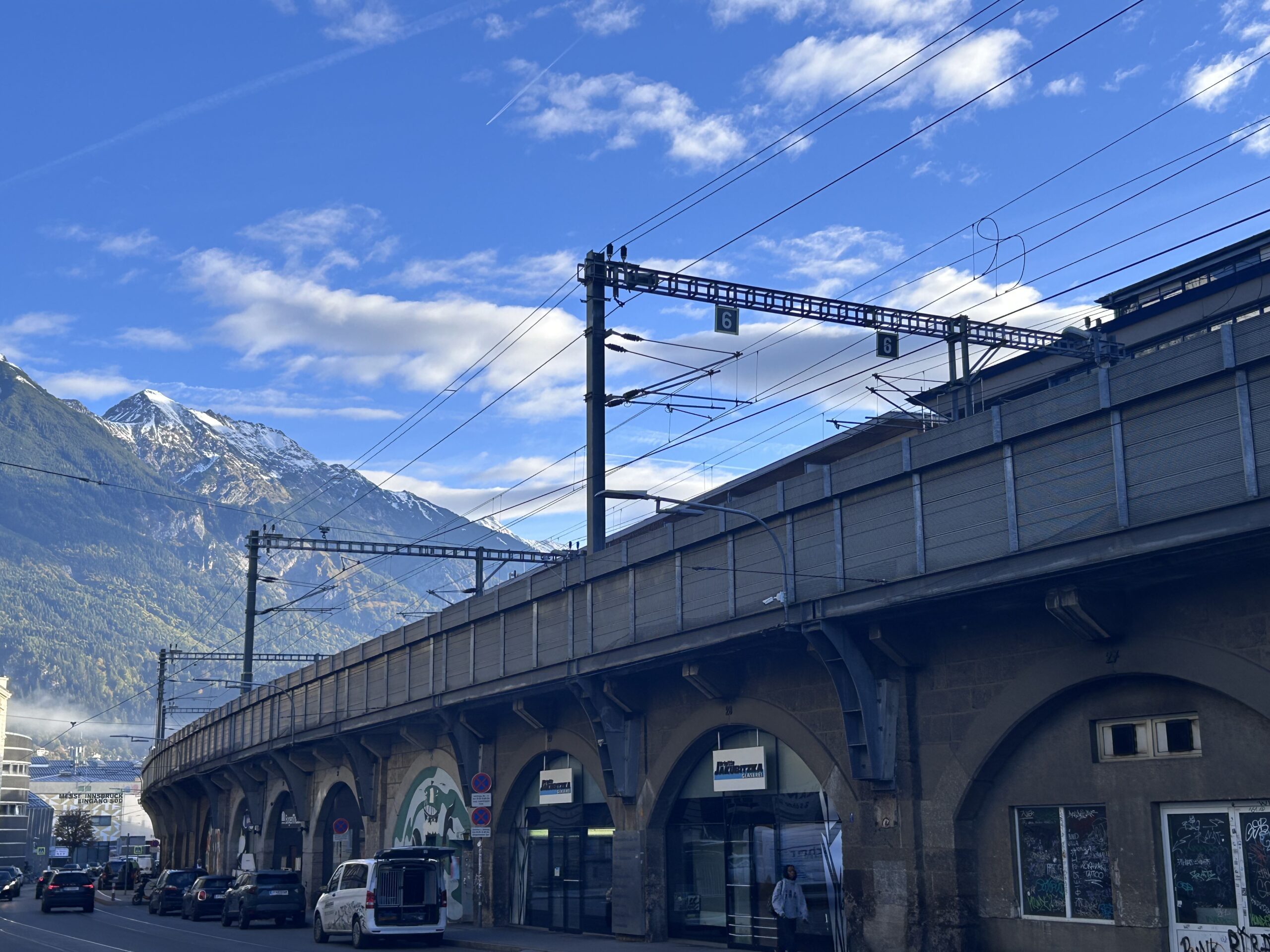
If one is to believe certain particularly cautious Innsbruck residents, the gateway to hell lies somewhere between the city center, Pradl, and Saggen. Others, however, associate the Bogenmeile with some of the best memories of their youth. For decades, the nightlife district along the railway viaduct has divided opinions and continues to inspire personal anecdotes, debates, and urban legends. Since the major renovation of the 1950s, the arches have been home to workshops, shops, and above all, bars and venues of every kind. In 1985, the youth center Z6 moved to the rear side of the arches. That same year, Bogen 13 opened, luring an alternative Innsbruck crowd away from the city center and under the viaduct for the first time. Today, pubs, bars, clubs, breweries, restaurants, and snack stands attract a colorful audience that usually celebrates peacefully until the early morning hours. In recent years, many façades have been decorated with striking street art. The district’s bad reputation stems from the comparatively rare exceptions to this peacefulness—but even more from the universal tradition of older generations finding youthful exuberance inherently threatening.
The arches form the largest structure in the city. Stretching 1.8 kilometers along Ing.-Etzel-Straße from the train station to the Mühlau railway bridge, they carry trains across the Inn toward the east. The massive structure was built between 1855 and 1858, during the construction of North Tyrol’s first railway line. The material used was Höttinger breccia, the same stone used in countless Innsbruck landmarks—from the Old Town to the Triumphal Arch to the South Tyrolean housing estates of the 1930s—until the quarries on the Hungerburg eventually closed. Thousands of workers toiled on the enormous construction site. Unlike today, the area traversed by the stone belt was not densely populated; the great wave of development in eastern Saggen—with housing blocks, the military barracks, the fairgrounds with its cycling track, and the slaughterhouse—was still far in the future.
The viaduct arches acted like an artificial barrier between Pradl and the city center. That this separation did not last is due to the mastermind behind Austrian railway construction: Carl Ritter von Ghega (1802–1860). Thanks to the turbulence of global politics, he became involved in what was perhaps the largest infrastructure project of the monarchy—possibly even in Austrian history. Born as Carlo Ghega, the son of a naval officer in Venetia, he grew up under Napoleonic rule. Only after the Congress of Vienna in 1815 did the region, as Lombardy-Venetia, come under the control of the imperial-royal monarchy. After a brief military career, he chose to study in Padua. At only 17, he completed his studies in mathematics and engineering. Following work experience in road construction and on the Northern Railway between Vienna and Moravia, he traveled to England and North America in the mid‑1830s to study railway technology in its birthplace and in the American frontier firsthand. In 1848, Ghega became Inspector General of the State Railways in the Ministry of Public Works, and in the following year head of the railway construction department and of the general directorate for state railway construction. Elevated to nobility by Emperor Franz Joseph I, the Albanian‑Italian Carlo became Carl Ritter von Ghega—the portrait of whom appeared on the Austrian 20‑schilling banknote from 1968 to 1989. It was his plans that connected the vast Habsburg Empire, from Lviv to Bregenz and Trieste. Innsbruck owes part of its ability to grow spatially to his genius. Von Ghega rejected an earlier plan by Alois von Negrelli, which envisioned an embankment between Innsbruck and Pradl. Although cheaper and faster to build, it would have permanently blocked any eastward connection for the city. In 1958, the extension of Museumstraße through the breakthrough to Rapoldipark created today’s main traffic axis between Pradl and the city center. Since then, the arches have been repeatedly renovated and adapted to evolving traffic needs. Several passageways through the viaduct’s 175 arches now connect Dreiheiligen and the various parts of Saggen. Some of the underpasses have been extensively modernized with artistic lighting installations. At Claudiaplatz, a new regional train station and a traffic‑calmed urban park have emerged. That Carl Ritter von Ghega, with his forward‑thinking engineering, would not only enable a transportation solution but inadvertently create an urban nightlife hotspot was surely never his intention.
Die Eisenbahn als Entwicklungshelfer Innsbrucks
In 1830, the world’s first public railway line for passenger traffic, operated by a steam locomotive, was put into service between Liverpool and Manchester. Shortly thereafter, this new means of transport rapidly spread across the entire continent. Until then, travel had been expensive, long, and arduous—undertaken by carriage, on horseback, or on foot—something that hardly anyone did at all, and certainly not with pleasure. Innsbruck’s mayor, Joseph Valentin Maurer (1797–1843), recognized the importance of the railway as an opportunity for the Alpine region at an early stage. In 1836, he advocated the construction of a railway line in order to make the beautiful but hard-to-reach region accessible to as broad and affluent a public as possible and to re-establish Innsbruck as a European transport hub during economically difficult times for the city. The first practical pioneer of railway transport in Tyrol was Alois von Negrelli (1799–1858). At the end of the 1830s, when the first railway lines of the Danube Monarchy were being put into operation in the eastern parts of the empire, he presented an “Expert Report on the Route of a Railway from Innsbruck via Kufstein to the Royal Bavarian Border at the Otto Chapel near Kiefersfelden.” Negrelli, later one of the many intellectual fathers of the Suez Canal, had served in his youth in the Imperial and Royal Building Directorate in Innsbruck and knew the city well. His report already contained sketches and a cost estimate. As a location for the main railway station, he had proposed the area around the Triumphal Arch and the Hofgarten. In a letter, he expressed himself about the railway line through his former home city as follows:
"...I also hear with the deepest sympathy that the railway from Innsbruck to Kufstein is being taken seriously, as the Laage is very suitable for this and the area along the Inn is so rich in natural products and so populated that I cannot doubt its success, nor will I fail to take an active part in it myself and through my business friends when it comes to the purchase of shares. You have no idea of the new life that such an endeavour will awaken in the other side..."
Hier ist die Übersetzung des gesamten Abschnitts: Friedrich List (1789–1846), known as the father of the German railway, put forward the plan for a rail link from the North German Hanseatic cities through Tyrol to the Italian Adriatic. The intellectual liberal economist and advocate of the largest possible customs union in Central Europe saw the expansion of the railway network as the key to economic prosperity. On the Austrian side, Carl Ritter von Ghega (1802–1860) inherited overall responsibility for the railway project within the sprawling Habsburg Empire from the early-deceased Negrelli. List would not live to see his dream of a sensibly connected Central European economic area realized; in 1846, driven to despair by the conservative political situation in the German states, he shot himself on Tyrolean soil in Kufstein. Five years later, Austria and Bavaria expressed their intent in a treaty to build a railway line to the Tyrolean state capital. In May 1855, construction began on what was until then the largest building site Innsbruck had ever seen. The station area took shape between Museumstraße, Pradl, and Wilten, and the station forecourt subsequently became one of the city's new focal points. Modern hotels were no longer located in the Old Town, but right here. To the east, the tracks led out of the city along newly constructed viaducts. On November 24, 1858, after just three years of construction, the railway line between Innsbruck and Kufstein—and onward via Rosenheim to Munich—went into operation. The line was ahead of its time: unlike the rest of the railway system, which was only privatized in 1860, it opened right from the start as a private railway, operated by the previously founded k.k. privilegierte südliche Staats-, Lombardisch-, Venetianisch- und Zentral-italienische Eisenbahngesellschaft (Imperial Royal Privileged Southern State, Lombard, Venetian, and Central Italian Railway Company). With this strategic move, the costly construction of the railway could be kept off the books of Austria’s chronically cash-strapped state budget. With this opening toward the eastern parts of the monarchy and, above all, toward Munich, the first step toward modernizing Tyrol had been taken. Goods and passengers could now be transported quickly and comfortably from Bavaria to the Alps and back. In South Tyrol, the first trains began rolling along the tracks between Verona and Trento in the spring of 1859. For the time being, the north-south corridor remained incomplete. The first serious considerations regarding the Brenner Railway were made in 1847. Conflicts south of the Brenner Pass and the commercial necessity of connecting the two parts of the province prompted the Permanente Central-Befestigungs-Commission (Permanent Central Fortification Commission) to step in by 1854. However, the loss of Lombardy following the war with France and Sardinia-Piedmont in 1859 delayed the project in a now politically unstable Northern Italy. In 1860, the k.k. privilegierte südliche Staats-, Lombardisch-, Venetianisch- und Zentral-italienische Eisenbahngesellschaft had to be reorganized into the k.k. privilegierte Südbahngesellschaft (Imperial Royal Privileged Southern Railway Company) to begin detailed planning. The following year, the mastermind behind this outstanding infrastructural achievement of the era, Engineer Carl von Etzel (1812–1865), began surveying the terrain and drafting concrete plans for laying the tracks. The planner was instructed by the private company’s investors to keep costs as low as possible and avoid large viaducts and bridges. Contrary to earlier considerations by Ghega—who had suggested starting the route in Hall to soften the incline up to the pass at 1,370 meters above sea level—Etzel developed a plan that included Innsbruck. Together with his site manager Achilles Thommen, he selected the Sill Gorge (Sillschlucht) as the best route. This not only saved seven kilometers of track length and a significant amount of money, but also secured Innsbruck's crucial status as a transport hub. The alpine terrain, mudslides, snowstorms, and floods posed immense challenges for the construction crews. River courses had to be diverted, rock faces blasted, earthworks excavated, and walls constructed to master the environment. However, the severe outbreak of war in Italy in 1866 caused the greatest disruptions. Particularly patriotic German-speaking workers refused to work alongside the "enemy." As a result, 14,000 Italian-speaking laborers had to be dismissed before work could resume. Nevertheless, what was then the world's highest standard-gauge railway line, featuring 22 tunnels blasted out of the solid rock, was completed in a remarkably short construction period. How many men lost their health and lives while working on the Brenner Railway remains unknown.
Die Eröffnung ging bemerkenswert unspektakulär über die Bühne. Viele Menschen waren sich nicht sicher ob der technischen Neuerung. Wirtschaftszweige wie das Rodfuhrwesen und die Poststationen entlang der neuen Brennerstraße, die nach 20 Jahren Bauzeit erst 1850 vollendet worden war, swaren dem Untergang geweiht, wie das Sterben der Flößerei nach der Eröffnung der Bahnlinie ins Unterland gezeigt hatte. Schon während der Bauarbeiten war es zu Protesten der Bauern, die ob des drohenden Imports landwirtschaftlicher Güter um ihren Gewinn fürchteten, gekommen. Auf eine dem Ereignis würdige Feier wurde, wie bereits zuvor beim Bau der Bahnstrecke verzichtet. Wegen der Hinrichtung des ehemaligen Kaisers Maximilians von Mexiko, dem Bruder Franz Josef I., vor einem revolutionären Kriegsgericht, war Österreich in Staatstrauer. Anstelle einer priesterlichen Weihe und festlicher Taufe spendete die Southern railway company 6000 guilders to the poor relief fund. Also in the Innsbrucker Nachrichten there is not a word about the revolution in transport, apart from the announcement of the last express train over the Brenner Pass and the publication of the timetable for the Southern Railway.
(The last express coach). Yesterday evening at half past seven the last express coach to South Tyrol departed from here. The oldest postilion in Innsbruck was driving the horses, his hat was fluttered with mourning, and the carriage was decorated with branches of weeping willows for the last journey. Two marksmen travelling to Matrei were the only passengers to pay their last respects to the express coach. In the last days of 1797, the beautiful, otherwise so lively and now deserted road was conspicuously dead.
Until the opening of the railway line over the Brenner Pass on 24 August 1867, Innsbruck was a terminus station of regional importance. The new, spectacular Brenner railway across the Alps connected the northern and southern parts of the country as well as Germany and Italy. The new Brenner road had already opened the year before. The Alps had lost their divisive character and their terror for transit, at least a little. While an estimated 20,000 people crossed the Brenner in 1865, three years later in the first full year of operation of the railway line there were around ten times as many. In addition, a whole flood of goods found their way across the new north-south axis, boosting trade and consumption.
The second alpine obstacle that had to be overcome for territorial unity was the Arlberg. Initial plans for a railway line connecting the Lake Constance region with the rest of the Danube Monarchy existed as early as 1847, but the project was repeatedly postponed. In 1871, export bans on food due to the Franco‑Prussian War led to famine in Vorarlberg, because supplies could not be transported quickly enough from the eastern parts of the vast empire to the far west. The economic crisis of 1873 delayed construction yet again. Only seven years later did parliament decide to realize the railway line. In the same year, complex construction work began east and west of the Arlberg massif. A total of 38 mountain streams and 54 avalanche-prone zones had to be secured with 3,100 structures under precarious alpine weather conditions. The most remarkable achievement was the ten-kilometer-long tunnel carrying two tracks. On June 30, 1883, the last transport of mail by horse-drawn carriage departed from Innsbruck to Landeck in a ceremonially mournful setting. The very next day, the railway took over this service. With the opening of the railway from Innsbruck to Landeck and the final completion of the Arlberg Railway to Bludenz in 1884—including the breakthrough of the Arlberg tunnel—Innsbruck was once again definitively established as a transport hub between Germany and Italy, France, Switzerland, and Vienna. In 1904 the Stubai Valley Railway, and in 1912 the Mittenwald Railway, were opened. Both projects were planned by Josef Riehl (1842–1917).
For a large part of the population, the railway was the most directly perceptible sign of progress. The railway viaducts, built from Hötting breccia quarried nearby, formed a physical and visible boundary to the east of the city toward Pradl. However, the railway did not change the region only from a technical perspective—it brought immense social transformation. Workers, students, soldiers, and tourists streamed into the city in large numbers, bringing new ways of life and ideas with them. Josef Leitgeb described this transformation in his novel The Untouched Year as follows:
“Even then, the railway had already brought many newcomers to Wilten. They lived in the new tall buildings that were springing up everywhere on land where grain had grown for centuries. Yet they were still perceived as outsiders; their Czech, Slovenian, and Hungarian names did not fit into the familiar sounds. They wore cheap ready-made clothing bought on installment, avoided church services, and instead attended meetings where the established citizens felt out of place. Seen clearly, they were quiet, hardworking, thrifty people who had simply brought different ways of life from the large cities and the lowlands. Anyone who looked at them askance could claim no other justification than that they did not want spectators for their own comfort. Nevertheless, the rejection of newcomers by the locals was still clearly palpable at the time; the father once heard a sermon in which the priest assured that all people could attain eternal salvation—‘even robbers and murderers, yes, even railwaymen.’”
The Federal Railway Directorate of the Imperial and Royal General Directorate of the Austrian State Railways in Innsbruck was one of only three directorates in Cisleithania. New social classes emerged as a result of the railway as an employer. People from all strata of society were needed to keep railway operations running. Workers and craftsmen could experience social advancement within the railway, similar to opportunities in state administration or the military. New professions such as track keeper, conductor, stoker, or locomotive driver emerged. Working for the railway carried a certain prestige. Not only was one part of the most modern industry of the time; titles and uniforms turned employees and workers into figures of respect. By 1870, Innsbruck’s population had grown from 12,000 to 17,000, largely due to the economic impulses generated by the railway. Local producers benefited from the ability to import and export goods quickly and at low cost. The labor market changed. Before the railway lines were opened, nine out of ten Tyroleans worked in agriculture; after the opening of the Brenner Railway, this figure dropped to below 70%. The new mode of transport contributed to social democratization and the rise of a bourgeois society. Not only wealthy tourists but also ordinary subjects—those who did not belong to the upper class—could now take excursions into the surrounding area. New foods altered people’s diets. The first department stores appeared with the arrival of consumer goods that had previously been unavailable. The appearance of Innsbruck’s inhabitants changed with new, fashionable clothing that became affordable for many for the first time. Not everyone welcomed this development. Shipping on the Inn River, previously an important transport route, almost immediately came to a standstill. The already weakened lower nobility and particularly strict clergy feared the collapse of local agriculture and a final moral decline due to the presence of strangers in the city.
The railway was worth its weight in gold for tourism. It was now possible to reach the remote and exotic mountain world of the Tyrolean Alps. Health resorts such as Igls and entire valleys such as the Stubaital, as well as Innsbruck city transport, benefited from the development of the railway. 1904 years later, the Stubai Valley Railway was the first Austrian railway with alternating current to connect the side valley with the capital. On 24 December 1904, 780,000 crowns, the equivalent of around 6 million euros, were subscribed as capital stock for tram line 1. In the summer of the following year, the line connected the new districts of Pradl and Wilten with Saggen and the city centre. Three years later, Line 3 opened the next inner-city public transport connection, which only ran to the remote village in 1942 after Amras was connected to Innsbruck.
The railway was also of great importance to the military. As early as 1866, at the Battle of Königgrätz between Austria and Prussia, it was clear how important troop transport would be in the future. Until 1918, Austria was a huge empire that stretched from Vorarlberg and Tyrol in the south-west to Galicia, an area in what is now Poland, and Ukraine in the east. The Brenner Railway was needed to reinforce the turbulent southern border with its new neighbour, the Kingdom of Italy. Tyrolean soldiers were also deployed in Galicia during the first years of the First World War until Italy declared war on Austria. When the front line was opened up in South Tyrol, the railway was important for moving troops quickly from the east of the empire to the southern front.
Carl von Etzel, who did not live to see the opening of the Brenner railway, is commemorated today by Ing.-Etzel-Straße in Saggen along the railway viaducts. Josef Riehl is commemorated by Dr.-Ing.-Riehl-Straße in Wilten near the Westbahnhof railway station. There is also a street dedicated to Achilles Thommen. As a walker or cyclist, you can cross the Karwendel Bridge in the Höttinger Au one floor below the Karwendel railway and admire the steel framework. You can get a good impression of the golden age of the railway by visiting the ÖBB administration building in Saggen or the listed Westbahnhof railway station in Wilten. In the viaduct arches in Saggen, you can enjoy Innsbruck's nightlife in one of the many pubs covered by history.
The Red Bishop and Innsbruck's moral decay
In the 1950s, Innsbruck began to recover from the crisis and war years of the first half of the 20th century. On May 15, 1955, Chancellor Leopold Figl officially declared a political turning point with his famous words, "*Austria is free*," and the signing of the Austrian State Treaty. During the years that went down in history as the *Wirtschaftswunder* (economic miracle), moderate prosperity established itself in many households. Between 1953 and 1962, an annual economic growth rate of over 6% allowed an increasing portion of the population to dream of exotic luxuries like refrigerators, a private bathroom, or even a vacation in the South. This era brought not only material but also social change. People's desires became more elaborate with rising prosperity and the lifestyle promoted in advertising and media. The phenomenon of a new youth culture began to take root amidst the somber postwar society of small-town Austria. Previously unknown terms like *teenager* and *latchkey kid* (*Schlüsselkind*) entered everyday vocabulary in the 1950s. In 1956, the magazine *BRAVO* launched. For the first time, a media outlet catered directly to the interests of young people. Marilyn Monroe was featured on the first cover, under the headline: "*Did Marilyn's curves get married too?*" The biggest stars of those early years were James Dean and Peter Kraus, before the Beatles took over in the 1960s. After the *Summer of Love*, the advice column "Dr. Sommer" began educating youth on love and sex. The church's all-powerful authority over the moral conduct of adolescents began to crumble, albeit slowly—the first photo love story featuring nudity did not follow until 1982. Up until the 1970s, opportunities for young people in Innsbruck were largely limited to traditional inns (*Wirtshausstuben*), the marksmanship club (*Schützenverein*), and brass bands (*Blasmusik*). Only gradually did bars, discos, nightclubs, pubs, and event venues begin to open. Events like the *5 Uhr Tanztee* (5 o'clock tea dance) at the Sporthotel Igls attracted young singles looking to socialize. *Café Central* became the "second home of long-haired youths," as the *Tiroler Tageszeitung* horrifiedly observed in 1972. Establishments such as the *Falknerkeller* on Gilmstraße, the *Uptown Jazzsalon* in Hötting, the Jazzclub in Hofgasse, the *Clima Club* in Saggen, the *Scotch Club* on Angerzellgasse, and the *Tangente* on Bruneckerstraße had nothing in common with the traditional tavern. The performances by The Rolling Stones and Deep Purple at the Olympiahalle in 1973 marked the temporary peak of Innsbruck's cultural awakening. While this did not turn Innsbruck into London or San Francisco, locals had at least caught a breath of rock 'n' roll. By contrast, what remains anchored in cultural memory as the 1968 revolution barely took place in the "*Heiliges Land*" (Holy Land of Tyrol). Neither workers nor students took to the barricades in large numbers. Though a few radical student groups eventually emerged to protest social injustice, the Vietnam War, and traditional gender roles, there was no comparison to the unrest seen in Prague, Paris, or the distant USA. The historian Fritz Keller famously described Austria's '68 movement as a mere "*Mailüfterl*" (gentle May breeze). Nevertheless, society was undergoing a quiet transformation. A look at the annual music charts offers a clue: While the top 10 in 1964 was still dominated by *Kaplan Alfred Flury* and *Freddy* with "Lass die kleinen Dinge" and "Gib mir dein Wort," alongside the Beatles with their German version of "Komm, gib mir deine Hand," musical tastes were shifting. Although Peter Alexander and Mireille Mathieu could still be found on the charts, from 1967 onward, international acts with foreign-language tracks—such as *The Rolling Stones, Tom Jones, The Monkees, Scott McKenzie, Adriano Celentano*, and *Simon & Garfunkel*—dominated the top spots with increasingly socially critical lyrics.
This change sparked a backlash. The spearhead of the conservative counter-revolution was the Bishop of Innsbruck, Paulus Rusch. Cigarettes, alcohol, overly revealing fashion, trips abroad, working women, nightclubs, premarital sex, the 40-hour workweek, Sunday sports events, dance nights, mixed-gender education and leisure—all of this was deeply abhorrent to the strict clergyman and devoted follower of the Sacred Heart of Jesus cult. Peter Paul Rusch was born in Munich in 1903 and grew up in Vorarlberg as the youngest of three children in an upper-middle-class household. Both of his parents and his older sister died of tuberculosis before he reached adulthood. Forced to fend for himself at the young age of 17 during the lean post-war years, inflation wiped out his father's inheritance—which was meant to finance his university studies—in no time. Rusch worked for six years at the Bank für Tirol und Vorarlberg to fund his theology degree. In 1927, he entered the Collegium Canisianum, and six years later, he was ordained as a priest of the Jesuit order. His meteoric career led the intelligent young man to serve as a chaplain in Lech am Arlberg and Hohenems. He then returned to Innsbruck as head of the partial seminary. In 1938, he became Titular Bishop of Lycopolis and Apostolic Administrator for Tyrol and Vorarlberg—two imaginative titles intended to replace the authority of the bishop in North Tyrol. As the youngest de facto bishop in Europe, he had to endure the harrassment of the National Socialist rulers against the Church. Although his critical stance on National Socialism was well known, Rusch himself was never imprisoned; the authorities feared turning the popular young bishop into a martyr. After the war, the socially and politically active bishop was at the forefront of the reconstruction effort. With hands-on dedication, he sought to strengthen the influence of the Church. His father had worked his way up from carpenter to architect, passing down a passion for construction. Added to this was Rusch's own experience in banking: thanks to his background in the private sector, he recognized the opportunities for the Church to step in and distinguish itself as a helper in times of need. Under Rusch's leadership, the Katholische Jugend (Catholic Youth) volunteered without pay to construct the Heiligjahrsiedlung (Holy Year Settlement) in Höttinger Au. The diocese purchased the plot of land from the Ursuline Order, and interest-free loans were advanced to the settlers by the Church. His pragmatic, hands-on approach to the housing shortage earned him the nickname the "Red Bishop." In these modest houses with self-sufficiency gardens—built according to the vision of the dogmatic and frugal "worker's bishop"—41 families, with preference given to those with many children, found a new home. Alleviating the housing shortage was meant to keep the greatest threats of the Cold War away from his congregation. Both the state-mandated atheism of communism and the consumer-driven capitalism spilling over from the US into Western Europe were anathema to him. In 1953, Rusch published his book "Junger Arbeiter, wohin?" ("Young Worker, Whither Bound?"). What sounded like revolutionary, left-wing literature was actually an exposition of Christian Social Teaching, which condemned both capitalism and socialism. Families were expected to live modestly, managing in Christian harmony on the moderate income of a single breadwinning father. Employers, employees, and laborers were to form a peaceful unit—cooperation instead of class struggle, laying the groundwork for today's social partnership. Everyone had their place in a Christian sense: a sort of modern feudal system, which had already been envisioned for implementation under Dollfuss's Austrofascist Corporate State (Ständestaat). He shared his political views with State Governor Eduard Wallnöfer and Mayor Alois Lugger, who together with the bishop formed the "Holy Trinity" of conservative Tyrol during the economic miracle era. To this, Rusch added a latent Catholic antisemitism that remained widespread in Tyrol even after 1945, enduring as a supposed tradition through aberrations like the veneration of Anderle von Rinn.
Besondere Anliegen waren dem streitbaren Jesuiten Erziehung und Bildung. Die gesellschaftliche Formung quer durch alle Klassen durch die Soldaten Christi konnte in Innsbruck auf eine lange Tradition zurückblicken. Der Jesuitenpater und vormalige Gefängnisseelsorger Alois Mathiowitz (1853 – 1922) gründete 1909 in Pradl den Peter-Mayr-Bund. His approach was to put young people on the right path through leisure activities and sport and adults from working-class backgrounds through lectures and popular education. The workers' youth centre in Reichenauerstraße, which was built under his aegis, still serves as a youth centre and kindergarten today. Rusch also had experience with young people. In 1936, he was elected regional field master of the scouts in Vorarlberg. Despite a speech impediment, he was a charismatic guy and extremely popular with his young colleagues and teenagers. In his opinion, only a sound education under the wing of the church according to the Christian model could save the salvation of young people. In order to give young people a perspective and steer them in an orderly direction with a home and family, the Youth building society savings strengthened. In the parishes, kindergartens, youth centres and educational institutions such as the House of encounter am Rennweg errichtet, um von Anfang an die Erziehung in kirchlicher Hand zu haben. Der allergrößte Teil des sozialen Lebens der Stadtjugend spielte sich nicht in verruchten Spelunken ab. Den meisten Jugendlichen fehlte schlicht und ergreifend das Geld, um regelmäßig in Lokalen zu verkehren. Viele fanden ihren Platz in den halbwegs geordneten Bahnen der katholischen Jugendorganisationen.
Hier ist die Übersetzung des letzten Teils: Rusch failed to foresee that the clergy itself was changing with the times. Alongside the conservative bishop, a generation of liberal clerics was emerging and immersing themselves in youth work. In the 1960s and 70s, two church youth movements wielded immense influence in Innsbruck. Responsible for this were Sigmund Kripp and Meinrad Schumacher, who won over teenagers and young adults through new pedagogical approaches and a more open handling of sensitive topics like sexuality and substances. In Innsbruck, the Marianische Kongregation (Marian Congregation)—known to this day as the MK—had been shaping the minds of the elite according to the principles of the Jesuit Order since 1578. This youth organization catered to high school students (Gymnasiasten). The MK was strictly hierarchical, designed to teach young "Soldiers of Christ" obedience from the outset. In 1959, Father Sigmund Kripp took over the leadership of the organization. Under his direction—and supported by financial contributions from the Church, the state, parents, and substantial volunteer labor—the youth built projects such as the Mittergrathütte along with its own material ropeway in Kühtai, as well as the legendary youth center Kennedyhaus on Sillgasse. Federal Chancellor Klaus and members of the US Embassy attended the cornerstone laying of this youth center—which would become the largest of its kind in Europe with nearly 1,500 members—as the building was dedicated to the first Catholic, recently assassinated President of the United States. Innsbruck's second church youth organization was Z6. City youth chaplain Father Meinrad Schumacher took care of all those young people who had no place in the MK or the Katholische Hochschülerschaft (Catholic Students' Association) through the Aktion 4-5-6. Working-class children and apprentices met in various youth centers in Pradl or Reichenau until a new center opened in 1971 at its namesake Zollerstraße 6, also built by the members themselves. Josef Windischer took over as director. Z6 had much more in common with what Denis Hopper and Peter Fonda displayed on movie screens riding their motorcycles in Easy Rider. Things were rougher here than in the MK. Rocker gangs, petty criminals, and drug addicts also spent their free time at Z6. While Schumacher ran his program with the "well-behaved" youth upstairs, Windischer populated the basement with the "outsiders" to support these lost sheep as best as possible. By the late 1960s, both the MK and Z6 decided to open their doors to non-members. Girls' and boys' groups were partially merged, and non-members were admitted. Although the two youth centers targeted different demographics, their overall concept was identical: theological knowledge and Christian morality were imparted in a playful, age-appropriate environment. Sections dedicated to chess, soccer, hockey, basketball, music, movies, and a party cellar addressed young people's desires for play, sports, and destigmatizing their first sexual experiences. The youth centers offered a space where adolescents of both genders could mingle. However, the MK in particular remained an institution that had little to do with the wild lifestyle of the 1968 movement as commonly portrayed in films. For instance, dance classes were not held during Advent, Carnival, or on Saturdays, and they remained forbidden fruit for anyone under 17. Nonetheless, the youth centers went too far for Bishop Rusch. The critical articles in the MK magazine Wir diskutieren ("We Discuss")—which reached a circulation of over 2,000 copies—increasingly met with his displeasure. Solidarity with Vietnam was one thing, but criticism of the Schützen (traditional Tyrolean marksmanship guilds) and the Austrian Armed Forces (Bundesheer) could not be tolerated. After years of disputes between the bishop and the youth center, the showdown arrived in 1973. When Father Kripp published his book Abschied von morgen ("Farewell to Tomorrow"), detailing his pedagogical concept and work in the MK, closed-door proceedings were launched against the head of the youth center within the diocese and the Jesuit Order. Despite massive protests from parents and members, Kripp was removed from his post. Neither inner-church intervention by the prominent theologian Karl Rahner, nor a petition initiated by artist Paul Flora, nor regional and national outrage in the press could save the overly liberal priest from the wrath of Rusch—who even secured the papal blessing from Rome for Kripp's dismissal. In July 1974, Z6 also came to a temporary end. Articles about the birth control pill and the Z6 newspaper's criticism of the Catholic Church were too much for the strict bishop. Rusch simply had the locks to the youth center changed—a method he had previously used against the Katholische Hochschülerschaft when it drifted too close to a left-wing activist group. On August 1, 1974, the Tiroler Tageszeitung noted in an article on the matter:
"In recent weeks, there had been profound disputes between the educators and the bishop over fundamental issues. According to the bishop, the views expressed in "Z 6" were "no longer in line with church teaching". For example, the leadership of the centre granted young people absolute freedom of conscience without simultaneously recognising objective norms and also permitted sexual relations before marriage."
It was his adherence to conservative values and his stubbornness that damaged Rusch's reputation during the last 20 years of his life. When he was consecrated as the first bishop of the newly founded Diocese of Innsbruck in 1964, times were changing. The progressive clergyman with practical life experience of the past was overtaken by the modern lifestyle of a new generation and the demands of an establishing consumer society. The bishop's constant criticism of his flock's lifestyle and his stubborn refusal to abandon his overly conservative values—paired with occasionally bizarre statements—transformed the young, hands-on bishop of the reconstruction era into a reason for many Tyroleans to leave the Catholic Church. His concept of repentance and penance produced surreal results. For instance, while he demanded admissions of guilt and atonement for transgressions during the Nazi era, he simultaneously criticized the denazification laws as too far-reaching and severe. Responding to changing sexual norms and the abortion law reforms under Chancellor Kreisky, he claimed that girls and young women who engaged in premature sexual relations were up to twelve times more likely to suffer from cancers of the reproductive organs. Rusch referred to Hamburg as a "den of sin" (Sündenbabel) and suggested that the simple minds of the Tyrolean population were ill-equipped to handle phenomena like tourism and nightlife, which lured them into immoral behavior. He feared that technology and progress would make people far too independent of God. He was adamantly opposed to the new trend of dual-income households: individuals were expected to be content with a modest "spiritual single-family home" complete with a vegetable garden rather than striving for more, while women were expected to dedicate themselves strictly to their traditional role as housewives and mothers.
In 1973, after 35 years at the head of the church community of Tyrol and Innsbruck, Bishop Rusch was named an honorary citizen of the City of Innsbruck. He resigned from his office in 1981. In 1986, Innsbruck's first bishop was laid to rest in St. James' Cathedral (Dom St. Jakob). The Bischof-Paulus-Studentenheim (Bishop Paulus Student Residence), located near the Petrus Canisius Church built under his leadership in Höttinger Au, serves as a reminder of his legacy. Following its closure in 1974, the Z6 youth center relocated to Andreas-Hofer-Straße 11 before finding its current home on Dreiheiligenstraße, right in the heart of the early modern working-class district opposite the Plague Church (Pestkirche). After his involvement in social projects in Brazil, Jussuf Windischer remained in Innsbruck. The father of four continued to work with marginalized social groups, served as a lecturer at the Social Academy, worked as a prison chaplain, and headed the Caritas Integration House in Innsbruck. The MK also continues to exist today, even though the Kennedyhaus—which was renamed Sigmund-Kripp-Haus by its members immediately following Kripp's departure—no longer exists. In 2005, Kripp was named an honorary citizen of the City of Innsbruck by his former sodalis and later vice mayor—just like Bishop Rusch before him.
The good and the bad of Innsbruck
The arches, that's where the good Innsbruckers don't go in Innsbruck. Unless they are drunk because they were somewhere else with the less good Innsbruckers beforehand, where the less good ones persuaded them to drink alcohol, which the good ones didn't want to drink, as they will tell their partner, spouse, guardian or breadwinner when they come home the next day, remorseful for their weakness and upset about the misfortune they suffered at the hands of the less good Innsbruckers. But who cares, the good Innsbruckers don't go there, because everything that doesn't meet anywhere else meets in the arches: men in shirts, women in dresses, women in trousers, men in kilts, men with long hair, women with dyed hair, rockers, hackers, students, young farmers, sportsmen, musicians, punks - in short, so that we can cope - everything. It's scary. And there's not just drinking, there's also dealing, beating and stabbing. I haven't seen the beatings, at least not any more than in other pubs where drunk people get together, and no stabbings anyway, but it's in the papers and that's probably how it is.
Sometimes, it used to be more often, because I'm already old, when I get talking to a good Innsbrucker in a beer mood, and the conversation turns to arcs at some point during the evening and how bad they are, then I like to explain that if you follow Einstein's theory of space-time, which I don't understand but still like to bring up to impress the good Innsbruckers, who don't understand it either, then arcs are neither good nor bad, but relative at best. Then nobody understands it and I have to explain it. The arcs are relative because they have neither a beginning nor an end in terms of time or space, neither on a small scale nor on a large scale.
Not in the short term, because the arches never really close. When the last bar closes, the first one opens again. Brennpunkt sells its coffee to hipsters more in the morning than in the evening. And not in the big time either, because the things that happen there repeat themselves like in an endless time loop, except that everything gets worse, of course. Because when I was younger, everything was better than it is now that my son is starting to go out, the music anyway and it wasn't as expensive and we didn't dress as stupidly or talk as stupidly to each other as the boys do today. And when I tell him about the old days and how great everything was, especially in the arches, then of course he listens to me in awe, just like I used to listen to my dad when he told me how everything was better in the old days.
And it's not just the arches that are in this time loop, what happens afterwards because of the arches doesn't change either, you can't get that old. My mum used to complain when I was younger and lived at home, well, with my parents, because you live at home anyway, when I came home early in the morning and drunk. "Have you been drinking in the arches again, ha?". When I moved out and had a girlfriend who didn't drink alcohol at all and therefore never went to the arches, I didn't go there as often, but she always complained when it happened. Now I have a friend who used to go to the arches and when I go there now, she goes with me and if you think that hardly anyone can complain, then you're wrong, because the complaint is just because she has a headache and a hangover the next day because of me, because she had to go with me. So it's no use growing up, if you go to the arches, whether alone or not, you'll get told off.
And the spatial aspect is also relative, because the arches have two beginnings and two ends, and you can't really say where they begin and end, because that depends on where you go in and then leave again when you've finished. For me, the arches start at the front, at Sillpark, where the Viaduktstüberl used to be, a pub that always had dirty windows with Unterberg advertisements and where it could happen that someone would get wild very early in the evening, because where the arches start, people started drinking alcohol very early. Now, by the way, there's a restaurant in this arch where families are supposed to go.
For someone else, the arches certainly start at the back of the Sillzwickl where the Outsider Motorcycle Club has its clubhouse, although I find that strange, but as a cosmopolitan person you have to respect this wrong opinion. I was there once at a 150th birthday party. When I turned 30, I had a party with four friends who were also turning 30. That was also funny, by the way, especially how the girlfriend of one of my friends cuddled with one of the motorbike waiters, that was the end of the story.
But it's better to go back to the beginning. Here's the thing about the bends. If you count the last bend after the Outsider, which is actually a pass, there are 175. 175 bends spread over 1.7 kilometres. I know this because I measured it with my sports watch. Between the Outsider and the next restaurant, the Cafe zum Mo In the 103 bend, the first 650 metres, or the last, as you see it, are actually only car and moped garages and the Veloflott for bicycles, i.e. mobility, and I'm more interested in the alcoholic side of the bends. And the interesting part is the first one, because there are bars and pubs along this kilometre.
The first is the Little Rock, which looks a bit like a saloon and where we used to say, when everything was better, that we wouldn't go in there because it's very similar to the Down Under anyway, except that the Down Under is much cooler. It's just a shame that the Down Under no longer exists. When I was standing in front of the door and realised that it was closed, it was like a Catholic when the Pope dies, and the Catholic doesn't notice and then at some point when he's standing in Rome he's told: "The Pope has died." That's probably how I looked the moment I found out, with a very surprised and sad face, because Down Under I've drunk a lot of beer up at the tables and at the bar. And when a place like the Down Under no longer exists, you realise - Holla, I'm not young anymore either. It's like when your kindergarten is torn down and it's been so long since you were there that you can't even remember it. The difference between Down Under and kindergarten is that there was no tequila in kindergarten. And the music was always good there too, in the Down Under, not in the kindergarten. It was so loud that you could still have a conversation. That's why you always went to Down Under, where you could still talk and weren't completely drunk, and only later to PMK, where there are always concerts and the music is louder. What's more, people were always more relaxed at Down Under than at PMK, where everyone was always stressed.
If you now think that the PMK was the opposite of Down Under, then that's wrong. The opposite of PMK is on the other side of the arches, where the new railway station is now. The arches have their own railway station, as they should. The opposite of PMK, with all the alternatives and left-wingers, is both geographically and ideologically the St Andrew's parlourwhere the landlord, Ander, serves his Indians, most of whom have spent too many summers and winters in the arches, beer and Ramazzotti to the sound of pop music like a chieftain.
Next to the Andreasstüberl is Shakespeare's, where you might also hear pop music, because they often sing karaoke there and if the DJ is in a good mood, he might sing a pop song, even though he himself is more of a metal fan.
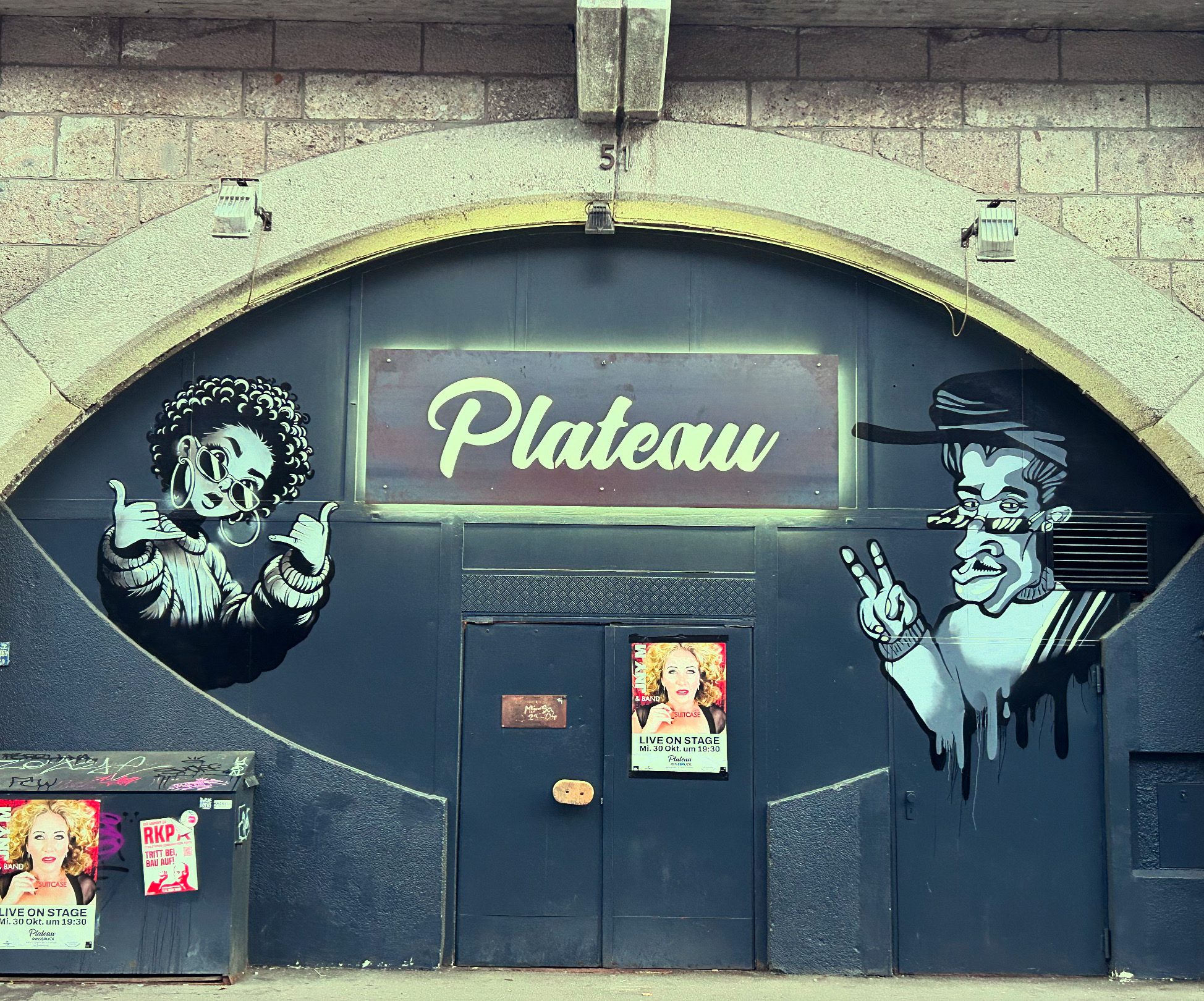
If you then take everything between the Little Rock and the Café zum Mo, then everything is relative, as Einstein says, but there is still a centre. Because no matter how much of a physicist you are, in the real world, which both the good and the less good Innsbrucker understand, there needs to be a centre. And in the arches, this centre is the plateau. Of course, like everything else, the Plateau has got worse because there's nothing going on there any more, which could of course be because I can't stand it until three o'clock any more, there was never anything going on there before, but I think it used to be better. It doesn't really matter, because the plateau is really the definition of spacetime, at least as far as I understand it. How else can it be that there is no time, the small space always looks much bigger and everything is relatively unimportant when you're in there. For example, you go in sometime after midnight and leave again at half past midnight. Half past midnight is the time when it's already light outside and the birds are chirping and the good people of Innsbruck, who weren't trapped in space-time, go to work and it's still dark on the plateau because it's only just past midnight there.
When I was young, I needed money, so I even spent two weeks during the Christmas holidays in the Plateau doing the accounts, scrubbing the floor and cleaning the toilets. So when I went in in the morning, the waiters were still sitting inside drinking and smoking and I was sober and wanted to clean, but I couldn't because in the Plateau's space-time, the drunks have priority. It can be there outside the door, but in this small room, it's always halfway there.
And when the good people of Innsbruck always grumble about the Plateau and the Andreasstüberl and the PMK and the other arches, then I have to say that I think it's great that we have something in the city where everyone meets and everyone is equal and even the space and time are no longer quite so exact and it's OK if it gets halfway. So!