Thurn und Taxis and the invention of the post office
Thurn und Taxis and the invention of the post office
The twentieth and twenty-first centuries are commonly regarded as the Information Age. The internet has revolutionized almost every aspect of life. Yet the major transformations that took place around 1500 were also closely linked to new ways of disseminating information. The production and distribution of news, information, and ideas were fundamentally transformed by two innovations. With the invention of the printing press, the reproduction of information became far easier. At roughly the same time, a more efficient postal system began to develop within the Holy Roman Empire. The history of the Taxis family, which established and operated this postal service, exemplifies the opportunities for advancement offered by the early modern period around 1500. Their story is closely connected to the Habsburgs and to the city of Innsbruck, which under Emperor Maximilian was, for a brief period, not only a residence city but the central hub of European postal communication.
The Taxis were a Lombard family of the lower nobility. As early as the thirteenth century, Omodeo de Tasso had established a courier service linking the major cities of northern Italy. During the Middle Ages, however, no reasonably functioning, cross-border postal system existed comparable to that of ancient Rome. The expanding empire under Maximilian—stretching from the Netherlands via Augsburg and Regensburg to Vienna—required communication to be as efficient as possible. To achieve this, Maximilian engaged the Compania de Tassis, which established a permanent relay-based postal route for the Emperor, complete with infrastructure and personnel. The brothers Janetto, Francesco, and Giovanni Battista de Tassis—known in German as Franz and Johann Baptist von Taxis—were appointed Imperial Postmasters by Maximilian I. The Emperor sought to harness their expertise in order to bind his vast realm together through information networks.
At intervals of 20 to 40 kilometers, stations known as posts were established, where messengers and horses could be changed in order to shorten delivery times. Innsbruck became the first modern postal center of the early modern Habsburg Empire. Its location at the foot of the Brenner Pass was now decisive not only for trade but also for the exchange of information. The first postal route, established in 1489, ran from Innsbruck to Mechelen. Soon, the route linking the Netherlands and Italy became known as the “German Route.” With the postal system came additional administrative functions to Innsbruck. The city became a collection point for court mail, which was forwarded from there to the Emperor’s current location. The court chancery assembled the archives of correspondence and chamber administration records in Innsbruck. The news exchanged between correspondents—so-called Zeitungen—gave rise to a new profession: the novellants, who gathered and wrote up current information.
A few years after Maximilian’s death, the Taxis courier service was opened to the private market, albeit still under strict supervision. The Habsburgs were notoriously late payers, and costs had to be covered. This development also offered advantages to the authorities. The growing number of users of the postal system enabled broader surveillance. The Counter-Reformation and the military made systematic use of the post for their purposes. At individual postal stations, so-called “Black Chambers” existed, where suspicious letters were opened. Postmasters also functioned as a kind of intelligence service. Gradually, passenger transport was added to the routes as a way of maximizing revenue. As the Habsburg Empire expanded, so too did the Taxis relay system. In 1505, Philip I of Spain granted the family responsibility for postal services on the Iberian Peninsula as well. Following the Italian conquests under Charles V, the Habsburgs also controlled large parts of northern Italy. From Spain to Hungary, from Milan to Brussels, an expansive information network emerged.
Durch die Kontrolle der europäischen Kommunikation kamen die Taxis zu Macht, Einfluss und Reichtum. Seit 1650 nannte sich das Geschlecht Thurn und Taxis. Vom alten italienischen Tasso, zu Deutsch Dachs, war nichts mehr übriggeblieben. Erst mit der Zentralisierung und dem neuen Staatsverständnis der Aufklärung des 17. Jahrhunderts begann ihr Stern zu sinken. 1769 wurde das Postregal der Familie Taxis für Vorderösterreich aufgehoben. Die Umwälzungen der Napoleonischen Kriege brachten weitere Änderungen mit sich. Als das Heilige Römische Reich When the Thurn und Taxis were dissolved in 1806, they were only able to claim the postal service for themselves in a few German principalities. The service was increasingly monopolised. Post offices became symbols of the penetration of state power in the public sphere. In 1908, the new main post office was built in Maximilianstraße in Innsbruck according to the plans of Natale Tommasi. As with railway stations, the architecture of the building was no different from other large post offices within the Habsburg Empire. Those who conducted their postal business as subjects of Emperor Franz Joseph I were to be able to do so in the same look and feel throughout the entire monarchy between Trento and Lviv.
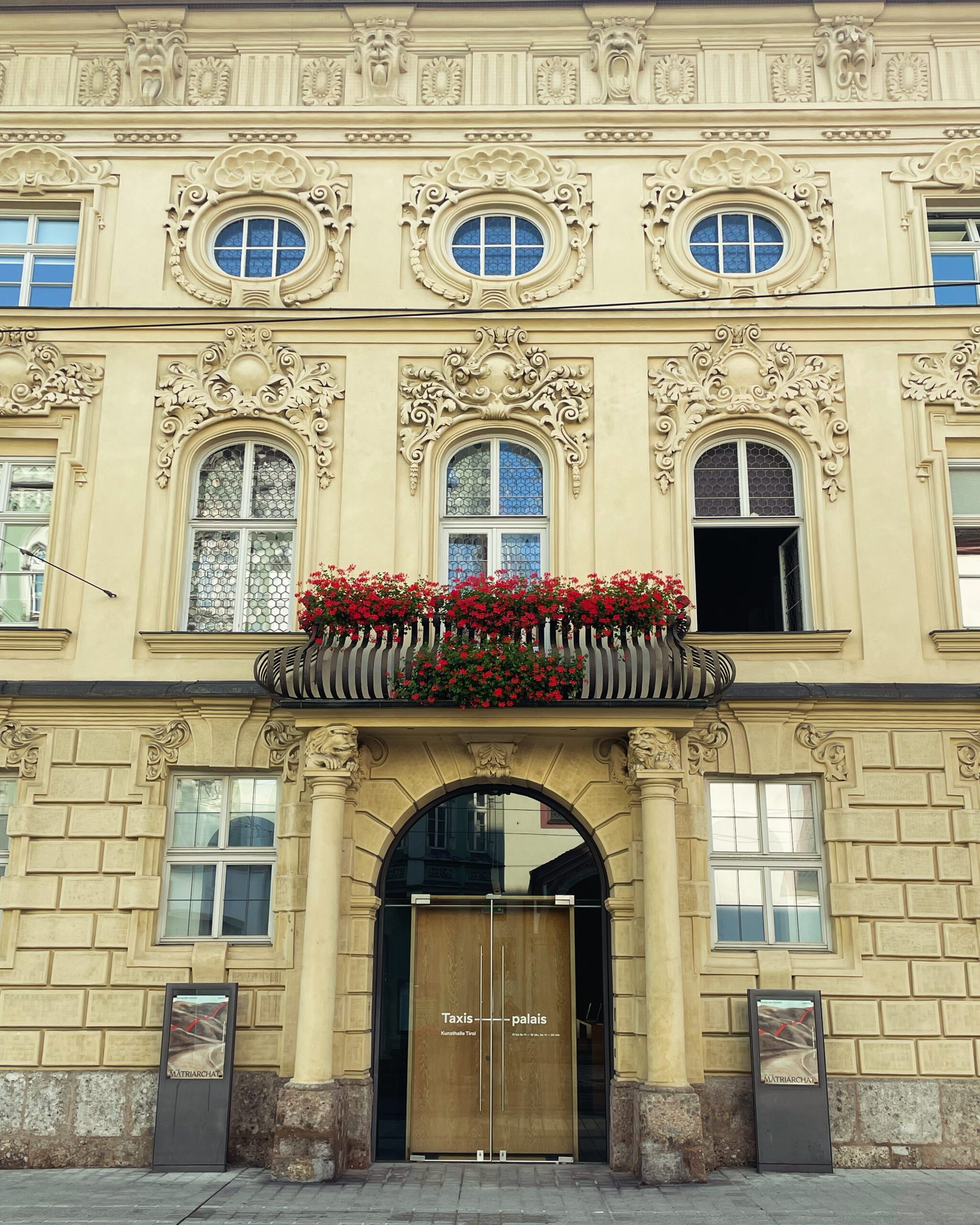
After the First World War, the Thurn und Taxis family lost its aristocratic privileges. Many of their castles, properties, and palazzi across Europe, however, remain in family ownership to this day. Until 1969, the Old Post Office stood opposite the main post office in Innsbruck; for a time, it was also owned by the Thurn und Taxis family. Since the turn of the millennium, the fate of postal services has mirrored that of the Taxis family itself: shipping and courier services are increasingly transferred to private hands. The state-monopolized postal system of the twentieth century may have been only a brief interlude. Unlike the Taxis family, however, DHL, UPS, and others must content themselves with plain profit and are not elevated to the nobility. The Fugger–Taxis Palace in Innsbruck, by contrast, still serves as a reminder of the Emperor’s postmasters.
Sights to see...
Palais Fugger-Taxis & Altes Landhaus
Maria-Theresienstrasse 45 / 43