Frederick IV: Innsbruck becomes a royal seat
Friedl with the empty pocket
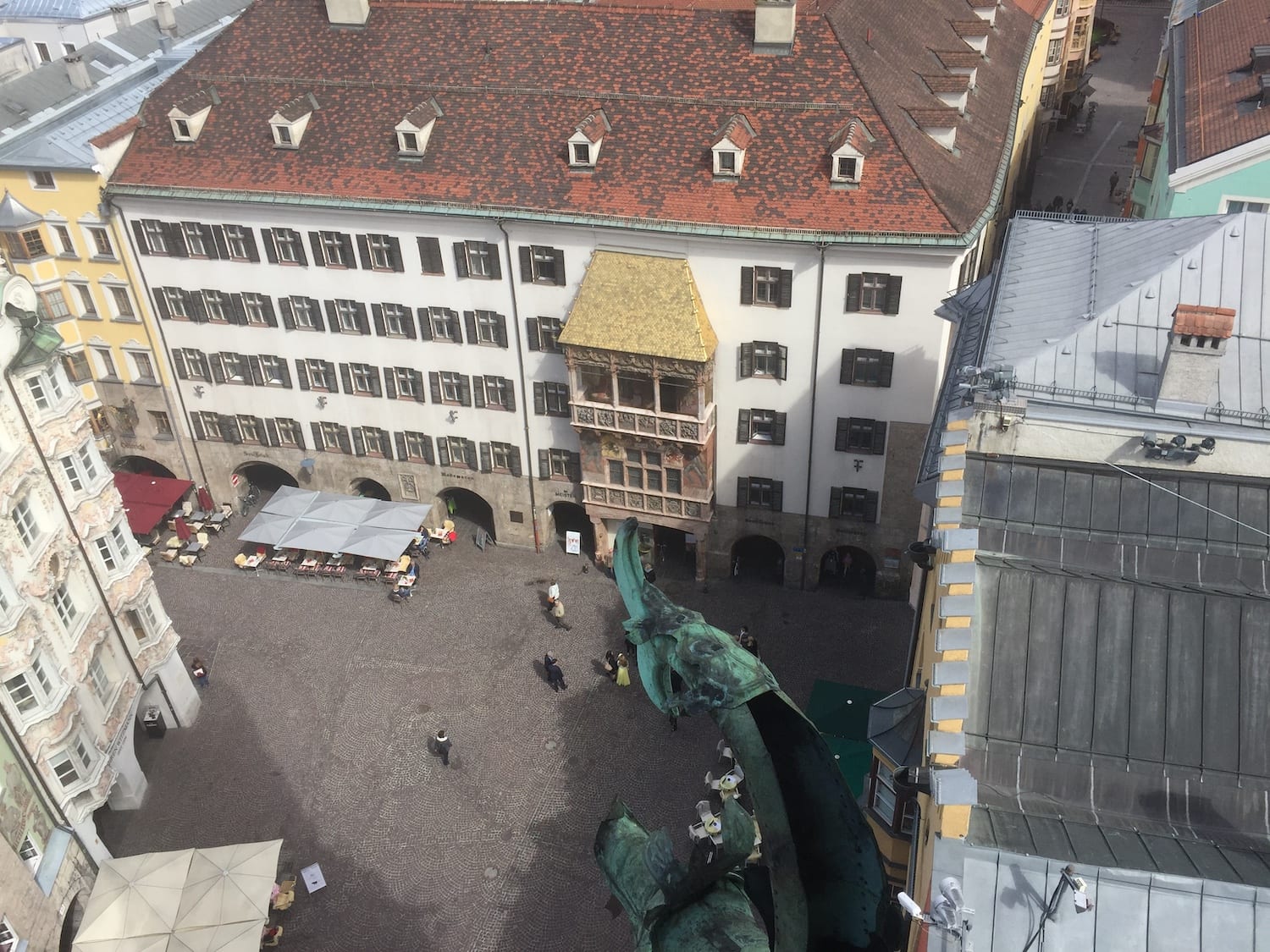
The Tyrolean sovereign Frederick IV (1382–1439) lived in a turbulent period of Habsburg and Innsbruck history. The key events of his life would provide suitable material for an adventurous medieval film, as would his physical appearance as it has been handed down to us. A long, bushy beard framed Frederick’s face. In many chronicles and accounts he was described as arbitrary, power-hungry, devious, and cunning. Contemporaries regarded him as a sex addict who, if necessary, did not shy away from violence to impose his will. This, however, was not unusual when one considers the biographies of other princes of the late Middle Ages, as a glance at his ancestry reveals. On his mother’s side, he descended from the Milanese Visconti family, who had ruthlessly fought their way up to ducal rank. At the age of twenty-four, Frederick assumed not only the regency of Further Austria but also the County of Tyrol. Further Austria—does that mean Vorarlberg? Not quite. Further Austria referred to Habsburg possessions that included parts of Switzerland, Vorarlberg, Alsace, and Baden-Württemberg. From Frederick’s time onward, Tyrol and Further Austria were jointly administered as Upper Austria. This made him one of the most powerful princes of the Holy Roman Empire. From the very beginning of his reign, he was involved in costly wars both along his borders and within the empire. In the west, the Appenzell region rose up against the Habsburg ruler; in the south, an uprising broke out in Trento; and north of the River Inn, Heinrich of Rottenburg instigated a feud. These were among the last conflicts still fought in the manner of purely knightly armies. Like his predecessor on the Tyrolean throne, Margaret, and like his grandfather Bernabò Visconti, Frederick also came into conflict with the pope. At the time, there was not only a pope in Rome but also one in Avignon. This papal question was to be resolved at the Council of Constance, perhaps the most important political event of the late European Middle Ages. Frederick sided with Pope John XXIII. King Sigismund of Luxembourg, King of the Holy Roman Empire, who supported the rival pope in Avignon, retaliated by placing Frederick under the imperial ban and having him imprisoned. This entailed not only loss of freedom and excommunication, but also the forfeiture of his territories and possessions. His enemies mockingly bestowed upon him the nickname “Frederick of the Empty Pockets.” After an adventurous escape from captivity and his return to Innsbruck, Frederick was forced to grant reforms to the population—above all to the landowning lesser nobility and the towns—as recognition for their support in his hour of greatest need. In addition to the clergy, nobility, and towns, the courts responsible for administering rural communities were now also permitted to send representatives to the regional assembly (Landtag). His nickname remained in popular usage, even though by the end of his reign he was one of the wealthiest princes of his time, thanks to the rich silver deposits in Schwaz and Gossensass as well as tolls and customs duties on trade between Venice and Augsburg. The Schwaz silver mine was the largest in Europe at the time. The mining economy also permanently altered Innsbruck’s social structure. The power of the guilds increased. When Frederick died, Tyrol—owing to the silver discoveries in Schwaz—had risen to become an important territory within the Habsburg lands. This development also transformed Innsbruck. Frederick decided to make the city on the River Inn his residence. In 1420, he purchased two burghers’ houses within the city walls. Merano had been the ancestral seat of the Counts of Tyrol and officially remained the provincial capital until 1849; in practice, however, Innsbruck had clearly taken the lead ever since Frederick’s relocation. During his reign, the arcades along Herzog-Friedrich-Strasse were constructed, and the City Tower was erected. Across Europe, the fifteenth century was an economically difficult period due to a generally colder climate than in previous eras and frequent crop failures. Through trade and the stimulus generated by the relocation of the court, Innsbruck prospered in contrast to this broader European trend. Although the city depended on its surrounding countryside for food supplies, its growing prosperity made it easier to navigate this period of crisis than was the case in purely rural regions. The princely court, comprising around 400 people, brought officials, servants, merchants, financiers, and soldiers into the city—along with money and a new lifestyle. As in many German-speaking European cities, urbanization spilled over from the Italian regions, leading to greater occupational specialization and an increasingly pronounced division of labor. The craft guilds became the economic engine and the foundation for later proto-industrial production. Inns and taverns opened, offering diversion from everyday life. Traveling theaters and performers came to the city. Immigration and rapid social change also generated tensions. The xenophobia of a superstitious, often illiterate and poorly educated population did not diminish at the same pace as social conditions evolved. Conflicts between long-established residents and newcomers, artisans, merchants, peasants, and members of the court were part of daily life in Frederick’s Innsbruck.
Because of his many conflicts with other princes and the pope, his wealth from tolls and the Schwaz mines, and his likely eccentric character, Frederick IV was regarded by his contemporaries as a kind of robber baron. Only later did he receive a more favorable reputation through the many legends that grew up around his person. According to one such story, he is said to have wandered through the land disguised as a beggar in order to learn what the people truly thought of him. From the reports commissioned by the Habsburgs from the sixteenth century onward, his image becomes considerably more positive. His affectionate nickname, “Frederick of the Empty Pockets,” still carries this image of the good-natured, somewhat clumsy Tyrolean ruler. Whether he was a miserly eccentric or a shrewd politician and a friend of the common people remains a matter of debate to this day.
Sights to see...
Stadtturm & Altes Rathaus
Herzog-Friedrich-Straße 21
Goldenes Dachl
Herzog Friedrich Straße