Colonial goods, coffee and enlightenment
Colonial goods, coffee and enlightenment
Legend has it that when the Turks laid siege to Vienna in 1683, they brought two things to Austria that have left a lasting mark on breakfast culture to this day: the crescent-shaped Kipferl and coffee. How the exotic beverage actually made its way from distant growing regions into the German-speaking world can no longer be conclusively reconstructed; it was almost certainly not through sacks of coffee beans allegedly abandoned on the battlefield outside Vienna. This urban legend can more plausibly be traced back to the late seventeenth century, when the coffee bean began to establish itself in Europe as a luxury commodity consumed by political and economic elites. This was the era of the great trading companies, the first stock exchanges, and the philosophers, legal scholars, and economists of the early Enlightenment—a period in which lucrative overseas trade brought coffee and the economic sectors that developed around it into Europe’s cities. As part of the Habsburg Empire and an important trading town, Innsbruck was involved in this imperial business from an early date. Long-distance trade was an integral part of the local economy. Thanks to the Inn Bridge and its favourable geographic position, the city had been integrated into European trade networks since the twelfth century. A substantial portion of Innsbruck’s wealthy elite—who also exercised political influence through the city council—emerged from the mercantile class.
At the beginning of the eighteenth century, coffee appeared for the first time in Innsbruck’s municipal legislation, a strong indication that it had crossed the threshold into public significance within urban life. In 1713, the city council decreed that coffee might be purchased exclusively in pharmacies. Much like Red Bull in the 1990s, the exotic drink was initially viewed with suspicion. As demand grew in the Enlightenment climate of Emperor Joseph II’s reign and coffee gradually gained wider social acceptance, these restrictions were relaxed. Coffee nevertheless remained an exclusive and expensive indulgence of eccentric elites rather than an everyday beverage. Spice merchants—shops specialising in spices and foodstuffs—began to sell coffee. The Innsbruck coffee brand Nosko, which still exists today, claims to be the city’s oldest roastery, tracing its origins to the spice shop founded in 1751 by Josef Ulrich Müller at Seilergasse 18. Unterberger & Comp. Kolonialwaren, the second coffee roastery still operating in Innsbruck today, likewise began as a spice merchant’s business. Jakob Fischnaller took over a shop in the Old Town that had existed since 1660 and began selling coffee there in 1768. Restaurateurs followed this slowly emerging trend. With the arrival of the first licensed coffee servers at the end of the 1750s, the triumphal advance of the coffee bean began. These early establishments bore little resemblance to the Viennese coffeehouse culture known worldwide today. In 1793, Café Katzung opened its doors to the affluent bourgeoisie, who began to appropriate public space with billiard tables and newspaper stands. Fifty years later, there were already eight coffeehouses in the small city of Innsbruck. Unlike traditional inns, coffeehouses symbolised a new, urban, and enlightened lifestyle and marked a clear distinction between city and countryside. For a long time, wine and beer had been the everyday drinks of the masses. In the Middle Ages, water from wells—especially in larger cities—was often considered unsafe, while light wine and nourishing, calorie-rich beer were more reliable alternatives. Alcohol, however, dulled the senses. Under Maria Theresa, peasants were granted local distilling rights. The strong, often cheaply produced spirits distilled from fallen fruit were popular among the rural population and among workers and employees in cities alike—and problematic at the same time. Anyone concerned with social standing avoided them. Coffee, by contrast, promoted alertness and productivity and supported the new virtues of diligence and industriousness. In cities such as Innsbruck, the compliant subject was gradually replaced by the critical, newspaper‑reading citizen. Consuming the expensive colonial commodity allowed one to present oneself as a connoisseur, capable of distinguishing genuine bean coffee from the cheap brews adulterated with various fillers—and able to afford it—thereby setting oneself apart from the lower classes. When Napoleon banned the import of coffee in the territories under his control in 1810 in an attempt to weaken the British economy, which depended heavily on overseas trade, this sparked fierce protests throughout Europe. Fig and chicory coffee, used as substitutes—as would later again be the case during the World Wars—met with little enthusiasm among the bourgeois population.
The colonial goods trade, which linked the exploitative business models of African coffee plantations, American tobacco plantations and South American fruit plantations with the Alps, reached a high point in Innsbruck, as in the entire German-speaking region, from the end of the 19th century, when the European powers' race for Africa entered the home straight. In 1900, there were around 40 colonial goods traders in Innsbruck. These were mostly speciality shops and general merchants who sold various, usually expensive goods from all over the world. Above all, luxury goods such as rum, tobacco, cocoa, tea and coffee or exotic fruits such as bananas were sold as colonial goods to the wealthy Innsbruck bourgeoisie. From this time onwards, the Viennese coffee house culture with all its peculiarities finally became the standard for the bourgeois culture of the Austro-Hungarian Empire. Monarchy. No matter where you were between Innsbruck in the west and Czernowitz in the east of the vast empire, you could be sure of finding a railway station, an appropriate hotel and a coffee house with German-speaking staff and a similar menu and furnishings. Coffee houses, unlike traditional inns, were places where not only the aristocracy and new elites, but also men and women, albeit often in separate areas as in the Cafe Munding, could spend time.
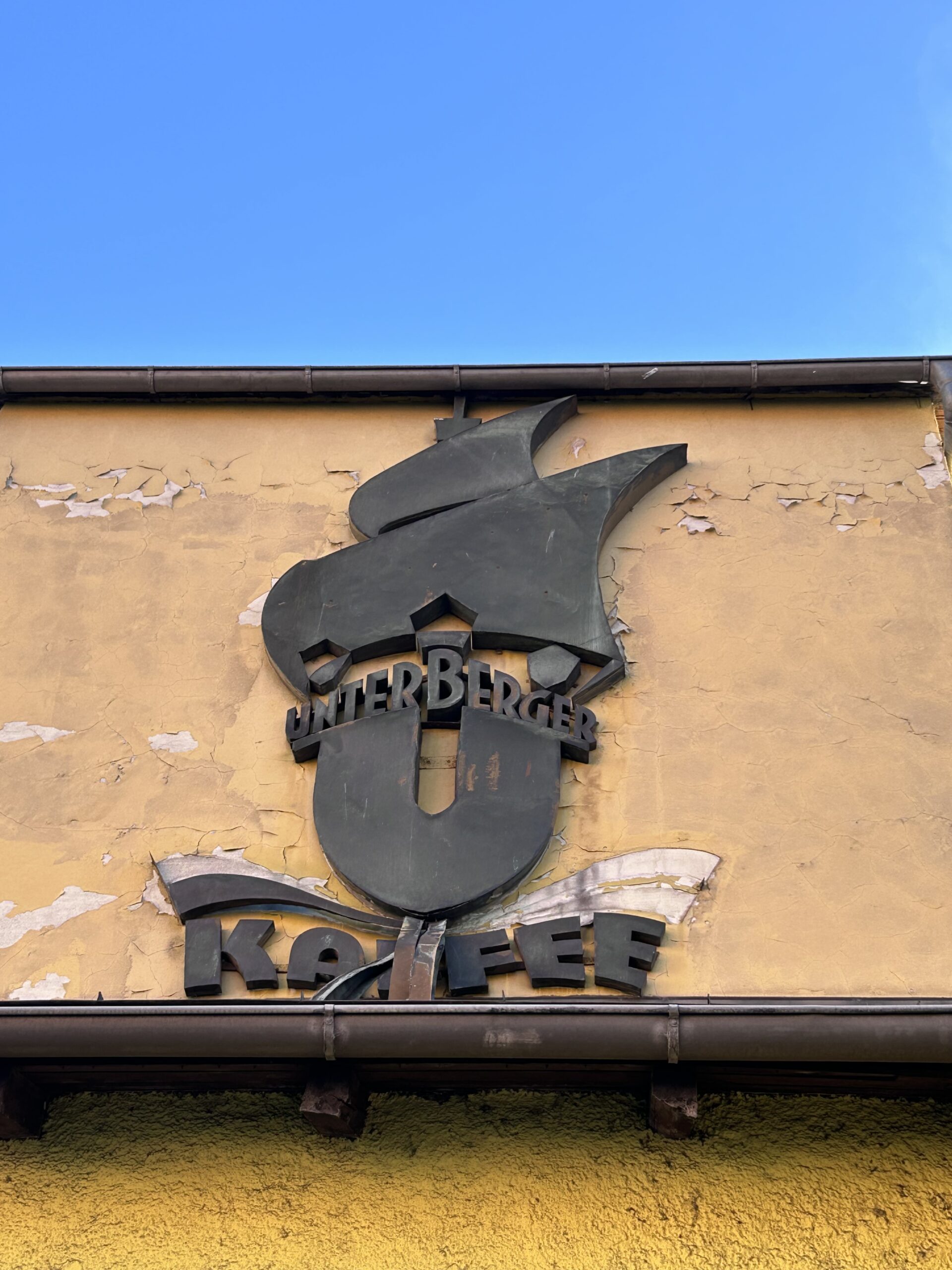
Neither coffeehouse culture nor colonial goods shops disappeared from everyday life with the rupture of the First World War and the end of the monarchy. In the 1930s, around sixty such businesses were still operating in Innsbruck. Supermarkets with extensive assortments as we know them today did not yet exist; shopping was still done at market stalls or in small shops. Only after the Second World War did the term Kolonialwaren disappear from the city’s trade registers, replaced by the designations coffee roastery and fruit importer. What remains, however, is not only Viennese coffeehouse culture. Innsbruck is still home to several of the oldest cafés of their kind, including Katzung, Munding, and Central. Since 1884, the firm Ischia has distributed exotic fruits in the city and remains a prominent feature of the urban landscape to this day with its distinctive logo on the company building next to the new city library. A brass plaque at Herzog‑Friedrich‑Strasse 26 and a large version of the logo depicting a trading ship on the main thoroughfare Egger‑Lienz‑Strasse near the Westbahnhof attest to the presence of the Unterberger brand. More contentious is the logo of Praxmarer Kaffee, which shows a kneeling “Moor” offering a cup on a façade in Amraserstrasse. While the traditional coffee company no longer exists, the firm Praxmarer Obst—trading in exotic fruits—continues to operate under the same name.
Sights to see...
Cafe Central
Gilmstrasse 5
Katzung & Trautsonhaus & Weinhaus Happ
Herzog-Friedrich-Straße 14/ 16 / 22
Cafe Munding
Kiebachgasse 16 / Mundingplatz