Anna Caterina Gonzaga - the pious sovereign princess
Anna Caterina Gonzaga - die fromme Landesfürstin
Innsbruck’s inhabitants like to see themselves as something of a northern outpost of Italy, a blend of Italian joie de vivre and German thoroughness. Besides an equal fondness for wine and beer and other cultural influences, this self‑image may also stem from the Tyrolean princes’ preference for daughters of the Italian high aristocracy and the resulting impact on the city. Between the House of Habsburg and the wealthy dynasties of the South, a lively marriage market developed—one in which practical considerations mattered far more than the search for true love. Anna Caterina Gonzaga (1566–1621), born a Principessa of Mantua, was married at the age of sixteen to Ferdinand II, the Tyrolean sovereign prince known for his libertine lifestyle. He had sought her hand while his first wife, Philippine Welser, was still alive, though already gravely ill. At the time, Mantua was one of the wealthiest princely courts in Europe and a major centre of the Renaissance. Ferdinand was already fifty‑three at the time of the wedding. Moreover, owing to unfortunate entanglements arising from the marriage politics of previous decades, he was Anna Caterina’s uncle: her father, Guglielmo Gonzaga, was married to a daughter of Emperor Ferdinand I. To make the marriage possible, a papal dispensation was required. The marriage became necessary because Ferdinand had been unable to produce an eligible heir from his first marriage. His union with Anna Caterina likewise resulted in “only” three daughters. For the House of Habsburg, the marriage brought a substantial dowry from Mantua to Tyrol. In return, Anna Caterina Gonzaga’s father was granted the title of Highness by Emperor Rudolf II, himself a Habsburg like Ferdinand.
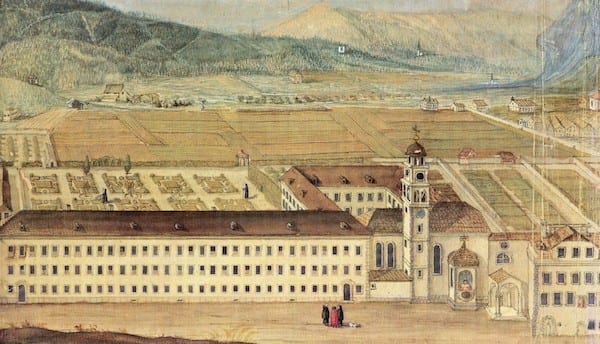
The devout Mantuan woman sought refuge in Tyrol in her faith. In doing so, she left behind a legacy whose substance continues to shape Innsbruck’s cityscape to this day. After the Jesuits under Ferdinand I and the Franciscans, the Capuchins settled in Innsbruck in 1593 under Anna Caterina Gonzaga’s patronage. A convent was established in Silbergasse at the eastern end of the Hofgarten, enabling the sovereign princess to practise her faith in quiet contemplation without having to submit fully to the rigours of monastic life. On the site now known as the Seven Chapels area, she had the Church of the Holy Sepulchre built. After Ferdinand’s death in 1595, the widowed sovereign princess of Tyrol—now a deeply devout woman—founded the Servite monastery in Innsbruck. The Servites were very popular among the populace, as they provided food for the poor. Generous donations to the Church were by no means unusual. Alongside a life pleasing to God, gifts to the Church and prayers after death were considered a means of securing salvation. Members of the House of Habsburg in particular had long practised this custom and thereby contributed significantly to public welfare in their territories. In 1612, Anna Caterina Gonzaga entered the open convent for women, which followed somewhat more lenient rules, together with her daughter Maria, and devoted herself to her faith there for the remainder of her life. She was initially buried in the crypt of the Servite convent alongside her daughter. In 1693, the earthly remains of the two women were transferred to the Jesuit church. Only in 1906 did they find their final resting place in the Servite convent on Maria‑Theresien‑Straße.