Holy Roman Empire
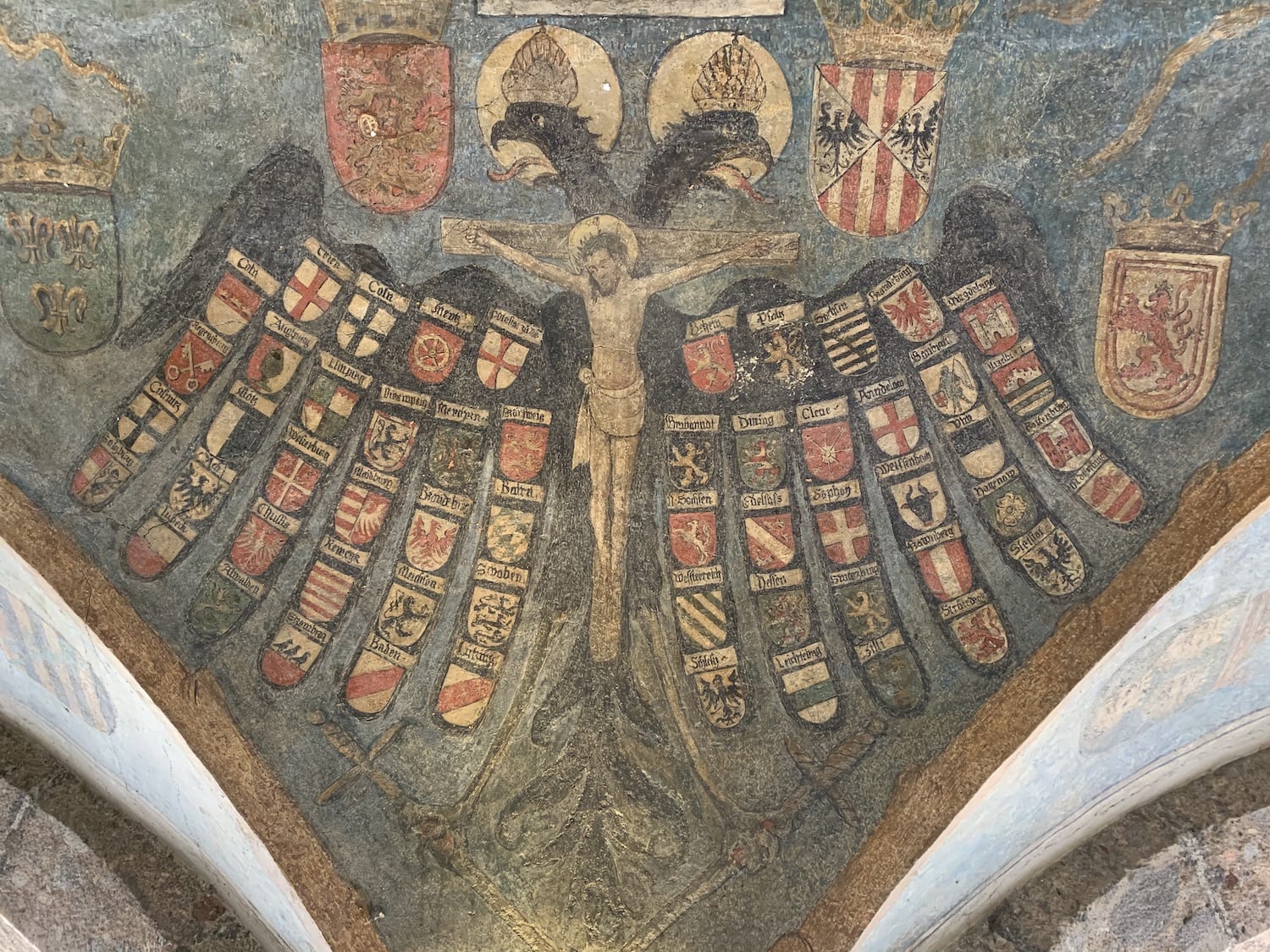
Holy Roman Empire
The state of Austria is a relatively young invention, as is citizenship. For more than 1,000 years, Innsbruck was part of the Holy Roman Empire. The people of Innsbruck were subjects of the Emperor—and subjects of the Tyrolean territorial prince—and of their feudal lord. If they possessed civic rights, they were also citizens of Innsbruck. And very likely they were Christians as well. What they were not, at least until 1806, was Austrian. But what exactly was this Holy Roman Empire? And who was the Emperor? And was he really more powerful than a king? The French philosopher Voltaire is said to have mocked it in 1761 with the words: “The Holy Roman Empire was neither holy, nor Roman, nor an empire.” He was probably not entirely wrong. In reality, it was an association of individual territories, shaped by conflicts and disputes over power—both among the princes of the Empire themselves and between the princes and the Emperor. It had no capital. The center of the Empire was wherever the Emperor happened to be, as he frequently changed his residences. Emperor Maximilian I. made Innsbruck one of his residences, which acted like a turbo boost for the city’s development. Nationality and a sense of belonging played a much smaller role in political affiliation until the 19th century than they do today. The bond that held much together was Christianity. Institutions such as the Imperial Chamber Court or the Imperial Diet were introduced only in the late Middle Ages and the Early Modern period to facilitate administration and to settle disputes among the territorial princes. The Golden Bull, which among other things regulated the election of the Emperor, was a very simple form of an early constitution. Three ecclesiastical and four secular prince-electors chose their head. The princes had seat and vote in the Imperial Diet, and the Emperor depended on them. To assert himself, he required a strong dynastic power base. The Habsburgs were able to draw on Tyrol for this, among other territories. Tyrol repeatedly became a bone of contention between the Habsburgs and the Dukes of Bavaria, even though both belonged to the Holy Roman Empire. Innsbruck was several times administered by Bavarian princely dynasties.
The hierarchy within the feudal system was strictly ordered, from the Emperor down to the peasant. Emperors and kings received power and legitimacy directly from God. The feudal system was divinely ordained. Peasants—more than 90 percent of the medieval population—worked in agriculture to sustain the clergy, who prayed for salvation, and the aristocracy, who fought for the defenseless and protected the clergy. It was a three-part relationship: one side provided order and prayers for the salvation of humankind, another provided protection of life and limb, and the third contributed obedience, loyalty, and labor. This concept of loyalty may seem alien to modern citizens, as today’s obligations—taxes, compliance with laws, elections, or compulsory service—are more abstract and far less personal. Yet well into the 20th century, the feudal system was built precisely on this principle. Loyalty was not based on a birthright comparable to modern citizenship. The “Austrian” military commander Prince Eugene may have been of French origin, yet he fought in the army of Leopold I., Emperor of the Holy Roman Empire, against France. He was a subject of the Archduke of Austria, with residences in Vienna and Hungary. While today one must be a native-born U.S. citizen to become President of the United States, rulers in earlier times were likewise not bound to an inherited nationality. Emperor Charles V. was born in what is now Ghent in Belgium, grew up at the Burgundian court, became King of Spain, inherited the Archduchy of Austria, and was later elected Emperor. To be “Germanic” did not mean to be German; it usually referred to the everyday language a person spoke.
The “Roman” element in the German imperial title was a centuries-old concept. When Charlemagne was crowned Roman-German Emperor in Rome in the year 800, he assumed the legacy of the Roman emperors with divine legitimacy through papal anointing—and at the same time became the secular protector of the Pope. In return, the Emperor was the earthly protector of the Holy Father. The Holy Roman Empire under the mantle of the Emperor ceased to exist in 1806 during the Napoleonic Wars. From this point onward, Central Europe slowly began to transform into a collection of nation-states modeled on France and England. The idea of the Roman Empire was rooted in the adventurous ancient notion that ancient Rome had to continue to exist. For devout Christians, according to the doctrine of the Four World Empires, it was of immense importance that the Empire endured. This doctrine was based on the Book of Daniel in the Old Testament. According to the story, the Babylonian king Nebuchadnezzar dreamed of four successive world empires. With the end of the fourth empire, the prophet foretold, the world would also come to an end. Around the year 400, the Church Father Jerome interpreted these four empires as Babylon, Persia, Greece, and the Roman Empire. In medieval belief, the end of Roman rule would therefore also mean the end of the world—and so Rome must not fall. Through the so-called translatio imperii, the transfer of the legal claim of the ancient Roman Empire to the Roman-German emperors after Charlemagne, Rome’s continuity was formally preserved, and the world was allowed to endure. Thanks to the Emperor, humanity still exists today.
Sights to see...
Triumphpforte
Maria-Theresienstrasse 46
Quaternionenadler
Herzog-Friedrich-Straße 35