New Schoolhouse
Kiebachgasse 10
Worth knowing
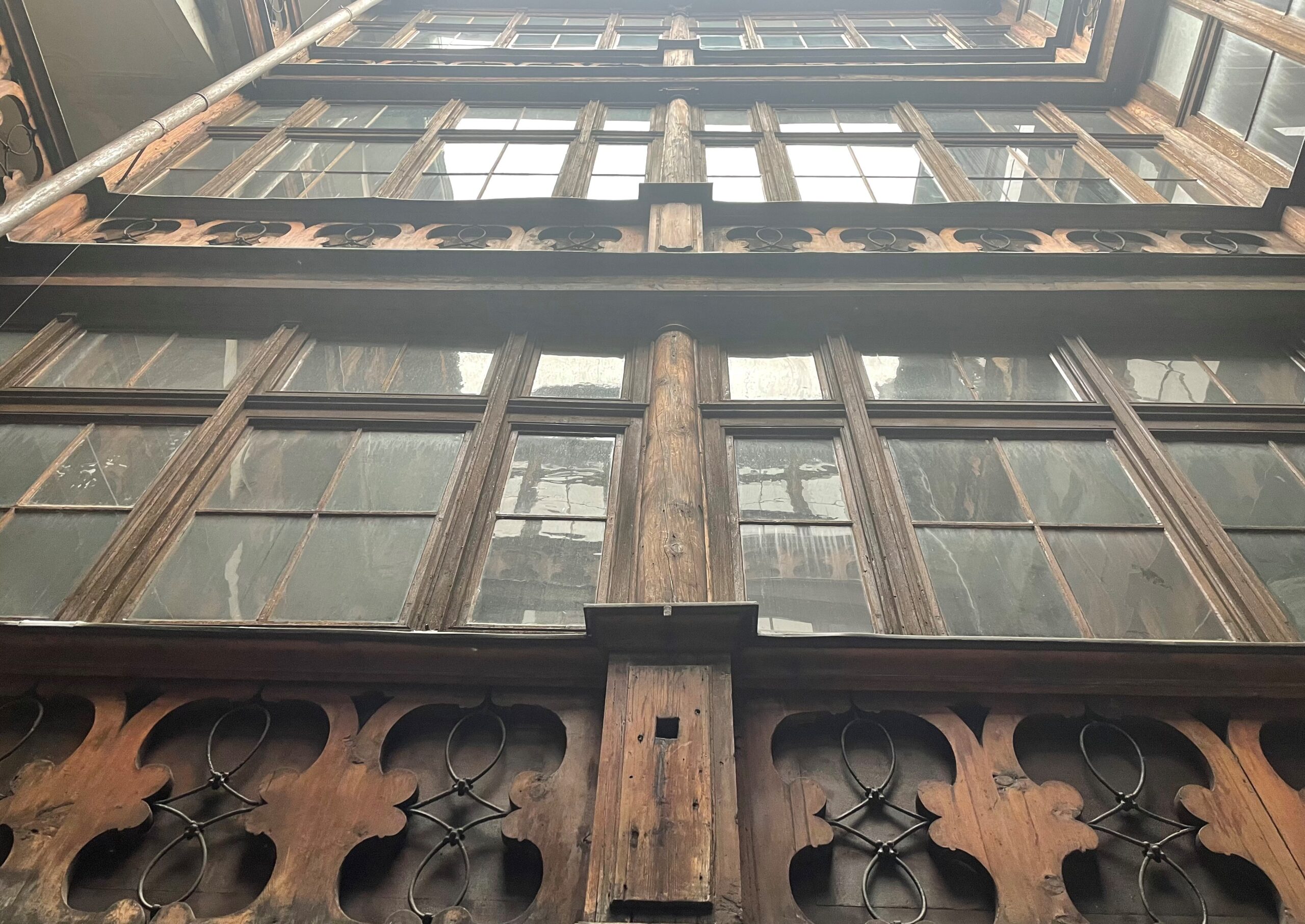
The building of the New City School in Kiebachgasse may look inconspicuous from the outside, but anyone who manages to glimpse the inner courtyard will be rewarded with a Gothic gem from the 16th century. The elaborate wood carvings of the staircase and façade give a good impression of the craftsmanship of the Early Modern period. Looking upward is almost dizzying. The fountain that has survived the centuries is also interesting. Curious visitors can ask for access at the locksmith’s shop in the neighboring building. With a bit of luck, you can enter.
The house tells the story of one of the greatest social changes in Austrian history. In 1774, Maria Theresa’s “General School Ordinance for German Normal, Main, and Trivial Schools in All Imperial-Royal Hereditary Lands” came into force. The enlightened ruler was keen to ensure that children’s education was no longer left to the uncontrolled influence of communities and the Church, as had been the case for centuries. The previous system had led to what we would now call an education crisis: poorly trained workers unable to reach their full potential. From then on, all children—including girls—up to the age of 12 had to, or rather were allowed to, attend school, at least in theory. Nationwide, even after the law change, only one in three children went to school, with a significant urban-rural divide. In villages like Pradl, Amras, and Wilten, which were not yet part of Innsbruck, farmers preferred their children to work in the fields rather than attend school. The school fees required in the early years of the new system were another hurdle for many families. In the city, however, the hunger for education and financial means had been greater even before the law change. As early as 1768, Innsbruck’s teachers and pupils had moved from the old school at Domplatz to the new City School in today’s Kiebachgasse due to lack of space. The new school system was divided into Normal, Main, and Trivial Schools. Trivial schools were mainly found in villages and poorer districts of Innsbruck. Although the Trivial schools in neighborhoods like St. Nikolaus and Kohlstatt could not compare to the New City School in terms of teaching quality, attendance rates were at least higher than in rural areas.
In many ways, the then-modern school differed from today’s system, yet there are similarities. Children were often grouped in classes regardless of age. Religion, German, and arithmetic were part of the curriculum, as was the subject “Instructions for Righteousness and Economy.” The still-familiar subject of general studies conveyed knowledge in disciplines such as geography and natural sciences—of course strictly within the Catholic doctrine of the time. The greatest change from the previously Church-dominated teaching was the stronger focus on numbers. The new curriculum placed special emphasis on mathematical basics, for good reason: whether craftsman, civil servant, or artilleryman in the growing army, without math skills one was lost. Since 1500, mathematics had gained importance over classical humanistic subjects like rhetoric, philosophy, and languages. Economy and technology favored mathematicians over philosophers, even though university disciplines were not yet as strictly separated as they are today. Another reason for the reform and stronger state influence was the sense of statehood necessary for a modern territorial state. From an early age, children were to be raised Catholic but also loyal to the state. Not only pupils but also teachers were standardized. A handbook written at court was intended to unify teaching methods throughout Maria Theresa’s empire and guarantee a certain level of standardization. The then Innsbruck school director Philipp Jakob Tangl (1733–1780) was appointed as an advisor to Maria Theresa’s court in Vienna. Despite the enlightened nature of the curriculum, corporal punishment for disobedience and misconduct remained part of everyday life—and would continue for centuries.
Until 1868, Innsbruck’s children were taught in the New City School. A new Imperial Elementary School Act that year extended compulsory schooling to age 14 and converted Trivial schools into elementary and civic schools. The bourgeois revolution of the second half of the 19th century thus surpassed the Enlightenment under Maria Theresa. Not only was the compulsory school age raised, but new school types such as the scientific secondary school (Realgymnasium), the trade school, and the business academy emerged. The building in Kiebachgasse had become too small for the now larger number of pupils. A new tenant was quickly found in the Protestant Church, as the school also had a small chapel that could be used. When the Protestant community moved to Saggen in 1905, a locksmith rented the building in the heart of the Old Town. What would be unthinkable in today’s museum-tourism context was everyday life well into the 20th century: industrial and craft businesses located right among residential buildings.
The Reformation in Tyrol
From today's perspective, the Reformation may have been a matter of faith. However, if we consider faith as an essential building block of everyday life and the identity of contemporaries, we realise that it was only one expression of many things that were in a state of upheaval. The religious reformation, which erupted in bloodshed between the 15th and 17th centuries, was a turning point for society as a whole, similar to 1848 or 1968. The majority of people may have remained superficially unaffected by it, but many things changed for everyone as a result of these revolutions. The accompanying social and political change did not stop at the Holy Land of Tyrol.
Around 1500, new discoveries and new ways of thinking began to herald the end of the Middle Ages. Artists, scholars and clerics throughout Europe began to question hierarchies, order and legitimisation. With the theological reformers of the 15th and 16th centuries, the feudal system, which saw the church and nobility above the people and bourgeoisie, began to crumble. In the 15th century, the Bohemian clergyman Jan Hus was one of the first in mainland Europe to question the omnipotence of the Pope and was banished to the stake at the Council of Constance for his actions. In France and Switzerland, it was Jean Calvin (1509 - 1564), in Holy Roman Empire Martin Luther (1483 - 1546) and Thomas Müntzer (1489 - 1525), who challenged the Roman Church in the 16th century.
In Tyrol, the mining towns of Hall and Schwaz were the main centres of the Reformation in the early 16th century. Many miners came from Saxony and brought their ideas about faith and the church with them. The old liturgy with sermons in incomprehensible Latin did not correspond to these ideas. Preachers such as Dr Jacob Strauß stirred up the people with Lutheran ideas, which also included criticism of the clergy and the ruling system.
This religious crisis also led to problems in the secular world outside the churches. Faith and the secular were not separate spheres. If the miners were dissatisfied with the pastoral care, they went on strike. Public order was in danger, and not just because the miners had the right to bear arms. They were well connected with each other. A general strike could trigger an economic crisis. The Fuggers and Habsburgs, capital and political power, were very careful not to let things get that far and granted the miners special rights.
Not only the miners, but also the progressive sections of the bourgeoisie and nobility were interested in the new way of living their faith, which was an important part of their lifestyle. The new teachings were a symbol of the new self-image and social significance that craftsmen, skilled labourers and entrepreneurs in this emerging industry had compared to the old system of feudal lords.
Ferdinand I and his successors were able to successfully push back the Reformation in Tyrol. Although the religious mandates with their numerous prohibitions were one of the reasons for the peasant wars, in the long term and with many coercive measures, the princely strategy bore fruit. Power politics may have been one reason, but in fact the ruling Habsburgs were pious people who, at least to a large extent, favoured Catholicism out of conviction. Ferdinand II described his motives with the words:
"...aus eingebung Gotes und seines Hayligen Geistes Inspiration. Alles zu ehre des aller höchsten aus ainem Rechen inprünstigen zu der heyligen Catholischen Alleinsseligmachenden Religion tragenden eyfer.“
It was primarily priests of the Jesuit order who were to bring apostate parishes and citizens back into the fold of the Catholic Church. They began with reform measures such as better training for the clergy. Concubinage and post haggling were to be abolished. Priests and bishops were to concern themselves less with worldly matters and more with the salvation of their flocks. However, as this measure could not be implemented overnight - capable priests first had to be found and educated - coercive measures were introduced. The possession of Protestant books and pamphlets was punishable by law. The lower the status of the citizen, the more severe the punishment. Nobles, counsellors and key workers were often able to practise their Protestant faith discreetly. Under Ferdinand II, underlings had to confess at Easter. The priest drew up a list with the names of those who fulfilled their duty. Anyone who did not appear in the confessional despite repeated reminders could be expelled from the country.
In the 17th century, Austria used so-called Religious Reformation Commissions in. Did these "Missionare" Protestant-oriented pastors or subjects who possessed forbidden literature were arrested and expelled from the country, and it was not uncommon for their houses to be set on fire along with all their possessions. Protestant civil servants could not practise their profession. They either had to convert or emigrate. Particularly stubborn subjects were publicly chained. Maximilian III had his own Religious agitation The police controlled craftsmen and traders in particular. They had to regularly hand in confession slips to certify their catholicity.
Under Maria Theresia In the 18th century, Tyrolean Protestants were forcibly resettled in remote parts of the Habsburg Empire. However, the resettlements were not only a problem for the citizens concerned. Labour power and the number of subjects were important features of development in modern states. This meant that the problem, which today is known as Braindrain was labelled. Expertise and military power were lost in the name of the Lord.
In 1781, the enlightened Emperor Joseph II issued the Toleranzpatent, das den Bau von protestantischen Kirchen erlaubte, wenn auch an Bedingungen gebunden. So durften diese Bethäuser keine Türme oder sonstigen baulichen Besonderheiten aufweisen. Die Gebäude durften keine straßenseitigen Fenster haben. In Tirol kam es zu Widerständen gegen das Toleranzpatent, man fürchtete um die guten Sitten und wollte fremdartige Religionen, Zwietracht und Unruhen aller Art vermeiden. Konvertierten Untertanen wurden Dinge wie Ehe und ein Begräbnis auf katholischen Friedhöfen verwehrt.
Bis heute gilt Tirol als selbsternanntes „Heiliges Land", whereby holy refers explicitly to the Catholic faith. Protestants were deported from the Zillertal as late as 1837. The descendants of the so-called Zillertaler Inklinantenwho emigrated under pressure from the authorities still live in Germany today. Tolerance gradually found its way into the empire and the provinces, but well into the 20th century, the affiliation between the authorities and the Catholic Church was firmly established in many areas of life, such as school education. When it became known during the constitutional negotiations of 1848 that the free exercise of religion was planned for the entire monarchy, public outrage in Tyrol was enormous. More than 120,000 signatures were collected following media campaigns against this liberalisation of religion. In 1861, Emperor Franz Josef issued the ProtestantenpatentThe Tyrolean government granted the Protestant Church more or less the same rights as the Catholic Church. The Tyrolean population did not allow their perseverance to be undermined by the imperial Protestantenpatent von ihrer Intoleranz abbringen. Das Argument lautete, dass es in Tirol ohnehin keine Andersgläubigen gäbe, es daher auch keiner Toleranz gegenüber Nichtkatholiken bedurfte. Erst 1876 kam es zur Gründung einer evangelischen Pfarrgemeinde in Innsbruck.
Maria Theresia, Reformatorin und Landesmutter
Maria Theresia zählt zu den bedeutendsten Figuren der österreichischen Geschichte. Obwohl sie oft als Kaiserin tituliert wird, war sie offiziell "nur" unter anderem Erzherzogin von Österreich, Königin von Ungarn und Königin von Böhmen. Bedeutend waren ihre innenpolitischen Reformen. Viele davon betrafen konkret auch den Alltag der Innsbrucker in merklichem Ausmaß. Gemeinsam mit ihren Beratern Friedrich Wilhelm von Haugwitz, Joseph von Sonnenfels und Wenzel Anton Kaunitz schaffte sie es aus den sogenannten Österreichischen Erblanden einen modernen Staat zu basteln. Anstatt der Verwaltung ihrer Territorien durch den ansässigen Adel setzte sie auf eine moderne Verwaltung. Ihre Berater hatten ganz im Stil der Aufklärung erkannt, dass sich das Staatswohl aus der Gesundheit und Bildungsgrad seiner Einzelteile ergab. Eine frühe Krankenreform Maria Theresias aus dem Jahr 1742 verpflichtete die Professoren des Fachbereichs Medizin an der Universität Innsbruck auch den Betrieb des Stadtspitals in der Neustadt sicherzustellen. Eine Schulreform veränderte die Bildungslandschaft innerhalb der Stadtmauern nicht nur thematisch, sondern auch örtlich. Untertanen sollten katholisch sein, ihre Treue aber sollte dem Staat gelten. Schulbildung wurde unter zentrale staatliche Verwaltung gestellt. Es sollten keine kritischen, humanistischen Geistesgrößen, sondern Material für den staatlichen Verwaltungsapparat erzogen werden. Über Militär und Verwaltung konnten nun auch Nichtadlige in höhere staatliche Positionen aufsteigen. Gleichzeitig sollten Reformen im Staatsdienst und in der Wirtschaft nicht nur mehr Möglichkeiten für die Untertanen schaffen, sondern auch die Staatseinnahmen erhöhen. Gewichte und Maßeinheiten wurden nominiert, um das Steuersystem undurchlässiger zu machen. Für Bürger und Bauern hatte die Vereinheitlichung der Gesetze den Vorteil, dass das Leben weniger von Grundherren und deren Launen abhing. Auch der Robot, den Bauern auf den Gütern des Grundherrn kostenfrei zu leisten hatten, wurde unter Maria Theresia abgeschafft. In Strafverfolgung und Justiz fand ein Umdenken statt. 1747 wurde in Innsbruck eine kleine Polizei which was responsible for matters relating to market supervision, trade regulations, tourist control and public decency. The penal code Constitutio Criminalis Theresiana did not abolish torture, but it did regulate its use.
As much as Maria Theresa staged herself as a pious mother of the country and is known today as an Enlightenment figure, the strict Catholic ruler was not squeamish when it came to questions of power and religion. In keeping with the trend of the Enlightenment, she had superstitions such as vampirism, which was widespread in the eastern parts of her empire, critically analysed and initiated the final end to witch trials. At the same time, however, she mercilessly expelled Protestants from the country. Many Tyroleans were forced to leave their homeland and settle in parts of the Habsburg Empire further away from the centre.
In crown lands such as Tyrol, Maria Theresa's reforms met with little favour. With the exception of a few liberals, they saw themselves more as an independent and autonomous province and less as part of a modern territorial state. The clergy also did not like the new, subordinate role, which became even more pronounced under Joseph II. For the local nobility, the reforms not only meant a loss of importance and autonomy, but also higher taxes and duties. Taxes, levies and customs duties, which had always provided the city of Innsbruck with reliable income, were now collected centrally and only partially refunded via financial equalisation. In order to minimise the fall of sons from impoverished aristocratic families and train them for civil service, Maria Theresa founded the Theresianum, das ab 1775 auch in Innsbruck eine Niederlassung hatte. Wie so oft bügelte die Zeit manche Falte aus und Innsbrucker sind mittlerweile stolz darauf, eine der bedeutendsten Herrscherpersönlichkeiten der österreichischen Geschichte beherbergt zu haben. Heute erinnern die Triumphpfote und die Hofburg in Innsbruck an die Theresianische Zeit.