Innsbruck's Olympic renaissance
Innsbruck's Olympic renaissance
There are events that endure in a community’s collective memory across generations. You don't have to have been there—nor even born yet—to know how Franz Klammer raced to a gold medal in his yellow jumpsuit during the Olympic downhill at the Patscherkofel on February 5, 1976. Franz Joseph I may have climbed the Patscherkofel in 1848, but it was "Kaiser Franz" Klammer who became a legend on this mountain. "Jawoll! 1:45.73 for our Franzi Klammer!" echoed from countless TV sets across Austria that day. To allow people to watch national hero Klammer on his hell-for-leather run, schoolchildren were permitted to stay home on the day of the men's downhill—just as they had been in 1964. Elsewhere, the streets were completely deserted during this wild ride. Klammer accomplished what scores of emperors, kings, and politicians had failed to do: he united the nation of Austria. "Mi hats obageibtlt von oben bis unten, I hatt nie gedacht, dass i Bestzeit foa" ("I was thrown all over the place from top to bottom, I never thought I'd set the fastest time"), Klammer admitted in his Carinthian dialect during the winner's interview. Not a Tyrolean—nobody's perfect—but for host nation Austria, the Olympic Games were saved on just the second day. In 1976, the Olympic Winter Games were held in Innsbruck for the second time. Denver was originally slated to host, but withdrew as organizer following a referendum sparked by financial and environmental concerns. Innsbruck prevailed in its second hosting bid over Lake Placid, Chamonix, and Tampere. The city had previously hosted the Olympics 12 years earlier; from January 29 to February 9, 1964, Innsbruck had been the center of the world after winning its bid against Calgary and Lahti. A severe lack of snow caused major problems during several events in 1964. Only with the help of the Austrian Armed Forces, who hauled snow and ice down from the high mountains to the venues, could the 34 competitions take place. Archival footage offers a good glimpse of the opening ceremony in the packed Bergisel Stadium. Unlike the elaborate ceremonies of modern Olympic Games, proceedings in the 1960s were still relatively unspectacular. The Wiltener Stadtmusik entertained international guests with traditional Tyrolean brass music. During the parade of flags, visitors caught their first glimpse of the North Korean flag at an Olympic Games. The Tyrolean Schützen watched over the Olympic flame with eagle eyes. For the logo, the Olympic rings were simply superimposed over the city's coat of arms, and there was no mascot yet. The sporting competitions were far less professionally organized than today's Olympics. The bobsleigh race took place on an artificial ice track for the first time, though not yet in today's Igls Ice Canal. Some of the ice hockey games were held in the exhibition hall on a very modest scale. Alpine skiing events, such as the women's slalom and giant slalom—where French sisters Christine and Marielle Goitschel swept gold and silver in alternating order—took place in the Axamer Lizum. At Bergisel, an official crowd of 80,000 spectators watched the spectacle as Finland's Veikko Kankkonen secured gold in ski jumping. In the ice hockey final, the Soviet Union triumphed over Sweden. With 11 gold medals, the USSR also took top spot in the medal table, while Austria finished a sensational second with four golds.
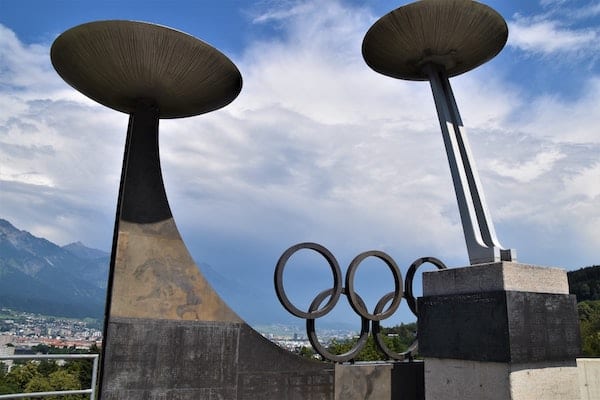
The opening ceremony of the 1976 Games also took place at Bergisel. In memory of 1964, two Olympic flames were lit at Bergisel during the opening. This time around, the 37 events were largely held at the same venues in Innsbruck, Axams, Igls, and Seefeld as in 1964. The ice stadium and ski jumping arena were still up to Olympic standards. In Igls, a new artificial ice track was built. The Axamer Lizum received a new funicular railway to transport the athletes to the start at the *Hoadl*. Once again, snow was in short supply in the lead-up, leading to renewed anxieties, but the weather turned just in the nick of time, blessing Innsbruck with plenty of snowfall. *Schneemanndl*—a round snowman with a carrot nose and a Tyrolean hat, serving as the mascot for the 1976 Games—proved to be a good omen. The biggest change between the two Olympic Games within twelve years was the status of the athletes. While the first Games officially featured only amateurs—sportsmen and sportswomen who held regular jobs—1976 allowed professional athletes to compete. The broadcast and photo quality were also significantly higher than in the first Innsbruck edition, with television having superseded radio by then. German alpine skier Rosi Mittermaier was captured perfectly on screen as she raced to two gold medals and a silver in the women's events. The ice hockey tournament was won once again by the Soviet Union ahead of Sweden—their fourth consecutive title. The USSR also topped the final medal table once more, this time ahead of East Germany. Austria was only able to secure two golds, but with Klammer's downhill victory, that was merely a side note. The Patscherkofel and Austria's "*Franzi*" have been inextricably linked ever since. And even if the people of Innsbruck are not quite as athletic as they like to think, no one can argue away the title of Olympic City after hosting two Winter Games, plus a Universiade and the Youth Olympic Games.
Even when it came to non-sporting infrastructure, the city—backed by federal funds—spared no expense for either Games. Following the city's rapid postwar reconstruction, the run-up to the Games triggered a major wave of modernization. Innsbruck's first Olympic edition fell right in the era of the *Wirtschaftswunder* (economic miracle). On two occasions, an Olympic Village was built from scratch, creating housing that remains in use to this day. A portion of the former village of Arzl, which had been incorporated into Innsbruck in 1940, was chosen as the location. Today's *O-Dorf* district in the east of the city served as the Olympic Village for the athletes during the Games, connected to the city center and venues via the Reichenauer Bridge over the Inn River. Construction on the first apartment blocks began in 1961 in the sparsely populated Arzler Au. The Arzl shooting range, still visible on a 1960 map, was relocated one tier higher up the valley. Additional blocks were added in the 1970s. Today, despite its less-than-picturesque 1960s and 70s style high-rises, the O-Dorf is a livable neighborhood thanks to its location along the Inn, its green spaces, and its good public transport links. Many other buildings in Innsbruck that were used as media and press infrastructure during the Games also date back to the Olympics. The Teacher Training College (PÄDAK) in Wilten, the IVB hall, and the Landessportheim can all be considered part of this Olympic legacy. The far-from-splendid building housing the former *Hotel Holiday Inn* next to the Triumphal Arch, which has undergone numerous operator changes in recent decades, was likewise born out of this Olympic renaissance. Despite all the fine new buildings, improvisation was necessary at every turn. Visiting youths and many a lesser-ranked official found accommodation in one of the schools, which were closed to serve as dormitories. Another infrastructural legacy of the Olympic Games is something people are desperately trying to change today: the city's expansion during the 1960s and 70s coincided with the early boom of the automobile. The fact that the city grew during this specific period is likely a key reason why Innsbruck, relative to its size, is considered above-average car-centric. In 1963, the Olympiabrücke was built to connect the western part of the city with the venues. Until then, east-west traffic in Innsbruck had to navigate a convoluted route through the city center. The individual streets between Amraser-See-Straße in the east and Bachlechnerstraße in the west—which today make up the major traffic artery known as the *Südring*—were only expanded subsequently; until then, they had been quiet suburban roads surrounded by meadows and fields. Comparing aerial photographs from 1960 and 2020 is fascinating: in Amras, where daily rush-hour traffic plays out today, farms and scattered residential houses stood well into the 1970s. On what is now Egger-Lienz-Straße near the West Station, the railway viaduct of the Westbahn once ran. Old photos show the tracks flanked by trees and playing children. Around today's *Graßmayrkreuzung* intersection, a new district emerged almost casually with the opening of the *Kaufhaus Forum*.
For Innsbruck, however, the Olympic Games were not merely a launching pad into modernity regarding winter sports, tourism, and infrastructure. On a psychological level, the events also swept away the stale air of the somber postwar era, spreading a sense of renewal and helping the city shed its reputation as a provincial backwater. Less than 20 years after the end of the war, Innsbruck hosted one of the world's premier sporting events. Within a single generation, the *Olympic Village* reached into the sky on the grounds of the former Reichenau concentration camp. The city may no longer have been an imperial residence as in the days of Emperor Maximilian, but it was once again firmly on the international map. All thanks to "*Kaiser Franz*!"
Sights to see...
Mariahilfpark
Mariahilfpark 1 – 4
Tivoli
Sillufer / Pradl
Power station & Casino
Salurnerstrasse 11 - 15
Mountain Isel
Mountain Isel 1