Operation Greenup - Innsbrooklyn's (re)birth
Operation Greenup - Innsbrooklyn's rebirth
Following minor skirmishes in the Außerfern region and at the Porta Claudia in Scharnitz near Seefeld, the US Army's *Cactus Division* reached Zirl on May 3, 1945, standing at the gates of the Gau capital of Innsbruck. A few resistance fighters from the O5 group—centered around Fritz Molden and Karl Gruber, who later became Governor of Tyrol—had occupied barracks and official facilities in Innsbruck after the Gau leadership, Gestapo, and SS had fled. Nevertheless, the American troops did not know what to expect in Innsbruck, as Adolf Hitler had declared Tyrol part of the "Alpine Fortress" (*Alpenfestung*)—a retreat that was to be defended to the last man. Had Innsbruck become a battleground, as was the case in many other cities, it would have resulted in the destruction of the city. That it did not come to this and that Innsbruck was surrendered without a fight is thanks to a handful of brave women and men who paved the way for a peaceful surrender as part of the US espionage mission *Operation Greenup*. The main figures of this movie-worthy coup were Friedrich "*Fred*" Mayer (1921–2016), Hans Wijnberg (1922–2011), Franz Weber (1920–2001), and Anna Niederkircher (1895–1968). Mayer and Wijnberg, fleeing National Socialism in Europe with their Jewish families, had ended up in New York. They volunteered for military service and, thanks to their European background and language skills, joined the OSS, the US military intelligence agency. Weber had ended up in a prisoner-of-war camp in southern Italy as a Wehrmacht deserter. A devout Catholic, he wanted to help overthrow the Nazi regime in his Tyrolean homeland after his wartime experiences, where he was also recruited by the OSS. Together, operating out of Innsbruck, they were tasked with spying on the supply line over the Brenner Pass as well as key military infrastructure and industry, such as the Messerschmitt works in Kematen.
On February 26, the three men and their equipment parachuted out of a plane over the snow-covered Ötztal Alps. Traveling by sled and public transport, they made their way deep in enemy territory to Oberperfuss, Franz Weber's hometown. They found support in the village, which was Catholic and critical of the regime. Weber's sisters Eva, Margarete, and Luise, his neighbor Maria Hörtnagl, and especially his fiancée Anni Niederkircher and her mother Anna, the landlady of the *Gasthof zur Krone*, played invaluable roles in providing supplies, cover, and shelter. Franz Weber acted as the group's local guide. Fred Mayer blended in with the population in Oberperfuss, Innsbruck, and Kematen under various identities. His exploits—sneaking into the officers' mess disguised as a Wehrmacht soldier or into the Messerschmitt works as a French forced laborer—seem like something straight out of a spy movie. He established contacts with other resistance groups and gathered intelligence. Weber's sisters in Innsbruck housed him and provided him with everything imaginable, such as forged documents or a stolen Wehrmacht uniform. Anni Niederkircher served as the liaison between Oberperfuss and Innsbruck. As the radio operator, Hans Wijnberg maintained communications with the US forces' base in Bari. Everyone involved knew that if their risky operation were uncovered, they would be sentenced to death. In April, just a few days before the end of the war, this worst-case scenario occurred. Robert Moser, the radio dealer and resistance member who had employed Fred Mayer in his shop as cover, was exposed. At the Gestapo headquarters in Innsbruck's Herrengasse, he was interrogated, tortured, and ultimately whipped and beaten to death. On April 20, Fred Mayer was also arrested. Yet despite beatings and torture, he held firm—and did even more: After revealing himself as a member of US Military Intelligence, he managed in negotiations with *Gauleiter* Hofer to arrange for Innsbruck to be surrendered without a fight as an open city. In exchange for Mayer's assurance that he would be treated as a prisoner of war, Hofer issued an order to the population in a radio broadcast on May 2 to refrain from any combat actions. On May 3 at 2:00 PM, Fred Mayer—still bearing the scars of his treatment by the Gestapo—reached the US troops near Zirl with this news. A few hours later, the ceasefire came into effect. The vehicles and soldiers were able to enter the city without any further bloodshed or destruction.
For a long time, the memory of *Operation Greenup* and the heroic actions of all involved under extreme danger was overshadowed by the narrative of self-liberation by the brave Tyrolean population. It was not until 2010 that Fred Mayer, who had received the *Purple Heart*—one of the US military's highest decorations for valor—was finally honored by the State of Tyrol at almost 90 years of age. Hans Wijnberg was awarded a Medal of Merit by the City of Innsbruck ten years after his death. Franz Weber, who served as a member of both the State Parliament and the National Council after the war, received the *Decoration of Honor of the State of Tyrol* and the *Decoration of Honor for Services to the Republic of Austria*. A hard-to-find bronze plaque at the former Gestapo headquarters in Herrengasse commemorates Robert Moser, who was tortured to death. A small information board can be found at Anichstraße 19, the building where Mayer stayed during his time in Innsbruck. It was only with the publication of Peter Pirker's gripping book "*Codename Brooklyn*," which received widespread international attention, that what is perhaps the most impressive episode in Innsbruck's history became known to a broader audience. Yet Innsbruck may owe a lasting legacy to Wijnberg's radio transmissions: His codename for the city was *Brooklyn*, named after the New York borough where he and Mayer had lived for a long time. Following the end of National Socialism, Innsbruck was reborn as *Innsbrooklyn*.
Sights to see...
South Tyrolean settlement Wilten West
Speckbacherstrasse
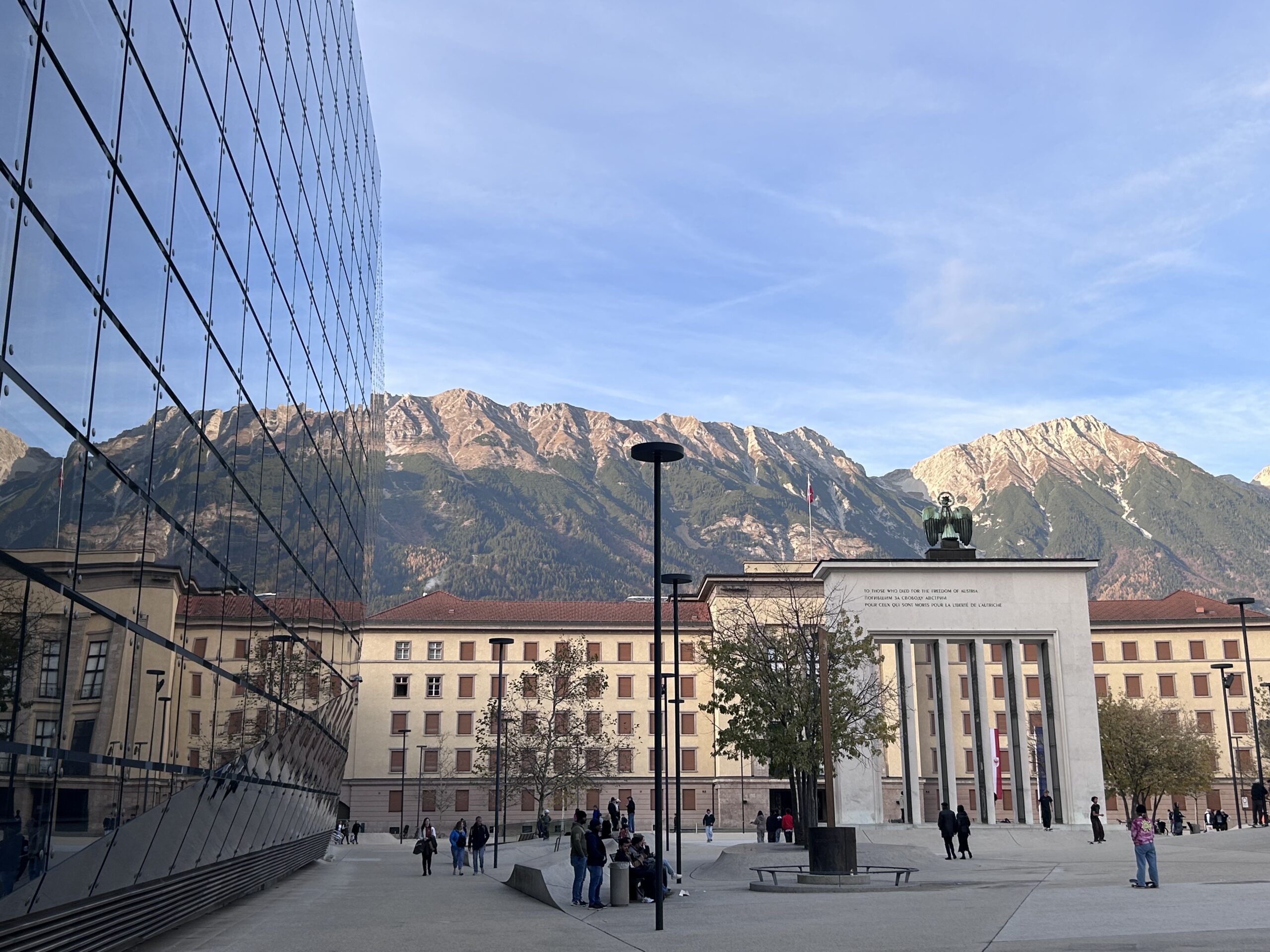
Landhausplatz & Tiroler Landhaus
Eduard Wallnöfer Square