Theodor Prachensky: Civil servant between monarchy and republic
Theodor Prachensky: Beamter zwischen Kaiser und Republik
Copilot said: Innsbruck is home to many famous sights, monuments, and spectacular buildings. The Golden Roof and the Bergisel Ski Jump attract tens of thousands of visitors every year. Less imposing, but arguably more important for the city's development during the turbulent first half of the 20th century, were other buildings. From the second half of the 1920s onward, major projects were implemented to alleviate the greatest hardship faced by many Innsbruck residents, who were living in barracks or crowded together with relatives in extremely confined conditions. Entire new districts were created, complete with kindergartens, schools, parks, and recreational facilities. One of the master builders who left a lasting mark on Innsbruck during this period was Theodor Prachensky (1888–1970). The story of his forty-year career in the service of the City of Innsbruck reads like a summary of Austrian history in the early twentieth century. Prachensky worked as both an architect and a civil servant under five different political systems. The Austro-Hungarian Empire was followed by the First Republic, which in turn gave way to the authoritarian Corporate State. In 1938 came the annexation by Nazi Germany, and in 1945, with the end of the war, the Second Republic was proclaimed. Like many artists, architects, and builders of his generation, Prachensky laid the foundations for his career at what is today the Higher Technical College (HTL). In 1908, he graduated from the construction engineering department of the Imperial-Royal State Trade School (k.k. Staatsgewerbeschule) in Innsbruck. Just one year later, he moved to Merano to gain his first experience with large-scale building projects at the renowned architectural firm Musch & Lun. In 1913, he returned to Innsbruck. In the same year, he married Maria, the sister of his friend Franz Baumann, moved into the Prachensky House, which he had designed himself at Bergiselweg 20, and began his employment with the Innsbruck City Administration under Senior Building Councillor Jakob Albert. This decision to enter public service would prove fortunate during the economically difficult years after the war, even though it required him to curb some of his creative ambitions. First, however, he was called to the front. Although Prachensky opposed the war, he volunteered for military service in 1915 as a one-year volunteer with the Tyrolean Imperial Rifles (Tiroler Kaiserjäger). Whether he was motivated by expectations associated with his position as a civil servant or by the widespread patriotic enthusiasm of the time can no longer be determined.
Nach dem Krieg kehrte er ins wirtschaftlich schwer angeschlagene Innsbruck zurück. Seine wegweisenden, wohl auch vom sozialdemokratischen Gedankengut seines Vaters Josef beeinflussten Projekte konnten erst nach den ersten und schwierigsten Nachkriegsjahren begonnen werden. Den Anfang machte der Schlachthausblock im Saggen zwischen 1922 und 1925. Es folgten der Mandelsbergerblock, der Pembaurblock sowie Kindergarten und Hauptschule in der Pembaurstraße, die ebenfalls für die wachsende Arbeiterschaft gedacht waren. Auch das 1931 entworfene Arbeitsamt war eine wichtige Neuerung im Sozialwesen. Seit der Republikgründung 1918 half das Arbeitsamt bei der Vermittlung von Arbeitssuchenden und Arbeitgebern und der Eindämmung der Arbeitslosigkeit.
The next major turning point after the First World War and the economic crisis was the succession of changes in Austria’s political system. Despite Dollfuss’s seizure of power and the banning of the Social Democratic Party in 1933, followed by Austria’s annexation to the German Reich in 1938, Prachensky was able to remain a senior civil servant and continued to influence the appearance of Innsbruck. Together with Jakob Albert, he implemented the residential developments that became known as the South Tyrolean Settlements (Südtiroler Siedlungen) under the National Socialist regime from 1939 onward. Unlike several members of his family, he himself never became a member of the Nazi Party. The Social Democratic influence of his father remained too strong, and this influence is reflected in his architecture. After the Second World War, he remained in office as Senior Building Councillor of the City of Innsbruck for another eight years. In addition to his work as an urban planner and architect, Prachensky was a passionate painter. He died in Innsbruck at the age of eighty-two.
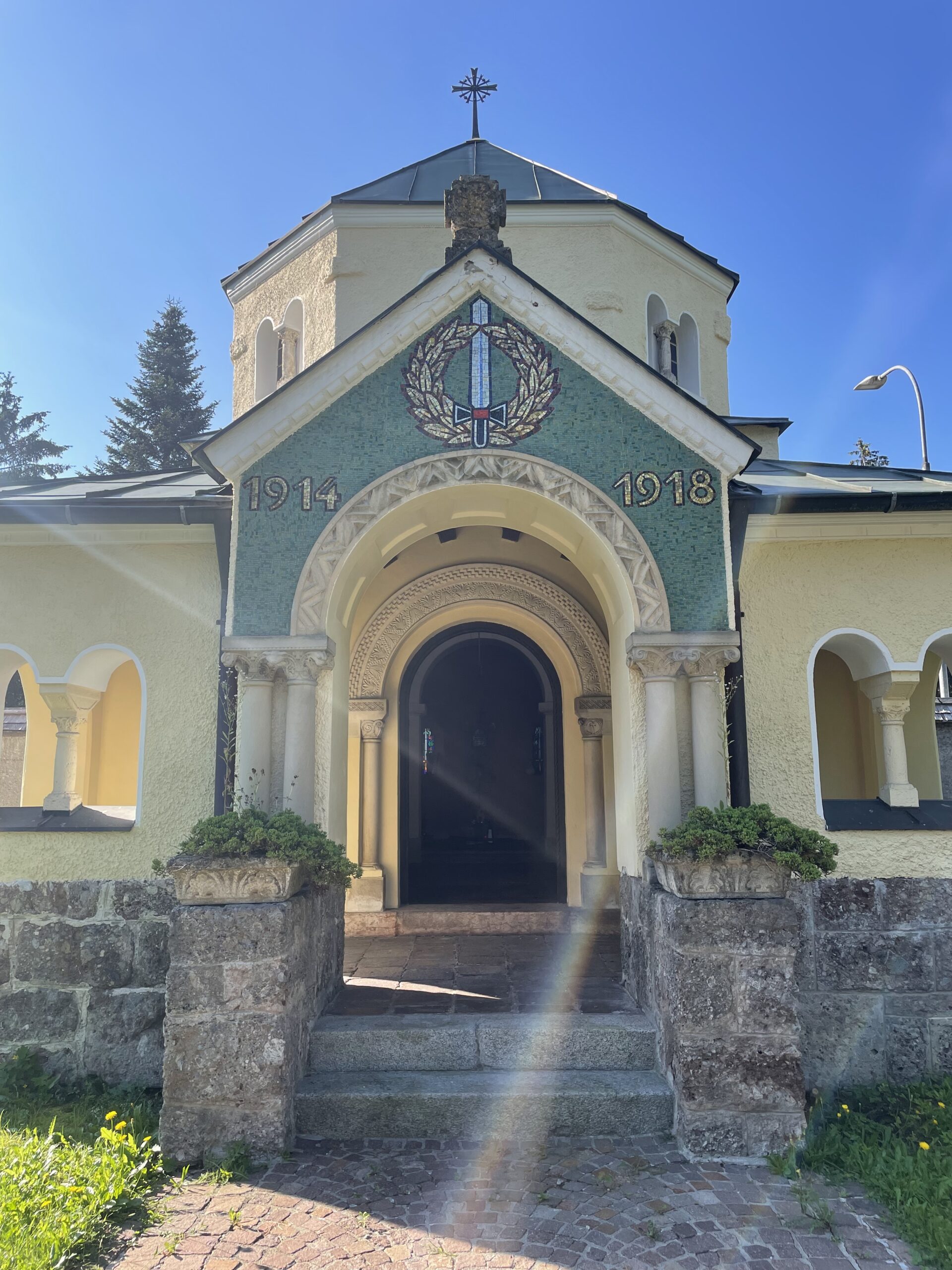
The projects realized by Prachensky are not as spectacular as the mountain stations designed by his brother-in-law Franz Baumann or Lois Welzenbacher’s high-rise building. His surviving structures often appear sober and purely functional, yet reveal their fascination upon closer inspection. Particularly remarkable is the symbolism that Prachensky repeatedly incorporated into his work. Looking at his drawings in the Archive of Architecture at the University of Innsbruck, one quickly recognizes that he was as much an artist as a technician. Many of his designs, such as the Social Democratic People’s House (Sozialdemokratisches Volkshaus) on Salurnerstraße, his Kaiserschützen Memorial, and the Peace and Heroes Church (Friedens- und Heldenkirche), were never built. Innsbruck nevertheless contains many of Prachensky’s buildings that document the history of the interwar period and the changing political and governmental influences under which he himself lived. These include the large residential complexes of the 1920s and 1930s, the War Memorial Chapel (Krieger-Gedächtniskapelle) at Pradl Cemetery, and the old employment office (note: today an annex of the University of Innsbruck, located behind the current AMS employment service building in Wilten). The War Memorial Chapel at Pradl Cemetery, the Kaiserschützen Chapel at Tummelplatz, designed together with Clemens Holzmeister, as well as his unrealized proposals for a Kaiserjäger memorial and the Peace and Heroes Church of Innsbruck, reflect both his own experiences of war and the longing for peace shared by many of his contemporaries. His sons, grandsons, and great-grandchildren carried forward his creative legacy as architects, designers, photographers, and painters in a variety of disciplines. In 2017, parts of the multi-generational body of work created by the Prachensky family of artists were honored in an exhibition at the former Adambräu Brewery.
Sights to see...
Slaughterhouse block
Erzherzog-Eugen-Straße 25 - 38
Racing school & kindergarten
Pembaurstraße 18 & 20
South Tyrolean settlement Wilten West
Speckbacherstrasse
Pembaurblock
Pembaurstraße 31 – 41
Militärfriedhof & Pradler Friedhof
Kaufmannstraße / Wiesengasse
Tummelplatz
Haltestelle Tummelplatz