Life reform and social democracy
Josef Prachensky: Lebensreform und Sozialdemokratie
Industrialisation and the rise of the bourgeoisie in the 19th century transformed society for better and for worse. Urbanisation was increasingly perceived by many people as a burden. Although many workers and employees in Innsbruck had, in absolute terms, more resources at their disposal than ever before, the pressure to participate socially also grew. From the 1890s onwards, several advertising columns (Litfaßsäulen) appeared in Innsbruck, on which artistically designed posters promoted the new variety of products. Department stores and fashion retailers made social differences within an increasingly differentiated society more visible than ever. Anyone who wanted to keep up in the new bourgeois class had to be able to afford membership in this emerging consumer society. At the same time, the strains of industrialisation increased. Traffic on the streets, factory emissions, cramped living conditions in tenement blocks, and the previously unknown haste brought about by the strict structuring of time—which made new illnesses such as neurasthenia socially acceptable—gave rise to counter-movements. Although Innsbruck could not be compared with Paris or London in terms of size or intensity of industrialisation, the social gap was nonetheless enormous for many residents of formerly rural villages such as Pradl and for workers who had migrated from the countryside.
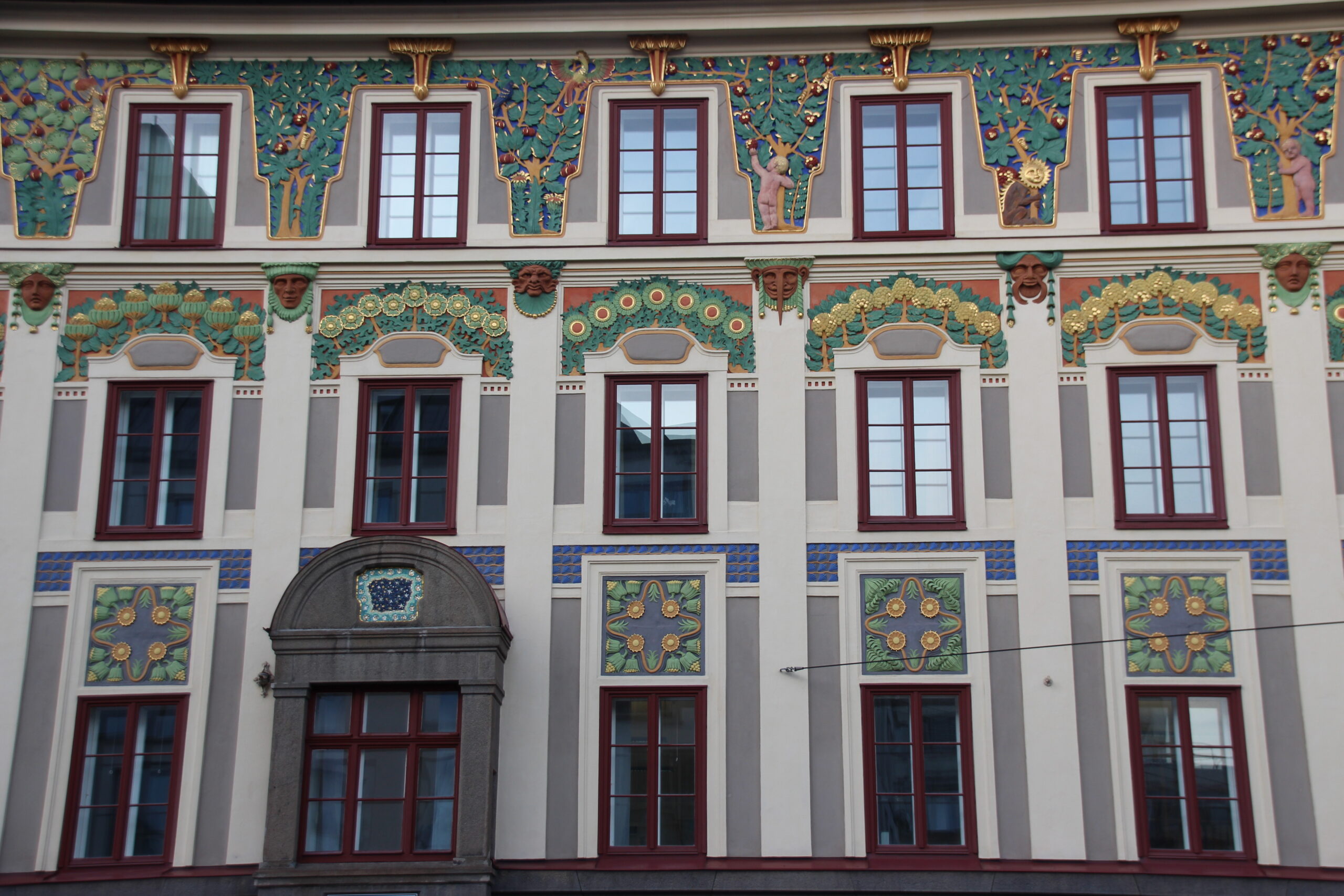
„Light air and sun“ war das Motto der Lebensreform, einer Sammelbewegung alternativer Lebensmodelle, die im späten 19. Jahrhundert in Deutschland im Gleichschritt mit der Entwicklung der Sozialdemokratie ihren Anfang nahm. Beide Ideen waren Reaktionen auf die Lebensbedingungen in den rasant wachsenden Städten. Schon vor der politischen Teilhabe beeinflussten Lebensreform und Sozialdemokratie Gesellschaft, Kunst und Architektur. Man wollte sich von dem, was Max Weber als protestantische Ethik beschrieb, der Industrie, den Stechuhren, ganz allgemein dem rasenden technischen Fortschritt mit allen Auswirkungen auf den Menschen und das Sozialgefüge, abgrenzen. Der Mensch als Individuum, nicht seine Wirtschaftsleistung, sollte wieder im Mittelpunkt stehen. Was dem Arbeiter Karl Marx´ Schriften, waren der gehobenen Bürgerschaft Kunst und Architektur. Der Jugendstil war der künstlerische Ausdruck auf dieses „Back to the origin“ der Jahrhundertwende. Das verspielte Element war das Gegenteil zum stets symmetrischen und aufgeräumten Historismus. Das Winklerhaus ist eines der wenigen im Stadtbild erhaltenen Zeugnisse dieses Zeitgeistes. Seit 1869 erschien die German Quarterly Journal for Public Health Care, which focussed on improving nutrition, hygiene and living space. In 1881 the Austrian Society for Healthcare gegründet. Private Vereine veranstalteten Aufklärungsveranstaltungen zum sauberen und gesunden Leben. Man betrieb politisches Lobbying zur Errichtung von Parks im öffentlichen Raum und der Verbesserung der Infrastruktur wie Bädern, Krankenhäusern, Kanalisation und Wasserleitungen. Assanation und Sozialhygiene waren Schlagwörter einer bürgerlichen Elite, die um ihre Mitmenschen und die Volksgesundheit besorgt war. Anstelle der sozialistischen Revolution sollte der christliche Gedanke der Nächstenliebe die Gesellschaft voranbringen. Wie alle elitären Bewegungen nahm auch die Lebensreform teils absurde und sektenartige Blüten an. Bewegungen wie der Vegetarismus, FKK, Gartenstädte, verschiedene esoterische Strömungen und andere alternative Lebensformen, die sich bis heute in der einen oder anderen Form erhalten konnten, entstanden in dieser Zeit. Auch Orientalismus und Spiritismus feierten in der Upper Class ein fröhliches Dasein.
This often well-intentioned but eccentric lifestyle remained largely inaccessible to workers; however, it formed, in many respects, the ideological core of the realpolitik of a then-young political party. Early Social Democrats confronted the everyday realities of workers and sought practical improvements beyond theoretical doctrine. Their basic demands are strikingly similar to today’s, albeit at a different level. Improving working conditions and housing ranked high on most people’s wish lists. Many tenement blocks were dreary, overcrowded environments lacking infrastructure such as sports facilities or parks. Modern housing estates were to be functional, comfortable, affordable, and integrated with green spaces. These ideas had also taken hold in public institutions. In 1907, Albert Gruber, a professor at the Innsbruck vocational school, wrote:
"I've often heard people say that we don't need plants in Innsbruck, that nature provides us with everything, but that's not true. What could be nicer than when professionals can walk from their place of work to their home through a series of plants. It turns the journey to and from work into a relaxing walk. Incidentally, there are many reasons why planting trees and gardens in urban areas is beneficial. I do not want to emphasise the interaction between people and plants, which is probably well known. In another way, plants improve the air we breathe by reducing dust."
Even before the First World War, changes occurred in everyday political life. Social Democracy had existed as a political party since 1889, but under the Habsburg monarchy its scope for political influence was very limited. Socialism was considered unchristian and viewed with suspicion in the “Holy Land” of Tyrol. Nevertheless, the labour movement was significant as a secularly organised social counterweight and alternative to the Catholic structures that dominated Tyrol. In 1865, the first Tyrolean Workers’ Educational Association was founded in Innsbruck. Workers were to become aware of their position within society in preparation for the impending world revolution. For this, it was essential to possess at least a basic level of education and to be able to read and write. Ten years later, Franz Reisch founded the General Workers’ Association in Innsbruck. Two years after that, the empire-wide “General Workers’, Sick, and Invalids’ Fund” was launched. Despite state repression, considerable gatherings of “radicals” repeatedly took place. From 1893 onwards, the Social Democratic Volkszeitung für Tirol und Vorarlberg was published in Innsbruck as a countervoice to the Catholic press. It was here that a young printer from the eastern part of the Austro-Hungarian monarchy began his career in Innsbruck’s local politics. The Bohemian-born Josef Prachensky (1861–1931) had discovered the labour movement during the printers’ strike in Vienna while on his journeyman travels. It is no longer entirely clear whether he first fell in love with the city or with his future wife. What is known is that he took over the management of the printing house that published the Social Democratic workers’ newspaper. Prachensky played a key role in founding the Social Democratic Party of Tyrol in 1890. In 1899, he was a driving force behind the opening of the First Tyrolean Workers’ Bakery (Erste Tiroler Arbeiter-Bäckerei, ETAB) on what is now Maximilianstraße. This cooperative aimed to produce high-quality bread under good working and hygienic conditions at fair prices. After several relocations, the ETAB settled on Hallerstraße, where it produced fresh baked goods daily until 1999. With his views and business initiatives, Prachensky quickly gained a reputation as an anarchist—a current within the political left that enjoyed a certain popularity around the turn of the century, but was also feared and discredited due to its often violent activism. In addition to the ETAB, Prachensky supported the “Workers’ Consumers’ Association” and founded the alcohol-free beverage hall at Museumstraße 16, a venue that, in keeping with the ideals of the Lebensreform movement and socialism, sought to improve the general health of the working class. Where people had once fasted according to the Christian calendar, abstinence was now to purify body and mind according to the measure of individual reason and personal well-being. Friedrich Engels (1820–1895), co-author of the Communist Manifesto, had already recognised spirits and hard liquor as a social ill of the working class in the first half of the 19th century. The aim of steering people away from alcohol was shared by socialism and, in many respects, by various Christian organisations that preached abstinence. Alcoholics, after all, could neither launch a world revolution nor lead a God-fearing life according to church ideals—whether Catholic, Lutheran, or Calvinist. How little this approach succeeded in Innsbruck during the Belle Époque is illustrated by the rapid renaming of the establishment from Alcohol-Free to Reform, accompanied by the introduction of alcohol sales and Prachensky’s subsequent bankruptcy. One of his particular political concerns was to limit the influence of the Church within the school system, which in the 19th and early 20th centuries remained very strong even in nominally liberal Innsbruck, which was bound to follow national educational regulations. Although the liberal educational reform of 1869 was intended to push the clergy out of schools, their influence remained considerable in practice. Prachensky advocated giving children from working-class families at least a decent education, in order to provide them with a minimum chance of improving their living conditions. His demands around the turn of the century—for better and more uniform teacher salaries, a reduction in the proportion of religious instruction, support for less affluent children, and smaller class sizes—seem strikingly modern today.
The first free elections to the Imperial Council (Reichsrat) of the Austro-Hungarian monarchy for all male citizens in 1907 altered the political and social balance of power and gave Social Democrats new momentum, even though the census-based voting system still applied at the municipal level. The “common people” (Pöbel, colloquially referred to as Pofl) now had political representation. Important legislation—such as limits on working hours and improvements in working conditions—could now be demanded with greater force. The Crown Land of Tyrol, together with Upper Austria, had the longest working hours in the entire Danube Monarchy. Although trade union membership grew in number, Tyrol remained too heavily shaped by rural structures outside small urban centres to exert significant pressure. After the proclamation of the republic in 1918 and the introduction of universal suffrage at the municipal level, Social Democrats won the most votes in Innsbruck for the first time. However, the fulfilment of their demands still had to wait even after the first municipal elections following 1918. Innsbruck was “red,” but decisive authority over major political issues remained with the conservative provincial government. Although Innsbruck did not experience civil war–like conditions as seen in industrial strongholds such as Vienna, Linz, or Steyr, brawls, assassination attempts, and violence were nonetheless frequent. Prachensky—who, as a Social Democrat, had always resisted being labelled a “radical”—was drawn into the entrenched conflicts of the interwar period and founded the Tyrolean branch of the Republican Protection League (Republikanischer Schutzbund, RESCH), the counterpart to the right-wing paramilitary Heimwehr units.
Der socialdemokratische Wählerverein in Wilten
Artikel erschienen: Innsbrucker Nachrichten / 7. November 1898
Der socialdemokratische Wählerverein in Wilten hielt am Sonntag in der Restauration zum Fischnaller eine Versammlung, in welcher der Referent Holzhammer den Unterschied und die Berührungspuncte der Socialdemokraten und Anarchisten auseinandersetzte. Nachdem er aus geführt und dargethan hatte, dass die Socialdemokraten, welche die Anwendung von Gewaltmitteln verabscheuen, mit den Anarchisten der That nicht nur nichts gemein, sondern alle Ursache haben, diese als ihre grimmigsten und schädlichsten Gegner anzusehen, weil dieselben den herrschenden Classen Gelegenheit bieten, aus den Gewaltthaten der Anarchisten Waffen gegen die Socialdemokraten zu schmieden, unterzog er das Programm der theoretischen Anarchisten einer Kritik und wies nach, dass diese Partei überhaupt nicht mehr den Namen Anarchisten verdiene, weil sie die Ordnung in dem von ihnen gedachten Staatswesen auf die Gemeinsamkeit des Vorgehens der Productions-Genossenschaften aufbauen, deren Mitglieder durch gegenseitige Verträge verpflichtet werden sollen, sich den Beschlüssen der Majorität zu fügen. Da nun die Gesetze nichts anderes sind oder sein, sollen als der in bestimmten Normen zum Ausdruck gebrachte Volkswille, so kann von einer Gesetzlosigkeit im geplanten Staat der theoretischen Anarchisten nicht die Rede sein. Manche ihrer Forderungen gleichen im Princip völlig denen der Socialdemokraten und einige davon wie z. B. die Verstaatlichung der meisten Verkehrswege und Verkehrsmittel (Eisenbahnen, Post, Telegraph, Tramway) sind sogar schon im heutigen Staate verwirklicht und eine Menge andere wie Wasserversorgung, Straßenreinigung, Beleuchtung sind vielerorten, wo es nicht schon geschehen ist, im Begriff verwirklicht zu werden. Daß dies so rasch als möglich geschehe und überhaupt alle Productionsmittel welch immer für Art in den Besitz des Staates übergehen und jedermann sein Wohl im Wohl des Ganzen suche, das ist das Programm der Socialdemokraten, während die verruchten Anarchisten der That überhaupt kein Programm haben und jedwede Unterwerfung des Einzelnen zum Wohl der Gesellschaft verneinen. Nachdem der Referent für diese seine Ausführungen mit reichem Beifall belohnt worden war, brachte der Referent Prachensky die Schulverhältnisse in Wilten zur Sprache, um durch die öffentliche Behandlung die dort herrschenden Missstände beseitigen zu helfen. Prachensky wies zunächst auf die Ueberfüllung dieser Schule hin, wodurch der Unterricht so zu Schaden komme, dass hier mehr Kinder in ein und derselben Classe länger als ein Jahr sitzenbleiben müssen, als dies in anderen Schulen der Fall ist. Wilten, welches derzeit 9000 Einwohner hat, hat bloß eine einzige Schule, während Innsbruck mit seinen 25000 Einwohnern nicht weniger als sechs Schulen aufweist. Das ist ein schreiendes Missverhältnis und verlangt dringend eine Abhilfe, auf welche die arme Bevölkerung, welche nicht in der Lage ist, ihre Kinder ins Pädagogium zu schicken, geradezu ein Recht hat, zumal die reiche Gemeinde in der glücklichen Lage ist, hier Abhilfe zu schaffen. Der Redner tadelt ferner, dass die Gemeinde zur Bestreitung der Lehrmittel für arme Kinder so gut wie nichts thue, da der dafür ausgeworfene Betrag von 80 fl. ganz unzulänglich ist. Ein weiterer von der Partei des Redners beanständeter Nachtheil liege in der Thatsache, dass der Religionsunterricht in der Mädchenschule auf Kosten der übrigen Lehrfächer erweitert werde. Seit Beginn des Schuljahres sind erst 45 Tage verflossen und doch halte man im Katechismus bereits auf Seite 41. Die Kinder wären nicht im Stande einen so großen Stoff in so kurzer Zeit zu bewältigen, wenn die Schulschwestern nicht vor Beginn der Religionsstunde die Kinder auf diese vorbereiteten und den Unterricht verkürzten. Zum Schlusse bringt der Redner noch die schlechte Besoldung der Lehrer zur Sprache und verlangt, dass die Gemeinde ihre Lehrer anständig bezahle, damit sie sich sorglos ihrem schweren und eminent wichtigen Dienste hingeben können. Während in Innsbruck kein einziger Lehrerunter 100″ fl.Gehalt bezieht, hat im mindesten ebenso theueren Wilten erst der Schulleiter, welcher bereits *6 Dienstjahre hinter sich hat. 1000 fl. Die übrigen Lehrer haben wesentlich weniger Gehalt und man kann sich leicht denken, mit welchen Sorgen sie an die Arbeit gehen müssen. Die Kinder sind das kostbarste Gut der Bevölkerung, und die Volksschulbildunq ist das einzige, was die armen Eltern ihren Kindern für den harten Kampf um das Dasein mit auf den Weg geben können; Redner beantragt daher, die Partei möge dahin wirken, dass die Wiltener Lehrer ebenso besoldet werden, wie die von Innsbruck. Ueber den ganzen Complex der Schulfrage knüpfte sich eine längere Debatte, die schließlich damit endete, dass der Ausschuss mit dem Studium der ganzen Angelegenheit betraut wurde, um für den Fall, als der Appell an die Oeffentlichkeit fruchtlos bleiben oder die Forderungen nur mit halben Maßregeln beantwortet würden, in einer großen Volksversammlung eingehend zu erörtern und Mittel und Wege ausfindig zu machen, um den gerügten Uebelständen endlich ein Ziel zu setzen und zeitgemäße Reformen zu erzwingen. Dieser Antrag wurde mit großem Beifalle einstimmig angenommen, worauf interne Vereinsangelegen heilen und Anträge zur Verhandlung kamen
Sights to see...
Slaughterhouse block
Erzherzog-Eugen-Straße 25 - 38
Racing school & kindergarten
Pembaurstraße 18 & 20
Rapoldi Park
Leipziger Platz
Tivoli
Sillufer / Pradl
Städtisches Hallenbad
Amraserstraße 3
Pembaurblock
Pembaurstraße 31 – 41
Winklerhaus
Leopoldstraße/Maximilianstraße