Tyrolean "democracy" and the Sacred Heart of Jesus
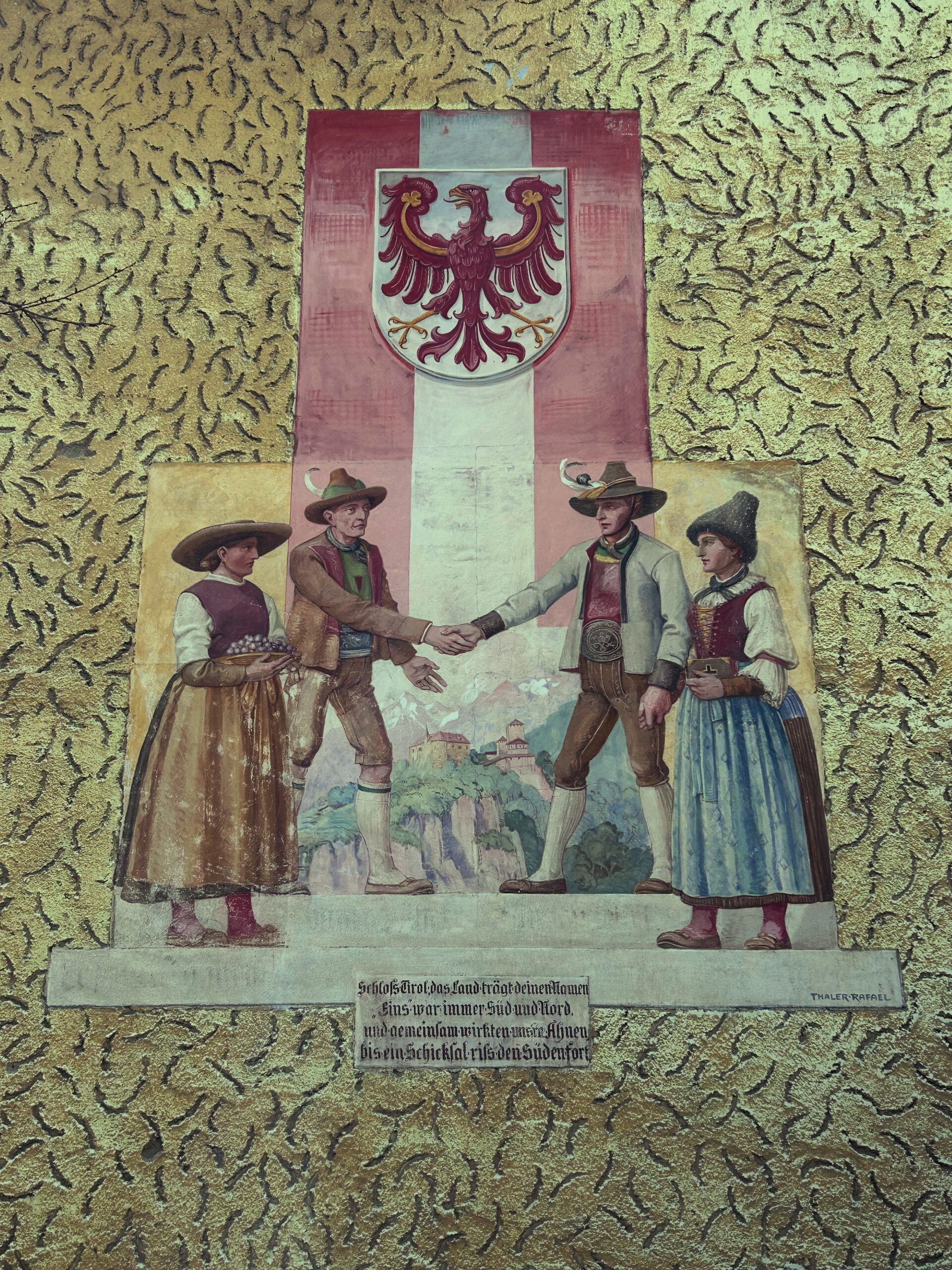
The Tyrolean nation, "democracy" and the heart of Jesus
Many Tyroleans still like to see themselves as a nation of their own. With “Tirol isch lei oans,” “Zu Mantua in Banden,” and “Dem Land Tirol die Treue,” the federal state has no fewer than three more or less official anthems. This pronounced local patriotism, as in other Austrian provinces, has historical roots. Tyrolean freedom and independence are frequently invoked almost as local sacred relics to substantiate this self-image. People also like to speak of the first democracy on mainland Europe—an assertion that is clearly an exaggeration when one considers the feudal, hierarchy-driven history of the region well into the twentieth century. Nevertheless, a certain distinctiveness in Tyrol’s historical development cannot be denied, even if this involved less the participation of broad sections of the population than the curtailment of the sovereign’s power by local elites. Tyrolean princes were already minting coins bearing their likenesses at an early stage, yet their relationship with the clergy, the estates, and the population was subject to constant fluctuation. The first act of what might be called proto-democratic Tyrolean historiography was what the Innsbruck historian Otto Stolz (1881–1957) enthusiastically celebrated in the 1950s—drawing on English history—as a Magna Charta Libertatum. Following the marriage of the Bavarian Ludwig of Wittelsbach to the Tyrolean sovereign Margaret of Tyrol-Gorizia, the Bavarian Wittelsbach dynasty briefly ruled Tyrol. In order to win over the Tyrolean population, Ludwig decided in the fourteenth century to offer the estates a concession. In the Great Charter of Freedom of 1342, he promised the Tyroleans that no laws would be enacted and no taxes raised without prior consultation with the estates. However, this was by no means a democratic constitution in the modern, twenty-first-century sense, as the estates consisted primarily of the landed nobility, who naturally represented their own interests. Although one version of the document mentioned the inclusion of peasants as an estate in the regional assembly, this version was never officially implemented.
The second act followed with Habsburg involvement. As cities and the bourgeoisie gained greater political weight in the fifteenth century due to their economic importance, a counterbalance to the nobility emerged within the estates. At the Landtag of 1423 under Frederick IV, eighteen members of the nobility met for the first time with eighteen representatives of towns and the peasantry. Over time, a fixed composition developed in the regional assemblies of the fifteenth and sixteenth centuries. Represented were the bishops of Brixen and Trient, the abbots of Tyrolean monasteries, the nobility, delegates from the towns, and representatives of the peasantry. The Landeshauptmann presided over the assembly. Naturally, the resolutions and wishes of the Landtag were not binding on the prince; nevertheless, it was surely reassuring for a ruler to know that representatives of the population stood behind him or supported difficult decisions.
Another important document for the region was the Tyrolean Landlibell. In 1511, Maximilian stipulated, among other things, that Tyrolean soldiers were to be deployed only for the defense of their own land. The reason for Maximilian’s apparent generosity lay less in affection for the Tyroleans than in the necessity of keeping the Tyrolean mines operational instead of sacrificing valuable workers and the peasantry that supported them on Europe’s battlefields. What is often overlooked is that the Landlibell also imposed significant restrictions on the population and increased financial burdens. In addition to regulating troop contingents, it defined special taxes. The nobility and clergy were required to use the income from their estates as the tax base, which often amounted to a rough estimate. Towns, by contrast, were taxed according to the number of hearths in their houses—a figure that could be recorded quite accurately. The highly sought-after mining workers were exempt from these taxes and were only conscripted for military service in cases of extreme emergency. This special regulation of territorial defense laid down in the Landlibell was one of the causes of the uprising of 1809, when young Tyroleans were conscripted during mobilization under universal military service. To this day, the Napoleonic Wars—during which the Catholic crown land was threatened by the “godless French” and the revolutionary social order—continue to shape Tyrolean self-perception. During this defensive struggle, a bond formed between Catholicism and Tyrol. Before a decisive battle against Napoleon’s armies in June 1796, the Tyrolean riflemen entrusted their fate to the Sacred Heart of Jesus and entered into a personal covenant with God to protect the Holy Land of Tyrol. Another identity-forming legend from 1796 centers on a young woman from the village of Spinges. Katharina Lanz, who entered regional history as the “Virgin of Spinges,” is said to have motivated the nearly defeated Tyrolean troops through her commanding presence in battle, ultimately enabling them to overcome the French superiority. Depending on the account, she is said to have wielded a pitchfork, a flail, or a scythe—much like the French maiden Joan of Arc—striking fear into Napoleon’s troops. Legends and traditions surrounding the riflemen and the notion of being an independent, God-chosen nation accidentally attached to the Republic of Austria stem from these narratives. The government in Vienna under Maria Theresa viewed this identity with skepticism. Distinct identities of individual crown lands did not align with enlightened concepts of a modern state. In the nineteenth century, too, efforts were made to strengthen identification with the monarchy and foster a new national consciousness. Subjects were meant to feel allegiance not to Tyrol, but to the House of Habsburg. The press, visits by the ruling family, monuments such as the Rudolf Fountain, and the opening of Bergisel with Hofer portrayed as a loyal Tyrolean were intended to help transform the population into faithful imperial subjects. Over the centuries, Innsbruck’s inhabitants saw themselves as Tyroleans, Germans, Catholics, and subjects of the emperor—but hardly anyone identified as Austrian before 1945. Only after the Second World War did a sense of belonging to Austria slowly begin to develop in Tyrol as well.
The end of the monarchy further strengthened Tyrolean national sentiment. When the Habsburg Empire collapsed after the First World War, the crown land of Tyrol also fell apart. What had been known as South Tyrol until 1918—the Italian-speaking region between Riva on Lake Garda and Salurn in the Adige Valley—became Trentino with its capital in Trento. Liberals and conservatives, otherwise divided on almost every issue, were united in their hostility toward the unwanted division of the province and the founding of the Republic of German-Austria. Even today, many Tyroleans take particular pride in their local identity and readily distinguish themselves from residents of other federal states. For many Tyroleans, the Brenner Pass still represents an unjust border more than a century later, even though political cross-border cooperation takes place at the EU level within the framework of a “Europe of the Regions.” The legend of the Holy Land, the independent Tyrolean nation, and the first mainland democracy persists to this day. The saying “bisch a Tiroler bisch a Mensch, bisch koana, bisch a Oasch” (“If you’re a Tyrolean, you’re a human being; if you’re not, you’re an arse”) succinctly captures Tyrolean nationalism. The fact that the historical crown land of Tyrol was a multiethnic construct—including Italians, Ladins, Cimbrians, and Rhaeto-Romans—is often deliberately ignored in right-wing circles. Laws from the federal capital Vienna or even from Brussels are viewed with unreflective skepticism. Nationalists on both sides of the Brenner still draw on figures such as the Virgin of Spinges, the Sacred Heart of Jesus, and Andreas Hofer to present their causes in a way that resonates with the public.
Sights to see...
Landhausplatz & Tiroler Landhaus
Eduard Wallnöfer Square
Katzung & Trautsonhaus & Weinhaus Happ
Herzog-Friedrich-Straße 14/ 16 / 22
Claudiana – Altes Regierungsgebäude
Herzog-Friedrich-Straße 3
Rudolfsbrunnen & Boznerplatz
Boznerplatz