Of Maultasch, Habsburgs and the Black Death
Of Maultasch, Habsburgs and the Black Death
Between the last Count of Andechs and the first Tyrolean territorial prince from the House of Habsburg lay 115 eventful years in the history of the city of Innsbruck. After the extinction of the Andechs line, the Counts of Tyrol guided the fortunes of the region for about a hundred years and thus also largely shaped the development of the city of Innsbruck. Meinhard II of Tyrol (1239–1295) succeeded, through skillful politics and a measure of good fortune, in expanding his territory. From his ancestral seat in Merano, he managed to unite what had previously been a patchwork of lands into a coherent county. Alongside the Prince-Bishops of Brixen and Trent—who were not politically disempowered until the 19th century—the Counts of Tyrol were the most powerful territorial lords in the region that today encompasses Trentino as well as North and South Tyrol. Meinhard’s more modern and tightly administered territories were politically and economically closer to the pulse of the times. His advisers included Florentine merchants and bankers, who at the time represented the most advanced financial and commercial expertise in Europe. Under his rule, a codified territorial law was created, granting estates, entrepreneurs, and subjects a certain degree of legal security. For the first time, all possessions in Tyrol were uniformly recorded in a land register (Urbar). Financial matters were also brought under centralized control. Meinhard broke the bishops’ monopoly on coinage and had coins minted bearing the Tyrolean eagle, following Italian models. This significantly curtailed the de facto power of the Church. Although the bishops of Brixen and Trent remained landowners and feudal lords, their imperial immediacy had become largely formal, as their ties and dependencies on the County of Tyrol had grown too close. In 1254, the territory was no longer referred to merely as the “land in the mountains,” but officially as the Dominium Tirolis—the Lordship of Tyrol. Innsbruck also grew under Meinhard’s rule, with approximately 1,500 inhabitants settling there. Beyond the city walls, the Neustadt began to develop in the area where Maria-Theresien-Straße today invites leisurely strolling. Meinhard found his final resting place at Stams Abbey, which today is known as a training center for Tyrol’s winter sports elite.
His son and successor as Tyrolean territorial prince, Duke Henry of Carinthia (1265–1335), ranked among the most important nobles in the Holy Roman Empire as King of Bohemia. Owing to his extensive possessions in southeastern Europe, Henry was one of the most powerful princes of his time. He was a strong supporter of cities, recognizing their growing importance. In Innsbruck, he promoted the construction of the civic hospital in the Neustadt. However, Henry had no male heir. Before his death, he ensured that his daughter Margaret of Tyrol-Gorizia (1318–1369) could succeed him. She assumed power as territorial princess at the age of seventeen. This placed the young ruler at the center of power struggles among the leading dynasties of the age: the Habsburgs, the Wittelsbachs, and the Luxembourgs. She entered marital alliances with two of these houses; the third would ultimately inherit the County of Tyrol and thus the city of Innsbruck. After her father’s death, Margaret was married to John Henry of Luxembourg, the son of the new King of Bohemia. John Henry was even younger than his wife and primarily served as a political foothold for his father in Tyrol. He was opposed by the Habsburgs and Wittelsbachs as well as by the local nobility. His rule proved disastrous. In the Hall saltworks—leased to Florentine financiers and, alongside customs duties, the backbone of Tyrol’s economy—labor unrest broke out. Despite severe financial difficulties, the court of John Henry was reportedly conducted in an extravagant manner. In 1341, with the support of Emperor Louis of Bavaria, a Wittelsbach, the Tyrolean estates expelled John Henry from the country in a coup planned together with Margaret. Contemporary sources hostile to Margaret portrayed her in highly polemical and defamatory terms. [Here, contemporary scandalous descriptions and explicit allegations are omitted or neutralized.] An imperial chronicler sympathetic to the emperor described John Henry as incapable of fulfilling marital duties, allegedly due to immaturity. These rumors were deliberately circulated throughout the empire to enable the emperor to install his son, Louis of Brandenburg, as Margaret’s new husband and thus as ruler of the strategically important transit territory of Tyrol. This coup, which entered history as the “Tyrolean marital scandal,” triggered a far-reaching crisis. Even the philosopher and critic of papal authority William of Ockham commented on the affair. The issue was not merely the separation itself, but the fact that Margaret had not been formally divorced from her first husband at the time of her second marriage. The emperor and his supporters regarded the marriage between John Henry and Margaret as unconsummated and therefore invalid. The fourth major political power of Central Europe at the time, the papacy, took a different view. Pope Benedict XII excommunicated the emperor and his son because of what he considered an unlawful union between Margaret and Louis of Brandenburg. Beyond moral concerns, the pope also had political motives. Both the papacy and the Habsburgs were in armed conflict with the Wittelsbach emperor and sought to weaken his influence. For medieval society, such an interdict was among the harshest of punishments, as it prohibited the celebration of Mass and the administration of communion throughout the land. It was likely during this period that Margaret acquired the popular nickname “Maultasch” and was described as particularly unattractive. No contemporary portraits exist that would indicate any physical deformity. The images of Margaret Maultasch known today date at the earliest from the late 15th century, when the medieval scandal was first reinterpreted by later historians.
Margaret’s reign was marked by crises for which she bore little responsibility, yet for which she was often blamed. The 14th century brought a period of climatic warming that led to severe locust plagues, including in Innsbruck. Crop failures and famine followed. In addition, after the fire of 1333 in Anbruggen, another major blaze devastated Wilten and Innsbruck seven years later, destroying the parish church of St. James. From 1348 to 1350, the plague swept across Europe. Arriving from Venice via Trent and the Adige Valley, the Black Death reached Innsbruck and dramatically reduced the population. In some parts of Tyrol, more than half of the inhabitants perished. The horrifying manner in which victims died left a deep impression on the deeply religious population. Archival sources provide little detailed information on the outbreak of the plague in Innsbruck itself, but its consequences were devastating, as elsewhere in Europe. In her will, a woman from Innsbruck afflicted by the plague spoke of the “common dying that goes through the land.” Many people interpreted famine and pestilence as divine punishment and as consequences of the papal ban, blaming Margaret and her husband Louis. In reality, the causes of disease and suffering lay far beyond ecclesiastical sanctions and propaganda. Like many medieval cities, Innsbruck lacked paved streets, sewage systems, and reliable drinking water supplies. Humans and animals shared the confined space within the city walls, resulting in highly unhygienic living conditions. Advances in medical knowledge came primarily from Italy. In Salerno, the first medical school had emerged in the 11th century. Under Emperor Frederick II, the professions of physician and apothecary were formally separated and regulated in 1241. In Innsbruck, a pharmacy was first mentioned in 1303 and officially founded in 1326. Located in the Schöpferhaus at today’s Herzog-Friedrich-Straße 19, it served as both court and city pharmacy and is now considered the oldest still-existing pharmacy in Austria.
After the Wittelsbachs, Luxembourgers and Habsburgs had fought over Tyrol for decades, a happy ending was finally reached. Rudolf IV of the House of Habsburg intervened with the Pope and was able to negotiate the lifting of the interdict in 1359 in exchange for considerable financial compensation at the expense of Margaret and Louis. At the same time, a document is said to have been drawn up that is now considered a forgery: in this document, Margaret bequeathed the land of Tyrol to Rudolf IV and the Habsburg family.
Soon thereafter, this transfer of power took effect. One year after the death of Margaret’s husband Louis in 1361, her son Meinhard III also died. According to the account of Filippo Villani, written around 1400, Margaret was rumored to have been involved in both deaths—an allegation that remains historically unproven. In 1363, with the consent of the Tyrolean nobility, Margaret formally transferred the governance of Tyrol to Rudolf IV of Habsburg. Tyrol thus became part of the Habsburg dominions, which already included the Duchy of Austria. The Dukes of Bavaria from the House of Wittelsbach refused to recognize this inheritance treaty and attempted to assert their claims by force of arms. In 1363, they marched toward Innsbruck. Rudolf IV, however, had secured the support of key local nobles and the cities of Innsbruck and Hall. The fortified city successfully withstood the attack. After consolidating power, Rudolf confirmed the city hospital and granted temporary customs exemptions as well as the right to levy major tolls.
With the acquisition of Tyrol, the Habsburg family was able to close an important geographical gap within its sphere of influence. Although there were repeated incursions by Bavarian troops, for example the abbot of Wilten Abbey was abducted and taken hostage, the Inn Valley and Innsbruck were gladly part of the Habsburg lands. The incorporation of the city into the much larger territory of the Habsburgs meant that Innsbruck became even more important, while the actual capital Merano was further marginalised. In addition to the north-south transport of goods, the city on the Inn had now also become a west-east transport hub between the eastern Austrian lands and the old Habsburg possessions in the west. For the survivors of the great plague wave of 1348 and the political turmoil, there was an economic upswing. Labour had become scarce due to the shrinking population, but greater resources were available per capita. For those Innsbruck residents who had survived the turbulent first half of the 14th century, better times were to come.
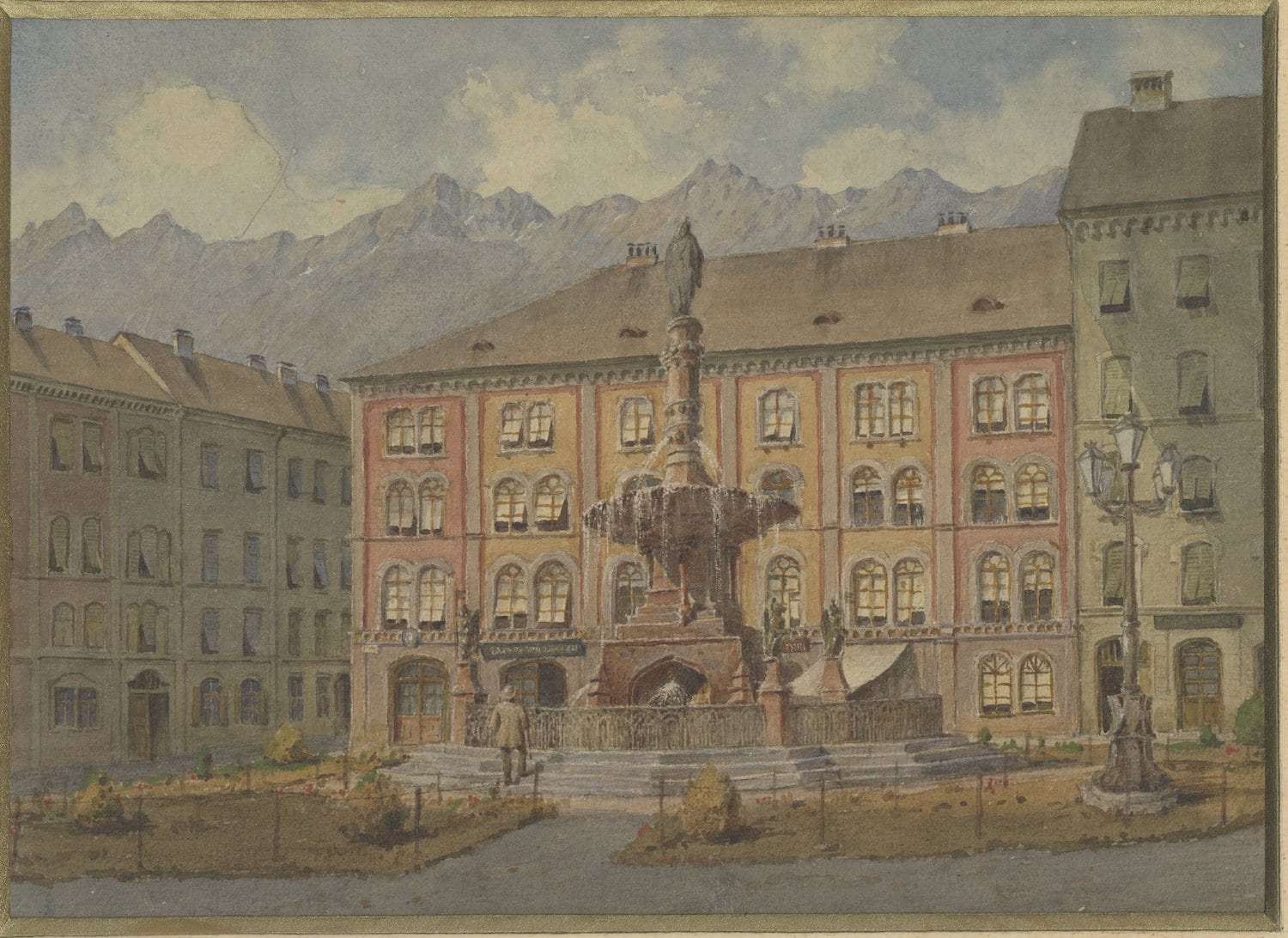
Little remains in Innsbruck’s cityscape from the era of Margaret Maultasch and her husbands. Political and economic hardship, warfare, plague, fires, earthquakes, and later building activity erased much of the medieval city. Yet the memory of Margaret endures in legend. She remains one of the most famous female figures in Tyrolean history. Conflicting accounts written even during her lifetime allow room for interpretation. Her biography could easily serve as the template for a character in a modern historical drama. Whether she was a ruthless schemer or an innocent pawn of greater powers remains an open question. Margaret and her successor Rudolf IV of Habsburg are commemorated in stone at the fountain on Bozner Platz, formerly known as Margarethenplatz.
Sights to see...
Hospital church & old city hospital
Maria-Theresien-Strasse 2
Rudolfsbrunnen & Boznerplatz
Boznerplatz