Wilten Abbey as a Structuring Authority
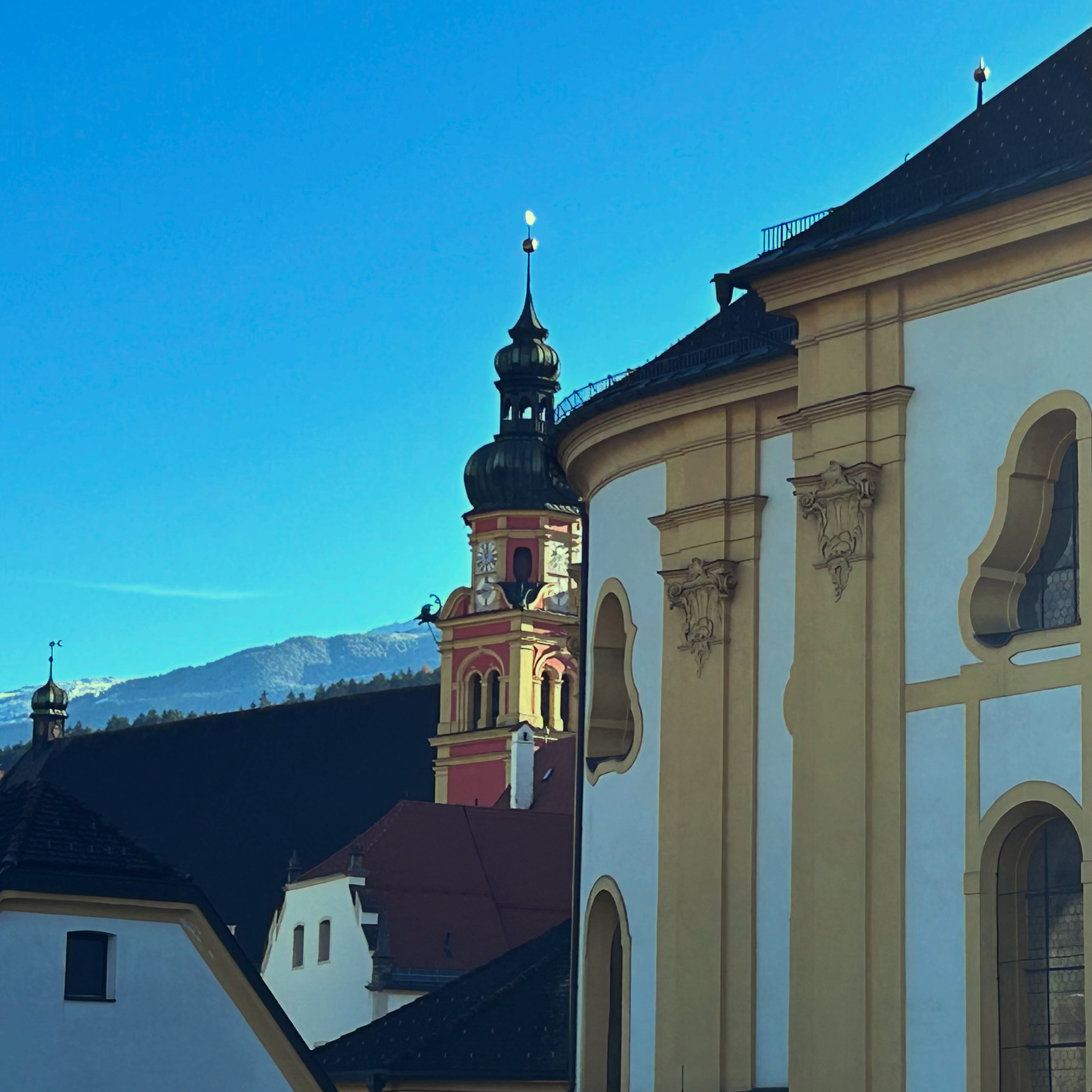
Wilten Abbey as a Structuring Authority
“Austria is a democratic republic. Its law emanates from the people,” as stated today in Article 1 of the Austrian Federal Constitutional Law. Ministries and their local representatives, the magistrates, are representatives of a secular republic. Unlike in many other regions, church and state are separated in Austria. This was not always the case. For centuries, it was the clergy who exercised jurisdiction and administration. Ecclesiastical institutions such as monasteries, thanks to their educated and literate brethren, were the most important administrative units in Late Antiquity, orchestrating structures of power, governance, law, property ownership, infrastructure, and public order. In Wilten, a small community of pastors managed the affairs of the region between the Nordkette mountain range and the Brenner Pass. As early as the sixth century, a church can be documented in what is now Wilten. The Bavarian dukes, who counted the Inn Valley among their dominions in the early Middle Ages, were more than willing to make use of these educated churchmen to keep the administration of the territory on an orderly footing. In 1128, Bishop Reginbert of Brixen transferred the monastery to the then newly founded Premonstratensian Order. The charter confirming the transfer to the Premonstratensians in 1138 has been preserved in the archive of Wilten Abbey to this day. Considering that the mother monastery in Prémontré in France was founded only in 1120 by the order’s founder, Norbert of Xanten, the spread of the order to Tyrol occurred remarkably quickly. Originating in France, the order managed to establish itself throughout Europe within just a few decades. The ideal of poverty was less pronounced among the Premonstratensians than among the contemporaneously emerging Franciscans or Dominicans. Norbert, venerated as a saint from 1582 onward, was indeed a church reformer; yet, despite all his spirituality, he could not deny his noble lineage or his political role as Archbishop of Magdeburg and advisor to the king. With the assumption of ecclesiastical rights and duties came lordship over extensive lands at the abbey’s disposal. In 1140, the Prince-Bishopric of Brixen transferred all its landholdings between Bergisel, the Sill River, and the Inn River to Wilten Abbey. The powerful Bavarian Duke Henry the Lion donated a hereditary farm from his own possessions to the abbey. In addition, Mentlberg and lands in the Sellrain Valley were added. One of Tyrol’s most beautiful valley termini, Lüsens, remains in ecclesiastical ownership to this day, as does the Heiligwasser inn in Igls.
Thanks to its extensive landholdings, the abbey also became a political actor. On these lands, the abbey held lower jurisdiction, encompassing all matters not subject to blood justice. In 1180, it was Wilten Abbey that transferred the lands south of the Inn to the Counts of Andechs—lands on which Innsbruck was founded. Not only in 1180, but also in 1339 and 1453, the expansion of Innsbruck was possible only after the acquisition of land from Wilten. In matters of pastoral care and liturgical service, the city was dependent on the abbot. Thus, for a long time, the right to conduct burials was a privilege of Wilten Abbey. Only in the late Middle Ages did Innsbruck acquire this privilege itself. The parish church of St James was merely a filial church. With considerable foresight, Wilten Abbey secured not only ecclesiastical but also secular special rights contractually in return for the sale of land. The Kleine Sill, a canal constructed in the High Middle Ages, supplied the city with water indispensable to its craft workshops. As the canal ran through abbey lands, the abbot retained authority over its use rights—along with many other matters—until the sixteenth century. The abbey also possessed the important milling rights. During the Middle Ages, farmers from Amras, Pradl, and Innsbruck were required to bring their grain to the Wilten mills along the Sill to have it ground. When medieval cities ran out of bread, unrest and uprisings threatened, as grain formed the staple of the daily diet. The well-being of Innsbruck’s city council depended on Wilten; in many respects, the city relied on the abbot’s goodwill. The relationship between ecclesiastical authority in Wilten, embodied by the abbot, and secular power in Innsbruck, embodied by the territorial prince, resembled the enduring struggle between pope and emperor in the Middle Ages.
In addition to economic matters, Innsbruck also remained dependent on Wilten Abbey in educational affairs for a long time. A monastic school is mentioned as early as 1313. Ruedger the schoolmaster appears in Wilten’s chronicles even ten years earlier, noted as village schoolmaster. Alongside lively panel painting, the pupils likely also copied books. The city school at the Church of St James, a filial church of Wilten Abbey, likewise stood indirectly under the abbot’s authority. Until 1561, the abbots successfully prevented the settlement of further religious orders in Innsbruck in order to maintain the abbey’s sphere of influence within the city. Only during the Counter-Reformation did the territorial prince—originating from Spain, disregarding many local customs, and later Emperor Ferdinand I—succeed, together with the Jesuits, in establishing a religious order in the city itself, thereby making the residential city more independent. Nevertheless, masses on major feast days such as Christmas and Easter, as well as baptisms, continued to be celebrated in Wilten. From the sixteenth century onward, the influence of the church gradually began to wane, even though it persisted in one form or another for centuries. Well into the twentieth century, disputes between church and state over supremacy in various aspects of subjects’ and citizens’ lives shaped power structures and social policy. During the interwar period, the Catholic faith was still raison d’état of the corporative state under Federal Chancellors Dollfuss and Schuschnigg, and even today, in many fundamental questions of education policy, the church remains unavoidable. Today, the abbots of Wilten no longer wield political power; however, the landownership and the wealth reflected in the abbey’s buildings have by no means been lost.
Sights to see...
Haymon Giant Inn
Haymongasse 4
Mentlberg Castle & Pilgrimage Church
Mentlberg 23
Mountain Isel
Mountain Isel 1