The Wallschen and the Fatti di Innsbruck
The Wallschen and the Fatti di Innsbruck
Prejudice and racism toward immigrants were and remain common practice in Innsbruck, as in all societies. Whether Syrian refugees since 2015 or Turkish guest workers in the 1970s and 80s, 'the foreign' usually generates little goodwill in the average Tyrolean. Today, Italy may be the favorite travel destination of Innsbruckers and pizzerias a part of everyday dining, but for a long time, our southern neighbors were the most suspiciously eyed population group. What Jews and Bohemian brickmakers ('Ziegelböhmen') were to the Viennese around 1900, the 'Wallsche' (Italians) were to the Tyrolean. The aversion to Italians in Innsbruck can look back on a long tradition. Although Italy did not exist as an independent state—instead, many small counties, city-states, and principalities between Lake Garda and Sicily shaped the political landscape, with individual regions also differing linguistically and culturally—people gradually began to see themselves as Italians over time and were perceived as such abroad. Most of those with whom Innsbruckers interacted belonged to the upper class, which automatically generated a certain resentment. During the Middle Ages and the Early Modern period, they resided in Innsbruck as members of the civil service, the court staff, bankers, wholesalers, or wives of various local rulers. The mutual dislike between 'Italians' and 'Germans' went both ways: one side viewed the other as dishonorable, unreliable, arrogant, vain, morally corrupt, and lazy; the other side viewed them as uncivilized, barbaric, uneducated, and 'pigs.' With the wars between 1848 and 1866, hatred of all things Italian reached a new peak in the 'Holy Land of Tyrol,' even though many 'Wallsche' served in the Imperial-Royal (k.u.k.) Army and the rural Italian-speaking Tyrolean population largely remained loyal to the monarchy. Italians—especially Garibaldi's troops—were considered godless insurgents and republicans, and were lambasted from church pulpits between Kufstein and Riva del Garda in both Italian and German. The Tyrolean press landscape played a major role in the conflict. The Innsbrucker Nachrichten, with a circulation of around 15,000 copies, was Tyrol's widest-reaching media outlet at the turn of the century; while it had no explicit political orientation, it was considered Pan-German liberal-leaning. On the Italian side, Cesare Battisti (1875–1916) stood out—he was later executed by hanging for high treason by the Austrian military during the war. The publicist and politician from Trento had begun studying at the German-language university in Vienna before transferring to the University of Florence. With a sharp pen in the two Italian newspapers Il Popolo and L’Avvenire, he repeatedly fueled the nationalities conflict within the country's borders. Thanks to his blend of socialist ideology and Italian patriotism, he was considered public enemy and traitor number one by many Tyroleans. Clubs and associations also played a supporting role in the hardening of positions. In 1867, not only were the press laws liberalized, but so was the right of association, triggering a genuine boom in new foundations. Sports clubs, gymnastics societies, theater groups, marksmen companies (Schützen), or the Innsbrucker Liedertafel often served not just for recreation, but as political front organizations. Student fraternities were particularly extreme. Facing them were the Italian-speaking students, who were inferior both in terms of numbers and organization. Due to the loss of Padua, Italian-descended Tyroleans no longer had the opportunity to complete university studies in their native language within the empire, leading many to orient themselves toward Innsbruck—where they met with little affection. One of the main political bones of contention between Italian- and German-speaking students was the opening of an Italian faculty or university. The discussion over whether to target a university in Trieste (the preferred location for Italian-speaking representatives), Innsbruck, Trento, or Rovereto played out over years. Although attending university was actually a matter for a small elite, irredentist, anti-Austrian-minded Tyrolean deputies from the Trentino were able to repeatedly inject emotional charge into the issue as a symbol for sought-after autonomy—given that by law, all language groups within the monarchy were to be treated equally after 1867. Pan-German nationalist politicians, such as Innsbruck Mayor Wilhelm Greil (who was repeatedly admonished by Tyrol's Imperial-Royal Governor for his improper conduct toward the Italian population), used the emotions surrounding the issue to whip up sentiment about impending 'foreign infiltration' (Überfremdung). Added to the ethnic and racial resentment toward their southern neighbors—especially among conservatives—was the fear of figures like Cesare Battisti, who as a socialist embodied living evil anyway.
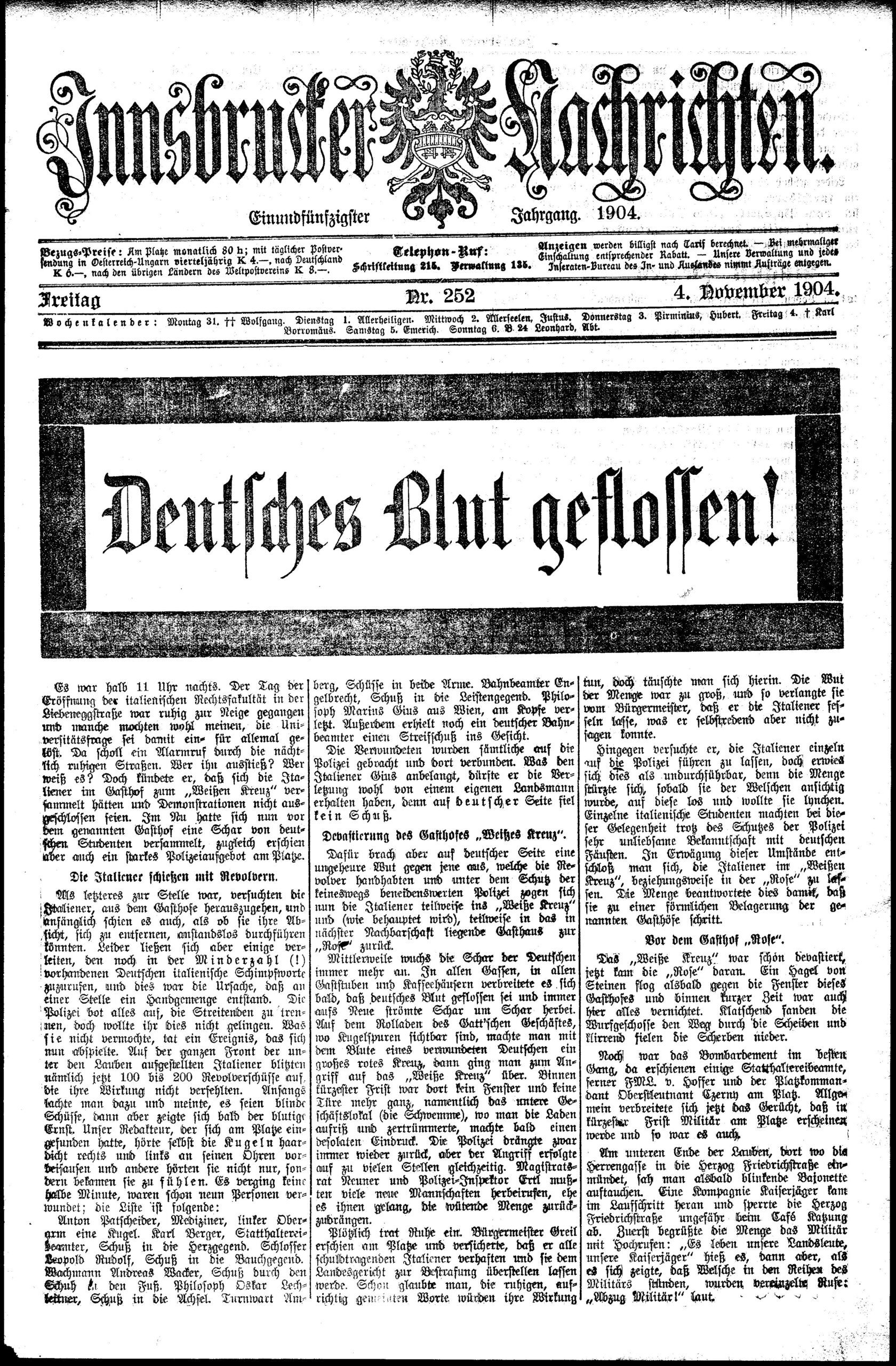
Demographic data shows how inflated the fear of Innsbruck being "Italianized" by Trentino students actually was. As is so often the case, facts back then were replaced by gut feeling and racially motivated populism. After the incorporation of Pradl and Wilten in 1904, Innsbruck had just over 50,000 inhabitants. With slightly over 1,000 students, the student population accounted for less than 2%. Of the roughly 3,000 people of Italian descent—most of them Welschtiroler from the Trentino—only just over 100 were enrolled at the university. The vast majority of the Wallsche consisted of workers, innkeepers, merchants, and soldiers. Many had been living in and around Innsbruck for a long time. In the somewhat cheaper district of Wilten, a sort of Little Italy had emerged. Anton Gutmann sold Italian wines at his winery cooperative Riva at Leopoldstraße 30, while across the street one could eat well and affordably at Gasthaus Steneck. As subjects of the monarchy, most immigrants spoke excellent German; only a small fraction came from Dalmatia or Trieste and was genuinely foreign-speaking. The differences were socio-cultural. There were separate associations such as the Club Ciclistico and the Unione Ginnastica, socialist-oriented workers' and consumer organizations, music societies, and student fraternities. Although students made up only a small fraction among the Italian population, disproportionate attention was focused on them and their demand for an institute with Italian as the language of examination and instruction. After much back-and-forth, it was decided in September 1904 to establish a provisional faculty of law in Innsbruck. This was intended to separate the students without alienating either group. From the outset, however, the project was ill-fated. No one was willing to rent the necessary premises to the university. Finally, the enterprising builder Anton Fritz made an apartment available in one of his tenement buildings at Liebeneggstraße 8. At the inaugural lecture and the festive evening event at Gasthaus zum Weißen Kreuz on November 3, prominent figures such as Battisti and the future Italian Prime Minister Alcide De Gasperi were present. As the night wore on, the mood grew increasingly boisterous. When taunts such as "Porchi tedeschi" and "Abbasso Austria" ("German pigs" and "Down with Austria") were shouted, the situation escalated. A mob of German-speaking students armed with sticks, knives, and revolvers besieged the Weißen Kreuz, where the Italians—likewise largely armed—had barricaded themselves. A squad of Kaiserjäger successfully dispersed the initial turmoil, and several Italians were detained. In the process, the painter August Pezzey (1875–1904) was mistakenly fatally wounded by a bayonet thrust from an overly nervous soldier. Following the night's events, the Innsbrucker Nachrichten appeared on November 4 under the headline: "German Blood Has Flowed!". The reporter on site claimed that 100 to 200 revolver shots were fired by the Italians at the "host of German students," reporting Pezzey's death. News of what transpired sparked a wave of revenge acts and violence. Joining those who were politically motivated—as in any riot—were onlookers and rioters who simply enjoyed causing havoc under the cover of the crowd, without holding any genuine political convictions. While the detained Italians sang the martial song Inno di Garibaldi in the city's hopelessly overcrowded prison, severe riots broke out across the city against Italian establishments and businesses. The premises of Gasthaus zum Weißen Kreuz were completely devastated in monarchist fashion, leaving nothing intact except a portrait of Emperor Franz Joseph. Rioters threw stones at the residence of the already unpopular Governor at Palais Trapp because his wife had Italian roots. The building on Liebeneggstraße provided to the university by Anton Fritz was destroyed, as was his private home. Once the initial turmoil had settled, myth-making around the event began rapidly. August Pezzey, who hailed from a Ladin family and died in the chaos, was proclaimed a "German Hero" in a nationalistic frenzy by politicians and the press. He was given an honorary grave at Innsbruck's Westfriedhof cemetery. At his funeral, attended by thousands of mourners, Mayor Greil delivered a melodramatic speech:
"...A gloriously beautiful death was granted to you on the field of honour for the German people... In the fight against impudent acts of violence you breathed your last as a martyr for the German cause..."
Reports of the Fatti di Innsbruck reached the international press and contributed significantly to the resignation of the Austrian Minister-President Ernest von Koerber. Depending on the medium, Italians were portrayed either as dishonorable bandits or as courageous national heroes, while Austrians were depicted as pangermanist barbarians or as a bulwark against the “Welsch.” On 17 November, just two weeks after its ceremonial opening, the Italian faculty in Innsbruck was dissolved again. A university of their own remained denied to this linguistic group within Austria-Hungary until the end of the monarchy in 1918. The long tradition of viewing Italians as dishonorable and lazy was further intensified by Italy’s entry into the war in 1915 on the side of France and England. To this day, many Tyroleans continue to maintain negative prejudices toward their southern neighbors with great persistence.
German blood flowed
Published: Innsbrucker Nachrichten / 4 November 1904
It was half past ten at night. The day of the opening of the Italian law school in Siebenengasse had ended quietly, and some might have thought that the unrest had been settled once and for all. Then a warning cry rang out through the quiet night-time streets. Who was shouting it? Who knows? But it soon turned out that the Italians had gathered at the "White Cross" inn and that demonstrations were not over. And soon a crowd of German students had gathered in front of the inn, but at the same time a large contingent of police appeared on the scene.
The Italians shoot with revolvers.
When representatives of the local force had come to the scene, disarming them in vain, it seemed at first as if the Italians would have to leave without objection. But it soon came to light that the Italians gathered in the "Weißes Kreuz" inn suddenly fired a volley of insults, which was soon followed by an immediate scuffle. The police did all they could to separate the quarrelling parties, but force had to be used, and an event developed that ended in bloodshed. A bloody catastrophe occurred in the open alley. Italians shot wildly and one of the German students was left bleeding on the ground. Two bullets hit him in the arm, one in the neck. Blood flowed. Shots rang out. More Germans were seriously injured, shot in both arms. Railway official Gruber injured, shot in the lower region. Physicist, German student from Vienna, injured in the head. A German railway official also suffered a graze shot to the face.
The revolt could only be suppressed by force by the police. Soon 300 Italians had gathered, and the wounded formed their own medical detachment, as a seriously wounded man fell on the German side.
Declaration of the "Weißes Kreuz" inn.
On the German side, a tremendous rage erupted against those who committed the acts of violence and, under the protection of the Italian demonstrators, the police against their brothers, covering the Italians with weapons. And this slogan, which fortunately prevailed during the last night of terror, led to the terrible catastrophe.
Immediately the German gunfire increased. In every corner, in every alley, the most terrible threats. Italians and German students were clashing weapons. What a terrible night! A sea of blood, of revolver shots through the streets, and the terrible experience of several German students falling to the ground in the street, covered in blood. One was grazed in the face, another shot in the chest, a third shot in the arm.
Finally, the police intervened. The Italians were forced back into the alleyways at point-blank bayonets. With terrible noise, wild shouting, insults and threats on their lips. Shots rang out once more and an Italian fell, badly hit. Finally the crowd dispersed.
Still on Friday morning.
On Friday morning the streets were still full of pools of blood, the blood of the wounded was still pouring out of the pavement joints and could not be stopped.
It became more and more obvious that the Italians, mindful of the police, were shooting at them and thus taking all the blame. It is indisputable that the crowd only had to defend itself, and that such a terrible event arose from the behaviour of the Italian students.
The opportunity was taken to close the "White Cross" because of its German blood and undeniable illegality. On Friday, remodelling work again. Soon the building was in flames. It was a new "liberation attempt".
The crowd demanded this so that the name "White Cross" would disappear from the city forever.
Sights to see...
Leopoldstraße & Wiltener Platzl
Leopoldstrasse
University of Innsbruck
Innrain 52