Innsbruck as part of the Imperium Romanum
Innsbruck as part of the Imperium Romanum
In the year 15 before the Common Era, the field commanders Tiberius and Drusus, both stepsons of Emperor Augustus, reached the northern Alpine region with their armies. While the modern Italian today comes to Tyrol for Christmas markets in winter and more tolerable temperatures in summer, at that time it was the power ambitions of the rising superpower that made the legionaries lace up their sandals. Drusus marched from Verona to Trient, then followed the Adige River over the Brenner Pass into the area of present-day Innsbruck. From the Roman strategic perspective, the conquest was long overdue. Roman troops stationed in Gaul in the west and Illyricum on the Adriatic in the east were to be connected, raids by barbarian peoples into northern Italian settlements prevented, and routes for trade, travelers, and the military expanded and secured. Contrary to how it is often portrayed, the mountainous land was not terra incognita for the Romans. The Inn Valley had not become a permanently inhabited zone only with the climatic warming known as the Roman Climate Optimum. Trade and cultural exchange extending as far as central Italy can be demonstrated through archaeological finds. Partly multi-storey houses with stone foundations, clustered in nucleated villages, similar linguistic idioms, burnt-offering sites such as the Goldbühel in Igls, and ceramic finds point to a shared cultural background with the Etruscans. Finds indicate economic exchange between ethnic groups and communities stretching from Vorarlberg through the Lake Garda region to Istria, even though the Romans liked to depict the militarily inferior Alpine inhabitants as wild barbarians. The conquered peoples north of the main Alpine ridge were referred to by Greek and Roman authors using the rather vague collective term “Raeti.” Today, research understands the Raeti to have been the inhabitants of Tyrol, the Lower Engadine, and Trentino—the area of the Fritzens–Sanzeno culture, named after its major archaeological sites. The tribe living in the area of present-day Innsbruck was given the name Breones by the new rulers. The settlements of the Breonic population were located in mid-mountain elevations and on higher alluvial fans such as Amras and Wilten, slightly above the Inn Valley, which at the time was a floodplain and marshland. Whether the Romans destroyed settlements and cult sites between Zirl and Wattens during their campaign of conquest is unclear. What is certain is that the burnt-offering site on the Goldbühel in Igls was no longer used after the year 15. There are also no precise sources regarding how the conquerors treated the subdued population.
Roman military power was followed by Roman administration and the legal system. Already under Augustus’ successor Tiberius, an administrative structure was rolled out and the new territory integrated into the state system. What is now Tyrol was divided along the Ziller River. The area east of the Ziller became part of the province of Noricum, while Innsbruck became part of the province Raetia et Vindelicia. This province extended from present-day central Switzerland with the Gotthard massif in the west to the Alpine foreland north of Lake Constance, from the Brenner Pass in the south to the Ziller River in the east. Remarkably, the Ziller as a boundary still persists today in ecclesiastical terms: the area east of the Ziller belongs to the Diocese of Salzburg, while Tyrol west of the Ziller is part of the Diocese of Innsbruck. It likely did not take long for the former barbarians to assimilate into Roman culture. While the Romans did not bring chewing gum, vinyl records, or silk stockings for their new subjects—as would be the case nearly 2,000 years later—the Roman lifestyle certainly introduced new possibilities. The route between what is now the Seefeld Saddle and the Brenner Pass had existed for centuries but was unsuitable for trade or troop movements. In the 3rd century CE, the Brenner route was expanded into a via publica. Slightly over five meters wide, it ran from the Brenner Pass to the Ferrariwiese above Wilten, over Mount Isel, to what is today the Gasthaus Haymon, where the Roman military camp Veldidena was located. As the Via Raetia, this road competed with the Via Claudia Augusta, which connected Italy and Bavaria via the Reschen and Fern passes. For poorly equipped merchant caravans, the Brenner route was in parts too steep to become the main route, but through the road network Veldidena was now integrated into an economic and intellectual space stretching from Britain through the Baltic region to North Africa. At intervals of 20 to 40 kilometers, way stations (mansiones) with accommodation, food, and stables were established. In Sterzing, at the Brenner, in Matrei, and in Innsbruck, villages developed around these Roman mansiones, where Roman culture gradually took hold. The local population began to exploit their role as a transit and supply region. Along the trade routes, smithies emerged as an early form of metalworking industry, as well as taverns and inns. With an imperial edict in 212 CE, the Breonic population became full Roman citizens, with all associated rights and obligations. Military service in the Roman army offered opportunities for social advancement. After Christianity became the state religion in the 4th century, the Tyrolean region was also Christianized, starting from the Diocese of Brixen. By that time, cultural achievements such as the imperial coinage system, glass and brick production, the Latin language, bathhouses, thermal baths, schools, and wine had long since become standard. There was probably no Breonic People’s Front, but the famous quote from Life of Brian could just as well have been uttered in pre-Christian Innsbruck:
"Apart from medicine, sanitation, education, wine, public order, irrigation, roads, water treatment and public health insurance, what, I ask you, have the Romans ever done for us?"
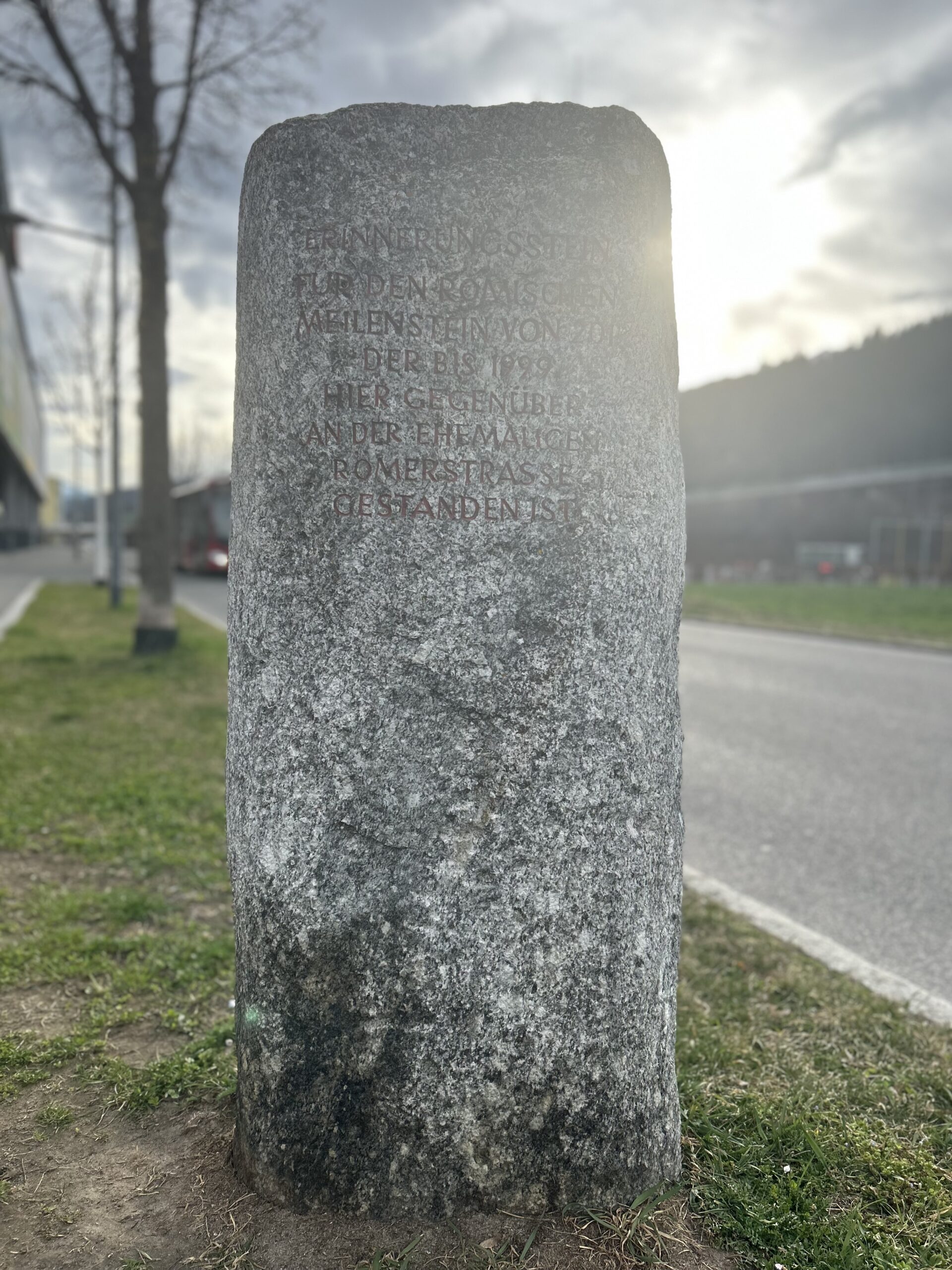
Very little of Roman Innsbruck remains visible in the modern cityscape. Exhibits can be seen at the Tyrolean State Museum Ferdinandeum. Various excavation projects around the present-day Wilten Abbey uncovered graves and remains such as walls, coins, bricks, and everyday objects from the Roman period in Innsbruck. The core of the Leuthaus next to the abbey dates back to Roman times. One of the Roman milestones from the former main route over the Brenner can be seen in Wiesengasse near the Tivoli Stadium. Even less has survived of the Breones themselves. Near Lake Lans, visitors can explore remains of Raetian houses, and just below Mount Isel, the former cult site Goldbühel welcomes interested visitors.
Sights to see...
Tram line 6
Stops: Mühlau - Igls
Leopoldstraße & Wiltener Platzl
Leopoldstrasse
Wilten Abbey & Basilica
Klostergasse 7 / Pastorgasse 2