Petrus Canisius and the Jesuits
Petrus Canisius and the Jesuits
Franciscans, Premonstratensians, Carmelites, Servites, Capuchins, Ursulines. Anyone visiting Innsbruck strolls past numerous monasteries—usually without realizing it. Yet the most politically and socially influential order in the city’s history since the sixteenth century was the Jesuits. These “Soldiers of Christ” were founded in 1540 by the Spanish nobleman Ignatius of Loyola (1491–1556). Loyola was a morally rigorous reformer and an influential church politician with access to the highest circles of power of his time. His aim was to reform the Church—not, like Luther, without the Pope as its supreme authority. Nor did he consider dissolving monastic property. Renewal of faith from the top down, rather than the destruction of the existing order, was the guiding principle of the Societas Jesu. The order rapidly gained influence. Its military-inspired organization and structure, the combination of humanist learning with Catholic tradition, its affinity for science and education paired with a form of popular piety imbued with mysticism—all this made the Jesuits attractive to many people who were disillusioned by the moral decay of the late medieval clergy. In these respects, the Jesuits were very much attuned to an era shaped by new political, social, and economic structures. Like the Protestant reformers, they skilfully exploited the new medium of print to disseminate their writings. They represented the confessional continuation of a societal transformation characterized by the growing power of the state, new media, and double-entry bookkeeping. In this environment, spiritual guidance was in high demand. Politically, the Holy Roman Empire in the mid-sixteenth century was steeped in crisis. Italy had been severely affected by the wars between France and the Habsburgs. Major trading houses such as the Fuggers and the Welsers amassed ever greater influence. The German territories were still reeling from the Peasants’ Wars. Inflation posed a serious threat, and the many technological innovations around 1500 inspired fear among broad segments of the population. How, then, could the wrath of God—provoked by the failings of the Renaissance popes—and the looming end of the world be averted, if not through moral reform and a life lived according to the teachings of Christ?
A zealous patron of the Jesuits in Tyrol was the territorial prince and later Emperor Ferdinand I. Like Ignatius of Loyola, he had grown up in Spain. He struggled with German customs, the Reformation movement—unknown in Spain—and even the German language itself. The Tyrolean population, for its part, regarded their sovereign with suspicion, easily mistaking his foreign courtly entourage for an occupying power. A unifying element between these two worlds was the Roman Church, and in particular the modern Jesuit order. Probably the most important Jesuit theologian was Petrus Canisius (1521–1597). Born Peter Kanis into an upper-middle-class household in the Netherlands—his father was mayor of Nijmegen—he was exposed to high politics from an early age and learned courtly manners before studying in Cologne. Canisius became the first member of the order active within the Holy Roman Empire. Intelligent and highly educated, he rose swiftly through the ranks. Ferdinand appointed him to Vienna, where he was tasked with restoring order both as episcopal administrator and at the university. Alongside teaching and research, one of his main duties was to identify and interrogate university members suspected of Protestant sympathies. Canisius also spent several years in Innsbruck. Initially, the Jesuits were supposed to move into the newly completed Court Church (Hofkirche) and assume responsibility for the choral prayers at the tomb of Maximilian I. Canisius, as the highest-ranking representative of the order north of the Alps, politely but firmly declined. In 1563, however, the Emperor succeeded in luring him to the Alps after all. The scholar was needed as an adviser during a dispute with the Pope at the Council of Trent. For Ferdinand, Canisius composed a prayer manual intended to guide the ruler along the right spiritual path. The presence of Petrus Canisius made Innsbruck one of the theological centres of the German‑speaking world in the sixteenth century. In October 1571, he informed the parish of Wilten of the victory of the papal‑imperial fleet over the Ottomans at Lepanto. From the pulpit, Canisius proclaimed the triumph of Christian forces over the looming pagan threat in the greatest naval battle in history, adopting a tone reminiscent of a Catholic news broadcaster. His role as preacher and scholar in the city would be comparable to Albert Einstein holding a teaching post at a university in the 1930s. Canisius himself was deeply impressed by the piety of the Alpine population.
"Tyrol deserves our special attention, because it is even more Catholic than any other region of Germany and has not yet allowed itself to be ensnared by the heretics like the other countries. Even if many places have already been corrupted [...]. Innsbruck is ... the heart and life of the whole country."
Beyond courtly circles, the court preacher also cut a fine figure. While many Innsbruck residents eyed other foreign preachers and advisers at court with suspicion, Canisius was a man of the people. On behalf of his spiritual—and even more so his secular—masters, he travelled across Europe. Like Martin Luther, he “listened to the people’s speech.” Canisius is said to have travelled more than 100,000 kilometres between the Netherlands, Rome, and Poland, usually staying in modest inns. He understood how vital it was to win over the rural population. While his fellow Jesuits evangelised in distant India, he fought Protestantism in the German lands. He recognized that sermons in Latin were ill‑suited to immunise peasants, farmhands, and maids against the threat posed to the Roman Church by Luther’s Protestantism.
The strongest and most enduring pillar in the struggle against the Reformers was education. Canisius regarded many bishops and politicians as corrupt, morally depraved, and sinful. Instead of eliminating them, however, they were to reform themselves under the protective wings of the Soldiers of Christ. By founding new colleges, the Jesuits sought to improve the education of civil servants, the nobility, and the clergy, and to raise moral standards rooted in Christian principles. To this end, they established colleges throughout the Empire. In Protestant regions, German schools, academies, and grammar schools were founded with the aim of enabling as many subjects as possible to read the Bible for themselves in pursuit of piety and salvation. The Jesuits, by contrast, concentrated on educating elites and thus attained lasting influence within the power centres of Catholic states. With his Catechism, Petrus Canisius created a foundational German‑language compendium for the Catholic struggle against the Reformation. Translated into all major European languages, it long served as a guiding text of the Catholic Church. Between 1555 and 1558, three versions of varying complexity were produced for different audiences. Resourceful publishers even created an illustrated catechism for the illiterate. Well into the nineteenth century—and in some regions even beyond the Second World War—the Kanisi, as it was affectionately known, remained the most influential religious‑philosophical work in Tyrol and the foundation of religious instruction in schools. Canisius also made use of the new medium of the pamphlet to reach as wide an audience as possible. Together with those of Luther, his writings were probably the most widely read of the sixteenth century. In Innsbruck, the Jesuits founded the Latin School from which the university later emerged. This new educational institution had a profound impact on urban development, training the intelligentsia that enabled Innsbruck’s rise as an administrative and economic centre. In addition to university chairs, the Jesuits also oversaw the Theresianum. From 1775 to 1848, noble pupils and students housed in the Franciscan monastery were instructed in courtly etiquette and virtuous conduct in preparation for their careers. The Theresian Knightly Academy provided instruction in diplomatic skills such as foreign languages and dance, as well as military disciplines like fencing. Under Joseph II, Jesuit activities were temporarily interrupted. He stripped ecclesiastical orders of power and property, including the Jesuits—an order he personally disliked and which was also banned by the Pope for being too powerful. In 1781, the University of Innsbruck was downgraded to a lyceum. The vacated Jesuit College was used to establish the city’s first botanical garden, which was expanded further after the Theresianum was dissolved in 1808 during Bavarian administration. The Jesuits were recalled to Innsbruck in 1838. In 1910, the garden was relocated to Hötting as part of new school construction.
Through a dense network of influential positions and control over the education system, the order expanded rapidly. Especially during the Counter‑Reformation, the Jesuits succeeded in forging a close alliance with the Habsburg dynasty. The influence of Jesuit education is evident in the governance of many Habsburg rulers. Jesuits such as Bartholomäus Viller and Wilhelm Lamormaini wielded considerable political influence as confessors and advisers in the Early Modern period. It is no coincidence that Jesuits continue to feature as adversaries of Freemasons in countless conspiracy theories and novels, often cast as the modern equivalent of a James Bond villain. At the same time, the Jesuits were remarkably open to research, knowledge accumulation, and education, striving to understand the world as part of Christian creation. To Catholics, this made them a fashionable counterpoint both to traditional, ossified orders and to Protestantism. Faith and empiricism merged into a kind of pre‑modern science seeking to explain nature and physics. The collection of Ferdinand II at Ambras Castle testifies to this spirit of inquiry, as do the alchemical experiments of Emperor Matthias (1557–1619), which now appear rather absurd.
Despite their rational leanings, the Jesuits also re‑introduced mysticism into everyday church life. Passion plays, Holy Sepulchres, processions, and feast days wrapped strict doctrinal principles in spectacle and performance. Work hard – play hard was the motto. Festivities during processions often escalated into exuberant celebrations, not unlike today’s tent festivals, occasionally erupting into brawls and even violent riots. Bread and wine were celebrated in the style of Roman panem et circenses. On behalf of Ferdinand I, Petrus Canisius authored a book promoting a miracle in Seefeld—On the Highly Celebrated Miraculous Sign that Occurred with the Most Holy Sacrament of the Altar at Seefeld in the Princely County of Tyrol in the Year 1384—to stimulate pilgrimage to the site.
The Jesuit order, fully committed to popular belief, was also highly motivated when it came to persecuting witches and people of other faiths. Peter Canisius was one of the masterminds behind the early modern witch hunts:
"Witches are being punished everywhere, and they are multiplying strangely.... They envy children the grace of baptism and deprive them of it. There are large numbers of child murderers among them... Never before in Germany have you seen people so devoted and dedicated to the devil..."
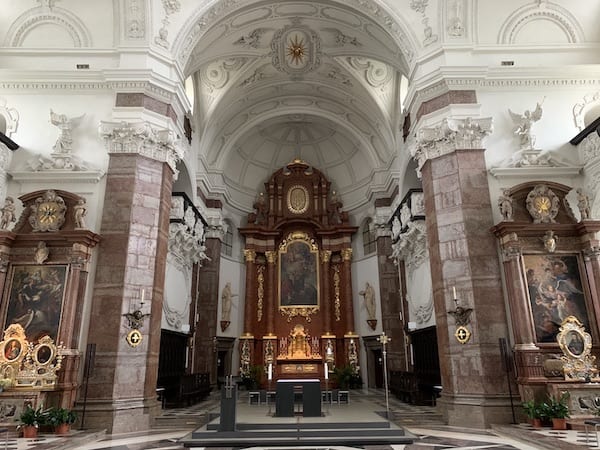
Canisius also attracted attention as an exorcist, particularly in cases involving noblewomen allegedly afflicted by the “virus” of Protestantism. He exploited the public fascination with witches and demoniacs to promote the power and authority of the Catholic Church. At the same time, the Jesuits were highly active in missionary efforts in the then newly discovered New World of the Americas as well as in Asia. Saint Francis Xavier, one of Ignatius of Loyola’s earliest companions, died during a missionary journey in China. An altar dedicated to this Soldier of Christ can be found in a side chapel of the Jesuit Church in Innsbruck.
To this day, the Jesuits continue to exert an educational influence over Innsbruck. When the city was elevated to an independent diocese in 1964 under the Jesuit Paulus Rusch, Petrus Canisius was chosen as its patron saint. Karl‑Rahner‑Platz today is home not only to the Jesuit Church but also to the Faculty of Theology of the University of Innsbruck. In the Saggen district, the Collegium Canisianum remains under Jesuit administration. The principle of broad‑based societal influence aimed at mass audiences has endured on many levels. The Marian Congregation, known in Innsbruck as the MK, was once one of the largest youth centres in Europe and, in a modern sense, stands in the tradition of the Jesuit approach to the gentle introduction into faith and the education of youth within the Church.
Sights to see...
University of Innsbruck
Innrain 52
Collegium Canisianum
Tschurtschenthalerstrasse 7
Jesuit Church & Pfeifersberg Palace
Karl-Rahner-Platz / Sillgasse 6