Ferdinand II.: Renaissance, Glanz und Glamour
Ferdinand II: Principe and Renaissance prince
Archduke Ferdinand II of Austria (1529–1595) ranks among the most colourful figures in Tyrolean regional history. His father, Emperor Ferdinand I, ensured that he received an excellent education. Ferdinand grew up at the Spanish court of his uncle, Emperor Charles V. The years of his formal education coincided with the early phase of Jesuit influence at the Habsburg courts. The young statesman was educated by these devout scholars entirely in the spirit of Christian humanism, complemented by instruction in the customs and etiquette of the High Renaissance aristocracy. In his youth, Ferdinand travelled extensively through Italy and Burgundy, where he became acquainted with a refined and luxurious courtly lifestyle that had not yet been established among the German aristocracy. He also spent several formative years in Innsbruck. Ferdinand was what one might today describe as a globetrotter, a member of the educational elite, or a cosmopolitan. He was regarded as intelligent, charming, and artistically inclined. Among contemporaries less enamoured of his eccentricity, however, he was reputed to be immoral and hedonistic. Even during his lifetime, rumours circulated that he hosted extravagant and indecent orgies. This reputation was likely connected to his private life. In a first, “semi‑morganatic” marriage, Ferdinand was wed to the commoner Philippine Welser. After the death of his first wife, Ferdinand married at the age of fifty‑three the deeply religious Anna Caterina Gonzaga, a sixteen‑year‑old princess of Mantua. Mutual affection between the two appears to have been limited, not least because Anna Caterina was Ferdinand’s niece. The Habsburgs were far less squeamish about marriages within the family than about unions between nobles and commoners. From this marriage, too, Ferdinand “only” fathered three daughters.
After the rarely Ferdinand I, Innsbruck once again gained a resident ruler. Ferdinand’s father divided his realm among his sons. Maximilian II, suspected by his parents of heresy and sympathy with Protestant doctrines, inherited Upper and Lower Austria as well as Bohemia and Hungary. Ferdinand’s younger brother Charles ruled Inner Austria—Carinthia, Styria, and Carniola. The middle son received Tyrol, which at the time extended as far as the Engadin, along with the fragmented Habsburg possessions west of the central European core lands. The golden age of silver mining in Tyrol was already fading. The mines of Schwaz were becoming unprofitable due to cheap silver imports from the Americas. The influx of precious metals from the Habsburg territories in New Spain led to inflation. These financial challenges did not deter Ferdinand from commissioning extensive public and private infrastructure projects. Innsbruck benefited enormously—economically and culturally—from once again becoming the seat of an active ruler after years of neglect following Maximilian’s death. Ferdinand’s archducal presence attracted aristocrats and officials back to the city. By the late 1560s, the administrative apparatus had grown once again to around one thousand people, whose spending stimulated local commerce. Bakers, butchers, and inns flourished after leaner years. By the end of the sixteenth century, Innsbruck had an above‑average number of taverns compared to other cities, profiting handsomely from merchants, travellers, and guests. Wine taverns also functioned as storage and trading centres.
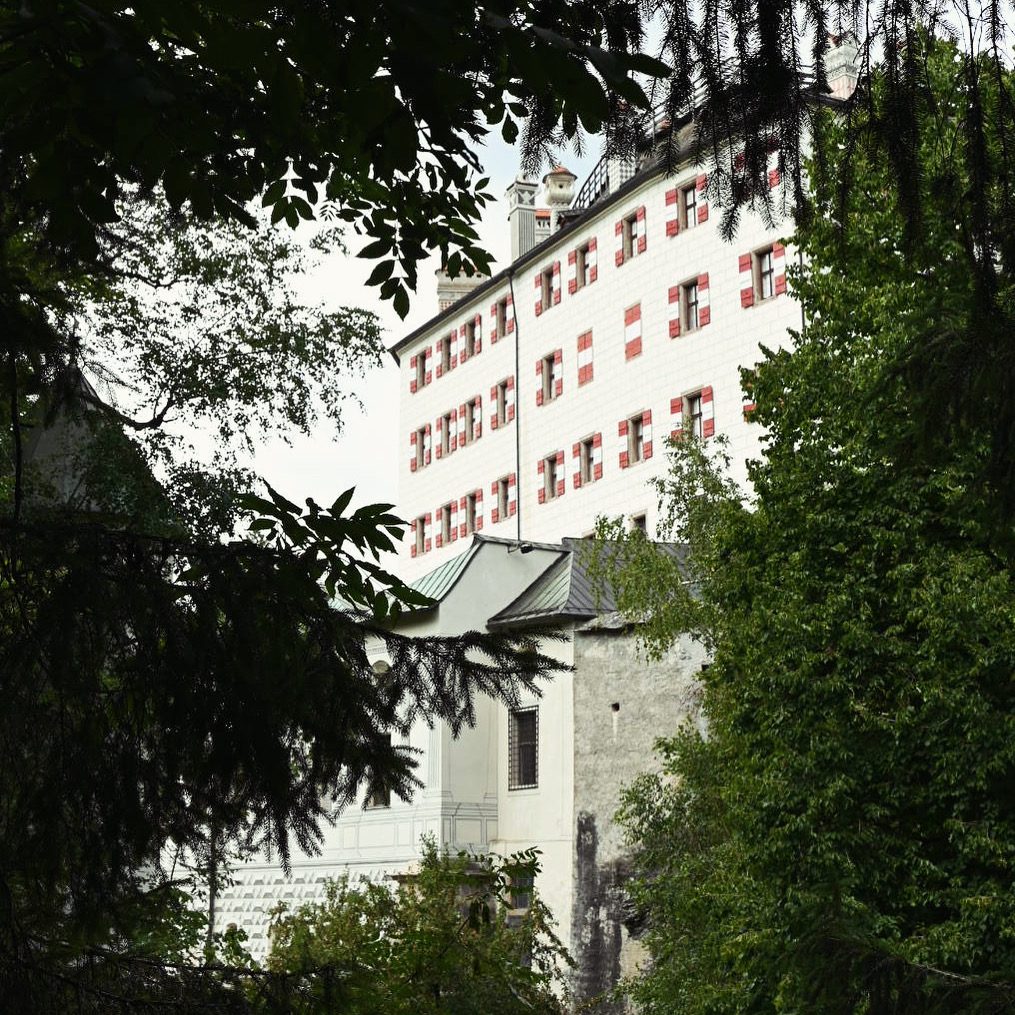
The Italian cities of Florence, Venice and Milan were trendsetters in terms of culture, art and architecture. Ferdinand's Tyrolean court was to be in no way inferior to them. Gone were the days when Germans were considered uncivilised in the more beautiful cities south of the Alps, barbaric or even as Pigs were labelled. To this end, he had Innsbruck remodelled in the spirit of the Renaissance. In keeping with the trend of the time, he imitated the Italian aristocratic courts. Court architect Giovanni Lucchese assisted him in this endeavour. Ferdinand spent a considerable part of his life at Ambras Castle near Innsbruck, where he amassed one of the most valuable collections of works of art and armour in the world. Ferdinand transformed the castle above the village of Amras into a modern court. His parties, masked balls and parades were legendary. During the wedding of a nephew, he had 1800 calves and 130 oxen roasted. Wine is said to have flowed from the wells instead of water for 10 days.
The transformation of Innsbruck did not end with Ambras Castle. West of the city, an archway still commemorates Ferdinand’s game reserve, complete with a pleasure pavilion (Lusthaus), also designed by Lucchese. To allow the sovereign access to his weekend residence, a road was laid through the marshy Höttinger floodplains, forming the basis of today’s Kranebitter Allee. The Lusthaus was replaced in 1786 by the structure now known as the Powder Tower (Pulverturm), which today houses parts of the University of Innsbruck’s Faculty of Sport Science. In the city centre, Ferdinand commissioned the princely Comedihaus on today’s Rennweg. To improve Innsbruck’s water supply, the Mühlau Bridge was constructed, allowing water from the Mühlau stream to be channelled into the city. The Jesuits, who had arrived in Innsbruck shortly before Ferdinand’s accession to counter reformers and critics of the Church and to reorganise education, were granted a new church in Silbergasse. Numerous new buildings—including the monasteries of the Jesuits, Franciscans, Capuchins, and Servite nuns—stimulated crafts and construction. These new orders supported Ferdinand’s emphasis on the confessional conformity of his subjects. In the Tyrolean Provincial Ordinance of 1573, Ferdinand not only sought to curb fornication, profanity, and prostitution, but also obliged his subjects to live a God‑fearing—i.e. Catholic—life. The “Prohibition of Sorcery and Superstitious Divination” outlawed any deviation from the true faith under threat of imprisonment, corporal punishment, and confiscation of property. Jews were required to wear a clearly visible yellow ring on the left side of their clothing. At the same time, Ferdinand brought a Jewish financier to Innsbruck to manage the court’s complex finances. Samuel May and his family lived in the city as protected court Jews; Daniel Levi entertained the archduke with dance and harp music, while Elieser Lazarus served as his personal physician.
To live lavishly, tax the population heavily, tolerate Protestant advisers at court while suppressing Protestantism among the populace posed no contradiction for a Renaissance prince. Ferdinand saw himself as Advocatus Ecclesiae, the secular representative of the Church, responsible in an absolutist confessional sense for the salvation of his subjects’ souls. At the age of fifteen, he had already marched into battle with his uncle Charles V during the Schmalkaldic War against the enemies of the Roman Church. Coercive measures, the founding of churches and monasteries—such as those of the Franciscans and Capuchins in Innsbruck—improved pastoral care, and Jesuit theatrical productions like The Beheading of John were among the preferred weapons against Protestantism. Ferdinand’s piety was sincere, yet like most of his contemporaries he was adept at adapting to circumstances. His policies reflected the influence of contemporary Italian avant‑garde thought. Machiavelli’s Il Principe argued that rulers were permitted whatever was necessary for success—and could be deposed if they failed. Ferdinand II sought to embody this early absolutist style of leadership and, with his Provincial Ordinance, introduced a comparatively modern legal framework. For his subjects, however, this meant higher taxes, as well as significant restrictions on common land usage, fishing, and hunting rights. Miners, mining entrepreneurs, and foreign trading companies with their counting houses in Innsbruck further drove up food prices. In summary, while Ferdinand enjoyed exclusive hunting privileges on his estates, his subjects endured hardship caused by rising burdens, inflation, and game damage exacerbated by hunting bans. Owing largely to his architectural legacy, Ferdinand continues to enjoy a favourable reputation today. The eccentric archduke found his final resting place—fittingly according to his own tastes—in the Silver Chapel, beside his first wife, Philippine Welser.
Sights to see...
Weiherburg & Alpine Zoo
Weiherburggasse 37-39
Hofgarten
Rennweg / Karl-Kapfererstraße
Jesuit Church & Pfeifersberg Palace
Karl-Rahner-Platz / Sillgasse 6
Schloss Ambras
Schloßstraße 12-20
Claudiana – Altes Regierungsgebäude
Herzog-Friedrich-Straße 3
Hofkirche, Silberne Kapelle & Volkskunstmuseum
Universitätsstraße 2
Tyrolean State Theatre & Congress Centre
Rennweg 3
Hofburg
Rennweg 1
Hofzwerg und Burgriese
Hofgasse 12