The year 1848 and its consequences
The year 1848 and its consequences
The year 1848 occupies a mythical place in European history. Innsbruck was not one of the hotspots like Paris, Vienna, Budapest, Milan or Berlin, but even in the “Holy Land” of Tyrol the revolutionary year left its mark. In contrast to the rural surroundings, an enlightened educated bourgeoisie had developed in Innsbruck. Enlightened people no longer wanted to be subjects of a monarch or territorial prince, but citizens with rights and duties in relation to a modern state. Students and members of the liberal professions demanded political participation, freedom of the press and civil rights. Workers demanded better wages and working conditions. Particularly radical liberals and nationalists even questioned the absolute authority of the Church. In March 1848 this socially and politically highly explosive mixture erupted in uprisings and street fighting in many cities. In Innsbruck, some students and professors celebrated the newly granted freedom of the press with a torchlight procession. On the whole, however, the revolution proceeded quietly in the rather leisurely Tyrol. To speak of a spontaneous outburst of emotion or even a revolution would already be an exaggeration: the date of the procession was postponed from 20 to 21 March because of bad weather. There were hardly any anti-Habsburg riots or violent incidents; a stray stone thrown into a Jesuit window was one of the highlights of the Alpine version of the Revolution of 1848. The students even supported the city magistrate in maintaining public order, thereby demonstrating their gratitude to the monarch for the newly granted freedoms and their loyalty.
The initial enthusiasm for change among the bourgeois elites was soon replaced in Innsbruck by a surge of German-national patriotism. On April 6, 1848, the governor of Tyrol led a ceremonial procession in which the German flag was displayed. A German tricolour was also hoisted on the city tower. While students, workers, liberal-national citizens, republicans, supporters of a constitutional monarchy, and Catholic conservatives could not agree on social issues such as press freedom, they shared a common hostility toward the Italian independence movement, which had spread across northern Italy from Piedmont and Milan. Innsbruck students and riflemen, with the support of the imperial army leadership, marched into the Trentino to suppress unrest and uprisings at an early stage. Notable members of this corps included the already elderly Father Haspinger, who had fought alongside Andreas Hofer in 1809, and Adolf Pichler. Johann Nepomuk Mahl-Schedl, a wealthy owner of Büchsenhausen Castle, even equipped his own company and marched over the Brenner Pass to secure the border. However, the war did not remain confined to the southern borders. Innsbruck itself, as the political and economic center of the multinational crown land of Tyrol and home to many Italian speakers, became an arena of the conflict between nationalities. Combined with ample alcohol consumption, anti-Italian sentiment posed a greater threat to public order than the demand for civil liberties. A dispute between a German-speaking craftsman and an Italian-speaking Ladin escalated to such an extent that it nearly triggered a pogrom against the numerous businesses and inns of Italian-speaking Tyroleans.
The relative calm of Innsbruck suited the imperial court in Vienna, which was under pressure. As unrest in the capital continued after March, Emperor Ferdinand fled to Tyrol in May. According to contemporary press reports, he was enthusiastically welcomed by the population.
"“What is the name of the land to which such an honour falls, what is the people that enjoys such trust in these fateful times? Does the peace and security here rest solely on legend from ancient times, or is there also in the present a foundation on which one can build, which the wind cannot blow away and the storm cannot shake? This Alpine land is called Tyrol, do you like it? Yes, the Tyrolean people alone prove, in the midst of a shaken Europe, reverence and loyalty, courage and strength for their hereditary ruling house, while all around rebellion, contradiction, defiance and demands, often even revolt and upheaval rage; Tyrol alone stands firmly without wavering in custom and obedience, in religion, truth and law, while elsewhere insolence and falsehood, madness and passions prevail …”"
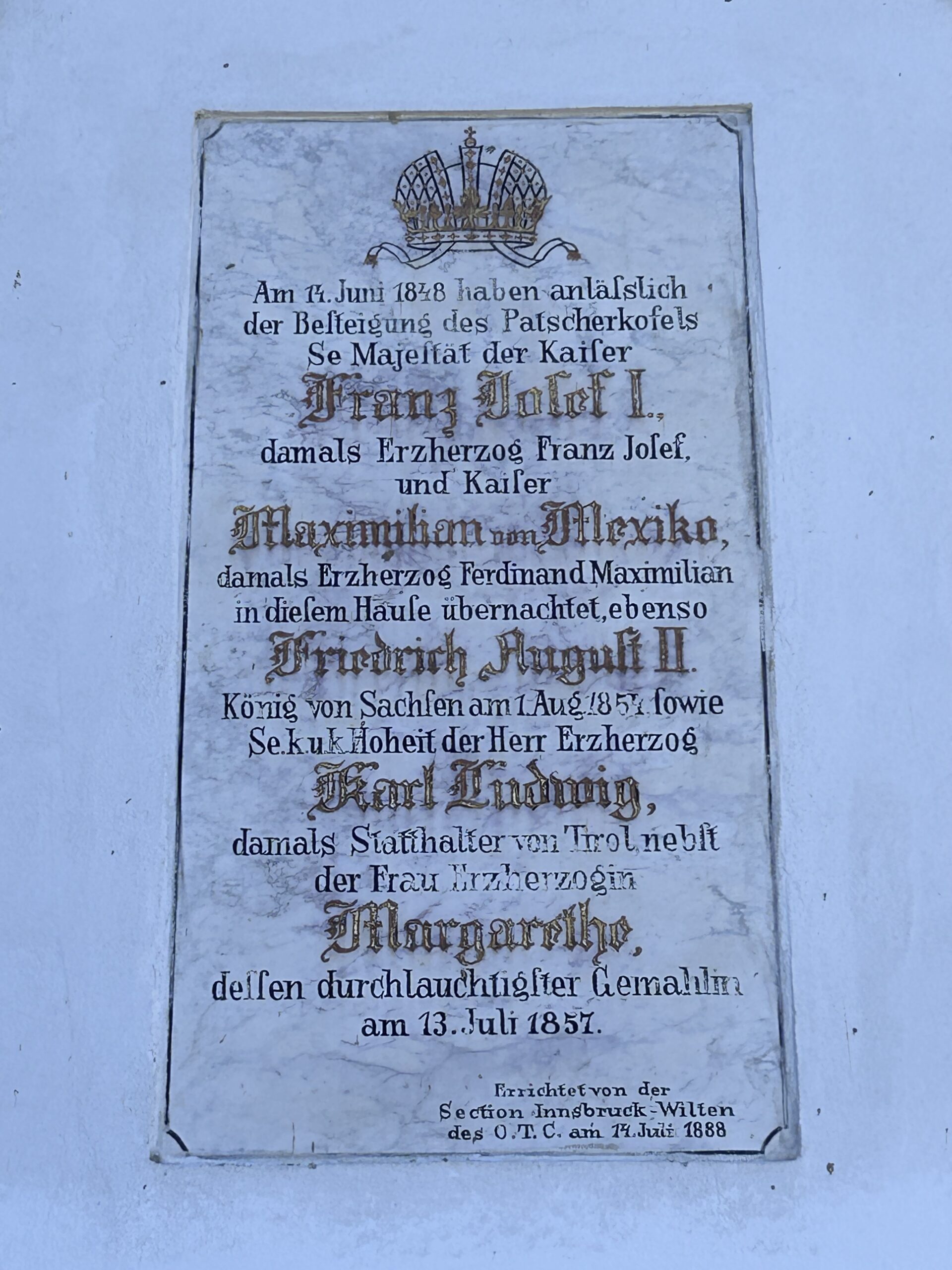
In June, a young Franz Joseph—still not yet emperor—also stopped at the Hofburg on his return from the battlefields of northern Italy instead of traveling directly to Vienna. Innsbruck once again became a royal residence, albeit only for one summer. While blood was shed in Vienna, Milan, and Budapest, the imperial family enjoyed rural Tyrolean life. Ferdinand, Franz Karl, his wife Sophie, and Franz Joseph received guests from foreign courts and were driven by carriage to excursion destinations such as Weiherburg, Stefansbrücke, Kranebitten, and even up to Heiligwasser, and went on hikes. This calm did not last long. Ferdinand, considered no longer fit to rule, handed over power under gentle pressure to Franz Joseph I. In July 1848, the first parliamentary session was held in Vienna, and a constitution came into force. However, the monarchy’s willingness to reform soon waned. The new parliament—the Reichsrat—could not pass binding laws, the emperor never attended it, and he did not understand why a monarchy ordained by God needed such a council.
The subtly initiated liberalization nevertheless ran its course in the cities. Innsbruck was granted the status of a city with its own independent charter (Statutarstadt). In 1850, the "Provisorische Gemeindegesetz für die Landeshauptstadt Innsbruck" ("Provisional Municipal Code for the State Capital of Innsbruck") came into force:
"The municipality is to provide for the sanitation police; it takes care of the paving and maintenance of streets, alleys, and paths, with the exception of those whose maintenance is the responsibility of the Imperial Treasury, as well as for street lighting, the maintenance and cleaning of the main drainage canals, and the maintenance of municipal bridges, fountains, aqueducts, and other facilities, as well as public bathing establishments. It administers the health, fire, market, building, and traffic police, oversees land boundaries, measures, and weights; it is charged with the provision of food supplies, and takes police precautions to avert threats to personal safety and property posed by flooding or other natural disasters."
Innsbruck's municipal law provided for citizenship rights that, while tied to property ownership or tax payments, legally guaranteed certain rights to members of the community. Right of domicile (Heimatrecht) could be acquired through birth, marriage, or extraordinary conferral, granting voting rights at the municipal level to at least adult males. If one fell into financial hardship, one was entitled to basic welfare provided by the city. Within the city government, the Greater German-liberal faction prevailed thanks to the census-based majority voting system, with merchants, tradesmen, industrialists, and innkeepers setting the tone. On June 2, 1848, the first edition of the liberal and Greater German-leaning Innsbrucker Zeitung was published—from which the above article on the emperor's arrival in Innsbruck is taken. Conservatives, on the other hand, read the Volksblatt für Tirol und Vorarlberg. Moderate readers who favored a constitutional monarchy preferred to consume the Bothe für Tirol und Vorarlberg. However, freedom of the press was short-lived. The previously abolished censorship was partially reinstated. Newspaper publishers were subjected to various forms of harassment by the authorities, and newspapers were strictly forbidden from printing content critical of the state government, the monarchy, or the Church.
"Anyone who, by means of printed matter, incites, instigates or attempts to incite others to take action which would bring about the violent separation of a part from the unified state... of the Austrian Empire... or the general Austrian Imperial Diet or the provincial assemblies of the individual crown lands.... Imperial Diet or the Diet of the individual Crown Lands... violently disrupts... shall be punished with severe imprisonment of two to ten years."
After Innsbruck had officially replaced Meran as the provincial capital in 1849 and had thus finally become the political centre of Tyrol, parties began to form. With the establishment of the Catholic-conservative faction and the liberals, a pair of opposing ideas emerged that would shape politics not only until the First World War. Associations of all kinds as political organisations in advance of parties, and newspapers, formed the lines along which society split in all questions of life from the cradle to the grave. From 1868 onwards, the liberal, greater German-oriented party provided the mayor of the city of Innsbruck. The influence of the Church declined in Innsbruck in contrast to the surrounding municipalities. Individualism, capitalism, nationalism and consumption stepped into the breach. New worlds of work, department stores, theatres, cafés and dance halls did not displace religion entirely even in the city, but the weighting shifted as a result of the civil freedoms won in 1848.
The probably most important legal change of 1848 was the land relief patent. In Innsbruck the clergy, especially Wilten Abbey, owned a large part of the agricultural land. The Church and the nobility were exempt from taxes. In 1848/49 feudal lordship and the relationship of subjection were abolished in Austria. Ground rents, tithes and compulsory labour were thus removed. The landowners received one third of the value of their land from the state within the framework of the reform, one third was regarded as tax relief, and one third of the compensation had to be borne by the peasants themselves. They could pay this amount in instalments over twenty years. The after-effects can still be felt today. The descendants of the peasants who were successful at the time enjoy, through inherited land ownership resulting from the 1848 reforms, the fruits of prosperity and also political influence through land sales for housing, leases and compensation payments by public authorities for infrastructure projects. The landowning nobility of the past had to come to terms with the humiliation of taking up bourgeois occupations. The transition from privilege by birth to privileged status within society through financial means, networks and education often succeeded. Many Innsbruck dynasties of academics have their origins in the decades after 1848.
Life also changed for the broader population. The previously unknown phenomenon of leisure time emerged and, together with disposable income available to a greater number of people, fostered hobbies. Civil organisations and associations—from reading circles to choral societies, fire brigades and sports clubs—were founded. The revolutionary year also manifested itself in the cityscape. Parks such as the English Garden at Ambras Castle or the Hofgarten were no longer reserved exclusively for the aristocracy but served citizens as local recreational areas. In St. Nikolaus the Waltherpark was created as a small oasis of calm. One floor above, the first swimming and bathing facility in Tyrol opened at Büchsenhausen Castle; soon afterwards another bath followed in Dreiheiligen. Excursion inns around Innsbruck flourished. Alongside high-end restaurants and hotels, a scene of taverns emerged in which workers and employees could also afford pleasant evenings with theatre, music and dancing.
Sights to see...
Villensaggen
Falkstrasse / Saggen
Tyrolean Glass Painting and Mosaic Institute
Müllerstrasse 10
Farmhouses in Pradl
Pradlerstrasse / Egerdachstrasse
Fraternity House Austria
Josef-Hirn-Straße
Villa Epp
Hunoldstraße 10
Büchsenhausen Castle
Weiherburggasse 3-13
Gasthaus Elephant & Gasthof zur Eiche
Innstraße 85 / 87
Workers' housing & Weyrer area
Ferdinand-Weyrer-Straße
Chamber of Commerce
Meinhardstraße 12
Tyrol department stores'
Maria-Theresienstrasse 31
Hofgarten
Rennweg / Karl-Kapfererstraße
Winklerhaus
Leopoldstraße/Maximilianstraße
Lutheran Church of Jesus Christ
Richard-Wagner-Strasse 2
Monastery of Perpetual Adoration
Karl-Kapferer-Straße 7-11
Claudiaplatz
Claudiaplatz
Ferdinandeum
Museumstraße 15
Cafe Central
Gilmstrasse 5
Schloss Ambras
Schloßstraße 12-20
Katzung & Trautsonhaus & Weinhaus Happ
Herzog-Friedrich-Straße 14/ 16 / 22
Cafe Munding
Kiebachgasse 16 / Mundingplatz
Hofburg
Rennweg 1