Air raids on Innsbruck
Air raids on Innsbruck
The appearance of a city is subject to constant change. Certain eras left particularly visible changes in Innsbruck's cityscape. The political, economic, and social upheavals from the 15th century onward, as well as in the second half of the 19th century, are also reflected in buildings and monuments. However, the most drastic event with the greatest impact on the cityscape was likely the air raids on the city during World War II, when the "home front" became an actual theater of war. For centuries, its location at the foot of the Brenner Pass had been a blessing for the city; now, it became its undoing. Innsbruck was an important supply station for reinforcements for the Italian front. On the night of December 15–16, 1943, the first Allied air raid struck the ill-prepared city. 269 people fell victim to the bombs, 500 were injured, and more than 1,500 were left homeless. Over 300 buildings, primarily in Wilten and the inner city, were destroyed and damaged. On Monday, December 18, the front page of the Innsbrucker Nachrichten—the predecessor to the Tiroler Tageszeitung—featured all kinds of propagandistic reports about the successful and heroic defensive struggle of the German Wehrmacht on all fronts against the alliance of the "Anglo-Americans" and "the Russian," but made no mention of the bombing raid on Innsbruck.
"Bombing Terror over Innsbruck"
December 16 will remain recorded in the history of Innsbruck as the day on which the air terror of the Anglo-Americans struck the Gau capital with all the severity of this mean and brutal method of warfare, which can no longer be called conduct of war. In several waves, enemy bomber formations approached the city and directed their attacks with numerous high-explosive and incendiary bombs against residential areas. Severe damage to residential buildings, hospitals, and other community facilities was the sad result—exceeding all previous damage—of this criminal assault, which brought severe suffering to numerous families in our city, a heavy burden on their way of life, the bitter fate of the destruction of cherished property, the destruction of hearth and home, and homelessness. Boundless hatred and the burning desire to retaliate against this inhuman atrocity with relentless severity are the sole sentiments moving all minds, alongside dealing with personal and community hardships. We all look upon our soldiers with complete trust and await with confidence the day on which the Führer will give the command to deploy their concentrated power with new weapons against the enemy in the West, who through his terror of murder and arson against the defenseless has once again proven that he differs in no way from the Asiatic beasts in the East—unless it be through greater cowardice. The city's air-raid protection facilities have proven their worth, as has the air-raid discipline of the population. Up to this hour, 26 fallen have been reported, a number that in all likelihood should not increase significantly. Relief measures began immediately and effectively under the leadership of the Party and with the active cooperation of the Wehrmacht.
This imaginatively crafted report barely made it onto page 3. The city's poor preparation for the foreseeable bombardment was likely something they preferred not to display too prominently, given the immense scale of the damage to the city and the tragic personal losses among the population. That the mortal remains of the victims of the December 15, 1943 air raid were laid out in state on what is today's Landhausplatz, directly in front of the newly constructed *Gauhaus*—the symbol of National Socialist power—carries a sad irony of fate. In January 1944, construction began on air-raid shelters and other protective measures. A large portion of the work was carried out by prisoners from the Reichenau concentration camp.
In total, Innsbruck was attacked twenty-two times between 1943 and 1945. In the process, nearly 3,833—almost 50%—of the buildings in the city were damaged, and 504 people died. In the final months of the war, any sense of normalcy had ceased to exist. The population lived in constant fear. Schools were closed as early as the morning hours. A regular daily routine was out of the question. Fortunately, the city was only subject to targeted attacks. German cities like Hamburg or Dresden were completely flattened by Allied firestorms within a matter of hours, leaving tens of thousands dead. Nevertheless, the toll was devastating. Many buildings, such as the Jesuit Church, Wilten Abbey, the Servite Church, and the public indoor pool on Amraserstraße, were hit. The attack on December 16, 1944—one year after the first strike—devastated the Cathedral and the Town Hall. Historical buildings and monuments in Innsbruck received special care and protection. The *Golden Roof* was protected with a specialized structure, as was Maximilian's sarcophagus in the Court Church (*Hofkirche*). The statues of the Court Church, the "*Schwarze Mander*" (Black Men), were relocated to Kundl. The painting of the Virgin of Succor by Lucas Cranach from the Innsbruck Cathedral was transferred to the Ötztal during the war.
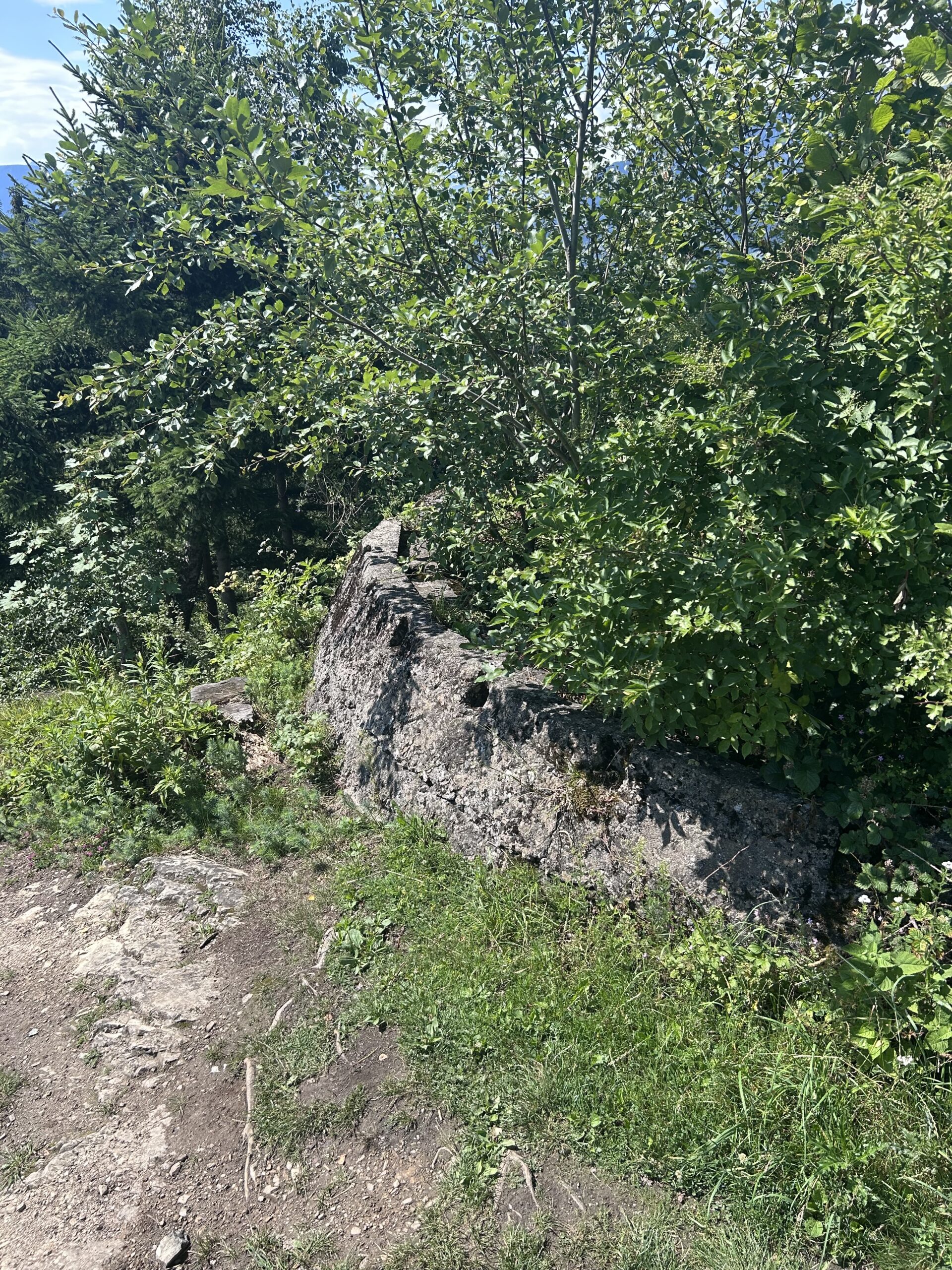
Many years after the war, the city was still characterized by the rubble and damage of the air raids; today, very little remains to remind us of these events that were traumatic for so many Innsbruck residents. The air-raid shelter south of Innsbruck along the Brennerstraße and the markings on houses indicating air-raid cellars—with their black squares, white circles, and arrows—can still be seen today. Two of the anti-aircraft gun positions, now merely overgrown masonry ruins, can be visited on the *Lanser Köpfl* above Innsbruck. In Pradl, where along with Wilten most of the buildings were damaged, bronze plaques on the affected houses point to their post-war reconstruction. On the old Innsbruck Town Hall, a wall painting commemorates the direct bomb hit in December 1944.
Sights to see...
HTL Anichstraße
Anichstrasse 26 / 28
Racing school & kindergarten
Pembaurstraße 18 & 20
Tivoli
Sillufer / Pradl
Power station & Casino
Salurnerstrasse 11 - 15
Pfarre Mariahilf
Dr.-Sigismund-Epp-Weg
South Tyrolean settlement Wilten West
Speckbacherstrasse
Städtisches Hallenbad
Amraserstraße 3
Tyrol department stores'
Maria-Theresienstrasse 31
Landhausplatz & Tiroler Landhaus
Eduard Wallnöfer Square
Wilten Abbey & Basilica
Klostergasse 7 / Pastorgasse 2
Servitenkirche
Maria-Theresienstrasse 42
Mariahilfzeile & Marketplace
Mariahilfstraße / Marketplace
Dom Sankt Jakob
Domplatz
Hospital church & old city hospital
Maria-Theresien-Strasse 2